
In November 2025, Justice P.S. Narasimha of the Supreme Court of India made an unusually candid observation from the bench:
“Property purchase has not been easy. It is not difficult to find people grudgingly telling us that it is, in fact, traumatic.”
The case was Samiullah v. State of Bihar. The Court was not discussing an isolated incident. It was diagnosing a systemic failure, one that affects millions of Indian property owners, and one that most people don’t fully grasp until they are already trapped inside it.
This article lays out the scale of the problem using government data, court records, and primary research. If you own property in India, or plan to, this is the landscape you are operating in.
Inheritance disputes are one of the quietest ways people get pulled into that system. Our guide on why NRI property gets stuck in succession disputes explains how missing wills, delayed mutation, and the wrong inheritance documents turn a family matter into a property dispute.
The Numbers
Property Disputes Dominate the Civil Backlog
According to the National Judicial Data Grid, district courts in India had 4,87,54,355 pending cases when checked on 14 April 2026. Of these, 1,10,68,892 were civil cases.
The Supreme Court in Samiullah v. State of Bihar said property disputes account for an estimated 66% of civil cases. NITI Aayog’s land-titling material uses similar language for subordinate courts. If that estimate is applied to today’s civil backlog, it suggests that a very large share of pending civil litigation is property-related, even though NJDG does not publish a standalone national property-disputes count.
To put that in perspective: if you printed each case file and stacked them, the pile would be taller than Mount Everest. And new cases are being filed faster than old ones are being resolved.
More Than 10% of Pending Cases Are Over a Decade Old
The NJDG dashboard showed 49,72,163 pending district-court cases above 10 years old on 14 April 2026. Another 89,34,197 fell in the 5-to-10-year range.
A widely cited policy estimate says land disputes can take around 20 years to resolve. That figure should be treated as a directional warning rather than a precise forecast for any one case, but the live pendency data alone is enough to make the underlying point: property litigation in India is often painfully slow.
Most Household Wealth Is Not in Financial Assets
The Reserve Bank of India’s Household Finance Committee Report (2017) found that the average Indian household held 77% of its assets in real estate, 7% in other durable goods, 11% in gold, and 5% in financial assets.
In most developed countries, household wealth is diversified across stocks, bonds, savings, and property. In India, property is the wealth. This means a property dispute is not an inconvenience; it is an existential threat to a family’s financial security.
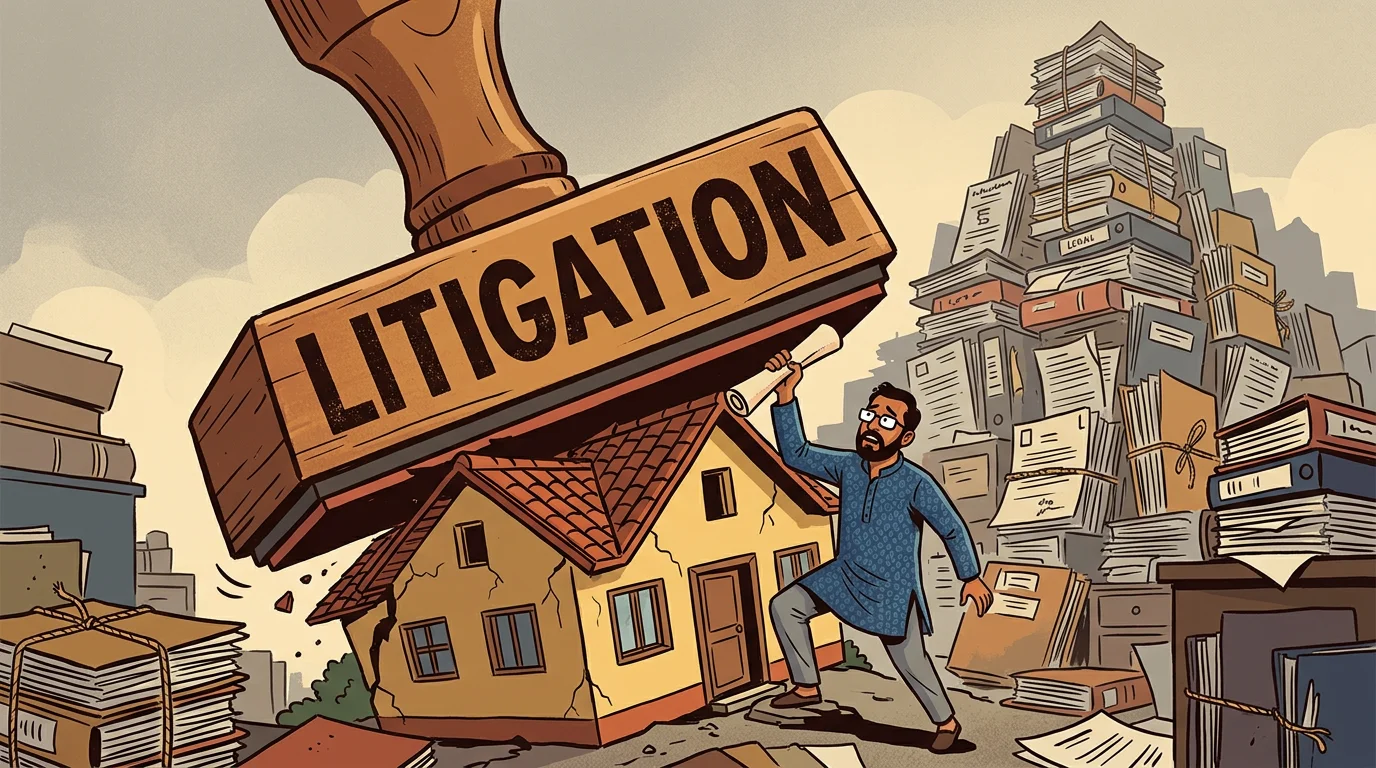
When your only significant asset is locked in a 20-year court case, you cannot sell it, mortgage it, develop it, or pass it on to your children. It is wealth that exists on paper but is frozen in practice.
Why This Keeps Happening
The Government Does Not Guarantee Who Owns What
This is the single most important fact about Indian property law that most people do not know.
India uses what is called a “presumptive” titling system. When you register a property at the Sub-Registrar’s office, the government records the transaction, but it does not certify that the seller actually owned the property, that there are no competing claims, or that the title is clean.
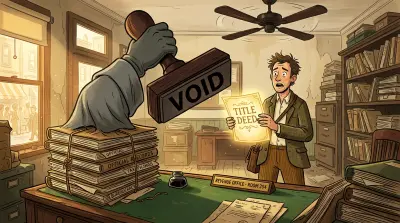
Registration is proof that a transaction happened. It is not proof of ownership.
Compare this with countries like Australia, the UK, and Singapore, which use “conclusive” titling. In those systems, the government maintains a central register of land ownership and guarantees the title. If the register turns out to be wrong, the government compensates the affected party. You can buy property with confidence because the state stands behind the record.
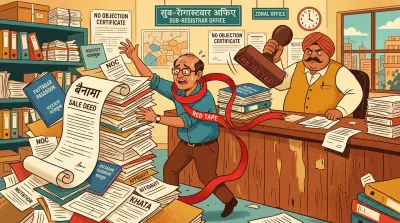
In India, no such guarantee exists. The burden falls entirely on the buyer to verify the chain of title, often going back 30 years or more, through a painstaking search of multiple government offices, Sub-Registrar records, revenue department files, and municipal archives.
As the Supreme Court noted in the 2025 Samiullah judgment:
“A substantial burden rests on the prospective buyer, who must undertake a painstaking search of title.”
NITI Aayog has published a Model Conclusive Land Titling Act to address this. But adoption requires state-level implementation, and progress has been slow.
Core Property Laws Still Rest on Colonial-Era Statutes
India’s land-law regime is fragmented across central and state legislation, with no simple single-code system for ownership, registration, revenue records, and transfer.
The core statutes governing property transactions were written during the British colonial era:
- Transfer of Property Act, 1882 (144 years old)
- Registration Act, 1908 (118 years old)
- Indian Stamp Act, 1899 (127 years old)
These laws were written for a pre-digital, pre-independence India. They assume in-person transactions, physical documents, and local revenue officials as the primary record-keepers. The system has been patched and amended over the decades, but the foundational architecture remains colonial.
State-level variations add another layer of complexity. Property law in Kerala is different from Karnataka, which is different from Punjab, which is different from Maharashtra. Each state has its own stamp duty rates, registration procedures, mutation processes, and land record formats.
Land Records Are More Digitised Than Before, But Not Always More Reliable
The Digital India Land Records Modernisation Programme (DILRMP) has made progress. The Department of Land Resources reported that, as of 31 December 2023, Record of Rights computerisation had reached 95.09% of villages, Sub-Registrar office integration had reached 75% in 23 States/UTs, and cadastral map geo-referencing had reached 49.10% of villages.
But computerisation is not the same as accuracy. Digitising an outdated record simply gives you faster access to wrong information. Telangana learned this the hard way when its Dharani portal digitised millions of records with errors at scale, forcing a complete system replacement.
In many areas, land records still reflect the names of grandparents or great-grandparents. Mutations after inheritance, sale, or partition have not been carried out, sometimes for generations. When a dispute arises, the revenue records show one thing, the registration records show another, and the physical possession tells a third story.
That still leaves a large mapping gap. Without accurate maps, boundary disputes remain hard to resolve without physical surveys that can take months.
Property Registration Has Long Been a Weak Institutional Point
In the now-discontinued World Bank Doing Business 2020 exercise, India ranked 154th out of 190 economies on registering property. Contemporary reporting on that dataset said the process took about 58 days and cost about 7.8% of the property value.
India’s overall business climate ranked 63rd, meaning property registration is one of the single biggest drags on the country’s institutional credibility.
What This Looks Like in Court
To get a sense of which types of disputes recur most often, we looked at Indian Kanoon, India’s largest free legal search database. The point here is directional, not statistical precision. Search-result counts on Indian Kanoon move over time, depend on search phrasing, and should not be treated as a complete census of property litigation.
The recurring categories are familiar to any property lawyer:
- title and ownership disputes
- occupancy certificate and approval disputes
- adverse possession and encroachment cases
- partition suits and inheritance fights
- mutation disputes
- forged sale deeds and document fraud
- succession and probate-related disputes
- power of attorney misuse
- encumbrance and due-diligence failures
- builder and RERA disputes
Even without leaning on exact search counts, the pattern is clear. Title disputes dominate. Document forgery is widespread. Family partition and succession issues are persistent. And power of attorney misuse remains a recurring risk for absentee owners and NRIs.
The Pattern Behind the Cases
Across these hundreds of thousands of disputes, a pattern emerges. The cases that drag on the longest and cause the most damage almost always involve one or more of these document failures:
Missing documents. The owner never obtained or preserved a critical document. A sale deed exists, but the mutation was never done. A will was written, but never registered. A property was inherited, but no succession certificate was applied for. Years later, when the owner needs to prove their claim, there is a gap in the chain.
Forged documents. Someone fabricated a sale deed, forged a power of attorney, or manufactured a mutation entry. This is especially common when the actual owner is absent, living in another city or another country. By the time the fraud is discovered, the property may have been sold to a third party who claims to be an innocent buyer.
Outdated documents. The documents were once valid, but circumstances changed and they were never updated. A property was subdivided, but the records still show the original plot. An owner died, but the records still show their name. A building was modified, but the approved plan still shows the old structure.
Documents nobody checked. The buyer relied on the seller’s assurances without independently verifying the title. No encumbrance certificate was obtained. No revenue records were checked. No physical verification was done. The purchase went through, and the problems surfaced years later.
In nearly every case, the dispute could have been prevented, or at least significantly de-risked, if the owner had maintained a complete, current, and verified set of property documents.
The NRI Problem
For Non-Resident Indians, every risk described above is amplified.
You cannot visit the Sub-Registrar’s office to check records. You cannot walk the property boundary to spot encroachments. You cannot follow up with the municipal office on a pending mutation. You rely on relatives, agents, or power of attorney holders, and that reliance is itself a risk vector.
Indian Kanoon contains a visible stream of NRI-related property disputes, especially around forged powers of attorney, family interference, encroachment, and delayed inheritance formalities. The exact count depends heavily on search method, but the pattern is real enough to justify treating NRI property as a higher-monitoring category rather than a passive asset.
We explore specific NRI cases in detail in our case study series, starting with why GPA property sales are legally worthless. If you are selling property as an NRI, understanding TDS obligations is equally critical.
What the Supreme Court Wants to Change
The Samiullah judgment did more than describe the problem. The Supreme Court proposed a direction:
“Blockchain technology has garnered particular attention for its potential to transform land registration into a more secure, transparent and tamper-proof system.”
“Adoption of Blockchain technology would ensure immutability, transparency and traceability, thereby minimizing fraud and unauthorized alterations.”
“We must dare to think and look for alternatives.”
The Court requested the Law Commission of India to examine the issue and prepare a report on blockchain-based land registration reform, consulting both the Union and state governments.
Whether blockchain is the right technical solution is debatable. But the Court’s underlying message is clear: the current system (colonial-era laws, fragmented records, no title guarantee, 20-year litigation timelines) is not working. It needs fundamental reform.
What You Can Do Today
Systemic reform will take years. In the meantime, most of the common document failures described above are preventable - not through expensive lawyers or political connections, but through a few focused hours of organisational work.
Here is a concrete checklist, starting with the most impactful actions:
1. Run a document audit for every property you own. For each property, you should be able to locate: the original registered sale deed (or gift deed, inheritance documents), the mutation record showing your name in revenue records, an encumbrance certificate from the past 15 years, and recent property tax receipts. If any of these are missing or outdated, that is your first priority. Our pre-sale document checklist works equally well as a general ownership audit.
2. Check your mutation record online - right now. Most states have digitised land records. Telangana: bhubharati.telangana.gov.in. Andhra Pradesh: meebhoomi.ap.gov.in. Punjab: jamabandi.punjab.gov.in. Karnataka: bhoomi.karnataka.gov.in. Maharashtra: mahabhulekh.maharashtra.gov.in. Search your survey or plot number and confirm your name appears as the current owner. If it does not, mutation may be incomplete - and someone else could appear to own your property in the government’s records.
3. Pull an Encumbrance Certificate for the last 15 years. An EC from the Sub-Registrar’s office shows every registered transaction against your property - sales, mortgages, liens. If anything appears that you did not authorise, you need to act immediately. Most state IGRS portals now offer online EC searches. For Telangana, use registration.telangana.gov.in. For AP, registration.ap.gov.in.
4. Pay any outstanding property tax - and get a receipt. Property tax arrears give municipalities grounds to act against your property and weaken your standing in disputes. Check outstanding dues through your city’s municipal portal and pay them. Keep the receipt - it is dated proof that you are actively exercising ownership. Our guide to paying property tax from abroad covers the process for NRIs.
5. Store everything digitally, accessible from anywhere. Physical documents in a relative’s cupboard are one fire, flood, or family falling-out away from being inaccessible. Scan and store your key documents - sale deed, mutation record, EC, tax receipts - in a secure system you can access from abroad. Assetly is built specifically for this: NRI property owners who need their documents organised, verifiable, and reachable without depending on someone in India.
6. Set a property review calendar. Once a year: check mutation records, pull a fresh EC, verify tax is paid. After any transaction or inheritance: complete mutation within 90 days, update nominee records, check for any new registrations. This does not require visiting India. Most checks can be done online in under an hour.
None of this is complicated. The families currently fighting 20-year land battles in India’s courts are not there because the law failed them. In most cases, they are there because a single document was never registered, a mutation was never completed, or a record was never checked. Thirty minutes of document organisation today is worth more than two decades in court tomorrow.
State-Specific Guides
- Managing Property in Telangana - Bhu Bharati portal, Hyderabad-specific considerations, and what happened with Dharani.
- Managing Property in Andhra Pradesh - Meebhoomi portal, Section 22A, and post-bifurcation issues.
- Managing Property in Punjab - Jamabandi portal, PLRS, and Punjab-specific NRI challenges.
- Managing Property in Kerala - Kerala land records, panchayat tax, and NRI-specific challenges.
Case Studies
- The Law That Made a Sale Deed Worthless: Land Ceiling Act Explained - how the 1973 Ceiling Act voids transactions on surplus agricultural land, with the Nadergul case as context.
- How to Gift Property to Family Without a Court Battle - Why document registration is non-negotiable, illustrated by a 25-year Hyderabad dispute.
- A Property Owner Lost an Encroachment Case - No Boundary Proof - Three courts dismissed the case for the same reason.
- Land Record Tampering: How It Happens and How to Catch It Early - How patwaris and tehsildars can alter records, and the checks that catch it.
- When Family Forges Your Power of Attorney - A real PoA fraud case and how NRIs can protect themselves.
- The Deed You Never Agreed To: Bengaluru Plot Fraud and the Confirmation Deed Trick - How a criminal consortium used confirmation deeds to target NRI plot owners in a Bengaluru layout, and what the Supreme Court said in 2026.
- A 1992 Lawsuit Cancelled a 1993 Sale Deed: The Section 52 Lis Pendens Rule - How the Supreme Court’s October 2024 ruling in Shingara Singh v Daljit Singh confirms that NRI buyers caught by a pending suit get no protection, even with a registered deed and full price paid.
Data sources: National Judicial Data Grid (live pending case statistics, checked 14 April 2026), NITI Aayog and its Model Conclusive Land Titling Act, RBI Household Finance Committee Report 2017, World Bank Doing Business 2020 archive, DILRMP, and Supreme Court of India: Samiullah v. State of Bihar (2025 INSC 1292) and Suraj Lamp & Industries v. State of Haryana (2012).
Assetly is a property document management platform that helps Indian property owners, especially NRIs, organise, verify, and track their property documents digitally. Learn more at assetlyhq.com.