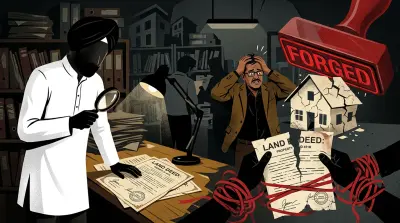
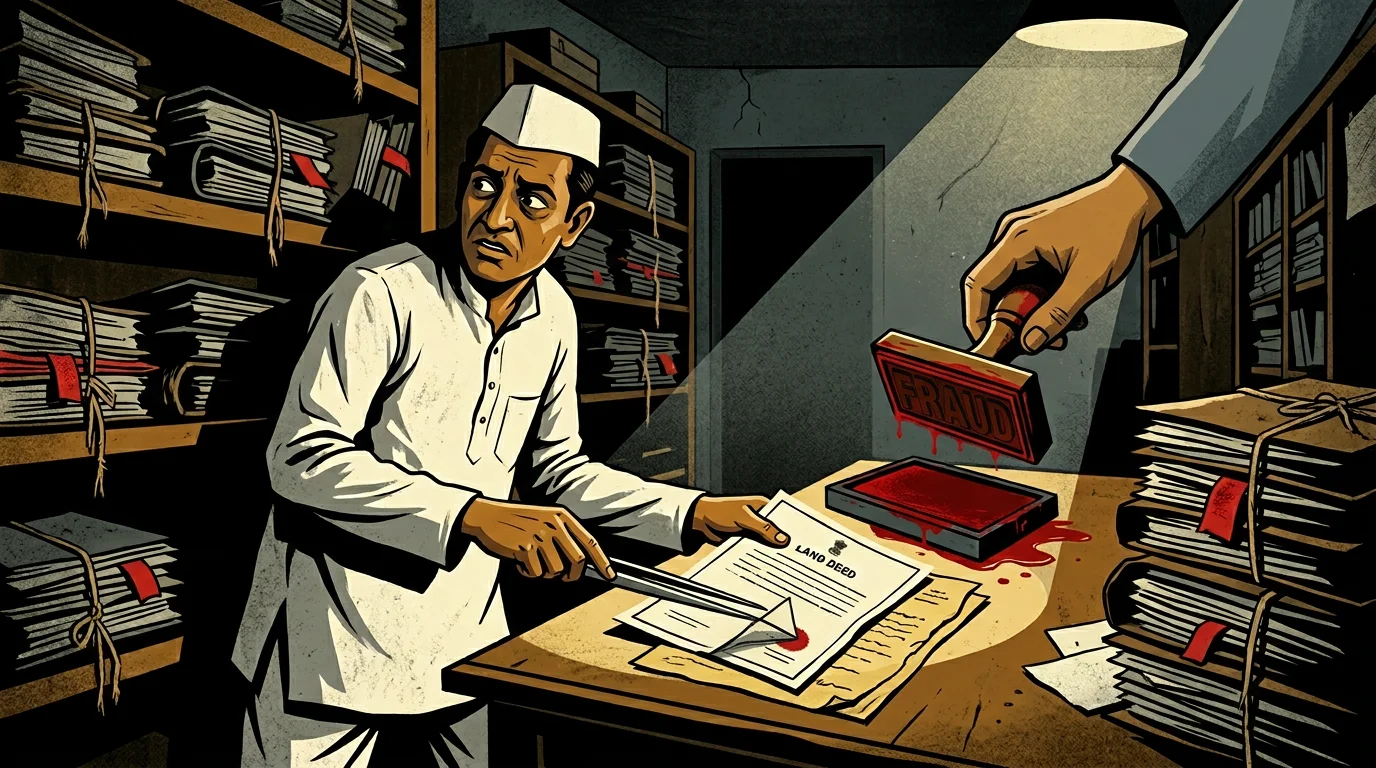

Property owners in India depend on revenue officials for some of the most important documents they will ever need. Patwaris prepare verification reports. Tehsildars approve mutations. Sub-registrars register sale deeds. These officials are the gatekeepers of your land records.
But what happens when the gatekeepers themselves alter the records?
Recent court cases across Haryana and Madhya Pradesh reveal a pattern: revenue officials misclassifying land, forging verification reports, and processing fraudulent mutations. The document lessons from these cases matter for every property owner, especially those who are not physically present to monitor their records.
How a Verification Report Can Change Everything
In a 2023 Punjab and Haryana High Court case (Rajender Singh v. State of Haryana), the prosecution alleged that a patwari had prepared a false physical verification report for a parcel of custodian land in Sonipat.
The land was commercial and residential. Shops, houses, and industries surrounded it. It fell within the Municipal Corporation limits. No one had farmed it for over two decades.
Yet the verification report classified it as agricultural.
That classification mattered enormously. The collector rate for agricultural land was Rs 1.60 crore per acre. The actual market value for commercial property in the area was approximately Rs 17 crore. Based on the patwari’s report, the land sold for Rs 2.30 crore.
The investigation also found that the verification report had been physically tampered with after its original preparation, with additional lines added to the document.
The property was custodian land, governed by the Haryana Evacuee Properties (Management and Disposal) Rules, 2011. Under these rules, the patwari’s verification report directly determines the sale terms. The tehsildar relies on it to approve the transaction. One document, prepared by one official, controlled the entire outcome.
The prosecution described the operation as one carried out “in connivance with land grabbers/mafia in a pre-planned manner.” Multiple revenue officials were charged, including the patwari, a tehsildar, and a naib tehsildar. The case is ongoing.
The Document That Nobody Checked
The Sonipat case illustrates a specific vulnerability in India’s land records system: the physical verification report.
When custodian property or government land is sold, the patwari physically inspects the site and prepares a report covering the land’s classification, surroundings, current use, and valuation. The tehsildar then uses this report to approve or reject the sale and set the price. There is no mandatory independent audit of the patwari’s findings.
This means a single official’s report can:
- Change land from commercial to agricultural (reducing the valuation by multiples)
- Omit the fact that the land is within municipal limits
- Understate the collector rate
- Conceal that the property is under litigation
Each of these was alleged in the Sonipat case. And because the tehsildar relies on the patwari’s report, a false report at the first stage cascades through the entire process.
Mutations: The Other Pressure Point
Verification reports are not the only vulnerable document. Mutation entries, which record changes in property ownership in revenue records, are another point where official misconduct can cause serious damage.
In March 2025, the Madhya Pradesh High Court heard a case where a Tahsildar passed a mutation order granting land rights based on a Will supposedly written in 1970 but only submitted in 2023, 53 years later. The mutation application had no date, no applicant signature, and no respondent names. The court found that a computer operator in the Tahsildar’s own office was a direct family member of the person whose name was being mutated.
The court held that the Tahsildar’s conduct “prima facie indicates commission of offence.” This was not an exercise of official duty. The Tahsildar had deliberately taken jurisdiction over a case assigned to someone else, processed a defective application, and benefited a subordinate’s family.
The same year, a full bench of three judges at the Madhya Pradesh High Court, including the Chief Justice, addressed the systemic scale of this problem in Vijay Singh Yadav v. Smt Krishna Yadav (2025). The court observed:
“There are many cases in the State whereby on the basis of forged and fraudulent Wills, mutations have been carried out without even noticing the actual legal representatives.”
And noted the speed at which fraudulent mutations are exploited:
“Immediately after getting mutation on the basis of will, the first thing which a person does is to alienate the land and in this manner, creates third party rights leading to a loss.”
The full bench directed that revenue authorities must require prior civil court validation before processing any will-based mutation. The court recognised that revenue officials lack the legal training to assess whether a will is genuine, and the system had no safeguards to prevent fraudulent mutations from going through.
Why This Matters for Property Owners
These cases share a common thread: property owners lost out because they had no independent record of what their land documents should say.
If you do not hold your own copies of your revenue records, you have no way of knowing whether a patwari has altered the classification, a tehsildar has processed an unauthorised mutation, or someone has added lines to a verification report. The manipulation happens inside the system you depend on for proof of ownership.
This vulnerability is sharpest for owners who are not physically present. NRIs, people who have inherited property in another state, owners of agricultural land they do not visit regularly: these are the people least likely to notice when records change.
What You Should Do
Get independent copies of your revenue records. Obtain certified copies of your jamabandi, khasra, and mutation entries directly from the tehsil office or through your state’s online land records portal. Do not rely on what an intermediary or official tells you the records say.
Compare your records against your registered documents. Your sale deed states the area, boundaries, and land use. Your revenue records should match. If they show a different classification, a different area, or a different owner, that discrepancy needs immediate investigation.
Monitor your mutation entries. Mutations record changes in ownership. If someone files for a mutation on your property without your knowledge, your revenue records will change. Periodic checks catch this. Some states now offer SMS alerts for mutation applications; register for these where available.
Keep timestamped copies of your documents. If your revenue records are ever altered, having your own dated copies gives you a basis for comparison. Platforms like Assetly let property owners store and organise their documents digitally, accessible from anywhere.
Engage a local contact. If you live abroad or in another city, having someone who can periodically visit the tehsil office and check records is not optional. In the cases discussed here, the manipulation went undetected because no one was watching.
The Underlying Problem
India’s revenue record system places enormous trust in individual officials with limited oversight. A patwari’s verification report can determine a property’s value. A tehsildar’s mutation order can transfer ownership. These are powerful documents, and when the officials preparing them act in bad faith, the property owner is often the last to know.
The courts have started responding. The Madhya Pradesh full bench ruling now requires civil court validation for will-based mutations. But for other types of record manipulation, like false verification reports and land misclassification, the safeguards remain thin.
The best protection remains the same: know what your documents say, keep your own copies, and check them regularly. The documents that are supposed to protect your ownership are only as reliable as the system maintaining them. When that system fails, as India’s broader property dispute crisis makes clear, the cost is measured in years and crores.
For practical guidance on monitoring digital land records, see our guide on how digital land records can change without you knowing. If you own property in Haryana or Punjab, our guide to managing property in Punjab covers the Jamabandi portal and state-specific NRI challenges. For Telangana or Andhra Pradesh, our state-specific guides cover the portals and records you need to check: Telangana and Andhra Pradesh.
Sources
- Rajender Singh v. State of Haryana, CRM-M-31672-2023, Punjab and Haryana High Court, 13 December 2023. Indian Kanoon
- Hari Singh Dhurvey v. State of Madhya Pradesh, MP High Court, Jabalpur, 11 March 2025. Indian Kanoon
- Vijay Singh Yadav v. Smt Krishna Yadav, MP High Court Full Bench, 14 February 2025. Indian Kanoon
Assetly is a property document management platform that helps Indian property owners organise, verify, and track their property documents digitally. Learn more.