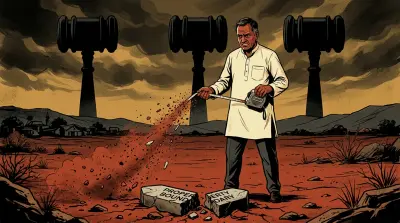

In 2019, the Supreme Court confirmed something that should alarm every property owner who does not physically live on their land.
If someone occupies your property for 12 continuous years, they can go to court and claim ownership. Not just possession. Ownership. And they will win.
This is the law of adverse possession under Article 65 of the Limitation Act, 1963. After 12 years, Section 27 of the same Act permanently extinguishes the original owner’s title. The word “extinguishes” is doing heavy lifting there. It does not mean you have a weaker claim. It means you have no claim at all.
The Supreme Court itself, in Hemaji Waghaji Jat vs Bhikhabhai Khengarbhai Harijan (2008), called this law “irrational, illogical and wholly disproportionate.” Justice Dalveer Bhandari wrote:
“The law as it exists is extremely harsh for the true owner and a windfall for a dishonest person who had illegally taken possession.”
The court recommended Parliament reform the law. That was in 2008. Three years later, in State of Haryana vs Mukesh Kumar (2011), the same judge asked: “How 12 years of illegality can suddenly be converted to legal title is, logically and morally speaking, baffling.”
Parliament has still not acted. As of 2026, the 12-year rule stands unchanged.
So what does this mean for you? It means protecting your land is not optional. It is a legal obligation you owe yourself, because if you do nothing for long enough, the law will take your property away and hand it to whoever happened to be sitting on it.
The 12-Year Clock: Understanding What Starts It
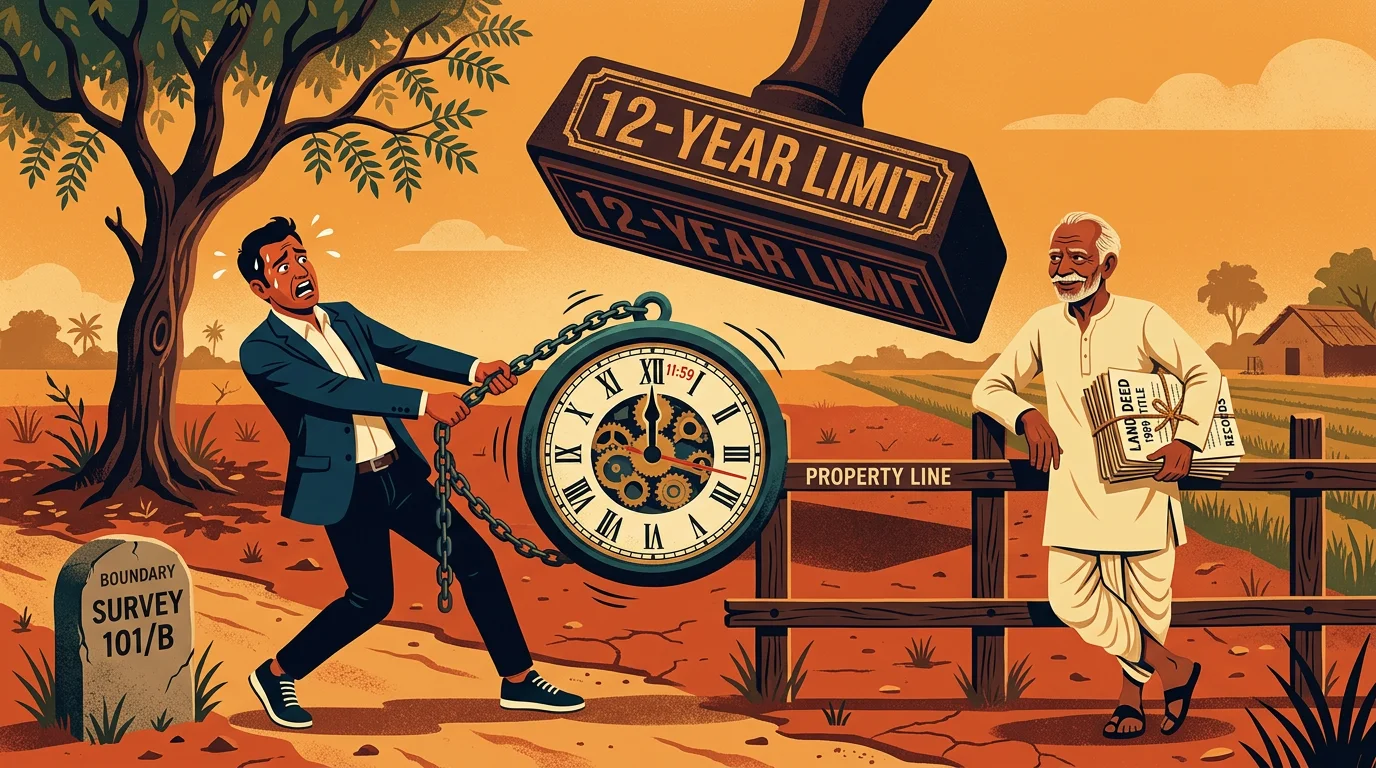
Think of adverse possession like a countdown timer that starts ticking the moment someone sets foot on your land without your permission.
For that timer to run, the encroacher’s possession must be:
- Open: not hidden or secret
- Continuous: unbroken for the full 12 years
- Hostile: without your permission (if you gave consent, it is not adverse)
- With animus possidendi: meaning the intent to possess as owner, not as a tenant or caretaker
The Supreme Court in Ravinder Kaur Grewal vs Manjit Kaur (2019) spelled out the requirements clearly. The possession “must be adequate in continuity, in publicity, and in extent.” And once 12 years pass, the encroacher does not just get to defend their occupation. They gain an enforceable title they can use to sue you.
The good news: anything you do to assert your ownership before those 12 years are up resets the clock. A legal notice. A revenue court complaint. A civil suit. Even a documented inspection visit.
The bad news: if you are living abroad and nobody is watching the property, you might not know the clock started.
Why NRIs Are Especially Vulnerable
In May 2025, the Punjab and Haryana High Court heard a case that illustrates the problem perfectly. In Bagel Singh v. State of Punjab, NRI-owned land in Ludhiana measuring 14 kanals (worth several crores) was sold through impersonation for just Rs 30.20 lakh. The cheques were never even encashed. A village official was involved in the transaction.
Justice Harpreet Singh Brar did not mince words. He said “absence is weaponised” in these cases and called NRI property fraud “symptomatic of systemic abuse” where “legal safeguards are routinely undermined.” For another example of how NRI absence is exploited, see the Nirmal Kaur PoA fraud case, where a family member forged a power of attorney to sell an NRI’s property.
The court refused bail to the accused, finding these offences have “cascading effects on public trust in the real estate ecosystem.”
This is not an isolated problem. According to a 2007 World Bank study, two-thirds of all pending civil cases in India are land disputes. NITI Aayog estimates the average resolution time at 20 years. For NRIs, the combination of physical absence and long legal timelines creates the perfect storm: by the time you discover the encroachment, the clock may already be deep into its countdown.
Seven Things You Should Do Now
1. Get a boundary survey done and keep the report
This is the single most important step. In the Sandhar vs Veera Wali case, a property owner lost his encroachment case in three courts because nobody could prove where his property boundaries were. The surveyor had not measured the defendant’s property. The government official could not point to the property on a map.
Hire a licensed surveyor to create a detailed boundary map with GPS coordinates. This is different from the rough site plan you might have from when you bought the property. A proper survey references survey numbers, adjoining properties, and physical markers.
Cost: typically Rs 5,000 to Rs 15,000 depending on the property size and location. Cheap insurance for land worth lakhs or crores.
2. Keep property tax payments current and in your name
Property tax receipts are not proof of ownership. Multiple Supreme Court judgments have made this clear, including Corporation of the City of Bangalore v. M. Papaiah (1989), which established that revenue records do not confer title.
But here is why they matter anyway: they are proof of continuous claim. When a court is deciding whether someone abandoned their property (which makes adverse possession easier to prove), a chain of unbroken tax receipts in your name is strong evidence that you never gave up your interest.
Pay on time. Pay every year. Keep the receipts.
3. Check your land records regularly through state portals
Most Indian states now have online portals where you can check your land records without visiting India:
| State | Portal |
|---|---|
| Telangana | Bhu Bharati (bhubharati.telangana.gov.in) |
| Andhra Pradesh | Mee Bhoomi (meebhoomi.ap.gov.in) |
| Karnataka | Bhoomi (landrecords.karnataka.gov.in) |
| Maharashtra | Mahabhulekh (bhulekh.mahabhumi.gov.in) |
| Tamil Nadu | Patta Chitta (eservices.tn.gov.in) |
| Uttar Pradesh | Bhulekh (upbhulekh.gov.in) |
| Punjab | Jamabandi (jamabandi.punjab.gov.in) |
| Kerala | E-Rekha (erekha.kerala.gov.in) |
| Gujarat | AnyROR (anyror.gujarat.gov.in) |
| Rajasthan | Apna Khata (apnakhata.rajasthan.gov.in) |
Check at least once a quarter. What you are looking for: any changes to the owner name, survey number, extent, or mutation entries that you did not initiate. Unauthorised mutations are often the first sign that something is wrong.
A word of caution: only about 15% of Indian land records have real-time updates, and just 9% of villages have completed their re-survey (DILRMP data, 2017). Online records are useful but not infallible. They supplement physical inspections, not replace them.
4. Visit or arrange inspections at least once a year
If you cannot visit personally, ask a trusted relative, friend, or property manager to inspect the land and send you:
- Photographs of the property from multiple angles
- Photos of boundary markers, walls, or fencing
- Notes on any new construction, cultivation, or occupation nearby
- A short video walkthrough if possible
The point is not just to spot problems. It is to create a documented trail that proves you are actively monitoring the property. If an adverse possession claim ever comes up, this trail is evidence that you never abandoned your interest.
Date-stamp everything. Store it digitally where it will not get lost.
5. Build a boundary wall or fence
A physical boundary does two things. First, it makes encroachment physically harder. Second, and more importantly, it signals to anyone contemplating encroachment that the land is actively owned.
In Indian property law, boundaries carry particular weight. The settled legal principle is that “boundaries will prevail over survey numbers and extent of property.” A clearly marked boundary supported by a survey report is one of the strongest forms of evidence you can have.
If a wall is not feasible (vacant agricultural land, for example), consider less expensive markers: concrete pillars at the corners, painted boundary stones, or even a wire fence. Something visible.
6. Ensure your registered sale deed has clear boundary descriptions
This is something many people overlook because it involves going back to the original purchase documents. Open your registered sale deed and check how the property boundaries are described.
If it says something vague like “bounded on the north by the road and on the south by the field of Ramesh,” that is a problem waiting to happen. Ramesh might sell his field. The road might be widened. Your boundary reference points are not permanent.
The strongest sale deeds reference survey numbers, precise measurements in metres or feet, and compass directions. If your deed is vague, you cannot retroactively change it, but you can get a surveyor’s report that ties the vague description to precise coordinates. Keep that report with the deed.
For a practical explanation of what an independent survey can establish, and what still requires a state revenue or survey process, see our guide to private land surveyors in India.
Per the Supreme Court in Suraj Lamp & Industries vs State of Haryana (2011), a registered sale deed is the only legally valid way to transfer immovable property. Everything else (GPA sales, agreements, power of attorney transfers) is legally void. Make sure yours is airtight.
7. Act immediately if you spot a problem
If you discover encroachment, you have three parallel tracks available:
Criminal track: File an FIR at the local police station under Section 329 of the Bharatiya Nyaya Sanhita (which replaced IPC Sections 441 and 447 from 1 July 2024). This covers criminal trespass, carrying a punishment of up to three months imprisonment.
Revenue track: File a complaint with the local Tehsildar or Sub-Divisional Magistrate (SDM). They have the power to order a boundary demarcation through the Kanungo (revenue surveyor), conducted in the presence of both parties. The demarcation report becomes part of the official record.
Civil track: File a suit in civil court seeking a declaration of title, permanent injunction against the encroacher, and recovery of possession.
Using all three simultaneously is the strongest approach. The criminal complaint creates urgency. The revenue complaint gets an official survey on record. The civil suit establishes your title formally.
The one thing you must not do: wait. Every month of inaction moves the 12-year clock forward.
A Note on Revenue Records
A common misconception: if your name is in the revenue records (patta, khata, mutation register), you are safe. This is not true.
The Supreme Court has said repeatedly that revenue records are not documents of title. In State of Himachal Pradesh v. Keshav Ram (1996), the court was explicit: “Entries in revenue papers, by no stretch of imagination can form the basis for declaration of title.”
Revenue records serve a fiscal purpose. They tell the government who to collect land revenue from. They do not tell a court who owns the property. Mutation of property in revenue records “does not create or extinguish title.”
This is why a registered sale deed matters so much. It is the one document that both creates and proves title. Revenue records, tax receipts, encumbrance certificates, and survey reports all support it. But without the deed, you are building on a weak foundation.
The Document Stack That Protects You
No single document proves ownership conclusively. The strongest position is a combination:
- Registered sale deed with clear boundary descriptions
- Certified survey map with GPS coordinates from a licensed surveyor
- Mutation records showing your name in revenue records
- Continuous property tax receipts showing unbroken payments
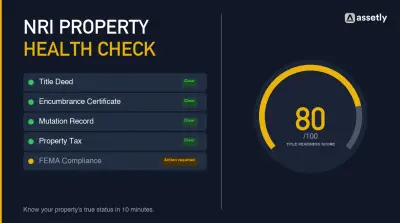
- Encumbrance certificate showing the transaction history of the property
- Dated photographs and inspection records proving regular monitoring
- Boundary markers on the physical property
If you are an NRI or a property owner who cannot visit regularly, storing these documents securely and accessibly is half the battle. A platform like Assetly lets you keep all of these in one place, accessible from anywhere, so you are never scrambling for paperwork when a problem surfaces.
The Bottom Line
The law of adverse possession is harsh. Even the Supreme Court thinks so. But until Parliament changes it, the 12-year clock is ticking for every property owner who is not actively protecting their land.
The good news is that the steps required are not expensive or complicated. A boundary survey, regular tax payments, periodic inspections, and proper documentation. These cost a fraction of what you would spend fighting an encroachment case in court for the next two decades.
As India’s property dispute numbers tell us, two-thirds of all civil cases are about land. The average dispute takes 20 years to resolve. Prevention is not just cheaper than cure. It is the only strategy that reliably works. For a case study of what happens when missing survey maps, incomplete partitions, and skyrocketing values collide, see our deep-dive into the Vattinagulapalli land dispute near Hyderabad’s ORR. And for a stark example of what happens when government land goes unmonitored for decades, read how ₹1,200 crore of assigned land in Khanamet was encroached - with apartments built and banks operating - before HYDRAA reclaimed it. Technology like satellite monitoring and AI change detection may eventually help catch encroachment earlier, but for now, your own vigilance is the best defence.
One important distinction: the 12-year adverse possession clock applies to encroachers who enter without permission. Tenants who enter with your consent are in a different legal category entirely - the Supreme Court confirmed in 2025 that tenants can never claim ownership through adverse possession, regardless of how long they stay.
Assetly is a property document management platform that helps Indian property owners, especially NRIs, organise, verify, and track their property documents digitally. Learn more.