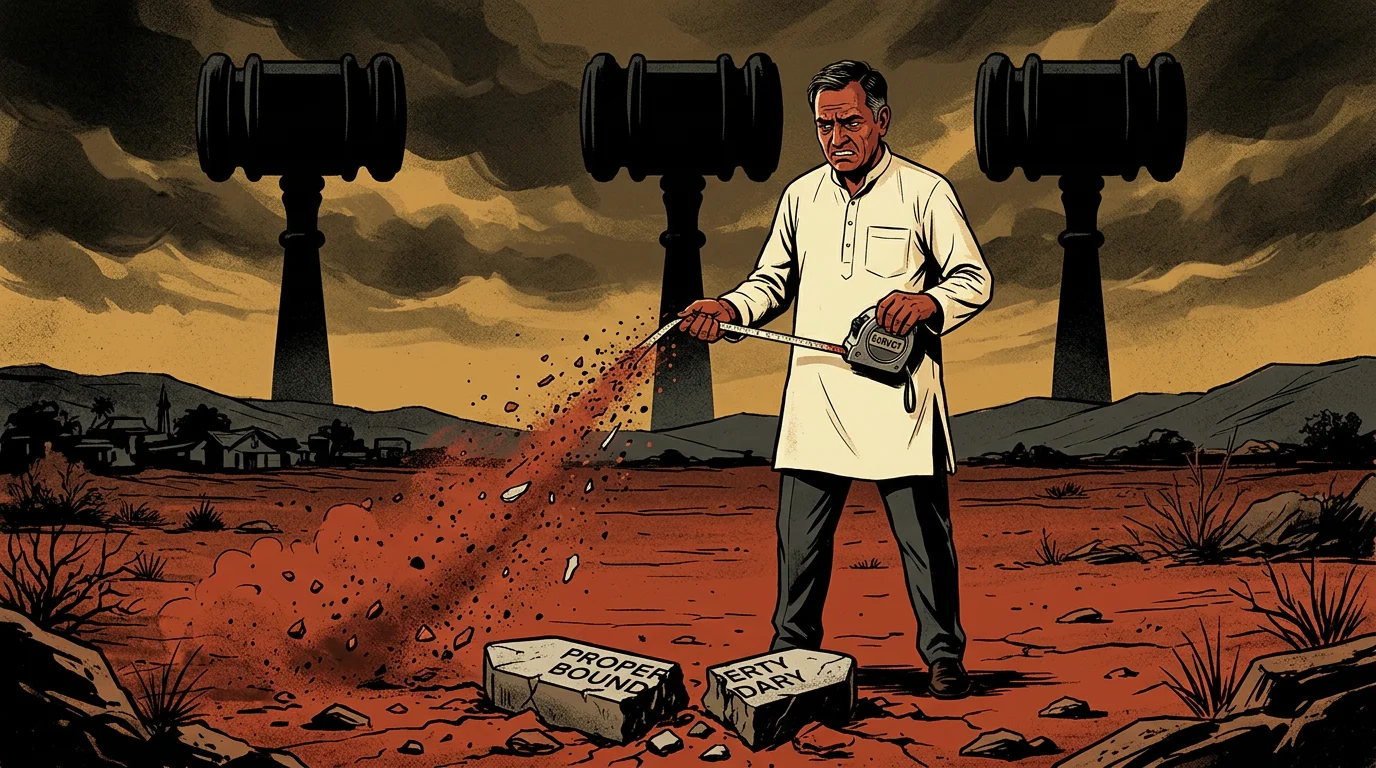

A property owner in Jalandhar claimed his neighbour had built a boundary wall on his land. He hired a lawyer. He filed a suit. He fought all the way to the Punjab and Haryana High Court.
He lost. Every single time.
The court did not rule on whether encroachment had actually occurred. It never got that far. The case was dismissed because the plaintiff could not prove where his property boundaries were in the first place.
What Happened
The plaintiff, Kanwar Varinder Singh Sandhar, owned a residential property in Jalandhar. He alleged that his neighbour, Veera Wali, had encroached on a portion of his land by constructing a boundary wall.
The neighbour denied any encroachment, stating the land was allotted to him by the Tehsildar and that he owned the adjacent plot.
This is where the case should have turned on documents. Whose papers showed what? Which survey proved the boundary?
The answer: nothing useful.
Why the Case Failed
The plaintiff’s case collapsed during cross-examination, and the reason was entirely about evidence.
The surveyor called as a witness admitted under oath that he had not measured the defendant’s property. The court had ordered him to do exactly this. He also conceded that he had not obtained supporting documents from the court.
A second key witness, a government official who was supposed to produce the departmental records for the plot, could not tell the court the exact location of the property. The boundaries were not even mentioned in the site plan he produced.
Justice Amit Rawal of the Punjab and Haryana High Court noted:
“I am in agreement with the findings rendered by both the Courts below as both the witnesses of the plaintiff-appellant prima facie conceded of not even giving the location of the property much less factum of measurement of the alleged encroachment.”
And stated the legal principle:
“The burden of prove is upon person who asserts particular fact and after discharging the same, the onus shifts upon the defendant to rebut the same. The instant case is a case of kind where plaintiff-appellant has failed to discharge the burden much less onus.”
The trial court dismissed the suit. The first appellate court dismissed the appeal. The High Court, in RSA No. 1851 of 2013, dismissed it again on 25 November 2014.
Three courts. Same conclusion. The plaintiff could not prove the boundaries of his own property.
What This Case Actually Teaches
This is not a story about an encroachment that went unpunished. We do not know whether encroachment happened. The court never reached that question because the evidence presented was insufficient.
What the case does teach is how Indian courts handle the burden of proof in encroachment claims. If you allege someone has taken your land, you must prove three things:
-
Where your property starts and stops. You need precise measurements, not vague boundary descriptions like “north of so-and-so’s house.” Neighbour names change. Landmarks shift. Survey numbers and GPS coordinates do not.
-
What changed. You need to show the boundary before and after the alleged encroachment. Without a baseline measurement, there is no way to demonstrate what was lost.
-
That the encroachment is on your land, not the defendant’s. This requires measuring both properties and showing the overlap. The surveyor in this case did not measure the defendant’s property at all.
Without this evidence, the court has no basis to grant relief. The defendant does not even need to present a defence. The case fails before it gets to that stage.
The Pattern
This case follows a pattern that repeats across Indian courts, particularly involving property owners who are absent for extended periods. Indian Kanoon indexes over 110 higher court judgments involving NRI property encroachment in Punjab alone. The actual number is far higher, since district court cases are largely not indexed.
In case after case, the outcome turns not on whether encroachment occurred, but on whether the plaintiff can prove it with documentary evidence. Consider:
A property owner in Dubai filed an encroachment suit over a small parcel of land (Darshan Singh, 2018). Like Sandhar, the claim failed because the evidence was insufficient. Concurrent findings went against him.
An NRI property owner’s land in Phagwara was allegedly occupied by someone using the pretext of running an animal welfare centre (Nidhi Walia, 2023). The possession had been transferred without written documentation. In another case, a family forged a power of attorney to sell an NRI’s property while they were abroad.
The underlying problem is consistent. When property boundaries are not properly documented, surveyed, and stored, any encroachment claim becomes nearly impossible to prove in court. The person who entered the land has physical possession. The burden of proving they should not be there falls entirely on the plaintiff. And that burden requires documents.
What Property Owners Should Do
For a comprehensive guide covering all prevention steps, including the legal framework around adverse possession and what to do if you discover encroachment, see our complete guide to protecting your land from encroachment.
1. Get a certified survey map. A licensed surveyor should measure your property, mark the boundaries with GPS coordinates, and produce a certified report. This is your baseline. Without it, you cannot prove encroachment because you cannot prove what the boundaries were before the dispute arose.
2. Ensure your sale deed has precise boundaries. Boundary descriptions like “North: property of Shri X, South: property of others” are vague and rely on the identities of current neighbours, which change over time. Your sale deed should reference survey numbers, plot dimensions in feet or metres, and permanent landmarks or GPS coordinates.
3. Complete mutation after purchase. Mutation (transfer of the revenue record in your name) is separate from registration. Many property owners register their sale deed but never complete mutation. Without mutation, the government’s land records still show the previous owner.
4. Keep dated photographs. Photograph your property and its boundary markers periodically. Have a trusted person do this when you cannot visit. Timestamped photos are admissible evidence and establish what the property looked like at a specific date.
5. Store documents where they are accessible. If your property documents are locked in a bank locker or sitting in a relative’s house, they may not be available when your legal team needs them. Platforms like Assetly let property owners store and organise documents digitally, so they are always accessible.
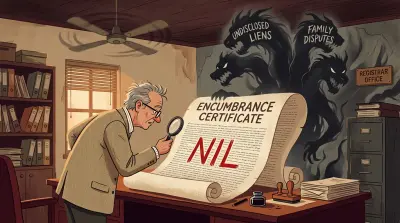
6. Check your property records annually. Pull an encumbrance certificate once a year to check for unauthorised transactions. Verify your mutation status. Confirm property tax is paid in your name. These are signals that your ownership is intact.
The Real Cost
The Sandhar case was litigated through three courts over several years. The monetary claim was modest. But the legal costs of fighting through a trial court, an appellate court, and the High Court almost certainly exceeded the value of the disputed land.
And at the end of it all, the court did not decide whether encroachment happened. It decided that the plaintiff had not proved his case. The dispute remains unresolved.
As we outlined in our analysis of India’s property dispute crisis, land disputes in India take an average of 20 years to resolve. But some disputes never resolve at all. They simply end when one party runs out of evidence, money, or time.
Sources
- Kanwar Varinder Singh Sandhar vs Veera Wali, RSA No. 1851 of 2013 (O&M), Punjab and Haryana High Court, decided 25 November 2014. Indian Kanoon
- Bhagwant Singh vs State of Punjab, CRM-M-5824-2025, Punjab and Haryana High Court, decided 31 January 2025. Indian Kanoon
- World Bank, “Land Policies for Growth and Poverty Reduction,” 2007; cited in NITI Aayog, “Report on Conclusive Land Titling,” 2019.
- National Judicial Data Grid (NJDG), njdg.ecourts.gov.in
Assetly is a property document management platform that helps Indian property owners organise, verify, and track their property documents digitally. Learn more.