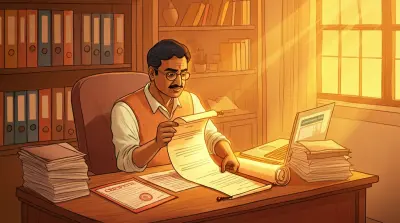

Your India property sits thousands of miles away. The caretaker sends an occasional message. Your cousin paid the property tax last year - or said they did.
This is how NRI property management India works for most families. Not through systems, but through trust. And without a system, small problems become expensive ones - encumbrances that block a sale, mutation records never updated after inheritance, tax arrears compounding quietly, encroachments that take years to reverse.
A property health check tells you where you stand before something forces you to find out. This guide covers the five things that most commonly go wrong, what a health check involves, how to check property status India step by step, and how Assetly’s free tools cover the core of it in under 10 minutes.
The 5 Things That Silently Go Wrong With NRI Property
Most property problems do not announce themselves. They accumulate in records offices, court filings, and municipal databases - until a sale, a dispute, or a government notice forces the issue.
1. Mutation records that were never updated
When a property changes hands - through inheritance, gift, or sale - the new owner’s name must be updated in revenue records. This is called mutation (khata transfer in Karnataka, patta transfer in Tamil Nadu, Pahani update in Andhra Pradesh and Telangana).
It is the most commonly skipped step in NRI property management in India.
A title deed or sale deed alone is not enough. If mutation has not happened, the revenue department still recognises the previous owner. Future sales become complicated. Heirs face avoidable legal hurdles.
What to do: Verify your name in your state’s land records - Bhu Bharati in Telangana (bhubharati.telangana.gov.in), Meebhoomi in Andhra Pradesh, Bhoomi in Karnataka. If mutation is pending, file an application with the local tehsildar.
2. Encumbrances that were never cleared
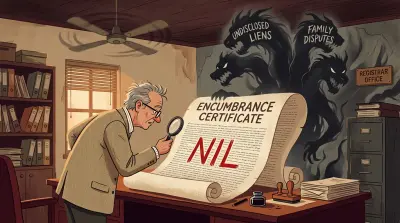
An encumbrance is any charge or claim on a property - a mortgage, a lien, a court attachment. If a previous owner took a loan against the property and the bank never filed a release certificate, that encumbrance can still appear in the records even after the loan was repaid.
An uncleared encumbrance can block a sale at the worst possible moment.
What to do: Obtain an Encumbrance Certificate from your state’s registration portal. For Telangana: registration.telangana.gov.in. For Andhra Pradesh: registration.ap.gov.in. For Karnataka: kaveri.karnataka.gov.in. For Tamil Nadu: tnreginet.gov.in. A 13-year EC (the minimum banks require, covering the Limitation Act period) is adequate for routine monitoring. Request a 30-year EC before any sale or mortgage.
3. Property tax arrears accumulating in the background
Property tax follows the property, not the person. If previous owners left arrears, they transfer to you. Missed payments - easy to lose track of from abroad - attract penalties that compound.
In Hyderabad, GHMC has authority to attach properties with persistent tax arrears. A clean tax record is also required before property registration can proceed.
What to do: Check dues on your municipal corporation’s online portal using your PTIN or door number. In Hyderabad, search via GHMC’s property tax portal. Verify the last payment date and confirm no arrears exist.
4. Title that was never properly established
Many NRIs acquired property without a complete chain of documents. Missing sale deeds from prior transactions, unregistered gift deeds, undivided family shares never formalised in writing - all of these create title weakness that may not surface day-to-day, but will appear during a sale, mortgage application, or legal challenge.
What to do: Trace the ownership chain for at least 30 years. Confirm all transactions were registered with the Sub-Registrar. If you acquired through inheritance, verify that succession documents are in order and mutation was completed in your name.
5. Encroachment on vacant land
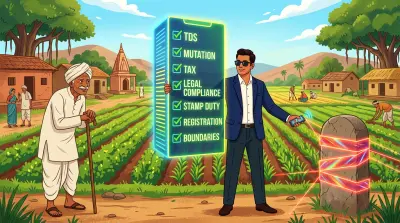
Boundary encroachment is among the most common problems with NRI-owned vacant land in India. Without physical presence, a neighbour or local actor can gradually shift a boundary wall, construct along the edge of a plot, or claim possession of a portion of the land.
Courts consistently require documentary boundary proof - FMB sketch, survey numbers, Pattadar Passbook details. Without these, even legitimate owners struggle to prevail.
What to do: Periodically verify physical boundaries against your survey records. For vacant land in Hyderabad, Telangana, or Andhra Pradesh, check for any government notifications affecting your survey number. If encroachment is suspected, file a complaint with the Revenue Divisional Officer promptly - delay strengthens adverse claims.
What a Property Health Check Covers
A health check is not a legal opinion. It is a structured status review across five dimensions:
Title and documents. Do you have the core documents - sale deed or title deed, Encumbrance Certificate, mutation record, Pattadar Passbook (for plots and agricultural land), khata, and tax receipts? Are they consistent with each other?
Encumbrance status. Is the property free from mortgages, liens, or court attachments? The Encumbrance Certificate is the primary instrument for this check.
Revenue records. Does your name appear correctly in land records - Bhu Bharati in Telangana, Meebhoomi in Andhra Pradesh, Bhoomi in Karnataka?
Tax compliance. Are all municipal taxes current? Are there outstanding arrears?
Risk flags. Are there pending disputes, government notifications, or acquisition orders affecting the property? In Hyderabad, this includes checking proximity to water bodies and government land given HYDRAA’s active enforcement operations.
How to Check Property Status India: Step by Step
Step 1: Locate your core documents. Sale deed, Encumbrance Certificate, mutation certificate or khata, Pattadar Passbook if applicable, and three years of property tax receipts. If you cannot locate the originals, that is the first problem to address.
Step 2: Check land records online. Verify your name appears correctly and that survey details match your documents:
- Telangana: bhubharati.telangana.gov.in
- Andhra Pradesh: meebhoomi.ap.gov.in
- Karnataka: landrecords.karnataka.gov.in
- Tamil Nadu: eservices.tn.gov.in (Patta Chitta)
If the name on the record is not the one you expect, our walkthrough on checking a property owner’s name in Telangana covers the routes that work. Telangana owners should also check the Section 22A prohibited land list, where privately held patta land was flagged in bulk.
Step 3: Pull an Encumbrance Certificate. Use your state’s registration portal. A 13-year EC covers routine monitoring needs. Get a 30-year EC before any transaction.
Step 4: Check property tax status. Use your municipal corporation’s online portal with your PTIN or door number. Confirm dues are nil and the last payment is recent.
Step 5: Check for government notifications. Verify whether your survey number appears in gazette notifications, acquisition orders, or - for Hyderabad - active HYDRAA enforcement lists. This step typically requires local contacts or professional support.
How Often Should You Do This?
Once a year at minimum. The NRI Property Annual Checklist covers the full schedule - but the short answer is that land records change, tax dues accumulate, and court proceedings can affect your property without any notification reaching you.
For vacant or tenanted land, twice a year is advisable. For properties in active risk zones - near water bodies, disputed layouts, or areas with government land reclamation - continuous monitoring is the only reliable approach.
The biggest mistake in NRI property management India is treating a health check as a one-time event. Property risk is not static.
Free Property Assessment India NRI: What Assetly Checks in 10 Minutes
Doing this manually requires time, local access, and document knowledge that most NRIs do not have readily at hand. Assetly’s free tools cover the core of an NRI property check in under 10 minutes - no account, no agent, no sales call.
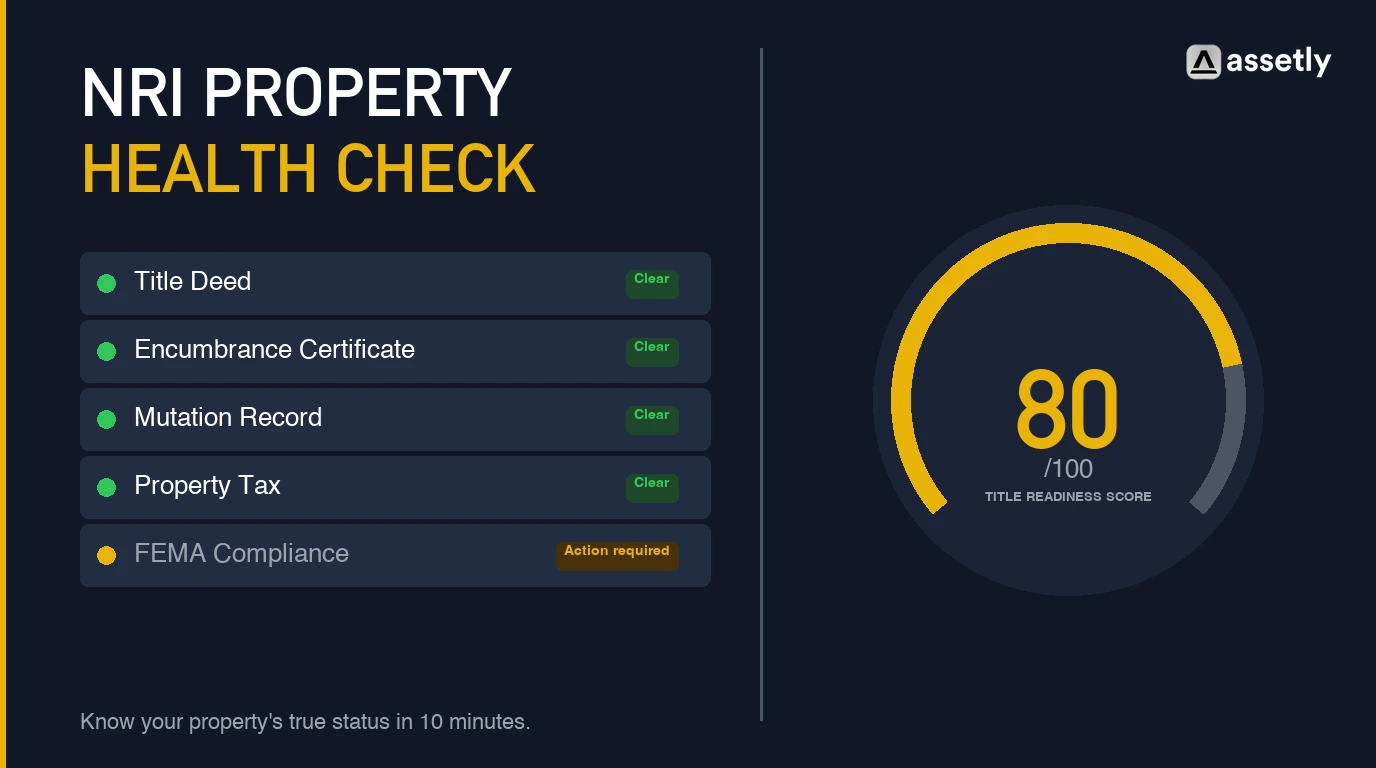
Title Readiness Check. Seven questions on your document status, encumbrance and litigation risk, tax compliance, and acquisition specifics. Output: a title readiness score from 0 to 100, a document gap checklist covering sale deed, Encumbrance Certificate, and Mutation Record, risk flags, and a prioritised action plan - emailed immediately.
NRI Compliance Check. Seven questions on FEMA compliance, tax obligations (PAN, NRO/NRE account, TDS on rental income, TDS on sale proceeds), and POA and document gaps. Output: a compliance status across each dimension - Compliant, Minor Gaps, Action Required, or Non-Compliant - with an annual monitoring checklist.
Both tools are free. No sign-up required. Start your free property assessment at assetlyhq.com/free-tools.
After the Health Check: What Comes Next
The free tools give you a diagnosis. For signed-up users, Assetly provides continuous monitoring of land records and compliance status, on-ground service ordering, and access to Prabhakar - Assetly’s AI assistant - for specific questions about your property documents and what your results mean in practical terms.
Related Reading
- The NRI Property Annual Checklist: 10 Things to Do Every Year
- How to Monitor Your India Property for Risks When You’re Not There - ongoing monitoring between health checks: tax, mutation, EC, boundary, and court alerts
- What Is an Encumbrance Certificate? (And What It Does Not Tell You)
- Mutation Record: The Property Document Most People Forget
- Dharani to Bhu Bharati: What Changed and What Property Owners Must Know
- FEMA Rules Every NRI Property Owner Must Know
- How Transaction Readiness Prevents NRI Property Sale Failures - when a health check turns into a sale, this is how you get the file buyer-ready
Assetly helps NRIs with property management in India - documents, compliance, title health, and on-ground execution, all in one place. Start your free property assessment at assetlyhq.com/free-tools.