

In Hyderabad, 6.8 lakh properties carry accumulated tax arrears worth Rs 10,000 crore as of 2025. Nearly Rs 7,000 crore of that is compounded interest - roughly three times the principal. Not because owners refused to pay. Because no portal told them anything was outstanding.
This is the NRI property monitoring problem. Risk does not announce itself; it compounds. You cannot drive past the property on a Sunday. You cannot see the notice on the gate. By the time the problem reaches you, it has typically been running for months.
The 5 Risks That Compound Silently
Not all risks are equal. Some are recoverable if caught early. Adverse possession, once completed, is permanent.
| Risk | How It Compounds | Urgency |
|---|---|---|
| Property Tax Arrears | Interest runs at 2% per month under GHMC (24% annually). Arrears attach to the property; buyers inherit the liability at sale. | High - daily |
| Boundary Encroachment | Small intrusions go uncontested. After 12 years of open, hostile, continuous occupation, adverse possession extinguishes the original owner’s title entirely. | Critical - 12-year clock |
| Unauthorised Mutation | Revenue records changed without the owner’s knowledge. Used to freeze transactions or support fraudulent claims. | High |
| Court Attachments or Caveats | Court orders and caveats appear on the Encumbrance Certificate without any notification to the owner. Block a clean sale until cleared. | High |
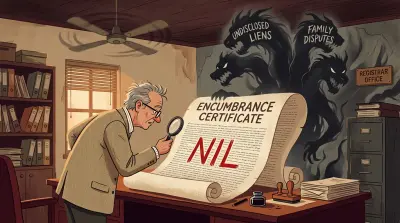
| Undisclosed EC Entries | A co-owner or third party can trigger charges that show up on the EC. Most NRIs pull an EC only at the point of sale, when it is already too late. | Medium - quarterly catch |
Each risk shares one characteristic: it is entirely invisible unless someone is actively watching.
What Good Monitoring Looks Like
Checking a portal once a year is a snapshot, not monitoring. Monitoring is about detecting change: whether something new has appeared on the Encumbrance Certificate, whether a mutation entry has been filed in Bhu Bharati, whether the boundary of your plot looks different from six months ago.
Three things make it meaningful.
Frequency. Annual checks catch annual problems. For vacant land or properties in dispute-adjacent areas, quarterly is the floor. The NRI Property Annual Checklist covers the full year-end routine.
Coverage. Checking only the municipal portal misses revenue record changes. Checking only the land records portal misses EC entries. All five risk dimensions need to be covered simultaneously.
Alerting. A check you must remember to do is a check you will eventually miss. Property compliance tracking works only when it reaches you automatically, without requiring a manual login.
The Self-Monitoring Toolkit
Most core records are now accessible online. Here is what each portal offers and where it stops.
| Portal | What You Can Check | Key Limitation |
|---|---|---|
| GHMC (Hyderabad) | Property tax status, outstanding dues | OTP sent to Indian SIM only; no arrear alerts |
| Bhu Bharati (Telangana) | Ownership record, mutation status | Manual check only; ~15% real-time update rate |
| Meebhoomi (Andhra Pradesh) | Pattadar Passbook, mutation status | Manual check only; Telugu-language interface |
| IGRS Telangana / AP | Encumbrance Certificate | Fee per download; no automatic alerts |
| eCourts | Case status | Requires a case number - no passive monitoring |
For state-specific portal guidance, the Telangana NRI property guide and Andhra Pradesh NRI property guide cover the procedures in detail.
Where Self-Monitoring Breaks Down for NRIs
Portal access was designed for residents. NRIs face friction at nearly every step.
OTP barriers. Most portals authenticate through OTPs sent to registered Indian mobile numbers. If your Indian SIM is inactive, those messages do not reach you. Many NRIs discover they cannot log in to check their own property status without first reactivating an Indian number.
No passive alerts exist. This is the central gap. No government portal will notify you when a new entry appears on your EC, a mutation is filed, a court case names your property, or your tax status moves from current to delinquent. Every check is pull-based. The system never reaches out to you.
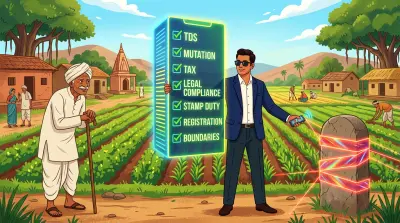
The 12-year encroachment clock. The Supreme Court, in Ravinder Kaur Grewal vs Manjit Kaur (2019), confirmed that adverse possession extinguishes the original owner’s title entirely after 12 years of open, hostile, continuous occupation: “possession must be adequate in continuity, in publicity, and in extent to show that their possession is adverse to the true owner.” Once those 12 years are up, there is no grace period. For NRIs, the issue is not ignorance of the law - it is that they cannot see the clock ticking from abroad. Understanding what to do once encroachment is discovered matters, but catching it before the clock starts is better.
Tax arrears are retroactive. The Delhi High Court, in Shubha Bhattacharya vs South Delhi Municipal Corporation (2024), dismissed a petition from buyers who argued they should not be liable for 17 years of arrears on a property they had owned for two. The court held that property tax is “the first charge” on the property and the municipality has no obligation to notify new owners of historical dues. The petitioners paid Rs 1,02,506. For NRIs selling, undiscovered arrears surface as a last-minute deduction. The full mechanics of property tax enforcement are worth understanding before assuming arrears can be left unaddressed.
Assetly’s Monitoring Layer
Assetly’s property monitoring covers all five risk dimensions passively, with no portal logins and no manual checks required, and extends to physical monitoring of the property itself.
Tax status. Tracking property tax payment status for linked properties and flagging overdue payments before interest accumulates.
Revenue record changes. Alerting when a mutation entry is filed in Bhu Bharati or Meebhoomi - catching unauthorised changes within days rather than at the point of a transaction.
EC monitoring. Periodic pulls from the IGRS portal, with alerts when a new entry appears. Most NRIs pull an EC only when selling. By then, an encumbrance that appeared months earlier has had time to become complicated. The encumbrance certificate guide covers what each entry type means.
Satellite boundary monitoring. Using satellite imagery and AI-based change detection, Assetly compares your registered property boundary at regular intervals and flags visual changes: new construction, cleared land, or structural encroachment. This catches physical encroachment before it becomes a legal claim. Satellite-based monitoring is already used by Indian defence authorities at scale. Assetly brings this to individual NRI property owners.
On-ground physical monitoring. Beyond satellite, Assetly offers CCTV, gate and boundary wall monitoring, so you can see who is on the property and whether its boundary is intact, in close to real time, without depending on a caretaker to tell you.
Court monitoring. Watching eCourts and IGRS for cases or caveats filed against your property, without requiring you to know a case number.
To see how monitoring works for your property, visit assetlyhq.com.
Related Reading
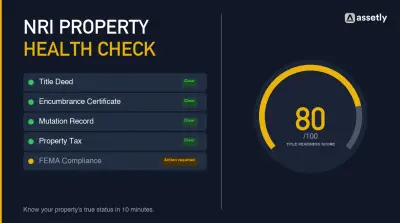
- The NRI Property Health Check - five-dimension diagnostic of current property status
- The NRI Property Annual Checklist - ten tasks covering the full annual compliance cycle
- How to Protect Your Land from Encroachment - what to do once encroachment is discovered
- Property Tax Arrears in India: What the Municipality Can Actually Do - the full enforcement ladder
Assetly is a property document management and monitoring platform for NRI and remote property owners. It organises your documents, monitors your property records, and alerts you when something needs attention. Learn more at assetlyhq.com.