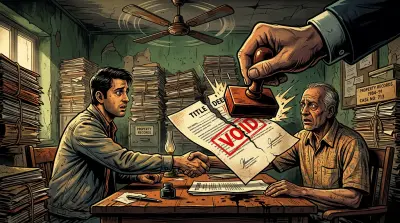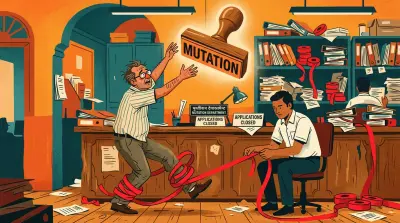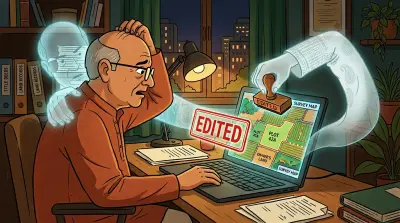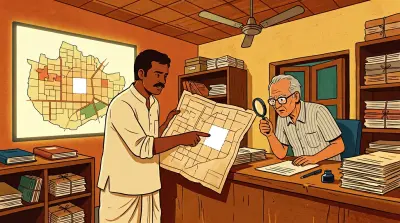
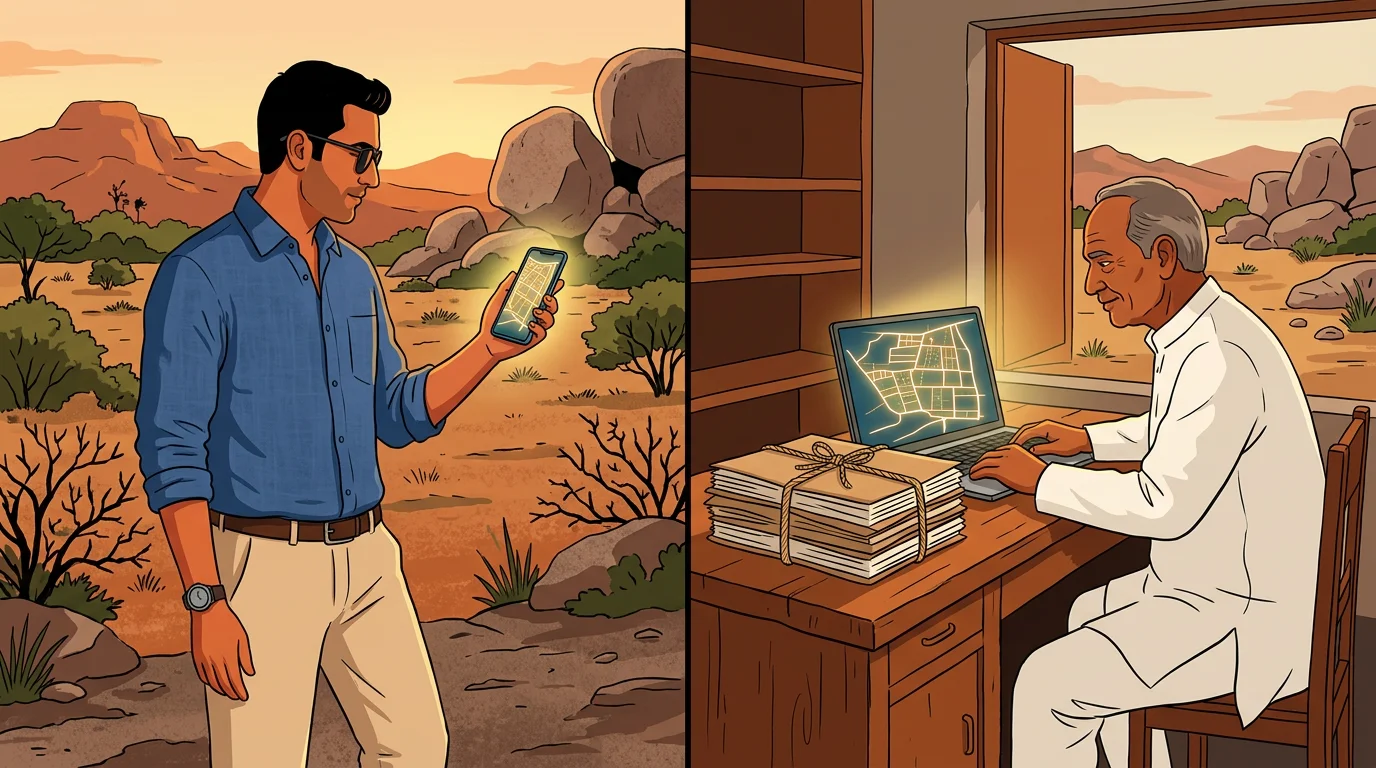

Telangana has been through more land records upheaval in the last five years than most Indian states see in a generation. The Dharani portal, launched in October 2020 as the state’s unified land records and registration system, was meant to be a revolution. It ended up being one of the most controversial property digitisation projects in the country, with 6.46 lakh pending grievances, incorrectly classified lands, and multiple High Court interventions.
For NRIs with property in Telangana, particularly in Hyderabad, this means the usual challenges of remote property management are compounded by a system that has undergone a complete overhaul. The state has replaced Dharani with a new portal called Bhu Bharati, backed by a dedicated Act of the legislature. Land records that existed under undivided Andhra Pradesh are still being reconciled. And Hyderabad’s overlapping municipal jurisdictions add another layer of complexity.
This guide covers what you need to know, what documents to keep, and what to watch out for. If you haven’t read it yet, our overview of India’s property dispute crisis provides essential background on why property ownership in India requires active management.
Why Telangana Property Needs Special Attention
Three factors set Telangana apart from other Indian states for property management.
First, the Dharani experiment and its fallout. In 2020, the then-BRS government launched the Dharani portal and simultaneously dissolved the authority of village-level revenue officers (VROs). All land records, mutations, and registrations were centralised on a single digital platform, with decision-making powers concentrated at the District Collector level. The intent was to eliminate corruption. The result was a system that created new problems faster than it solved old ones.
Second, the 2014 bifurcation. When Telangana was carved out of Andhra Pradesh, land records that had been maintained under the undivided state needed to be split, reconciled, and re-verified. More than a decade later, many of these records remain incomplete or disputed. Division of institutional assets worth over Rs 1.42 lakh crore is still unresolved between the two states.
Third, Hyderabad’s jurisdictional complexity. Property in and around Hyderabad falls under multiple authorities: GHMC, HMDA, gram panchayats, and cantonment boards, each with different approval requirements and record-keeping systems.
Key Documents Every Telangana Property Owner Needs
Depending on whether your property is agricultural land, a residential plot, or a flat, you will need different documents. Here is the core set.
For Agricultural Land
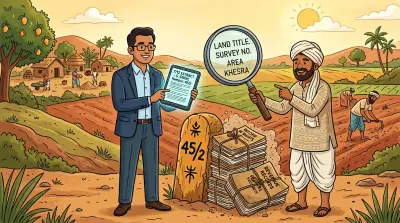
- Pahani (Adangal): The primary land record maintained by the Revenue Department. It contains ownership details, survey number, land extent, cultivation type, and crop information. Required for agricultural loans, subsidies, and legal disputes.
- Record of Rights (ROR 1B): Shows ownership history and transaction records for the land parcel. Essential for verifying title chains.
- e-Pattadar Passbook: The digitised ownership certificate now issued through the Bhu Bharati portal (formerly Dharani). This is the document that confirms you are the recorded owner.
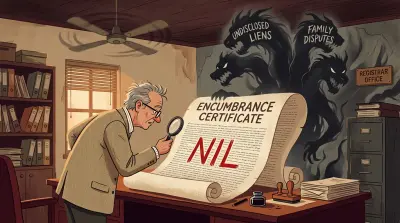
- Encumbrance Certificate (EC): Shows all financial and legal liabilities on the property, including mortgages, court attachments, and pending litigation. Available through IGRS Telangana for a 30-year search period.
For Urban Property (Plots, Flats, Houses)
- Registered Sale Deed: The primary proof of purchase, registered at the Sub-Registrar’s office.
- Encumbrance Certificate (EC): Same as above. Always get a fresh EC before any transaction.
- Property Tax Receipts: From GHMC (for Greater Hyderabad) or the local municipality. Keep receipts current; gaps in property tax payment can create complications during sale.
- Approved Building Plan / Layout Approval: From GHMC or HMDA, depending on location.
- Occupancy Certificate (OC): Confirms the building was constructed as per approved plans.
- RERA Registration: For apartments purchased from developers after 2017.
For Inherited Property (Additional Documents)
- Succession Certificate or Legal Heir Certificate
- Mutation Records showing transfer to the heir’s name
- Death Certificate of the previous owner
- Will (if one exists), preferably registered
The Dharani Portal: What Happened and What Comes Next
What Dharani Was Supposed to Do
The Dharani portal was designed to be a single-window system for all land-related transactions in Telangana: registrations, mutations, land record searches, encumbrance certificates, and more. It replaced the older system of manual record-keeping at the mandal and village level.
What Went Wrong
The problems were extensive. A Telangana High Court judge identified over 20 distinct issues with the portal, noting that “the idea behind introducing Dharani is to reduce human intervention… The irony is the same complaints are continuing.”
Specific problems included:
- Incorrect classifications: Privately owned patta lands were listed as “prohibited” or “assigned land,” blocking owners from selling or transferring their property.
- Missing co-ownership records: The system had no provision to register land in the name of multiple owners, a common scenario for inherited property.
- Data entry errors: Wrong survey numbers, missing sub-divisions, and mismatches between recorded and actual land measurements.
- Inaccessible correction process: The portal offered 33 different modules for corrections (TM-3, TM-33, etc.), each with a Rs 1,000 fee. Farmers and landowners often did not know which module to use, and lakhs of applications were rejected.
- Centralised decision-making: With all powers moved to District Collectors, there was no appellate mechanism. If a Collector rejected your application, there was no clear recourse.
- Data security concerns: The portal’s maintenance was outsourced to a private agency, raising questions about the safety of land records, Aadhaar details, and bank account information for millions of landowners.
When the Congress government took power in December 2023, the system had 2.45 lakh pending revision applications and over 1 lakh pending data correction requests.
Bhu Bharati: The Replacement
In April 2025, the Telangana government launched the Bhu Bharati portal as Dharani’s replacement, backed by the Telangana Bhu Bharati (Record of Rights in Land) Act, 2024 (Act No. 1 of 2025). The Act received the Governor’s assent on 3 January 2025, and the portal went operational on 15 April 2025, developed by NIC Telangana. It went statewide by June 2025.
Key improvements over Dharani:
- Simplified modules: Reduced from 33 modules to 6 transactional and 5 informational modules.
- Bhudhar numbers: Each land parcel gets a unique identification number - like Aadhaar for land - making it easier to track and verify ownership.
- Transparency: The “hidden” option that allowed land records to be concealed has been eliminated.
- Appellate structure: A two-tier appeals process (RDO, then District Collector) plus land tribunals with free legal aid.
- SMS notifications: Real-time SMS updates at every stage of a transaction.
- Bhu Mitra chatbot: An AI-powered assistant for portal guidance.
- Citizen dashboard: Land portfolios, Record of Rights, mutation status, encumbrance certificates, market values, village maps, and application tracking in one place.
- Pre-2014 transaction regularisation: A process for regularising informal transactions from before 2014.
First-year performance (April 2025 – January 2026): Over 6.17 lakh registration slot bookings, property registrations worth Rs 12,443 crore, and revenue of Rs 1,518 crore generated. The portal has received over 4.33 crore hits.
Integrated Bhu Bharati (April 2026): An upgraded version integrating survey data with registration on a single platform is being piloted from 2 April 2026 in five mandals: Kosgi (Narayanpet), Amangal (Ranga Reddy), Vatpally (Sangareddy), Kusumanchi (Khammam), and Aswaraopeta (Bhadradri Kothagudem). This pilot mandates survey map attachment for agricultural land registration and aims to clear pending Dharani-era grievances in these areas by June 2026.
Note on the deadline: Under the Bhu Bharati Act, landowners could file for Record of Rights (ROR) corrections within one year of the Act’s commencement. That window closed on 13 April 2026. If you have discrepancies in your land records, corrections now go through the Land Tribunal (Section 14) or the courts rather than the fast administrative form.
Post-Bifurcation Issues
The 2014 division of Andhra Pradesh created property record complications that persist today.
Record fragmentation. Land records that were maintained under the undivided state’s systems needed to be migrated, verified, and updated in Telangana’s new systems. Not all records made the transition cleanly. If your family owned property in what is now Telangana before 2014, verify that the records have been properly transferred and updated.
Institutional assets. The division of 91 institutions under Schedule IX of the AP Reorganisation Act (with assets of Rs 1.42 lakh crore) and 142 institutions under Schedule X (Rs 24,018 crore) has not been completed. While this does not directly affect individual property owners, it has created administrative bottlenecks in some districts.
Laws from undivided AP. The Supreme Court has confirmed that laws applicable to the undivided state continue to apply to both successor states. However, Telangana has been actively enacting its own property legislation (including the Dharani Act in 2020 and the Bhu Bharati Act in 2025), creating a layered legal framework that requires careful interpretation.
Hyderabad-Specific Considerations
If your property is in or around Hyderabad, you need to understand the distinction between the city’s two main planning authorities.
GHMC vs HMDA
GHMC (Greater Hyderabad Municipal Corporation) manages the area within city limits. It handles building permissions, occupancy certificates, property tax, and municipal services. If you own a flat or a house within GHMC limits, your property tax is paid to GHMC, and building approvals come from GHMC.
HMDA (Hyderabad Metropolitan Development Authority) covers the broader metropolitan region, including areas beyond GHMC limits. It handles layout approvals, venture permissions, and regional development planning. If you are buying a plot in the outskirts of Hyderabad, HMDA approval is what you need to verify.
Venture and Layout Approvals
A persistent issue in Hyderabad’s real estate market is unapproved ventures (layouts). Developers sometimes sell plots in layouts that lack HMDA approval, or that received only “tentative” approval that was never converted to final approval.
Recently, HMDA and GHMC paused approvals for 400-500 building and layout applications due to disputes over Full Tank Level (FTL) boundaries and buffer zones around water bodies. Officials were suspended and cases filed for issuing faulty building permissions.
What to check: Before buying any plot in the Hyderabad metropolitan area, verify the layout approval status on the HMDA public search portal. Check that the approval is “final,” not “tentative.”
Stamp Duty and Registration
Telangana’s registration process is handled through the IGRS portal. Current rates are as follows.
Urban Properties (Municipal/Corporation Limits)
| Component | Rate |
|---|---|
| Stamp Duty | 4.0% |
| Transfer Duty (Cess) | 1.5% |
| Registration Fee | 0.5% |
| Total | 6.0% |
Rural Properties (Gram Panchayat Areas)
| Component | Rate |
|---|---|
| Stamp Duty | 5.5% |
| Registration Fee | 2.0% |
| Total | 7.5% |
Important notes:
- Stamp duty is calculated on the higher of the agreement value or the government circle rate (market value). Telangana revised these values statewide on 5 June 2026, its first revision since April 2025, with the median village up around 75% and some pockets rising far more. See our breakdown of the 2026 revision for what changed and where.
- Telangana does not offer gender-based concessions. Men and women pay the same rates.
- E-stamps are valid for 180 days from the date of issue.
Power of Attorney for NRIs
If you cannot be present for registration, you will need a Power of Attorney (PoA). For NRIs:
- The PoA must be notarised in your country of residence and attested by the Indian Embassy or Consulate.
- If given to a family member, the stamp duty on the PoA is Rs 1,000. If given to a non-family member, it is 1% of the property’s market value.
- The Supreme Court has ruled that a PoA for selling immovable property must be registered in the jurisdiction where the property is situated.
- Be aware that Telangana has restricted the use of General Power of Attorney (GPA) for property transactions to curb fraud. Use a Special Power of Attorney (SPA) wherever possible.
What to Do Today
If you own property in Telangana and live abroad, here is a practical checklist.
-
Verify your land records. Log into the Bhu Bharati portal and check that your ownership details, survey numbers, and land classification are correct. Download and save copies of your Pahani, ROR 1B, and e-Pattadar passbook. If your records still show Dharani-era data, verify that they have been accurately migrated.
-
Get a fresh Encumbrance Certificate. Download your EC from IGRS Telangana for the full 30-year search period. Check for any unexpected entries: mortgages, court orders, or third-party claims.
-
Confirm municipal compliance. If your property is in Hyderabad, check that your GHMC property tax is current. Gaps in payment create problems during sale or transfer. For plots, verify HMDA layout approval status.
-
Check the prohibited properties list. Search your survey number on Bhu Bharati to confirm your property is not listed as “prohibited” or “assigned.” If it is, first identify the Section 22A clause and check the official list, then use our step-by-step Telangana 22A grievance guide to prepare the reason, supporting records, and Meeseva eKYC. A portal application is not an automatic deletion, and court-case, government-land, institutional, and notified entries can require different orders.
-
Organise your documents digitally. Collect your sale deed, EC, tax receipts, approved plans, mutation records, and any court orders into a single, accessible repository. For NRIs managing Telangana property from abroad, Assetly provides a purpose-built platform to store, organise, and track all property documents in one place.
-
Review your Power of Attorney. If you have an existing GPA, check whether it needs to be updated or converted to an SPA under Telangana’s current rules. Ensure it is registered in the correct jurisdiction.
-
Check your Bhudhar number. Verify that your land parcel has been assigned a Bhudhar number under Bhu Bharati. This unique identifier will be essential for all future transactions.
Telangana’s property records system has completed a full transition from Dharani to Bhu Bharati. The problems with Dharani are well-documented, and while Bhu Bharati is a significant improvement, the migration of records from one system to another means errors can still exist. For NRIs, this is not a time to assume your records are in order. Verify everything, keep your documents current, and if you find an error, pursue it through the Land Tribunal now that the fast ROR correction window has closed.
If a parcel or subdivision looks completely absent rather than merely incorrect, start with Survey Number Missing in Telangana Master Plan? What It Usually Means before you assume the title itself is gone.