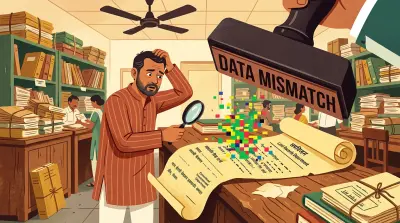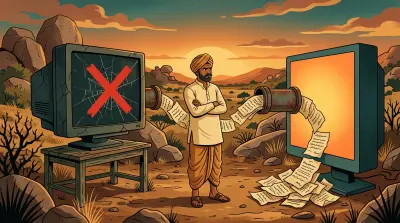
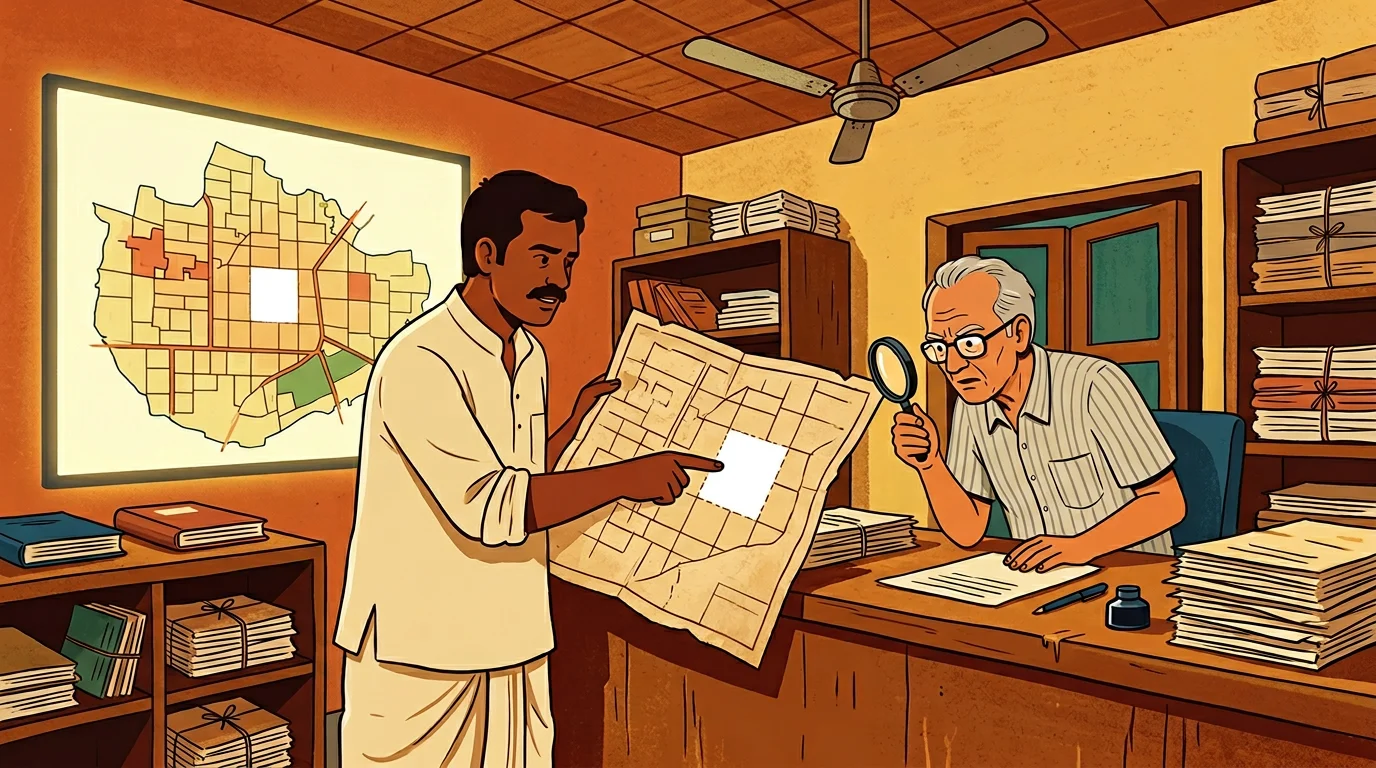

You search your survey number on a Telangana planning map and it is not there. Or Bhu Bharati shows your village, your khata, even your old pattadar passbook details, but the survey number you expected is missing. Somebody in the family says this means the land is “gone from the master plan.” Somebody else says the title is finished.
That is usually the wrong conclusion.
In Telangana, a “missing survey number” can point to several very different problems: a data gap in Bhu Bharati, a subdivision that never migrated cleanly from old records, a village map or Sethwar problem, or a planning-layer mismatch where people are checking the wrong map for the question they actually have.
The right approach is diagnostic, not dramatic. Work out which system is missing the parcel, then fix that system.
What People Usually Mean by “Missing in the Master Plan”
Property owners often use “master plan” as a catch-all phrase. In practice, they may be referring to one of three different things.
1. The planning map does not show the parcel clearly. This is usually an HMDA, DTCP, municipal, or layout-planning issue. Planning maps are about zoning, road reservations, land use, and development controls. They are not the same thing as your Record of Rights.
2. The survey number or subdivision is missing in Bhu Bharati. This is a land-record problem. It affects mutation, passbook issuance, and future transactions.
3. The underlying village map or Sethwar records are incomplete or inconsistent. This is the foundational problem. If the base cadastral records are weak, both revenue and planning systems can look broken from the citizen’s side.
If you do not separate those three questions, you can spend weeks trying to correct the wrong department’s records.
What the Telangana High Court Already Noticed
This is not a niche complaint. The Telangana High Court has already recorded that the old Dharani system repeatedly failed on exactly these issues.
In a batch of consolidated writ petitions decided by the Telangana High Court in 2023 - W.P. No. 39609/2022 (Y. Jaihind Reddy) and connected cases - the Court listed recurring citizen problems with Dharani and noted that:
“There is no option to include missing survey numbers and wrong entries”
The same judgment also noted there was no option to obtain patta from the legal heirs of a deceased vendor. That matters because many “missing survey number” disputes are not just mapping problems. They are inheritance-plus-record problems.
The Court’s broader point was equally important:
“These are the issues which arise before this Court on a regular basis.”
That tells you something practical. If your survey number is missing, you are not facing a bizarre one-off. You are dealing with a known category of land-record friction in Telangana.
One thing worth ruling out early: check whether the survey number appears on Telangana’s Section 22A prohibited-property registers. Government, endowment, and assigned land are recorded and handled differently, which can explain why a parcel behaves unexpectedly on the planning map.
Bhu Bharati Now Has a Direct Route for Missing Survey Numbers
This is one reason the query matters right now. Bhu Bharati is not just a renamed portal. It has specific workflows that were missing or harder to use earlier.
The official Bhu Bharati FAQ now says that if your survey number is missing:
“The citizen has to apply in Modification Request Application module under Missing Survey number/ Sub division Number option”
And if the pattadar is deceased, the FAQ provides a separate route for that scenario as well.
This is a meaningful change. It means the first question is no longer “can the portal handle this at all?” The first question is whether you have the right supporting records to prove what should be there.
The Real Problem Is Usually the Supporting Record Chain
A missing survey number is rarely solved by a screenshot alone. You need documents that tie the parcel back to the older record system.
The key records are usually:
- the old Pattadar Passbook (PPB)
- the registered sale deed or inheritance document
- the older Pahani/1B/ROR extracts
- any Sethwar or village map references
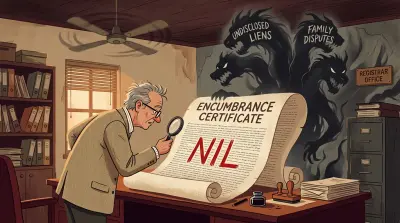
- a fresh Encumbrance Certificate to confirm the transaction trail
If these documents line up, the issue is usually administrative and curable. If they do not line up, the problem may be deeper: wrong extent, wrong subdivision, old family partition never reflected in the records, or land that was treated one way in registration and another way in revenue records.
That is why a missing survey number query is often really a title-verification query in disguise. Our guides to encumbrance certificates and mutation records matter here because they help you test whether the record chain is coherent before you begin the correction process.
What to Check First, in Order
Do these checks in sequence. It saves time.
1. Check Bhu Bharati’s exact issue
Do not stop at “not found.” Work out whether the problem is:
- the survey number is missing entirely
- the survey number exists but the subdivision is missing
- the extent is wrong
- the pattadar name is wrong
- the land is mapped under the wrong status
The Bhu Bharati FAQ separates these issues into different modules. If you file the wrong one, you lose time.
2. Compare against your last clean paper record
Your best comparison point is usually the last uncontested record you have:
- old PPB
- sale deed schedule
- certified copy from the Sub-Registrar
- older Pahani or 1B extract
If the paper chain is clean and the portal is not, that is a correction case. If the paper chain itself is inconsistent, you may need a lawyer or surveyor before you touch the portal.
3. Check whether this is actually a succession problem
This gets missed often. If the land belonged to a parent or grandparent, and no clean succession or mutation ever happened, the “missing survey number” may only be the visible symptom. The real problem is that the ownership transition was never properly captured.
The Bhu Bharati FAQ says:
“All legal heirs of deceased Pattadar have to apply in Application for succession including assigned lands”
If the pattadar has died and the family is trying to fix the land records years later, you may need both a succession step and a missing-survey-number correction.
4. Pull a fresh EC
If the survey number appears differently in old registered documents than it does in current revenue records, a fresh Encumbrance Certificate helps you see the transaction trail before you file anything. You want to know whether the registration side and the revenue side are diverging, and if so, since when.
5. Only then check the planning layer
Once you understand the revenue record position, then check the planning map or layout layer. If the parcel exists in revenue records but is not obvious on the planning map, that may be a zoning or mapping question, not a title question. If you are buying a plot and want to verify whether the layout itself is HMDA or DTCP approved, see how to check if a layout approval is valid in India.
What If the Owner Is Alive?
If the pattadar is alive and the issue is simply that the survey number or subdivision is missing from Bhu Bharati, this is the cleaner scenario.
Use the Modification Request Application route for missing survey numbers or extent corrections. Keep ready:
- old PPB
- Aadhaar or identity proof
- registered sale deed
- supporting revenue extracts
- any prior correction orders
The key is to file the issue narrowly. Do not ask the system to solve title, inheritance, extent, and missing subdivision all in one vague request. Identify the exact field that is wrong.
What If the Pattadar Has Died?
This is where many remote-owner families lose months.
If the pattadar is deceased, you usually need some combination of:
- death certificate
- family member certificate
- joint agreement of legal heirs
- old PPB
- succession or inheritance supporting documents
The official Bhu Bharati FAQ explicitly calls for the death certificate and family member certificate for succession. That is a clue about how the state views the issue: before it is willing to restore or issue a passbook, it wants the family relationship layer cleaned up.
For NRIs, this is the point at which the file often stalls. One sibling is abroad, another has partial documents, and nobody has the original PPB. If that sounds familiar, read our guide on why NRI property gets stuck in succession disputes. The land-record problem is often only the second problem.
When the Problem Is Bigger Than the Portal
Sometimes a portal correction request is not enough.
You should escalate beyond a simple online application if:
- the sale deed and old revenue records describe different land
- the village map or Sethwar itself is unclear
- the land is shown as government, assigned, or prohibited
- multiple heirs are contesting the same parcel
- part of the survey number was sold long ago but never subdivided properly
At that point, you are closer to a title-and-survey issue than a data-entry issue. The safer route is to build the full document stack first and then proceed with either a lawyer-led representation or a correction backed by supporting records.
What NRIs Should Do Differently
If you are abroad, the main risk is not ignorance of the portal. It is fragmented records.
Do four things immediately:
- Download and save the current Bhu Bharati result, even if it is wrong.
- Gather the old PPB, sale deed, and any inheritance documents into one file.
- Pull a fresh EC so you can compare the registration trail with the revenue trail.
- Give a limited-scope PoA to one person who can handle only the correction process, not broad sale powers.
Most families do these in the reverse order. They give someone a power of attorney first, then start hunting for documents. That is how record mistakes turn into unnecessary trust problems.
The Practical Rule
If a survey number is “missing” in Telangana, do not ask only one question. Ask three:
- Is it missing from the planning layer?
- Is it missing from the revenue record?
- Is it missing because the family ownership transition was never completed?
Those are different problems with different fixes.
What makes this query dangerous is that people often jump straight from “not visible on a map” to “title is gone.” Telangana’s own court record and Bhu Bharati’s own FAQ suggest a more grounded conclusion: missing survey numbers are a recognised, recurring record-management problem, and the solution usually begins with document comparison, not panic.
Related Reading
- Your Telangana Land Records May Have Errors. Here’s How to Check and Correct Them. - the step-by-step correction guide for Dharani-era errors and Bhu Bharati mismatches.
- Managing Property in Telangana: Bhu Bharati, Land Records, and What NRIs Must Know - the broader Telangana guide covering portals, approvals, and remote-owner risks.
- Dharani to Bhu Bharati: What Changed and What Property Owners Must Know - why old data problems still surface in the new system.
- Mutation Record: The Property Document Most People Forget - why revenue records matter even though they do not create title.
- What Is an Encumbrance Certificate? (And What It Does Not Tell You) - how to read the registration trail before you file a correction.
- HMDA Master Plan 2031: There Are Five Plans, and Only One Governs Your Plot - why the sheet you opened may not be the one your survey number sits in.
Assetly is a property document management platform that helps Indian property owners organise, verify, and track their property documents digitally. Learn more.