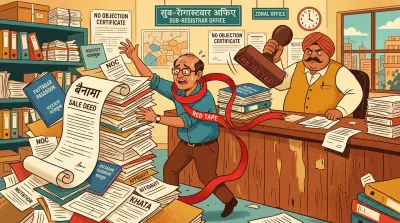


Property mutation is the administrative process of updating land, municipal or revenue records after a recorded interest changes through a sale, inheritance, gift, partition or court order. It helps authorities collect revenue and identify the recorded holder. It does not, by itself, create or extinguish legal title.
For mutation triggered by a death, start with our guide to choosing the correct inheritance documents so a legal heir certificate, succession certificate and mutation are not treated as interchangeable.
Mutation, khata and patta compared
These words are often used as if they mean the same document. They do not. Mutation is the change process; khata and patta are names used for particular accounts or land records in some states and local bodies.
| Term | What it is | Where it is commonly used | What it does not prove |
|---|---|---|---|
| Mutation | The administrative process of changing the recorded holder after a sale, gift, inheritance, partition or order | Land, revenue and municipal systems across India | Legal title by itself |
| Khata transfer | A change to a municipal or revenue account, especially in Karnataka | BBMP and other Karnataka local-body systems | That every title or planning issue is clear |
| Patta transfer | A change to the state land-revenue record for a parcel | Commonly used in Tamil Nadu and Andhra Pradesh | A complete registered title chain |
| Jamabandi update | The accepted change appearing in a periodic record of rights | Several northern states | Ownership where title is disputed |
Start with the event that changed the property interest, such as the registered sale deed, gift deed, succession document or court order. Then identify the authority that maintains the record for that specific property. A familiar state label is not enough if the property is actually governed by a municipal account or another revenue system.
In October 2019, the Bihar government amended its registration rules to require proof of mutation before any property sale could be registered. No mutation in the revenue records, no registration of your sale deed. Several landowners challenged the rules, arguing they made legitimate property transfers impossible, especially since Bihar’s land surveys were incomplete and many jamabandis still listed ancestors as owners.
The case went all the way to the Supreme Court. In Samiullah v. State of Bihar (2025), the Court struck down Bihar’s rules, holding that “interlinking and restraining registration till the jamabandi…would be illegal, as it has a direct impact on the right and freedom to purchase and sell property.” The Court made clear that mutation is an administrative function, not a prerequisite for ownership.
But here is the thing. The landowners still spent years in court over what should have been routine property transfers. All because of a gap in revenue records.
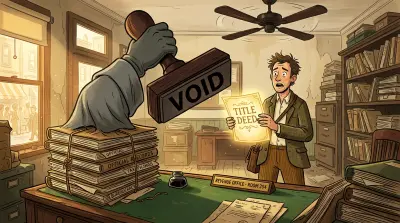
This is the story of mutation: a document that does not give you ownership, cannot take it away, and somehow still manages to derail property transactions across India when people ignore it.
What Mutation Actually Is
Let us start with the basics, because the terminology alone is enough to confuse anyone.
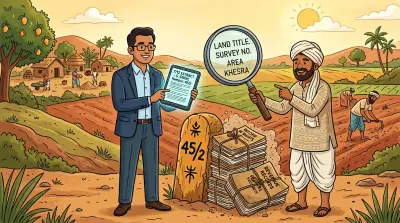
When you buy a property in India, the registered sale deed transfers ownership to you. That is the legal part. But the government also maintains separate revenue records, essentially ledgers that track who owns which piece of land for the purpose of collecting property tax and land revenue. Mutation is the process of updating those revenue records to show your name as the new owner.
Think of it like changing your name on utility bills after you move into a new house. The house is already yours. You already have the keys and the deed. But if the electricity bill still goes to the previous owner, things get confusing fast. Mutation is the property equivalent of updating your address.
Different states call it different things. In Karnataka, the revenue record is called a khata, and mutation is a khata transfer. In Tamil Nadu and Andhra Pradesh, it is a patta transfer. In Maharashtra, you will hear about mutations in the 7/12 extract (for rural land) or the property card (for urban property). In Punjab and Haryana, it is intkal or dakhil kharij. In Telangana, the entire process runs through the Bhu Bharati portal (which replaced the now-discontinued Dharani portal) and results in an updated pahani (also called a passbook).
The names change. The concept does not. You are updating a government ledger to show that property has changed hands.
| Term | Where you commonly encounter it | What it usually means |
|---|---|---|
| Mutation | Across India | The process of changing the recorded holder after a transfer or succession |
| Khata transfer | Karnataka and some municipal systems | Updating the municipal or revenue account into the new holder’s name |
| Patta transfer | Tamil Nadu and Andhra Pradesh | Updating the state revenue record for the parcel |
| Intkal / dakhil kharij | Punjab, Haryana, Uttar Pradesh, Bihar and nearby systems | Entry of the change in land records after the supporting event is examined |
| Jamabandi update | Several northern states | Carrying the accepted change into the periodic record of rights |
| 7/12 mutation | Maharashtra | Recording a change that is reflected in rural land records such as the 7/12 extract |
The labels overlap, but they are not nationally standardised. Always check which authority maintains the record for your specific property.
Mutation vs Registration: Why the Confusion?
This is where most people trip up. They assume that registering a sale deed automatically updates the revenue records. It does not. Registration and mutation are two entirely separate processes, handled by two entirely different government departments.
Here is the clearest way to think about it:
| Registration | Mutation | |
|---|---|---|
| What it does | Transfers legal ownership | Updates revenue records |
| Legal authority | Registration Act, 1908; Transfer of Property Act, 1882 | State-specific revenue laws |
| Handled by | Sub-Registrar’s office | Revenue department (Tehsildar, Talathi, VAO, or online portal) |
| Mandatory? | Yes, for properties over Rs 100 | Not legally mandatory, but practically essential |
| Necessary for valid transfer? | Yes | No |
| Fees | Stamp duty + registration fee (typically 5-9% of property value) | Nominal (Rs 25 to Rs 20,000 depending on the state and property value) |
| Timeline | Same day (if documents are in order) | Days to weeks, depending on the state |
The Supreme Court has stated this distinction repeatedly. In Sawarni v. Inder Kaur (1996), the Court held: “Mutation of a property in the revenue record does not create or extinguish title nor has it any presumptive value on title. It only enables the person in whose favour mutation is ordered to pay the land revenue in question.”
And in Balwant Singh v. Daulat Singh (1997), the same principle was reaffirmed: mutation in revenue records neither creates nor extinguishes title and is relevant only for the purpose of collecting land revenue.
So if mutation does not create ownership, why should you care?
Why Mutation Matters (Even Though It Does Not Create Title)
Because the gap between legal theory and daily reality in India is enormous.
Property tax goes to the wrong person. Until mutation is done, the municipal corporation or panchayat continues sending tax bills to the previous owner. If the previous owner ignores them (why wouldn’t they, it is no longer their property), arrears pile up. Interest accrues. And when you finally try to sell, you discover a tax liability attached to your property that you did not even know about.
Banks refuse to lend against it. Try getting a home loan against a property where the revenue records show someone else’s name. Banks check mutation records as part of their due diligence. Unmutated property is a red flag, and most banks will simply refuse to process the loan application until the records are updated.
Future buyers get cold feet. When you eventually sell, the buyer’s lawyer will pull the revenue records. If your name is not there, questions arise. Is the chain of ownership clean? Was there a dispute? Why was mutation never done? Even if you can explain it, the doubt slows down or kills the transaction.
Government compensation goes elsewhere. This is perhaps the most alarming consequence. If your land is acquired by the government for a road, a highway, or a public project, the compensation is often paid to whoever’s name appears in the revenue records. If mutation was never done, the compensation may go to the previous owner. You would have to fight for your own money in court.
Municipal services become complicated. Building permits, water connections, electricity connections: many municipal services require proof that you are the recorded owner of the property. Without mutation, you are navigating bureaucracy with one hand tied behind your back.
The pattern across India’s property dispute crisis is consistent: people who register their purchase but skip mutation end up spending far more time and money untangling the consequences than the mutation process itself would have taken.
When You Need Mutation
Mutation is not just for property purchases. You need it whenever the ownership of a property changes, regardless of the reason.
After purchase. The most common scenario. You buy property, register the sale deed, and then apply for mutation to update the revenue records in your name.
After inheritance. When a property owner passes away, their heirs need to get the property mutated in their names. If you plan to sell after inheriting, our guide to selling inherited property covers the full process. This is the one people forget most often. Families continue living in inherited property for years, sometimes decades, without updating the revenue records. By the time they try to sell or divide the property, the records are hopelessly outdated and the mutation process becomes far more complicated.
After a gift. If property is transferred through a registered gift deed, the recipient needs to apply for mutation.
After partition. When joint family property is divided, each co-owner needs mutation for their respective share.
After a court decree. If a court orders property to be transferred to someone (as part of a civil suit, a divorce settlement, or any other proceeding), mutation needs to follow.
Documents You Will Need
The required documents vary depending on how the property came to you. Here is a quick reference:
| Scenario | Key Documents |
|---|---|
| Purchase | Registered sale deed, latest property tax receipts, identity proof, application form with court fee stamp, indemnity bond on stamp paper |
| Inheritance | Death certificate, legal heir certificate or succession certificate, copy of the will (if any), NOC from other heirs, property tax receipts, identity proof |
| Gift | Registered gift deed, identity proof, property tax receipts |
| Partition | Registered partition deed or family settlement, identity proof, property tax receipts |
| Court decree | Certified copy of the court order, identity proof, property tax receipts |
Some states require additional documents. An affidavit declaring the legitimacy of the transfer is common. If you are applying through a Power of Attorney holder, you will need the original or attested copy of the POA as well. Always check with the local revenue office or the state’s online portal for the exact list before you start.
State-by-State Guide: How to Get Mutation Done
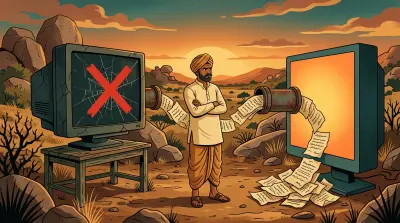
This is where things get genuinely different from one state to another. India does not have a single, unified system for land records. Each state runs its own revenue department, its own land record portal, and its own mutation process. Some states have gone fully digital. Others still require you to visit a revenue office in person and deal with a patwari.
Telangana: Bhu Bharati (formerly Dharani)
For an apartment’s municipal property-tax account, use the responsible municipal service. The checklist after buying a Hyderabad flat separates municipal mutation from land-revenue records, electricity accounts and association updates, and explains why an initiated mutation is not yet a completed one.
The original Dharani portal has been replaced by Bhu Bharati, the current starting point for Telangana agricultural land-record and mutation tasks. Some registered transactions may feed into an integrated workflow, but do not assume the record has changed merely because a deed was registered. Check the current Bhu Bharati entry, save a dated copy and follow the official correction or mutation route if the holder, survey number, extent or classification has not updated.
The result is a digital passbook (pahani) that reflects the current ownership, tied to a unique Bhudhaar ID for each land parcel. You can check your land records online anytime.
That said, the system is not without its problems. There have been cases of land record tampering even within the digital system, so periodic verification of your records is still important.
Portal: bhubharati.telangana.gov.in Fee and timeline: Check the live service for the transaction and case type; a disputed or correction case does not follow the same path as a routine registered transfer.
Andhra Pradesh: Meebhoomi
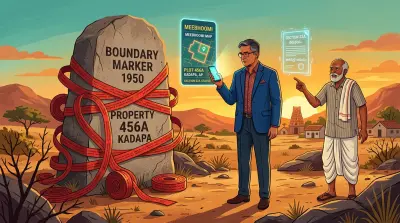
Andhra Pradesh uses the Meebhoomi portal for land records. For purchase transactions, AP now has an auto-mutation system: once a sale deed is registered, mutation is triggered automatically and typically completes within about 15 days without a separate application. For inheritance, gift, and other non-sale transfers, you submit documents through a MeeSeva centre or online, pay the mutation fee, and wait for the Tahsildar to process the transfer.
After approval, you get an updated pattadar passbook with your name in the revenue records. You can track your application status online through the Meebhoomi portal.
Portal: meebhoomi.ap.gov.in (records); ap.meeseva.gov.in (applications) Fee: 0.5% of property value (minimum Rs 1,000, maximum Rs 20,000) Timeline: 15 to 30 days (faster for auto-mutation after purchase)
Karnataka: Bhoomi
Karnataka’s Bhoomi portal was one of India’s earliest digital land record systems, launched in 2000. For rural land, you can check your Record of Rights, Tenancy and Crops (RTC) online at the Bhoomi portal. For urban property (BBMP area), the khata transfer process is handled through the BBMP portal.
Mutation applications for agricultural land go through the Taluk office, while urban khata transfers go through the respective municipal body. Karnataka has integrated some of its registration and revenue data, so mutation is relatively faster here compared to states with fully manual systems.
Portal: landrecords.karnataka.gov.in (rural); bbmp.gov.in (Bangalore urban) Fee: Rs 25 to Rs 100 (rural); varies for urban khata transfer Timeline: 15 to 30 days
Maharashtra: Talathi and Mahabhulekh
Maharashtra’s land records are maintained through the Mahabhulekh portal. For rural land, the mutation process involves applying through the talathi (village-level revenue officer) and submitting your registered sale deed, 7/12 extract, and other documents. For urban property, mutation goes through the municipal corporation.
Maharashtra has introduced e-mutation, which allows online application. You can register on the portal, fill in property details, upload scanned documents, and pay fees online (Rs 25 to Rs 100). The process still requires verification by the talathi before the record is updated.
Portal: bhulekh.mahabhumi.gov.in Fee: Rs 25 to Rs 100 (online); Rs 200 to Rs 1,000 (urban, varies by municipal body) Timeline: 15 to 30 days
Punjab and Haryana: Jamabandi Portal
In Punjab and Haryana, mutation is called intkal or dakhil kharij. The process involves collecting Form VII from the mutation counter or an Atal Seva Kendra, attaching photocopies of the sale deed, jamabandi (record of rights), and identity proof, and submitting with a court fee stamp of Rs 250 plus Rs 50 as service charges.
The patwari then conducts a field inspection, checks physical boundaries, and obtains signatures from neighbours. A 7-day notice period follows for objections. If there are none, the Circle Revenue Officer digitally signs the dakhil kharij order.
You can track mutation status online through the Jamabandi portal.
Portal: jamabandi.nic.in (Haryana); jamabandi.punjab.gov.in (Punjab) Fee: Rs 600 (Punjab, revised in 2020); Rs 250 plus Rs 50 service charges (Haryana) Timeline: 5 to 30 days
Tamil Nadu: e-Services Portal
Tamil Nadu uses the term patta transfer for mutation. You can apply online through the Tamil Nadu e-Services portal or at a Common Service Centre (CSC). The process involves submitting your sale deed, encumbrance certificate, original patta, identity proof, and paying fees of Rs 100 to Rs 300.
Applications through CSCs cost Rs 60 per application. You can track your patta transfer status online using the application ID provided at submission.
Portal: eservices.tn.gov.in Fee: Rs 100 to Rs 300 (online); Rs 60 (through CSC) Timeline: 15 to 30 working days
Common Mistakes (and How to Avoid Them)
Thinking Registration Is Enough
This is the biggest one. You register your sale deed, feel a sense of accomplishment, and assume everything is taken care of. It is not. Registration transfers ownership. Mutation updates the government’s records. They are two separate steps, and skipping the second one will cause problems that only grow with time.
Not Following Up
You submit your mutation application and then… forget about it. Weeks turn into months. In states with manual processes, applications can sit in a pile unless someone follows up. Check the status regularly, either online or at the revenue office. If there is a delay, file an RTI application to find out why.
Ignoring Inherited Property
This is especially common in families where the parents owned property and the children have moved to different cities or countries. The parents pass away. Everyone knows the property exists. Nobody gets around to mutation. Years later, when someone tries to sell or take a loan against the property, the revenue records still show the deceased owner’s name, and now you need death certificates, legal heir certificates, NOCs from all siblings, and possibly a succession certificate from court. What should have been straightforward becomes a project.
Patwari and Revenue Officer Fraud
In states where the mutation process still runs through patwaris and village-level revenue officers, there is a real risk of manipulation. Fraudulent mutations, where someone’s name is entered into revenue records without any legitimate transfer, are not uncommon. Cases from across India show patwaris processing mutations based on forged documents, concealing ongoing litigation to enable fraudulent sales, or simply demanding bribes to process legitimate applications.
The Anti-Corruption Bureau in Jammu and Kashmir has registered multiple cases in recent years against patwaris for illegal mutation of land records. In one case, a patwari processed a mutation when he was not even posted in that jurisdiction.
How do you protect yourself? Check your revenue records periodically. If you own land in a state with an online portal, log in once a year and verify that the records still show your name. If anything looks wrong, act immediately. File a complaint with the Tehsildar, the District Collector, or the state revenue department’s grievance portal.
For NRIs: Getting Mutation Done from Abroad
If you are an NRI who has inherited property or purchased property in India, mutation adds an extra layer of complexity because you cannot walk into a revenue office yourself.
Here is how to handle it:
Execute a Power of Attorney. You can give a trusted family member, friend, or lawyer a Power of Attorney to handle the mutation process on your behalf. The POA needs to be signed in the presence of a notary in your country of residence, attested by the Indian Embassy or Consulate (or apostilled if you are in a Hague Convention country), and then sent to India for registration with the local Sub-Registrar within three months of arrival. Make sure the POA specifically authorises the holder to apply for and complete mutation proceedings.
Use online portals where available. States like Telangana, Andhra Pradesh, Karnataka, Maharashtra, and Tamil Nadu have online application systems. While some steps still require physical presence (which your POA holder handles), you can at least track the status of your application remotely.
Keep digital copies of everything. Your registered sale deed, death certificates (if inheriting), legal heir certificates, previous mutation records, property tax receipts: have scanned copies of all of these before starting the process. Platforms like Assetly can help you organise and track your property documents digitally, so you are not scrambling for paperwork when your POA holder needs a document urgently.
Follow up actively. Do not assume your POA holder is on top of it. Set reminders to check the status every week or two. If the application is stuck, an RTI application can sometimes move things along.
The biggest risk for NRIs is delay. When you are not physically present, it is easy for mutation applications to languish. The earlier you start the process after acquiring property, the simpler it will be.
The Bottom Line
Mutation is one of those things that sounds unimportant until it is not. It does not give you ownership. It does not take ownership away. Courts have said this over and over. But in the practical reality of how property works in India, from tax collection to bank loans to government acquisition, your name in the revenue records matters.
The process is not complicated. The fees are minimal. Most states now have online portals that make it faster than ever. The only real obstacle is inertia, the very human tendency to put off an administrative task that does not feel urgent until the consequences catch up with you.
Do not be the person who discovers mutation twenty years too late, in a government office, trying to explain why the revenue records still show your grandfather’s name.
Get it done.
Assetly is a property document management platform that helps Indian property owners, especially NRIs, organise, verify, and track their property documents digitally. Learn more.