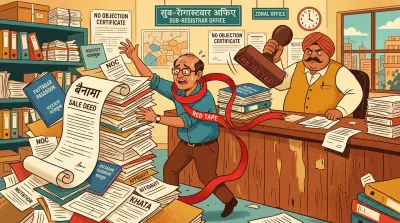


Your father bought a flat in Pune in 2003 for Rs 18 lakh. He passed away in 2024. You inherited the flat. The market value is now Rs 1.2 crore.
Here is the question nobody warns you about: when you sell that flat, what is your cost of acquisition for tax purposes?
Not Rs 1.2 crore (the value when you inherited it). Not even the fair market value on the date of death. It is Rs 18 lakh. The price your father originally paid, over two decades ago.
That means your taxable capital gain is roughly Rs 1 crore. At 12.5% (the current long-term capital gains rate), you owe about Rs 12.5 lakh in tax, plus surcharge and cess. If you are an NRI, the buyer will deduct nearly Rs 18 lakh as TDS before you see a single rupee.
This surprises people because India has no inheritance tax. You paid nothing to inherit the flat. Zero. The tax bill only shows up when you decide to sell. And if you do not understand the rules before listing the property, you will almost certainly overpay, miss critical documents, or run into legal roadblocks that could have been avoided.
This guide walks through the entire process: the tax maths, the legal steps, the documents you need, and the mistakes that trip people up.
The Tax Arithmetic: Why Inherited Property Is Different
India abolished the estate duty in 1985. So inheriting property is tax-free. But the moment you sell it, the Income Tax Act treats you as if you are the original buyer. This is not a metaphor. The law literally substitutes you into the previous owner’s shoes.
Cost of Acquisition: Section 49(1)
Under Section 49(1) of the Income Tax Act, when you inherit property (through a will, inheritance, or succession), your cost of acquisition is deemed to be the cost at which the previous owner acquired it.
The “previous owner” is defined as the last person who actually purchased the property (as opposed to inheriting it themselves). So if your grandmother bought a house in 1985, your mother inherited it in 2010, and you inherited it from your mother in 2025, your cost of acquisition goes all the way back to your grandmother’s 1985 purchase price. Not your mother’s. Not the market value in 2010 or 2025. The original purchase price.
This matters enormously. A property bought for Rs 5 lakh in 1990 and sold for Rs 2 crore in 2026 has a taxable gain of Rs 1.95 crore. That is a much bigger number than most people expect.
Holding Period: It Includes the Previous Owner’s Time
Here is the silver lining. Under Explanation 1(i)(b) to Section 2(42A), the holding period for inherited property includes the time the previous owner held it. So if your father bought the property in 2003 and you sell it in 2026, your holding period is 23 years, not the 2 years since you inherited it.
Since the threshold for long-term capital assets is 24 months for immovable property, inherited property almost always qualifies as long-term. This is good news, because long-term capital gains (LTCG) are taxed at a lower rate than short-term gains.
The Two Tax Regimes: Old vs New
The Finance (No. 2) Act, 2024 changed how LTCG on property is calculated, effective 23 July 2024.
New regime (default): Flat 12.5% on the capital gain, without indexation. You simply take the sale price, subtract the original cost, and pay 12.5% on the difference.
Old regime (grandfathering option): 20% on the capital gain, with indexation. Indexation adjusts the original purchase price for inflation using the Cost Inflation Index (CII), significantly reducing the taxable gain for properties held over long periods.
Here is the catch. The grandfathering option (choosing the more beneficial of the two regimes) is available only to resident Indians, specifically “resident individual or resident HUF.” If you are an NRI, you must use the new regime: 12.5% without indexation.
For inherited property bought decades ago, this can hurt. Consider a flat bought for Rs 5 lakh in 1995 and sold for Rs 1.5 crore in 2026. Under the old regime with indexation, the indexed cost would be around Rs 19 lakh, making the taxable gain about Rs 1.31 crore at 20%, so roughly Rs 26.2 lakh in tax. Under the new regime without indexation, the taxable gain is Rs 1.45 crore at 12.5%, so about Rs 18.1 lakh. In this case, the new regime is actually cheaper. But for properties where inflation was much higher than the price appreciation, the old regime would have been better, and NRIs do not get that choice.
TDS: The NRI Premium
If the seller is a resident, the buyer deducts TDS at just 1% of the sale price (Section 194-IA). If the seller is an NRI, the buyer must deduct TDS under Section 195 at the full capital gains tax rate, applied to the entire sale consideration, not just the profit.
For LTCG, that means 12.5% plus surcharge (capped at 15% for LTCG) plus 4% health and education cess. The effective rate comes to roughly 14.95% of the entire sale price.
On a Rs 1 crore sale, that is nearly Rs 15 lakh deducted upfront. If your actual tax liability is lower (because of exemptions under Section 54 for reinvesting in another property, or Section 54EC for investing in specified bonds), you can apply for a Lower Deduction Certificate under Section 197 before the sale. This is not optional advice. It is the single most important tax planning step for NRIs selling inherited property. Our complete guide to TDS on NRI property sales walks through the entire process.
The Legal Steps: A Realistic Timeline
Selling inherited property is not like selling property you bought yourself. You cannot just list it and sign a sale deed. There are legal formalities that must be completed first, and skipping any of them can derail the sale or expose you to litigation later.
Here is a realistic timeline, assuming you are starting from scratch.
Step 1: Establish Your Right to the Property (Month 1 to 6)
Before you can sell, you need to prove you are legally entitled to the property. The document you need depends on whether the previous owner left a will.
If there is a will: You need the will, and ideally, a probate order. Probate is no longer legally mandatory anywhere in India (the requirement was abolished in December 2025 by the Repealing and Amending Act, 2025), but buyers and their lawyers will almost certainly insist on it for high-value transactions. A probated will carries a court’s stamp of genuineness and is very hard to challenge. This takes 3 to 6 months.
If there is no will: You need a succession certificate from the civil court (for movable assets and to establish succession rights) and a legal heir certificate from the revenue authority (for mutation and administrative purposes). The succession certificate takes 3 to 6 months. The legal heir certificate takes 15 to 30 days.
For a detailed breakdown of which document you need and when, see our guide to wills and succession certificates.
Step 2: Get All Heirs on the Same Page (Month 1 to 3, parallel)
This is where most inherited property sales fall apart.
If the previous owner had multiple legal heirs (which is the case in most families), every heir has a legal interest in the property. You cannot sell the whole property unless all heirs agree. One heir selling the entire property without the others’ consent is not just bad practice. Courts routinely set aside such sales.
In Thulasidhara v. Narayanappa (2019) 6 SCC 409, the Supreme Court held that a co-heir who is not a signatory to a sale deed cannot be bound by it. The sale was challenged successfully. And in S. Sampoornam v. C.K. Shanmugam (2022), the Madras High Court granted a daughter her coparcenary share in ancestral property after her father had sold part of it without her consent, issuing a preliminary decree for partition of the remaining land.
You have three options:
Option A: All heirs sell together. Everyone signs the sale deed. This is the cleanest approach. Each heir receives their share of the sale proceeds.
Option B: Partition first, then sell your share. If some heirs want to sell and others do not, you can execute a partition deed (registered, on stamp paper) that divides the property into specific shares. Then each heir can deal with their share independently. This works well for land. It is harder for a single flat.
Option C: Get NOCs from non-selling heirs. If some heirs do not want to be involved but are willing to let you sell, get a notarised No Objection Certificate from each of them, clearly stating they have no claim on the property or its sale proceeds. This is not as airtight as Option A, but it is better than nothing.
Step 3: Complete Mutation (Month 3 to 5)
Mutation updates the government’s revenue records to show your name as the owner. It does not create ownership (the Supreme Court has been clear about this), but selling without mutation creates practical problems.
Buyers will ask why the property is still in a deceased person’s name. Banks will not approve a loan against it. Registration authorities may flag the discrepancy. And if you are an NRI, a buyer’s lawyer spotting an unmutated inherited property will almost certainly slow down or kill the deal.
The mutation process varies by state. In states with integrated digital systems like Telangana and Karnataka, it can happen within days of applying. In states where the process is still manual (parts of UP, Bihar, Punjab), expect 30 to 90 days. You will need: the death certificate, legal heir certificate or succession certificate, the original title deed, and an application form.
Step 4: Gather All Documents (Month 4 to 5)
Here is the full checklist. Miss any of these, and the sale will stall.
Inheritance-specific documents:
- Death certificate of the previous owner
- Will (if one exists) plus probate order (if obtained)
- Succession certificate or legal heir certificate
- No Objection Certificate from all legal heirs
- Partition deed or family settlement (if the property was formally divided)
For the full pre-sale document checklist, see our dedicated guide.
Standard property sale documents:
- Original title deed or sale deed
- Mutation records (khata/patta) in the seller’s name
- Encumbrance certificate for at least the last 13 to 30 years (covering the previous owner’s tenure)
- Property tax receipts (last 3 to 5 years)
- Building plan approval and occupancy certificate (for built-up property)
- Latest survey sketch or map
- PAN card and Aadhaar of all sellers
- Passport and OCI/PIO card (for NRI sellers)
- Power of Attorney (if the NRI is not physically present)
For NRI sellers specifically:
- FEMA declarations
- NRO/NRE account details
- Form 15CA and 15CB (for repatriation of sale proceeds)
- Lower Deduction Certificate under Section 197 (to reduce TDS)
Step 5: Find a Buyer and Execute the Sale (Month 5 to 8)
This part is the same as any property sale, with a few extra wrinkles for inherited property.
Draft the sale agreement. The agreement to sell should clearly state: the seller’s title is by way of inheritance, the details of the succession/probate, that all heirs have consented, and the specific TDS obligations (especially if the seller is an NRI).
Complete the sale deed registration. All selling heirs must be present at the Sub-Registrar’s office, or represented through a registered Power of Attorney. The sale deed should reference the chain of title: original purchase by the previous owner, death of the owner, succession/probate, and the current sale.
Handle TDS correctly. If any seller is an NRI, the buyer must deduct TDS under Section 195 (not Section 194-IA, which is for resident sellers only). The buyer deposits the TDS using Form 27Q and issues Form 16A to the NRI seller. Getting this wrong is one of the most common and expensive mistakes. Our TDS guide for NRI property sales covers the exact process.
Step 6: Post-Sale Steps (Month 8 to 12)
File your income tax return. Even if TDS was correctly deducted, you must file an Indian income tax return for the year in which you sold the property. This is where you claim exemptions (Section 54 for reinvestment in another property, Section 54EC for bonds) and get a refund for any excess TDS.
Repatriate the proceeds (NRIs only). Sale proceeds from inherited property go into your NRO account. You can repatriate up to USD 1 million per financial year, subject to a Chartered Accountant’s certificate (Form 15CB) confirming tax compliance. You will also need to file Form 15CA with the income tax department.
FEMA: NRI Inheriting From Resident vs NRI Inheriting From NRI
This is where the FEMA rules add a layer of complexity that catches many NRIs off guard.
NRI Inheriting From a Resident Indian
This is the straightforward case. Under FEMA, an NRI can inherit any type of immovable property from a person resident in India, including residential, commercial, and even agricultural land. No RBI approval is needed. You can hold the property, rent it out, or sell it.
When selling, there are no FEMA restrictions on who you sell to (residential or commercial property can be sold to anyone, including other NRIs). The sale proceeds go into your NRO account, and you can repatriate up to USD 1 million per year.
The one exception: inherited agricultural land can only be sold to a person resident in India. You cannot sell it to another NRI or OCI.
NRI Inheriting From Another NRI
This is less straightforward. An NRI can inherit property from another NRI, but only if the NRI who passed away had themselves acquired the property legally under FEMA. If the deceased NRI had originally purchased the property using NRE/FCNR(B) funds or Indian rupee funds, the inheritance is valid.
The key difference is in repatriation. If the original NRI owner bought the property using foreign exchange (NRE or FCNR(B) account funds), you can repatriate the original investment amount. If the property was purchased with NRO funds or inherited (not purchased), the general NRO repatriation limit of USD 1 million per year applies.
If you plan to sell inherited property received from another NRI, consult a CA who specialises in FEMA compliance before proceeding. The documentation requirements are stricter, and banks are particularly cautious about these transactions.
The Seven Mistakes That Derail Inherited Property Sales
These are not hypothetical. They come up repeatedly in property disputes across Indian courts.
1. Selling Without Completing Mutation
Mutation does not create ownership. But try selling a property that is still in a dead person’s name and watch how quickly the buyer’s lawyer kills the deal. Even if you find a buyer willing to proceed, the registration office may flag the mismatch between the revenue records and the sale deed. Complete mutation before listing the property. Full stop.
2. Not Getting All Heirs’ Consent
As the Thulasidhara case shows, a sale without all co-heirs’ consent is vulnerable to legal challenge. Even if one heir is “not interested” or “does not care,” get their consent in writing. A notarised NOC costs a few hundred rupees. Defending a lawsuit costs lakhs.
3. Using the Wrong Cost of Acquisition
Some sellers (and some CAs) mistakenly use the market value at the time of inheritance as the cost of acquisition. This is wrong. Section 49(1) is clear: the cost is the previous owner’s purchase price. Using the wrong cost means underreporting your capital gain, which means an assessment notice, interest, and penalties.
4. Buyer Deducting TDS at 1% for an NRI Seller
If the seller is an NRI and the buyer deducts TDS at 1% (the resident rate under Section 194-IA) instead of 12.5% or higher (the NRI rate under Section 195), the buyer becomes an assessee in default. They are liable for the shortfall plus interest at 1% to 1.5% per month, plus a penalty equal to the amount not deducted. The NRI seller may also face difficulty repatriating the proceeds.
5. Not Applying for a Lower Deduction Certificate
If your actual capital gains tax liability is lower than the standard TDS rate (because you are reinvesting under Section 54, 54EC, or 54F), you can apply for a Lower Deduction Certificate under Section 197. This reduces TDS to your actual tax liability, or even nil. Without it, you are giving the government a large interest-free loan that takes 12 to 18 months to recover through a refund.
6. Ignoring FEMA Rules for Agricultural Land
NRIs can inherit agricultural land, but they can only sell it to a person resident in India. Selling inherited agricultural land to another NRI or OCI violates FEMA and can attract a penalty of up to three times the transaction amount.
7. Not Getting an Updated Encumbrance Certificate
The previous owner may have taken loans against the property, entered into agreements, or faced litigation you know nothing about. An encumbrance certificate covering the deceased’s entire period of ownership (and ideally going back 30 years) is your safety check. Skipping this is how buyers discover mortgages after they have already paid.
Section 54 Exemption: How to Legally Reduce Your Tax Bill
If the capital gains tax on inherited property looks painful, Section 54 offers genuine relief. If you reinvest the long-term capital gains from selling a residential property into purchasing or constructing another residential property in India, the capital gains are exempt from tax.
The conditions:
- The new property must be purchased within 1 year before or 2 years after the sale, or constructed within 3 years after the sale
- The new property must be residential (not commercial)
- The new property must be in India
- If the capital gains exceed the cost of the new property, only the invested amount is exempt
- If you sell the new property within 3 years, the exemption is reversed
There is also Section 54EC: invest up to Rs 50 lakh in specified bonds (REC, PFC, IRFC, HUDCO, IREDA, and others as notified by the government) within 6 months of the sale, and that amount is exempt from LTCG tax. The bonds have a 5-year lock-in period. Our capital gains tax guide for NRIs covers both exemptions in detail, including the NRCGAS deposit option.
NRIs can use both exemptions. The key is planning. If you intend to claim Section 54 or 54EC, apply for a Lower Deduction Certificate before the sale so the TDS is reduced upfront. Otherwise, you will be chasing a refund for months.
A Quick Summary: The Entire Process in One Table
| Step | What you need | Timeline | Key risk if skipped |
|---|---|---|---|
| Establish succession rights | Will + probate, or succession certificate + legal heir certificate | 3 to 6 months | Cannot prove you have the right to sell |
| Get all heirs’ consent | NOCs or joint execution of sale deed | 1 to 3 months | Sale can be challenged and set aside |
| Complete mutation | Death certificate, succession documents, title deed | 15 to 90 days | Buyer’s lawyer flags the discrepancy |
| Gather documents | Full checklist above | 2 to 4 weeks | Sale stalls at registration |
| Find buyer and execute sale | Sale agreement, registered sale deed, TDS compliance | 2 to 3 months | Incorrect TDS leads to penalties |
| Post-sale compliance | ITR filing, repatriation (Form 15CA/15CB) | 1 to 3 months | Excess TDS not recovered, repatriation blocked |
Total realistic timeline: 6 to 12 months if starting from scratch, with cooperative heirs.
The Bigger Picture
India has over 7 million pending property cases. A disproportionate number of these involve inherited property. Families that agree on everything while a parent is alive discover they agree on nothing once the parent is gone. Siblings who never cared about property suddenly care very much when there is money on the table.
The legal system exists to resolve these disputes, but it is slow. The average property case takes 5 to 10 years to conclude. By the time a court decides who was right, the property may have lost value, accumulated liabilities, or been encroached upon.
The antidote is not legal brilliance. It is preparation. Get the documents in order. Get the heirs aligned. Complete the formalities before they become urgent. And if you are an NRI managing this from thousands of miles away, Assetly can help you keep every document organised and accessible, so you are not scrambling for a succession certificate or a 20-year-old sale deed when the buyer’s lawyer asks for it.
If you have recently inherited property and are not yet ready to sell, that guide covers what to do in the first 90 days. Start there. The selling can wait. The paperwork should not.
Assetly is a property document management platform that helps Indian property owners, especially NRIs, organise, verify, and track their property documents digitally. Learn more.