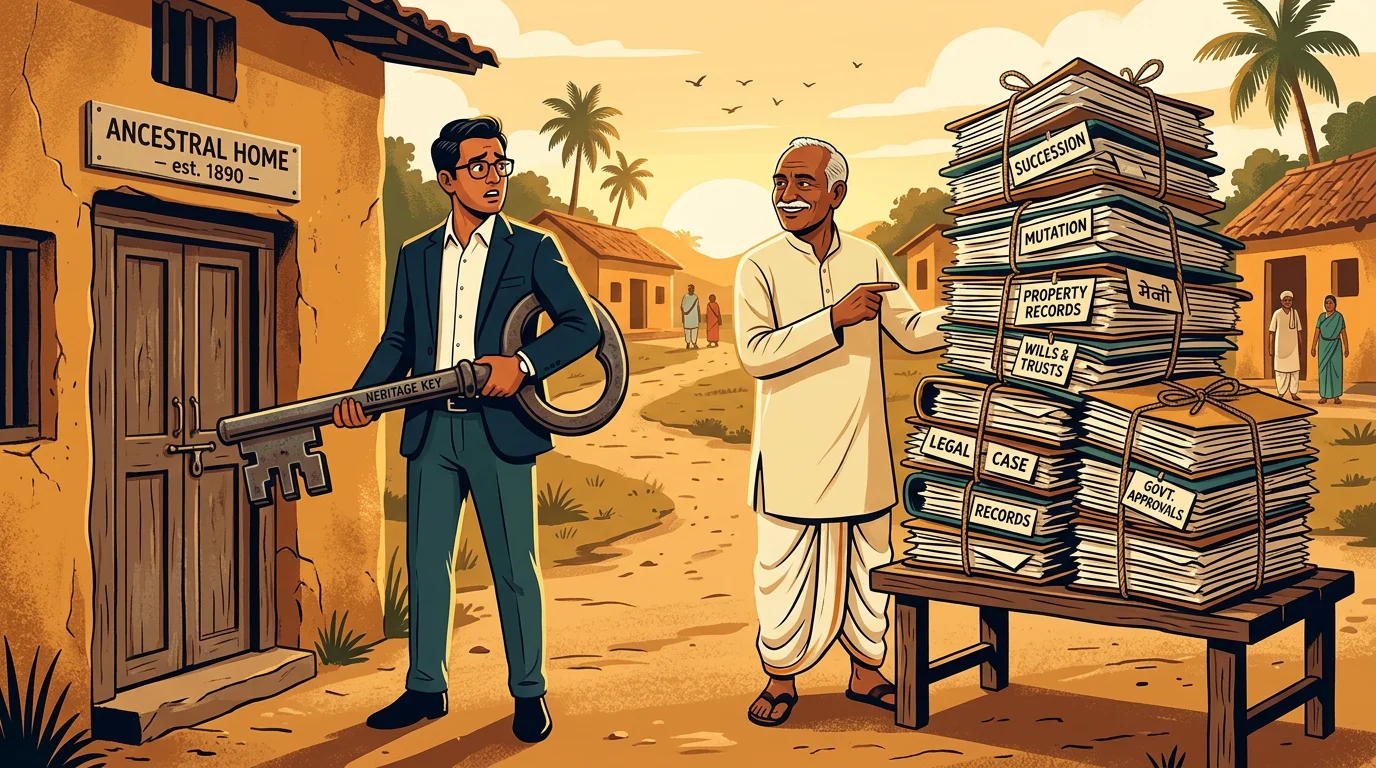

Your father passes away. You are in San Francisco, or Dubai, or London. Amid the grief, someone mentions the flat in Hyderabad, the ancestral land in Punjab, the small plot your grandmother left behind.
“We will sort it out later,” everyone says.
Later is how people lose property.
In Sh. Jai Singh v. Sh. Inder Singh (2022), a family in Delhi inherited agricultural land after their father died in 1964. One heir did not challenge a disputed mutation for decades. By the time he went to court, the judge dismissed his claim entirely, noting he had known about the mutation since at least 1979 but did nothing. Decades of inaction, and the claim was gone.
This is not an unusual story. India has over 7 million pending property cases, and a significant chunk of them are inheritance disputes that turned ugly because the legal formalities were treated as an afterthought.
For a quick starting map, see which inheritance document your family needs first after a property owner dies.
If you are an NRI who has inherited property (or expects to), this guide walks through what you need to do, when you need to do it, and how to do it from abroad.
What Actually Happens When You Inherit Property in India
Let us start with the basics, because this is where confusion begins.
When someone dies in India, their property does not automatically transfer to the heirs. The property exists in a kind of legal limbo until the heirs establish their right through formal channels. Think of it like a bank account: the money is yours, but the bank will not hand it over until you prove who you are.
How you prove your right depends on two things: whether the deceased left a will, and which personal law applies.
If There Is a Will
A will simplifies things, but it does not eliminate paperwork. For the will to be legally effective for immovable property, heirs typically need to get it probated (validated by a court). Until December 2025, probate was mandatory in Mumbai, Kolkata, and Chennai. The Repealing and Amending Act, 2025 abolished that requirement by omitting Section 213 of the Indian Succession Act. Probate is no longer mandatory anywhere in India, but it is still strongly recommended, especially for high-value properties or when disputes are likely. Banks and buyers often insist on it anyway.
Probate confirms three things: the will is genuine, it was the last will of the deceased, and the person was of sound mind when they wrote it. The process takes anywhere from 6 months to 2 years, depending on the court and whether anyone contests it.
If There Is No Will (Intestate Succession)
This is where personal law kicks in.
For Hindus, Buddhists, Jains, and Sikhs: The Hindu Succession Act, 1956 (amended in 2005) governs. Section 8 lays out a clear hierarchy. Class I heirs (sons, daughters, widow, mother, among others, including children of pre-deceased sons and daughters) inherit simultaneously, with each branch taking one share. After the 2005 amendment, daughters have exactly the same rights as sons in ancestral property. This applies even if the daughter is an NRI.
For Muslims: Islamic succession law applies, governed partly by the Shariat Application Act, 1937. The rules differ significantly. A Muslim can only bequeath one-third of their estate by will; the rest is distributed according to fixed shares prescribed by Islamic law.
For Christians and Parsis: The Indian Succession Act, 1925 governs. For Christians, if a male dies intestate, one-third goes to the widow and the rest is divided equally among children. For Parsis, the rules are slightly different, with specific shares for widow, sons, and daughters.
Why this matters for NRIs: Your citizenship status does not change which succession law applies. An NRI Hindu is still governed by the Hindu Succession Act. An NRI Muslim is still governed by Islamic succession law. What changes is how you execute the formalities from abroad.
The 90-Day Timeline: What to Do and When
The “90 days” is not a legal deadline (there is no single statute that says “complete everything in 90 days”). But it is a practical one. The longer you wait, the harder every step becomes. Witnesses become unavailable. Records get misplaced. Other family members make decisions without you. And, as the Jai Singh case shows, courts are not sympathetic to decades-long delays.
Here is a realistic timeline.
Days 1 to 15: Immediate Steps
Get the death certificate. This is the foundation document for everything that follows. Apply at the local municipal corporation within 21 days of death (this is a legal requirement under the Registration of Births and Deaths Act, 1969). You will need it for every subsequent step.
Secure the property. If the property is vacant, make sure someone trustworthy has access. Encroachment on inherited property is disturbingly common, especially when the heirs are known to live abroad. If you are worried, read our guide on how encroachment happens and what documents protect you.
Locate the will. Check with the deceased’s lawyer, bank locker, and family. If there is a registered will, the Sub-Registrar’s office will have a copy.
Gather existing property documents. The title deed or sale deed, previous mutation records, property tax receipts, and any existing encumbrance certificates. If you are abroad, ask a family member to collect physical copies and send you scans. This is where having organised documents upfront saves enormous time. Platforms like Assetly let NRIs store and track property documents digitally, so you are not scrambling to locate papers across continents during an already difficult time.
If the file is already stuck because the family cannot agree on the correct document path, read Why NRI Property Gets Stuck in Succession Disputes to understand the cause - and what to do if your inherited property is already blocked for the specific steps to unblock each scenario.
Days 15 to 45: Legal Documentation
Apply for a legal heir certificate. This is issued by the local revenue authority (Tahsildar or MRO), and the time it takes varies by state. You will need: the death certificate, an affidavit listing all legal heirs, identity proof of applicants, and address proof. If you are abroad, your Power of Attorney holder can apply on your behalf. Remember what it does and does not do: it records who the heirs are, but it does not by itself confer title.
Apply for a succession certificate (if needed). This is issued by a civil court under Part X of the Indian Succession Act, 1925 (Sections 370 to 390). You need this primarily for movable assets: bank accounts, fixed deposits, shares, mutual funds. The process takes 3 to 6 months. If the deceased left a will, you may need probate instead. Our step-by-step guide to getting a succession certificate covers the petition, court fees, and how NRIs run it from abroad.
Get the will probated (if applicable). File a petition in the district court where the deceased lived or where the property is located. Probate is no longer legally mandatory anywhere in India (the requirement was abolished in December 2025), but it remains strongly recommended for contested or high-value estates.
Set up or update your Power of Attorney. If you cannot travel to India, you need a registered PoA authorising someone to act on your behalf. For NRIs, the PoA must be executed at the Indian consulate or embassy, or apostilled if done before a notary in certain countries. Be specific about what the PoA authorises: mutation applications, bank account operations, property management. A general PoA is riskier. Our guide on why GPA-based property sales are invalid explains why specificity matters.
Days 45 to 90: Property Transfer Formalities
Apply for mutation. This is the step that updates the revenue records to reflect you as the owner. Mutation does not create title (the Supreme Court made this clear in Sawarni v. Inder Kaur, 1996: “Mutation of a property in the revenue record does not create or extinguish title nor has it any presumptive value on title”). But without it, you cannot pay property tax in your name, and selling becomes much harder.
The mutation process varies by state (more on that below). Generally, you will need: the death certificate, legal heir certificate or succession certificate, the original title deed, an application form, and a small fee.
Get a fresh encumbrance certificate. An EC for the period covering the deceased’s last few years confirms there are no hidden mortgages, liens, or registered claims against the property. This protects you from surprises.
Update property tax records. Visit (or have your PoA holder visit) the local municipal corporation to transfer the property tax account to your name. This is separate from mutation and often overlooked.
Notify the housing society (if applicable). For flats, the cooperative housing society needs to update their records. They may ask for a transfer fee and a No Objection Certificate (NOC).
Documents You Will Need: The Complete Checklist
Here is every document you are likely to need, gathered in one place:
- Death certificate of the deceased (original + copies)
- Will of the deceased (if one exists)
- Probate order (if the will is being probated)
- Legal heir certificate from the revenue authority
- Succession certificate from the civil court (for movable assets)
- Original title deed or sale deed of the property
- Previous mutation records (khata or patta)
- Encumbrance certificate (recent, covering at least 13 years)
- Property tax receipts (last 3 to 5 years)
- Identity proof of all legal heirs (passport, Aadhaar, PAN)
- Registered Power of Attorney (if applying remotely)
- Affidavit of heirship on stamp paper
- No Objection Certificate from other legal heirs (if not all heirs are claiming)
- Passport and OCI/PIO card (for NRI verification)
How Mutation Works Across States
Mutation is a state subject, which means every state has its own portal, its own process, and its own timeline. Here is a snapshot of the major states where NRIs own property.
Telangana: The Dharani portal has been replaced by Bhu Bharati under the Record of Rights (RoR) Act, 2025. Agricultural mutations are handled through this portal with Bhudhaar unique IDs for land parcels. For urban property, apply through the CDMA (Commissioner and Director of Municipal Administration) portal. Fee: 0.1% of registration value, minimum Rs 1,000 in municipalities, Rs 3,000 in municipal corporations. Timeline: 15 to 45 days. More details in our Telangana property guide.
Andhra Pradesh: Use the Meebhoomi portal for agricultural land and the CDMA portal for urban property. AP has digitised most land records, making remote tracking easier. Timeline: 30 to 60 days. See our AP property management guide for the full process.
Karnataka: The Bhoomi system integrates mutation with registration records. Registration happens through the Kaveri portal, and data flows to the Bhoomi system for land record updates. Karnataka offers relatively streamlined mutation services, which is good news for NRIs. Timeline: 15 to 30 days.
Maharashtra: E-mutation is available through the Mahabhulekh portal, linked with UID-based verification. For Mumbai properties, mutation through the BMC (Brihanmumbai Municipal Corporation) is a separate process. Fee: Rs 50 to Rs 500. Timeline: 30 to 90 days.
Punjab and Haryana: Mutation (called “intiqal”) is handled by the local Patwari and Tehsildar. These states are less digitised than southern states, so you will likely need someone on the ground. The Patwari verifies the claim, posts a public notice, and after the notice period (typically 30 days), mutates the record. Timeline: 45 to 90 days. Watch out for Patwari-level delays, which are well-documented.
Tamil Nadu: Apply online through the TN e-Services portal or at the Taluk office. For Chennai properties, probate of will was historically required before mutation, though this requirement was abolished in December 2025. Timeline: 30 to 60 days.
FEMA Rules for NRIs: What You Can and Cannot Do With Inherited Property
This is the section most NRI guides get wrong, so let us be precise.
Under the Foreign Exchange Management Act (FEMA), NRIs face restrictions on buying certain types of property. But inheritance is treated differently from purchase.
What FEMA allows for inherited property:
- NRIs can inherit any type of immovable property in India, including residential, commercial, and agricultural land.
- No prior RBI approval is needed for inheriting property.
- You can inherit from a person resident in India or from another NRI (provided that person also acquired it lawfully).
The agricultural land exception:
This is the big one. NRIs are strictly prohibited from buying agricultural land, plantation property, or farmhouses. But they can inherit all of these. Once inherited, an NRI can retain the agricultural land or sell it, but only to a person resident in India. You cannot sell inherited agricultural land to another NRI or OCI. Violating FEMA property rules can attract penalties of up to three times the transaction amount.
Repatriation of sale proceeds:
If you sell inherited property, the sale proceeds go into your NRO account. You can repatriate up to USD 1 million per financial year from the NRO account, subject to a Chartered Accountant’s certificate confirming tax compliance. For properties originally purchased with NRE or FCNR(B) funds by the deceased, different repatriation limits may apply.
Tax Implications: No Inheritance Tax, But Watch Out When Selling
India abolished the estate duty (inheritance tax) in 1985. So inheriting property costs you nothing in tax. The tax consequences only appear when you sell.
Cost of acquisition: When you inherit property, your “cost” for capital gains purposes is the price at which the original owner purchased it. Not the current market value. This matters.
Holding period: The holding period includes the time the previous owner held the property. So if your father bought a flat in 2005 and you inherit it in 2026, your holding period is 21 years, which is well into long-term capital gains territory.
Capital gains tax rates (post-July 2024 changes):
The Finance Act, 2024 changed LTCG on property to a flat 12.5% without indexation (down from 20% with indexation). For properties acquired before 23 July 2024, resident Indian taxpayers can choose the more beneficial option between the old and new regimes. However, this choice is not available to NRIs. As an NRI, you pay the flat 12.5% rate without indexation, regardless of when the property was acquired. This can result in a higher tax bill on inherited property held for decades, where indexation would have significantly reduced the taxable gain.
Short-term capital gains (property held less than 2 years from original purchase) are taxed at your income tax slab rate.
TDS for NRIs:
This is where NRIs get hit harder than resident Indians. When a buyer purchases property from an NRI seller, the buyer must deduct TDS at: The buyer must follow Section 393 using the current statutory entry and a computation for the actual transaction. Do not assume that a capital-gains rate is automatically the percentage to deduct from the entire sale price. If the estimated withholding is excessive, you can apply for a lower-deduction certificate using Form 128 under Section 395(1) of the Income-tax Act, 2025. This is the current successor to Form 13 under former Section 197 and can reduce an excessive deduction before the sale.
Section 54 exemption: If you reinvest the capital gains in another residential property in India within 2 years of selling (or 3 years if constructing), you can claim exemption from LTCG tax. NRIs can use this exemption, but the new property must be in India.
Common Mistakes NRIs Make With Inherited Property
Waiting too long to start the process. Every month of delay increases the risk. Other heirs may make decisions. Encroachers may move in. Documents may get lost. The 90-day framework exists for a reason.
Assuming mutation equals ownership (or that skipping it is fine). Mutation does not create title, but it is the practical proof that revenue authorities recognise you as the owner. Without it, you are the legal owner who cannot prove it to the property tax office, the bank, or a future buyer.
Not getting a fresh encumbrance certificate. The deceased may have taken loans against the property, entered into agreements, or faced litigation you do not know about. An EC is your safety check.
Using a general Power of Attorney instead of a specific one. A PoA that says “my brother can do everything” is both legally risky and practically problematic. Specify exactly what actions the PoA holder is authorised to take.
Ignoring the tax implications until it is time to sell. If you are thinking of selling, our guide to selling inherited property covers the full tax and legal process. The cost basis for inherited property is the original purchase price, not the inherited value. If your parents bought a flat for Rs 5 lakh in 1995 and you sell it for Rs 1.5 crore in 2026, your capital gain is calculated on that Rs 5 lakh base. As an NRI, you cannot use indexation, so the full difference is taxable at 12.5%. Plan for this.
Not registering a partition deed when multiple heirs inherit. If siblings inherit jointly, get a registered partition deed specifying who gets what. Oral agreements and informal divisions fall apart when circumstances change. The stamp duty on partition deeds is a fraction of sale deed duty in most states.
Not obtaining a No Objection Certificate from other heirs. If multiple siblings inherit a property and only one applies for mutation, the others can contest it later. Get written, notarised NOCs from all legal heirs before proceeding.
For a broader map of NRI property pitfalls - from caretaker risk to GPA fraud to missed tax filings - see 7 Mistakes NRIs Make With India Property.
How to Do All of This From Abroad
You do not need to fly to India to complete most of these steps. Here is how NRIs manage the process remotely.
Power of Attorney: Execute a specific PoA at the Indian consulate or embassy in your country. The consulate will attest it. Some countries also accept apostilled documents. The PoA should specifically authorise: applying for legal heir certificate, applying for mutation, operating the deceased’s bank accounts (with succession certificate), signing property-related documents, and representing you before revenue authorities.
Consulate attestation of documents: Most Indian consulates offer attestation services for affidavits, declarations, and NOCs. Book an appointment, bring your passport and OCI card, and get your documents attested. This is accepted by Indian courts and revenue authorities.
Digital portals for tracking: Most states now offer online portals where you can track mutation status, download encumbrance certificates, and verify land records. You will not be filing applications through these portals (your PoA holder does that), but you can monitor progress from anywhere.
Video conferencing for court matters: Some courts now allow video appearances for probate and succession certificate hearings. Check with your lawyer whether the relevant court permits this.
Organise digitally from day one. Scan every document. Store them securely. Track deadlines. When you are managing inherited property from 8,000 miles away, a missing document can cost you weeks. Assetly is built for exactly this situation, letting NRIs keep all property documents organised and accessible from anywhere.
Assetly is a property document management platform that helps Indian property owners, especially NRIs, organise, verify, and track their property documents digitally. Learn more.