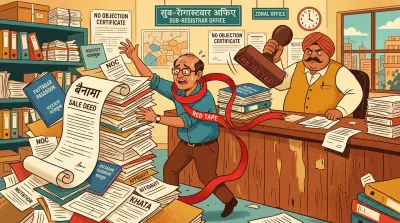


In 2012, a Supreme Court bench delivered a ruling that shook the Indian real estate market. Thousands of property transactions, many involving NRIs, were suddenly on legally uncertain ground.
The case was Suraj Lamp & Industries Pvt. Ltd. v. State of Haryana, and its implications are still felt today.
What Happened
For decades, a common practice had flourished across India: instead of executing a proper registered sale deed, buyers and sellers would complete property transfers using a combination of three documents: a Sale Agreement (SA), a General Power of Attorney (GPA), and a Will.
The arrangement was simple. The seller would sign an agreement to sell, grant the buyer a GPA to deal with the property as if they owned it, and execute a will bequeathing the property to the buyer. No visit to the Sub-Registrar’s office. No stamp duty. No registration fees.
This SA/GPA/Will method became especially popular in Delhi-NCR, Haryana, and Punjab, regions with large NRI populations who found it convenient to handle property matters through relatives holding power of attorney.
Why It Was a Problem
The practice existed in a legal grey area. The Transfer of Property Act, 1882 is clear: transfer of immovable property valued above Rs 100 can only happen through a registered instrument (Section 54). The Registration Act, 1908 makes registration of such documents compulsory.
But people ignored these requirements for years because the transactions worked in practice. Buyers took possession, paid property tax, and lived on the land without anyone questioning their ownership.
Until someone did.
The Supreme Court’s Ruling
The Supreme Court, in its judgment, did not mince words:
“The transactions of the nature of GPA sales or SA/GPA/Will transfers do not convey title and do not amount to transfer.”
The court held that:
- A sale agreement is not a sale. An agreement to sell creates a personal obligation, not a transfer of property.
- A GPA does not convey title. A power of attorney is an authority to act on someone’s behalf; it is not a deed of transfer.
- A will operates only after death. It cannot transfer property during the lifetime of the person making it.
- Combining all three does not change the law. Using SA + GPA + Will together is an attempt to achieve indirectly what the law does not permit directly.
The bench directed the government to take steps to discourage such transactions and instructed revenue authorities to stop recording these transfers in land records.
What This Means for NRIs
This ruling hits NRIs harder than most. Here is why:
You May Have “Bought” Property That Isn’t Legally Yours
Many NRIs purchased property in India through relatives who held GPA on their behalf. If the transaction was done via GPA sale (meaning the property was “transferred” through a power of attorney rather than a registered sale deed) the NRI may not have legal title to the property.
This is not a theoretical risk. Courts across India have refused to recognise GPA-based ownership when disputes arise. If a seller (or their heirs) later claims the property was never formally sold, the GPA buyer has no legal standing.
Your PoA Holder May Have Sold Property You Own
The reverse is equally dangerous. NRIs who granted GPA to relatives or agents in India have found their property sold, mortgaged, or transferred without their knowledge. The Punjab and Haryana High Court has observed that “properties of NRIs are being grabbed in unfair and illegal manner” through misuse of power of attorney (O.P. Mittal vs State, 2009).
There are over 245 indexed court cases involving NRI power of attorney fraud on Indian Kanoon alone, and the number is growing every year. The Nirmal Kaur case is a particularly instructive example of how family members can exploit a forged PoA to sell an NRI’s property.
You Cannot Fix This Retroactively from Abroad
If you discover that your property was transacted through GPA, fixing it requires:
- Locating the original seller (or their legal heirs)
- Getting them to agree to execute a registered sale deed
- Paying the stamp duty and registration fees that were originally avoided
- Being physically present or having a specific (not general) power of attorney attested by an Indian consulate
If the seller refuses, has died, or has sold the same property to someone else through a registered deed, the GPA buyer has virtually no legal recourse.
The Real Cost
The Suraj Lamp ruling did not invalidate all past GPA transactions. The Supreme Court acknowledged that lakhs of such transactions had already taken place and left it to the government to find a way to regularise them.
But here is the uncomfortable truth: no comprehensive regularisation has happened. Some states have offered amnesty windows to register GPA properties by paying a penalty, but these schemes have been inconsistent and time-limited.
For NRIs sitting abroad with GPA-based property, the clock is always ticking. Every year without a registered deed is another year of legal vulnerability.
What You Should Do Today
If you own property in India, or believe you do, here is a checklist:
1. Verify how your property was acquired
Pull out your property documents. Was the transfer done through a registered sale deed? Or through a GPA/sale agreement? If you are unsure, look for a document that says “Sale Deed” at the top and has a registration number from the Sub-Registrar’s office.
2. Check if your name is in the revenue records
Property ownership in India is ultimately reflected in the land revenue records: the khata, patta, or 7/12 extract depending on your state. Even if you have a registered sale deed, verify that the mutation (transfer of name in revenue records) has been completed.
3. If you have a GPA-based transaction, act now
Contact the original seller or their legal heirs. Negotiate execution of a proper registered sale deed. Yes, you will need to pay stamp duty and registration fees, but that cost is a fraction of what you would lose if the property is disputed.
4. If you have granted GPA to someone, audit their actions
Get copies of all documents your PoA holder has executed on your behalf. Check the Encumbrance Certificate (EC) from the Sub-Registrar’s office to see if any transactions have been registered against your property. You can request an EC by post or through an authorised representative.
5. Use a specific PoA, never a general one
If you must grant power of attorney, make it a Special Power of Attorney limited to a specific transaction with a defined expiry date. Have it attested at the Indian consulate in your country. Revoke it in writing once the transaction is complete.
6. Keep digital copies of every document
Title deeds, sale agreements, tax receipts, mutation records, encumbrance certificates: organise them digitally where you can access them from anywhere. If a dispute arises, the person with organised documentation has a significant advantage over the one scrambling to find papers in an old cupboard at a relative’s house. Property document management tools like Assetly are built for exactly this, letting NRIs store, organise, and track their property documents from abroad without depending on relatives or making trips to India.
The Suraj Lamp ruling was not a change in the law. It was a reminder of what the law always said: there are no shortcuts to property ownership in India. A GPA is not a deed. An agreement is not a sale. A will is not a transfer.
For NRIs managing property from thousands of miles away, the safest thing you can do is ensure every document is in order: registered, mutated, and accessible. The 20-year court battle always starts with a missing piece of paper.
For a deeper understanding of title deeds and why registration matters, see our guide to title deeds and sale deeds. NRIs should also review FEMA rules for property ownership to ensure compliance with foreign exchange regulations. If you are an NRI planning to sell property the right way (through a registered sale deed, not a GPA), our complete NRI selling checklist walks through every step from PoA to repatriation.
Assetly is a property document management platform that helps Indian property owners, especially NRIs, organise, verify, and track their property documents digitally. Learn more at assetlyhq.com.
This article references the Supreme Court judgment in Suraj Lamp & Industries Pvt. Ltd. v. State of Haryana (2012) 1 SCC 656. It is intended for educational purposes and does not constitute legal advice. Consult a qualified property lawyer for guidance on your specific situation.