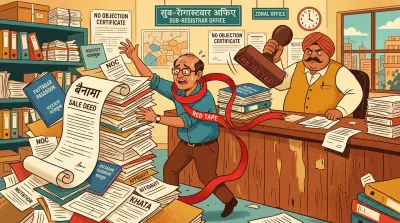


A 2022 property sale in Gurugram looked perfectly routine. A registered sale deed, a General Power of Attorney executed years prior, the usual paperwork. The property changed hands for Rs. 6.60 crores.
The problem: the property was worth approximately Rs. 50 crores. And the original owners - an elderly couple - said they had never executed the PoA.
The Supreme Court, in Pratibha Manchanda & Anr. v. State of Haryana (2023 INSC 612), found “overwhelming and clear cut prima facie evidence” of fraud and ordered a Special Investigation Team. The alleged PoA had been sitting dormant since 1996 - 26 years - before being activated when prices spiked.
This is not an isolated incident. It is a pattern. Court after court has seen the same mechanics: a General Power of Attorney, often broad in language, lying unused for years, then suddenly producing a registered sale deed that the property owner knew nothing about.
The PoA itself was not the problem. The problem was how it was drafted and what it permitted. A well-drafted Special Power of Attorney, with the right constraints, would not have enabled any of this.
What a Power of Attorney Actually Is
A Power of Attorney is a legal authorisation. You, as the principal, authorise another person (the agent or attorney) to act on your behalf for the purposes you specify. The agent steps into your shoes - legally, their acts within the scope of the PoA are your acts.
That is both the power and the risk of the instrument.
The Powers of Attorney Act, 1882 is the governing legislation. It is short and does not prescribe what a PoA must contain. The Registration Act, 1908 governs how a PoA must be authenticated to be used for presenting property documents. The Indian Contract Act, 1872 governs when a PoA can and cannot be revoked.
The practical rules come from decades of case law - specifically from cases where PoAs were misused.
General vs. Special: The First and Most Important Choice
A General Power of Attorney (GPA) says, in effect: “My agent can do anything I can do regarding [property / all matters].”
A Special Power of Attorney (SPA) says: “My agent can do this specific thing, by this date, under these conditions, and nothing else.”
For property, always use an SPA.
The Supreme Court was clear in Suraj Lamp & Industries Pvt. Ltd. v. State of Haryana ((2012) 1 SCC 656): a GPA is not a transfer instrument and cannot substitute for a registered sale deed. But beyond the Suraj Lamp issue, GPAs are disproportionately represented in PoA fraud cases simply because of their breadth. The more an attorney can do, the more they can do without your consent.
An SPA for property is typically drafted for one of these limited purposes:
- To execute one registered sale deed for a specific property at a minimum price
- To appear before a specific Sub-Registrar’s office for a specific transaction
- To collect rent and pay property taxes on behalf of the owner
- To manage a property under construction, sign contractor agreements, and oversee the build
- To complete a specific inheritance or mutation process
The key word is specific. Each purpose should be named. Anything not named is not authorised.
What a Safe PoA Must Contain
Property description - exact, not general. The PoA must identify the property by its survey number, khata or patta number, full postal address, total area, and all four boundary directions. “My flat in Bangalore” is not a property description. An agent with a vague description can apply it to the wrong property - or claim they did so innocently.
A specific list of authorised acts. Do not write “all acts regarding the property.” Write out exactly what the agent is authorised to do, in plain terms. If the purpose is a sale, write: to appear before the Sub-Registrar at [office name], to execute one registered sale deed for the property described above, to receive the sale consideration of not less than Rs. X, to sign all documents required for the registration, and for no other purpose.
An explicit price floor if authorising sale. In the Pratibha Manchanda case, a property worth Rs. 50 crores was sold for Rs. 6.60 crores. A minimum sale price clause - “the attorney shall not accept a consideration of less than Rs. Y” - is a simple safeguard. The attorney cannot complete a distress sale below this floor.
A time limit. This is the most commonly omitted safeguard and the one that enabled the Pratibha Manchanda fraud. A PoA executed in 1996 and used in 2022 was legally valid in terms of the instrument - there was no expiry clause. Every PoA for property should have an explicit expiry: “this PoA shall expire on [date], after which it shall stand automatically revoked.” For a transaction, six to twelve months is typically enough.
A prohibition on sub-delegation. The maxim delegatus non potest delegare - a delegate cannot further delegate - applies to PoA holders unless the principal explicitly permits it. Without a prohibition clause, a PoA holder may grant further PoAs to third parties the original principal never contemplated or approved, creating a chain of authority that is difficult to trace or control. Include this clause explicitly: “The attorney shall not sub-delegate this authority to any other person.”
Prohibition on mortgage and encumbrance. Even a PoA for sale should explicitly state: “The attorney is not authorised to mortgage, hypothecate, create any charge, lien, or encumbrance on the property, or to enter into any lease of more than eleven months.” Courts have held that authority to sell does not imply authority to mortgage - but clarity removes any argument.
An explicit revocation clause. State that the PoA is revocable at any time by the principal and will stand automatically revoked upon: the completion of the specific transaction, the expiry date, or the principal’s written notice to the attorney - whichever comes first.
How NRIs Execute a PoA Abroad
The process depends on which country you are in.
For Hague Apostille Convention countries (United Kingdom, United States, Australia, Canada since January 2024, and most of Europe):
- Draft the PoA with a property lawyer’s input. Get the language right before you sign.
- Sign the PoA before a local Notary Public in your country of residence.
- Get the notary’s signature apostilled by the designated authority in your country. In the UK, this is the Foreign, Commonwealth and Development Office. In the US, the Secretary of State of the relevant state.
- Send the original apostilled document to India.
- The PoA holder in India must present it for registration at the Sub-Registrar’s office within four months of its arrival in India (Section 26, Registration Act, 1908).
For non-Hague countries, including the UAE:
The UAE has not joined the Hague Apostille Convention. NRIs in the UAE follow a different route:
- Sign the PoA before a local Notary Public.
- Get it attested by the Indian Embassy or Consulate in the UAE.
- Send to India; register within four months of arrival.
A common misconception is that the window is three months - the actual statutory period under Section 26 is four months. Missing this deadline means the PoA cannot be registered, and the agent cannot use it to present documents for registration.
One more important point: you do not have to physically go to the Indian Consulate yourself. In most countries, consulate attestation services are available through authorised service providers.
Keeping Oversight After You Have Given PoA
Executing a PoA is not a set-and-forget act. The risk with any PoA is the absence of oversight - particularly for NRIs who cannot physically check what their attorney is doing.
Several practical habits reduce the risk significantly.
Check your revenue records periodically. After giving a PoA, monitor the mutation records for your property. If the PoA holder has executed any transaction in your name, it should show up in revenue records and eventually in mutation/khata records. If something unexpected appears, you want to know about it while there is still time to challenge it.
Request an encumbrance certificate periodically. An EC shows all registered transactions against the property. If your attorney has executed a sale deed, a mortgage, or any other registered document using the PoA, it will appear on the EC. An EC search takes minutes and costs a small fee through most state IGRS portals.
Keep the original PoA document yourself. Do not give the original to the attorney. Send them a registered copy. Keep the original in a secure location - a bank locker or a digital document vault. If the original is unavailable and only a certified copy exists (as in Pratibha Manchanda), that itself is a warning sign of potential misuse.
For NRIs managing property from abroad, Assetly can help you store and track all property documents, including PoA records, EC reports, and mutation certificates, with access from anywhere - so you always know what the current state of your records is.
The Broader Pattern: Who Is Most at Risk
The India property PoA fraud case pool is heavily concentrated in a few profiles:
NRIs who have been abroad for many years and rely entirely on one family member or lawyer to manage everything. The longer the absence, the wider the information gap.
Elderly owners who are physically present in India but unable to travel to government offices. They give PoA to a relative or trusted person without the clause-level scrutiny the document deserves.
People who gave PoA for a specific transaction and forgot to revoke it after the transaction was complete. A sale PoA that was used once, and then sits in the attorney’s drawer for years, is an open invitation.
The Nirmal Kaur case is a reminder that the threat is often close to home. Family member fraud - a sibling, a child’s spouse, a cousin - is the most common form. The very trust that made you choose this person is the reason you may not monitor them closely enough.
How to Revoke
If you need to revoke a PoA - because the transaction is complete, because you no longer trust the attorney, or because you simply want it cancelled - the process matters.
Execute a Deed of Revocation. For NRIs, this follows the same process as the original PoA: notarised and apostilled, or consulate-attested, then registered in India at the same Sub-Registrar’s office where the original was registered. If the PoA was registered, the revocation must also be registered to be fully effective.
Send written notice to the attorney by registered post, with acknowledgement due. Any act done by the attorney after receiving this notice is invalid.
Publish a notice in a local newspaper in the city where the property is located. This is not a statutory requirement, but it protects against claims by third parties that they had no knowledge of the revocation. Under Indian law, a bona fide purchaser who deals with the attorney before the revocation notice reaches them may have a valid claim, even after you have revoked. The newspaper publication is the standard way to establish constructive notice to the world.
Inform the Sub-Registrar’s office in writing of the revocation. Keep a copy of your letter.
The Right Mindset
A Power of Attorney is a tool. Like any tool, it is useful in the right hands with the right specifications, and dangerous when those conditions are not met.
You do not need to avoid PoA for property - for NRIs who cannot be physically present, it is sometimes the only practical option. What you need is to treat the drafting of the PoA with the same seriousness as the property transaction itself. Spend the time to get the language right. Include every limitation. Set an expiry date. And keep watching after you have given it.
The cases that end up in court share a common feature: not that PoA was given, but that it was given without enough care about what it permitted.
Related Reading
- Why Your GPA Property Sale May Be Legally Worthless - The Suraj Lamp ruling and what it means for PoA-based property transactions
- The Nirmal Kaur Case: Family Member Fraud Using PoA - A case study in how PoA misuse plays out in practice
- Your Registered Sale Deed Does Not Prove Ownership - Why registration alone is not enough to establish title
- Encumbrance Certificate: Your Property’s Transaction History - How to monitor your property for unauthorised transactions
- India’s Property Dispute Crisis - The systemic backdrop behind PoA fraud and why it is so common
Assetly is a property document management platform for Indian property owners and NRIs. Store, organise, and track your property documents, including PoA records and encumbrance certificates, with access from anywhere. Learn more at assetlyhq.com.