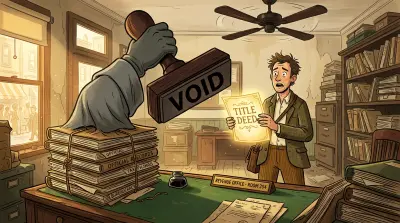
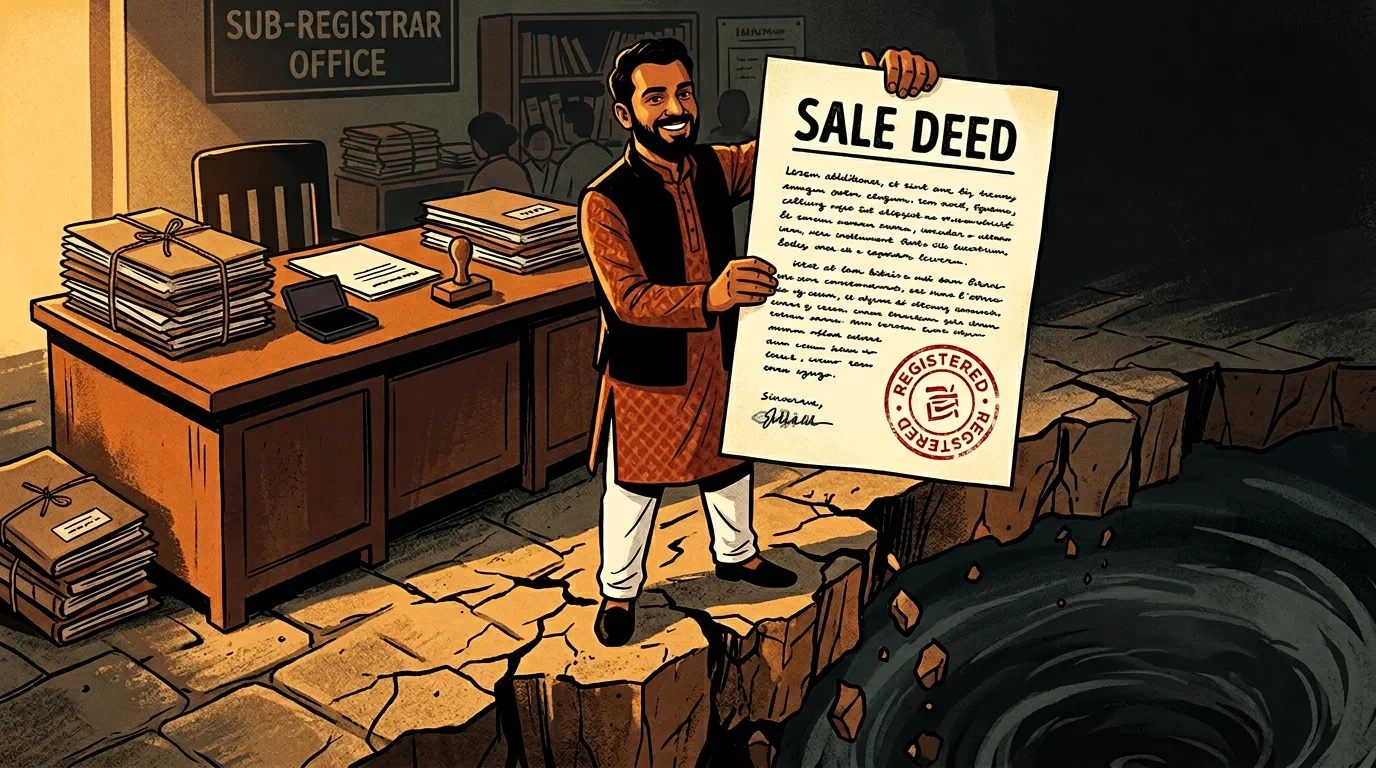

A property in Tamil Nadu. A willing buyer. A properly executed sale deed. Stamp duty paid. Both parties present and ready to sign.
The Sub-Registrar refused to register it.
His reason: the seller could not produce the original deed by which he had acquired the property. Without that document, the registrar would not proceed.
The buyer went to court. The Madras High Court sided with the registrar. He appealed further. And on 7 April 2025, the Supreme Court of India delivered a ruling that exposed one of the most dangerous assumptions in Indian property law.
What Buyers Think Registration Means
When you buy a property in India and get a registered sale deed, most people assume the hard part is done. You have the document. It has been stamped. A government official has recorded it. You own the property.
This assumption is wrong, and the Supreme Court has now said so explicitly.
In K. Gopi v. The Sub-Registrar & Ors. (2025 INSC 462), the court settled a long-running dispute about the registrar’s role. But in doing so, it laid bare a structural gap that affects every property buyer in India.
The court’s reasoning, stripped to its core: registering officers “have no adjudicatory power to decide whether the executant has any title.” Their role is “ministerial,” not judicial. They check whether the parties are present, whether execution has been admitted, whether stamp duty has been paid. That is all.
The court went further. It confirmed what follows from this: “Even if the executant has no title, the registrar cannot refuse registration if procedural formalities are met.”
Read that again. A document can be registered, perfectly and legally, even where the seller has zero title to pass.
The Rule That Was Meant to Help (But Could Not)
The Sub-Registrar in the K. Gopi case was not acting capriciously. He was following Rule 55A(i) of the Tamil Nadu Registration Rules, 1949, which required a seller to produce the previous original deed proving how they had acquired the property.
On its face, a sensible rule. Before we register your sale, show us that you actually own what you are selling.
The Supreme Court struck it down.
The reason: this rule exceeded the rule-making authority under the Registration Act, 1908. The Act does not give registering authorities any power to examine or adjudicate on a seller’s title. A state rule cannot create powers the parent Act does not confer. Rule 55A(i) was declared ultra vires and void.
All the Madras High Court orders upholding the refusal were quashed. K. Gopi was directed to re-lodge the sale deed. The Sub-Registrar was directed to register it upon procedural compliance, with no further inquiry into the seller’s title.
The buyer’s problem was solved. But the ruling crystallised the buyer’s deeper vulnerability.
What Registration Actually Does
The Registration Act, 1908 creates a public record of transactions. When a sale deed is registered, it becomes part of the Sub-Registrar’s records, which are public documents. This matters for three reasons.
First, it makes the document admissible as evidence in court. Unregistered sale deeds for immovable property above Rs 100 cannot be used as evidence of ownership.
Second, it establishes priority. If two people both have claims to the same property, the one with the earlier registered document generally wins (absent fraud).
Third, it puts the world on notice. Once registered, no one can claim ignorance of the transaction.
What it does not do: verify that the seller had the right to sell.
The operative principle comes from Section 54 of the Transfer of Property Act, 1882. A sale transfers ownership in exchange for a price paid or promised, but the seller can only transfer the rights they actually possess. The Latin principle that runs through Indian property law is nemo dat quod non habet: no one can give what they do not have.
So the registered sale deed in your possession transfers to you exactly what your seller owned. If they owned the full property, you own the full property. If they owned half, you own half. If they had no title, your registered deed conveys nothing, yet it will appear in the Sub-Registrar’s records as a valid, registered transaction.
The Pattern Is Not New
The K. Gopi ruling is the clearest statement of this principle in recent years, but it is not the first.
In Suraj Lamp & Industries Pvt. Ltd. v. State of Haryana ((2012) 2 SCC 656), the Supreme Court dealt with property sales conducted through General Power of Attorney documents rather than registered sale deeds. The court held that only a registered deed of conveyance can transfer title. But the same post-ruling principle applies: the registered deed must come from a seller with valid title. Registration is the necessary container; valid title is what goes inside it.
In Satya Pal Anand v. State of Madhya Pradesh ((2016) 10 SCC 767), the court held that registering authorities cannot cancel registered documents even if fraud is later discovered. Only civil courts can do that. The document, once registered, has a legal life of its own, regardless of the underlying truth.
And in S.P. Chengalvaraya Naidu v. Jagannath ((1994) 1 SCC 1), the court held that a decree obtained by playing fraud upon the court is a nullity. The broader principle in Indian property law is that fraud in the chain of title must be proved in civil court - a process that typically takes years.
The pattern across these cases is the same: registration is a strong procedural safeguard, but it is not a guarantee of substantive title. India operates what legal scholars call a “presumptive” or “deeds” registration system. The state records transactions but does not certify who owns any given piece of land. This is fundamentally different from countries like Australia and the UK, which operate “conclusive title” systems where the government guarantees ownership.
As the anchor post on India’s property dispute crisis notes, property disputes make up approximately 66% of all civil litigation in India. The gap between registration and title is one of the structural reasons why.
What This Means If You Have Bought Property
If you have a registered sale deed, you are not in danger simply because of this ruling. The K. Gopi case does not change the law; it restates what the law always was. Most registered sale deeds are perfectly valid because most sellers do genuinely own what they are selling.
But the ruling should prompt two questions.
The first is backward-looking: did your seller have valid title? If you conducted a thorough title search before buying, obtained an encumbrance certificate going back at least 30 years, checked mutation records, and had a lawyer verify the chain of ownership, you are in a strong position. If you relied on the registration itself as proof of a clean title, the chain of ownership going back to the root of title may never have been verified.
The second is forward-looking: can you prove your title if it is ever challenged? A registered sale deed is evidence. But in a dispute, you may need to establish the full chain: who owned the property before your seller, and who before them. If any link in that chain is broken, the title search is what establishes your position.
This matters especially for properties that have changed hands multiple times, properties received through inheritance, and properties in areas where land records have historically been unreliable or manually maintained. For a deeper look at the specific risks with title deeds and sale deeds, that guide covers the full chain-of-title concept.
The starkest version of this gap is land bought with no registration at all - the informal “Sada Bainama” purchases common in rural Telangana, where families paid, took possession, and never got a registered deed. Telangana now offers a way to convert those into legal title: see our guide to Sada Bainama regularisation under the Bhu Bharati Act.
The Palle Sabitha case study shows the opposite boundary: a revenue officer cannot use regularisation to decide a disputed title against a subsisting registered deed.
The NRI Gap
For property owners who live abroad, the structural gap between registration and title is magnified. NRIs typically cannot personally visit Sub-Registrar offices, revenue departments, or the NJDG litigation portal. They often rely on family members or lawyers for on-the-ground checks, sometimes with limited oversight.
The Supreme Court in K. Gopi confirmed that registration officers will not fill this gap. They cannot and should not: their role is to record, not to investigate. The due diligence is entirely the buyer’s responsibility, and it happens before the sale deed is executed, not after.
For NRIs who have inherited or purchased property and are not certain whether the full title verification was done at the time, the practical steps are the same as for any buyer. The verification can be done remotely, with a trusted local lawyer, and the documents can be stored and tracked digitally.
What to Do
Conduct a 30-year title search before any purchase. Hire a property lawyer to trace the chain of ownership going back to a clear root of title. The encumbrance certificate is the starting point, but it is not enough on its own. Original title documents must be read and verified.
Check revenue records after buying. Registration and mutation are separate processes. A registered sale deed does not automatically update the revenue records. Without mutation, government records still show the previous owner, which creates complications for tax payments, future sales, and dispute resolution.
Search for litigation on NJDG. Before buying, search the National Judicial Data Grid (njdg.ecourts.gov.in) for any pending cases involving the property or the seller. A property with pending litigation may be subject to court orders that affect your title.
Read the full chain of documents. Ask your lawyer to physically read every registered document in the chain, not just the most recent one. Pay attention to any gaps: periods where no registered transaction appears, properties that passed through inheritance without mutation, or properties held under GPA transactions before 2012.
Store everything digitally. After purchase, scan and store all original documents: the sale deed, prior title documents, the EC, mutation certificate, property tax receipts, and the building approval plan if applicable. For NRIs managing property from abroad, Assetly (assetlyhq.com) provides a secure digital vault for property documents with access from anywhere.
If you have doubts about existing title, get a legal opinion. A formal legal opinion from a property lawyer, reviewing the full chain of title, is your best documentation that due diligence was conducted. It is also useful evidence if title is later challenged.
Check if the land is government or assigned land. This is especially important in Telangana and other states where government land is sometimes built on illegally. In the Khanamet encroachment case, an apartment complex was built on government-assigned land, flats were sold, and courts allowed registration - but explicitly warned that registration did not confer title. The flat buyers had registered sale deeds. They did not have valid ownership.
Assetly is a property document management platform for Indian property owners and NRIs. It helps you organise, store, and track all your property documents digitally, so you always know what you have and what is missing. Learn more at assetlyhq.com.