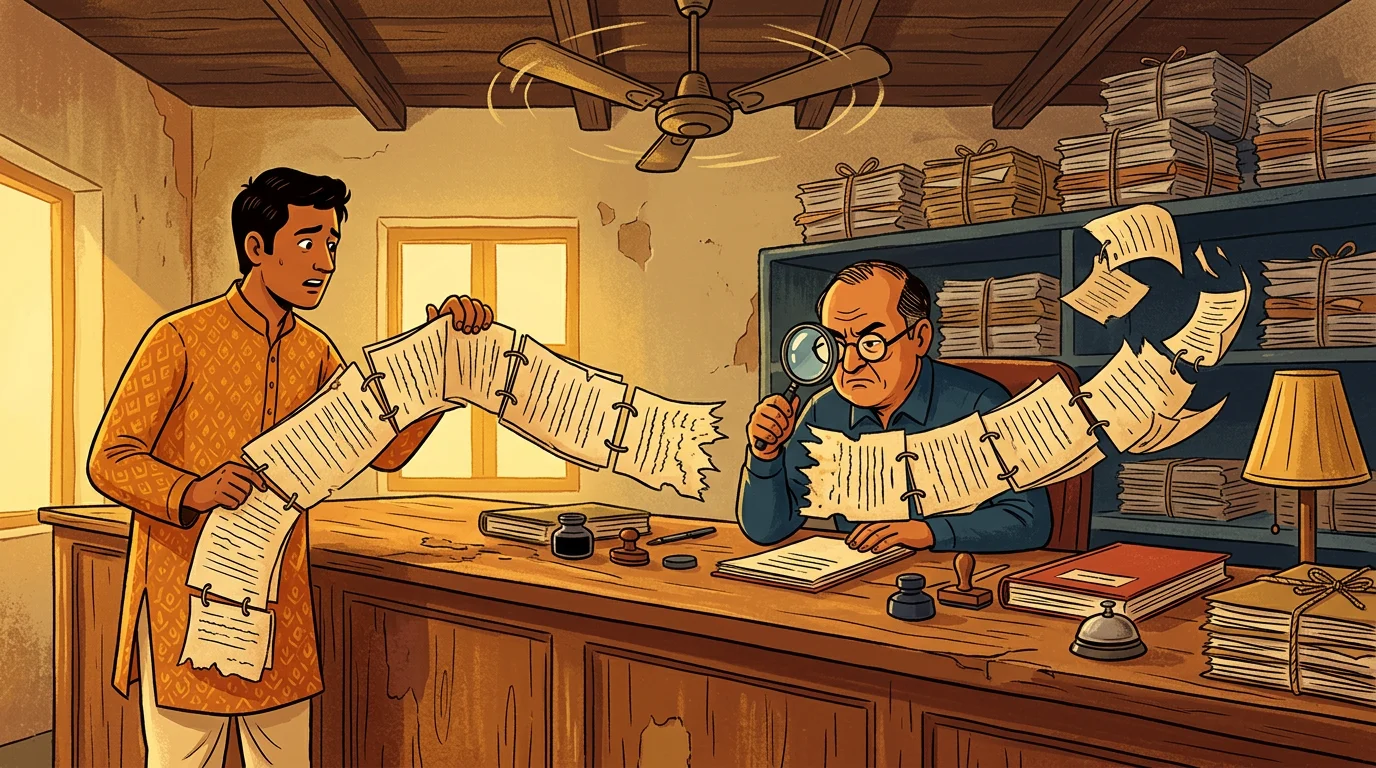

A property in Telangana. Two sale deeds from 1985. Both deeds had identical boundaries. Neither mentioned a survey number. And when the court asked for link documents showing how the seller had acquired the property in the first place, there were none.
The Telangana High Court, in Kampati Venkateswrlu v. Maddineni Sravan Kumar (2023), noted that the witness “admitted that there were no link documents to those sale deeds” and “there was no document filed before their Office to show how Sale Sundaraiah got the property.”
The title claim collapsed. Not because the sale deeds were forged. Not because there was a competing claimant with stronger evidence. But because nobody could show how the seller had come to own the property he sold.
This is what link documents are for. And this is what happens without them.
What Link Documents Actually Are
Think of property ownership like a relay race. Each runner hands the baton to the next. The baton is the property. The handoff is the transfer document. If you can trace the baton from the first runner to the last without a gap, you have a valid chain. If one handoff is missing or unclear, nobody can be sure the last runner is holding the right baton.
In property terms, link documents are the complete set of transfer documents that trace ownership from the earliest recorded owner (or original government grant) to the current one. Each document is one “link” in the chain of title.
A chain might look like this:
- 1965: Government grant of agricultural land to Ramaiah (patta)
- 1982: Ramaiah dies, legal heirs obtain succession certificate
- 1983: Legal heirs execute registered partition deed, Plot A goes to son Venkatesh
- 1998: Venkatesh sells Plot A to Suresh via registered sale deed
- 2015: Suresh gifts Plot A to daughter Priya via registered gift deed
- 2024: Priya is the current owner
Every document in that list is a link document. Remove any one of them and you cannot prove Priya owns the property. The 1982 succession certificate connects Ramaiah to his heirs. The 1983 partition deed connects the heirs to Venkatesh specifically. The 1998 sale deed connects Venkatesh to Suresh. Each link carries a legal principle the Supreme Court stated in Mrs. Umadevi Nambiar v. Thamarasseri Roman Catholic Diocese (2022): “No one can confer a better title than what he himself has.”
If Venkatesh never actually inherited the property (because the succession certificate was defective, or the partition was never registered), then his sale to Suresh transferred nothing. And Suresh’s gift to Priya transferred nothing. The chain is only as strong as its weakest link.
Why Link Documents Matter More Than Your Sale Deed
Most property owners think of their registered sale deed as the ultimate proof of ownership. It is not. Registration is an administrative act. It records that a transaction happened. It does not verify that the seller had the right to sell.
The Delhi High Court made this vivid in O.P. Aggarwal v. Akshay Lal (2012). Two parties claimed the same property in Delhi. The Aggarwals traced their chain back to a 1955 registered sale deed from the original owner, Shree Ram Sarwaria & Sons Limited, and produced every link document in between. The other side could not.
The court held: “The possession of this original title deed, with the appellants/plaintiffs is a very strong proof of the ownership of the suit property… by means of chain of title documents.”
It also addressed a practical question that comes up often: do you need to summon every previous owner to prove the chain? The court said no. “If what the trial Court holds is accepted, it will be necessary that to prove the chain of title deeds running into decades all earlier owners have to be summoned. This is not required to be done.” Once you file the registered documents in sequence, the burden shifts to the other side to show they are not genuine.
Three contexts where link documents are non-negotiable:
Selling property. Any serious buyer’s lawyer will ask for the complete chain. A gap means the buyer cannot get a clean legal opinion. Many deals fall through not because of fraud, but because the seller simply never collected the link documents and cannot produce them when asked. Our seller’s document checklist covers this in detail.
Getting a bank loan. Banks maintain panels of advocates who conduct title searches before approving home loans. The standard requirement is a complete chain of title for at least 13 to 30 years. If the chain has a gap, the bank’s lawyer will flag it, and the loan will be held up or rejected.
Court disputes. The Supreme Court established this in Moran Mar Basselios Catholicos v. Mar Poulose Athanasius (1954): “In an ejectment suit the plaintiff must succeed on the strength of his own title and not on the weakness of the defendant’s case.” You prove your title by producing the chain. If you cannot, it does not matter how weak the other side’s case is.
What a Complete Chain Looks Like
The documents in the chain vary by property type.
Agricultural Land
For agricultural land, especially in states like Telangana and Andhra Pradesh, the chain typically includes:
- Root of title: the original government grant, inam deed, or Occupancy Rights Certificate (ORC) under the Telangana Abolition of Inams Act, 1955
- Pattadar passbook and title deed under the ROR Act
- Pahani / ROR extracts (annual crop and occupancy records)
- Registered sale deeds for every transfer
- Mutation orders from the Mandal Revenue Officer for every change of ownership
- Succession certificates or legal heir certificates if any transfer happened through inheritance
- Partition deeds if ancestral land was divided among family members
The Telangana High Court’s 2025 ruling in Mahboob Unnisa Begum v. State of Telangana is instructive. A 70-year-old woman claimed ancestral property in an area now within GHMC limits and applied for a pattadar passbook. The court noted: “Except filing pahanies for some years, she has not filed any other documents including sale deed or link document.” The petition was dismissed partly because the ROR provisions apply only to agricultural properties, not urban land within GHMC limits, but the observation about the absence of link documents reinforces the broader point: revenue records alone, without actual transfer documents, do not establish title.
Urban Plots (Non-Agricultural)
For plots in cities and towns:
- Original allotment letter or sale deed from the development authority (BDA, HMDA, DDA, etc.) or layout developer
- Layout approval from the planning authority
- Land conversion order (if the land was originally agricultural)
- Each subsequent registered sale deed
- Mutation/khata transfer records from the municipal authority
- Encumbrance certificate covering the full period
Flats and Apartments
For flats, the chain has two layers: the builder’s chain (for the land) and your chain (for the unit):
Builder’s chain:
- Original sale deed or allotment for the land
- Development agreement or joint development agreement with the landowner
- Layout approval and building plan sanction
- RERA registration (mandatory under Section 4 of RERA Act, 2016, which requires the builder to file “authenticated copy of the legal title deed reflecting the title of the land”)
- Occupancy certificate or completion certificate
Your chain:
- Agreement for sale / allotment letter from the builder
- Registered sale deed or conveyance deed
- Society NOC (if part of a housing society, for resale)
- Share certificate or membership transfer
RERA has made this somewhat easier for new construction. Under Section 4(2)(l), builders must file a declaration confirming legal title to the land. State-level RERA rules go further: in several states, builders must submit a land title search report from an advocate with at least ten years of experience. But for older buildings, pre-RERA, the builder’s original title chain may be harder to trace.
The Seller’s Legal Obligation
This is not just a best practice. The law places a specific duty on sellers.
Section 55(1) of the Transfer of Property Act, 1882, requires the seller to:
(a) “disclose to the buyer any material defect in the property or in the seller’s title thereto of which the seller is, and the buyer is not, aware”
(b) “produce to the buyer on his request for examination all documents of title relating to the property which are in the seller’s possession or power”
(e) “take as much care of the property and all documents of title relating thereto which are in his possession as an owner of ordinary prudence would take”
In other words, if you are selling, you are legally required to produce all title documents when the buyer asks. And you are required to have taken reasonable care of them. “I lost them” or “my father never gave them to me” is not a defence; it is a problem you need to solve before the sale.
How to Obtain Missing Link Documents
If your chain has gaps, here is how to fill them.
Certified copies from the Sub-Registrar. Under Section 57 of the Registration Act, 1908, any person can apply for copies of documents in Books 1 and 2 (which include sale deeds, gift deeds, partition deeds, and most property transfer documents). The copies are “signed and sealed by the registering officer” and are “admissible for the purpose of proving the contents of the original documents.” You need the document number and year (if known), or the property details and party names so the office can search their index.
Encumbrance certificate search. An EC for 30 years will show every registered transaction against the property. This is often the fastest way to identify what link documents exist and when they were registered. From there, you can request certified copies of each transaction.
Revenue records. Pahani extracts, mutation entries, and pattadar records maintained by the revenue department can help you trace the ownership timeline, especially for agricultural land where the revenue chain predates the registration chain.
Court records. If a previous transfer happened through a court decree (succession, partition, specific performance), the decree is a link document. Certified copies can be obtained from the court registry.
Newspaper notices and indemnity bonds. If a link document is genuinely untraceable, a property lawyer may advise publishing a newspaper notice inviting claims and executing an indemnity bond. This does not replace the missing document, but it demonstrates that you took reasonable steps, which can satisfy a buyer or lender.
For NRIs
Obtaining old documents from Sub-Registrar offices typically requires a physical visit, especially for pre-digitisation records. NRIs have three options:
- Appoint a PoA holder specifically authorised to obtain certified copies (use a limited, specific Power of Attorney)
- Hire a local property lawyer to conduct the search and collect the documents
- Use state online portals where available (Maharashtra’s IGR, Tamil Nadu’s TNREGINET, Telangana’s Bhu Bharati) for digitised records
Once you have the documents, store them in a central, accessible location. Assetly lets you organise your complete chain of title digitally, so the full set is accessible from anywhere when you need it for a sale, loan application, or legal review.
What to Do Today
If you own property in India, especially if you inherited it or live abroad, here are the steps worth taking now:
List every transfer document you have. Lay out the chain: who owned it first, how it reached you, and what document records each step. Identify the gaps.
Get an encumbrance certificate for 30 years. This will tell you what registered transactions exist. Compare it against your chain.
Request certified copies for any missing links. Start with the Sub-Registrar’s office. For old documents, you may need to visit in person or send someone with a PoA.
Keep the originals safe and the copies digital. The Delhi HC in O.P. Aggarwal specifically noted that possession of original title deeds is “very strong proof of ownership.” The Telangana HC in Mohd. Ismail Ali v. Jamia Nizamia (2018) treated the physical handover of link documents and title deeds as evidence of delivery of possession in support of an oral gift (hiba) under Muslim law.
The cases that end up in court share a pattern: not that someone forged a document, but that a document was never obtained, never preserved, or never connected to the rest of the chain. A complete chain of link documents is the simplest form of insurance you can have for your property.
Related Reading
- What Is a Title Deed? (And What Happens Without One) - The single most important document in your chain
- Your Registered Sale Deed Does Not Prove Ownership - Why registration alone is not enough
- What Is an Encumbrance Certificate? - How to trace all registered transactions against your property
- Documents You Need Before Selling Property in India - The full seller’s document audit checklist
- Land Revenue Records: 7/12 Extract, RTC, Pahani - Understanding the revenue record layer of your chain
Assetly is a property document management platform for Indian property owners and NRIs. Organise your complete chain of title documents digitally and access them from anywhere. Learn more at assetlyhq.com.