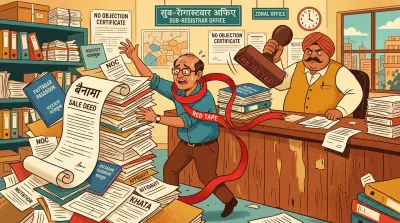

You have found a buyer for your flat. The price is agreed, the paperwork is lined up, and you are ready to close the deal. Then the housing society secretary tells you there is a “small formality” to complete first.
That small formality turns into three months of running around, unexpected charges, and a sale that almost falls through.
Welcome to the world of cooperative housing society transfers in India. If you own a flat in a society (and if you own a flat in Mumbai, Pune, or most cities in Maharashtra, you almost certainly do), selling it involves a layer of compliance that independent house owners never have to deal with. The society has to be in the loop. And the society does not always make it easy. Society transfer is one step in the wider property-sale process.
Why Does a Housing Society Get a Say in Your Sale?
Here is the thing that confuses most people. You own the flat. You have the registered sale deed. You pay property tax. So why does the housing society get to approve who you sell it to?
The answer lies in how cooperative housing societies work. When you buy a flat in a cooperative society, you are not just buying a physical unit. You are becoming a member of a cooperative. You hold shares in the society. Your flat is technically linked to your membership. And membership in a cooperative, by its very nature, requires the other members to accept you.
This is fundamentally different from buying an independent house or a flat in a standalone building. In those cases, the sale is between the buyer and seller, full stop. In a society flat, the sale also involves the society as a third party.
The legal framework comes from the cooperative societies acts of each state. Maharashtra has the most developed framework because Mumbai, India’s most expensive real estate market, runs almost entirely on cooperative housing societies.
The Legal Backbone: State Cooperative Societies Acts
Cooperative housing societies in India are governed by state-level legislation. The key acts include:
Maharashtra Cooperative Societies Act, 1960 is the most comprehensive. It governs everything from formation to dissolution of cooperative societies, including housing societies. Sections 22 and 23 deal with membership admission (critical for flat transfers), and Section 79A gives the state government power to issue binding directives to societies.
Karnataka Cooperative Societies Act, 1959 governs societies in Bangalore and the rest of Karnataka. The transfer rules are broadly similar but with different administrative procedures.
Multi-State Cooperative Societies Act, 2002 applies to societies operating across state boundaries.
Each state has its own rules, but the core principle is the same everywhere: when a flat in a cooperative society changes hands, the new buyer must be admitted as a member of the society, and the old member’s shares must be transferred.
What Documents Are Involved?
Three documents form the core of a society flat transfer. Each serves a different purpose, and confusing them is common. Here is how they line up before we go into detail:
| Document | What it actually proves | When it changes hands |
|---|---|---|
| No Objection Certificate (NOC) | Society has no objection to the sale and the seller has cleared all dues | Before the sale deed is registered |
| Share certificate | Membership in the society, not ownership of the flat | After registration, reissued in the buyer’s name |
| No-dues certificate | Nothing pending: maintenance, water, sinking and repair fund | Before the sale deed is registered |
1. The No Objection Certificate (NOC)
This is the document everyone talks about. The society NOC is a letter from the society’s managing committee confirming that they have no objection to the proposed sale. It typically states that the outgoing member has cleared all dues (maintenance, water charges, parking fees, sinking fund contributions) and that the society has no pending claims against them.
Here is what most people do not realise: in Maharashtra, the society NOC is not technically a legal prerequisite for selling your flat. Bye-Law No. 38 of the Model Bye-Laws framed under the Maharashtra Cooperative Societies Act lists the documents required for a flat transfer, and a society NOC is not among them.
But try selling without one. Banks will not disburse the buyer’s home loan without a society NOC. Some Sub-Registrar offices ask for it. And no buyer’s lawyer will let them proceed without seeing it. So while the law does not require it, the market effectively does.
2. The Share Certificate
This is your proof of membership in the cooperative society. Every member holds a certain number of shares (commonly five, with a face value of Rs 50 each, though this varies by society). When you sell your flat, the society cancels your share certificate and issues a new one to the buyer.
The share certificate is not a title document. It does not prove you own the flat. Your registered sale deed does that. But the share certificate proves you are a member of the society, and that membership is tied to the flat you occupy.
Think of it this way: the sale deed is your property ownership document, and the share certificate is your society membership card. You need both, and they serve different purposes.
3. The No-Dues Certificate
Separate from the NOC, this is a specific confirmation from the society that you owe nothing. No pending maintenance. No unpaid water or electricity charges. No outstanding contributions to the sinking fund or repair fund. Societies sometimes bundle this into the NOC, but they are conceptually distinct.
A buyer should always insist on seeing the no-dues certificate before closing the deal. Outstanding society dues can become a headache after purchase, especially if the encumbrance certificate does not capture them (society dues are not registered encumbrances, so they will not show up on an EC search).
The Transfer Fee Question: What Is Legal?
This is where things get contentious. Societies charge a “transfer premium” or “transfer fee” every time a flat changes hands. And the amounts some societies demand can be genuinely shocking.
Here is what the law says.
In Maharashtra, the government issued a landmark circular on 9 August 2001 under Section 79A of the Maharashtra Cooperative Societies Act, capping the transfer premium at Rs 25,000 in Municipal Corporation areas (Mumbai, Pune, etc.). Lower caps apply in smaller municipalities. But in any corporation area, twenty-five thousand rupees is the ceiling, whether your flat is worth Rs 50 lakh or Rs 5 crore.
| Location of the society (Maharashtra) | Maximum transfer premium |
|---|---|
| Municipal Corporation area (Mumbai, Pune, etc.) | Rs 25,000 |
| ’A’ class municipal council area | Rs 20,000 |
| ’B’ class municipal council area | Rs 15,000 |
| Rural area | Rs 5,000 |
These are ceilings, not standard charges, and they cover the entire transfer premium. Anything demanded on top is not legal, whatever it is called.
Many societies ignore this cap entirely. They slap on additional charges under creative labels: “welfare fund contribution,” “administrative charges,” “society development fee,” “common amenity fund.” These are all illegal.
The Bombay High Court has been categorical about this. In the Tirthankar Darshan Co-operative Housing Society case, the court held that societies are “precluded from levying any amount apart from the transfer fee of Rs 25,000.” The court found that the “welfare fee” demanded by the society was a “camouflage attempt to recover more than what the Government directive permitted.”
In the Tanvis Diamoda Co-op Housing Society case (2025), the Bombay High Court dealt with an auction purchaser under the SARFAESI Act. The court held that outstanding society dues from the previous member must be cleared before the new member can be admitted, upholding the society’s right to demand settlement of legitimate dues as a precondition for transfer.
If your society demands more than Rs 25,000, you have legal backing to refuse. The circular is binding. The court rulings are clear. And you can complain to the Deputy Registrar if the society holds your NOC hostage over illegal charges.
In other states, the caps vary. Karnataka does not have as explicit a statutory cap, but societies must follow their registered bye-laws, and any fees must be reasonable. The cooperative tribunal can intervene if fees are found to be excessive.
Step by Step: How a Society Flat Transfer Works
Here is the typical process, using the Maharashtra framework (the most common and most detailed):
Step 1: Clear all dues. Before anything else, settle every pending payment with the society. Maintenance, water charges, parking fees, sinking fund, repair fund. Get a written no-dues certificate from the society secretary. Any outstanding amount gives the society a legitimate reason to hold up the transfer.
Step 2: Submit a transfer application. Write a formal application to the society’s managing committee, informing them of the proposed sale. Attach a copy of the agreement to sell, identity proof of the buyer, and the no-dues certificate. Send it by registered post so you have proof of submission and the date.
Step 3: Pay the transfer fee. Pay Rs 25,000 (in Maharashtra) as the transfer premium. Get a receipt. If the society demands more, pay the legal amount and put your objection to the excess demand in writing.
Step 4: Society issues the NOC. The managing committee reviews the application and issues an NOC if everything is in order. The society should respond within one month. If they do not, you have remedies (more on that below).
Step 5: Register the sale deed. With the NOC in hand, the buyer and seller go to the Sub-Registrar’s office and register the sale deed. Stamp duty and registration fees are paid. The sale is now legally complete as far as the property transfer goes.
Step 6: Buyer applies for society membership. After registration, the buyer submits a membership application to the society along with a copy of the registered sale deed, identity proof, and the old share certificate (surrendered by the seller).
Step 7: Society transfers the share certificate. The society cancels the seller’s share certificate and issues a new one in the buyer’s name. The buyer is now a member of the society with all rights: voting, attending general body meetings, access to common amenities.
The whole process should take 4 to 8 weeks in an efficient society. In practice, it can stretch much longer if the society is slow, uncooperative, or poorly managed.
What If the Society Refuses the NOC?
This is one of the most common complaints, and fortunately, the law offers real remedies.
Societies refuse NOCs for all sorts of reasons: personal disputes between the seller and the committee, the committee wanting a buyer of a particular profile, or (most commonly) the society demanding illegal charges that the seller refuses to pay.
Here is what you can do:
Deemed membership. Under Section 22 of the Maharashtra Cooperative Societies Act, if the society fails to communicate any decision on a membership application within three months, the applicant is deemed to have been admitted as a member. The society’s silence works in your favour. Under Section 23, if a society refuses an eligible person’s membership application, the person can apply to the Registrar. If the society does not communicate any decision within 60 days, the applicant is deemed to have become a member.
Approach the Deputy Registrar. The Deputy Registrar of Cooperative Societies has the authority to direct a society to issue an NOC if the refusal is without lawful basis. This is often the fastest remedy.
File a dispute. Under Section 91 of the Maharashtra Cooperative Societies Act, disputes between members and the society (or between a person claiming membership and the society) can be referred to the Cooperative Court. The court can order the society to admit the buyer as a member.
Civil remedies. If all else fails, a civil court can grant an injunction directing the society to process the transfer. Courts have consistently held that societies cannot arbitrarily refuse transfers where the seller has cleared all dues.
The key in all these situations is documentation. Every application, every payment, every communication should be in writing and dated. If it ever goes to the Registrar or a court, your paper trail is your strongest evidence.
Society Flat vs Builder Flat vs Independent House: How the Sale Process Differs
Not all property sales in India are created equal. The society NOC layer only applies to cooperative housing society flats. Here is how the process compares across the three main types:
Cooperative society flat: Requires society NOC, share certificate transfer, and membership admission. The society is an active third party in the transaction. Transfer fees apply. This is the framework we have been discussing.
Builder flat (no society formed yet): If the building’s cooperative society has not been formed (common in newer buildings), you need a NOC from the builder instead. Once a society is formed, the builder has no legal standing to charge transfer fees. Under RERA, for registered projects, the builder must facilitate the formation of a society or association within specified timelines.
Independent house/villa: No society involved. The sale is purely between buyer and seller. You need the registered sale deed, an encumbrance certificate, mutation in revenue records, and an occupancy certificate if applicable. No NOC from anyone. No share certificate. No transfer fee to a third party. This is the simplest sale process.
The presence or absence of the society layer significantly affects the timeline, cost, and complexity of a sale. Buyers should factor this into their planning.
NRI-Specific Challenges
If you are an NRI trying to sell a society flat from abroad, you face a unique set of challenges. Society processes are designed for people who can physically walk into an office, attend meetings, and sign documents in person. Here is how to navigate it:
Power of Attorney is essential. Grant a specific PoA to a trusted person in India (a family member or a lawyer) to handle the society transfer on your behalf. The PoA should explicitly cover: submitting the transfer application, paying society dues and transfer fees, collecting the NOC and no-dues certificate, attending the general body meeting if required, and surrendering the old share certificate.
The PoA must be attested by the Indian consulate or embassy in your country of residence. For more on the legal nuances of power of attorney, see our guide to GPA property sales. Note that a specific PoA for a defined transaction is very different from a general PoA used to circumvent property registration.
Track your documents remotely. The society NOC, no-dues certificate, share certificate, and all correspondence should be digitally stored so you can access and share them with your lawyer or PoA holder without delays. Platforms like Assetly are built for exactly this situation, helping NRIs organise and track property documents from anywhere.
Be prepared for delays. Society committees in India are volunteer-run bodies. They meet monthly (if that). Responses can be slow. Factor in extra time. If you are dealing with a society that meets only quarterly, a transfer that should take one month can easily take four.
Common Disputes That Derail Transfers
Society flat transfers do not always go smoothly. Here are the disputes that most commonly hold things up:
Unpaid maintenance. The outgoing member has years of unpaid maintenance. The society legitimately refuses to issue the NOC until dues are cleared. The solution is straightforward: pay up. But the amounts can be significant if arrears have accumulated with interest.
Parking allocation disputes. The seller claims a specific parking spot. The society says parking is not individually allocated. The buyer expects an assigned spot. This can become surprisingly contentious. Check the society bye-laws. In many societies, parking is a common area and cannot be “sold” by the outgoing member.
Structural modifications without permission. The seller enclosed a balcony, broke a wall, or added a loft without the society’s (or the municipal authority’s) approval. The society may refuse the NOC until the modification is regularised or reversed. This is one of the trickier situations because regularisation may require the occupancy certificate to be revisited.
Disputes between committee members and the seller. Sometimes the refusal is personal. A committee member has a grudge. This is where the deemed membership and Deputy Registrar remedies become critical. Personal animosity is not a lawful ground for refusing a transfer.
Pending litigation involving the society. If the society itself is embroiled in a legal dispute (redevelopment disagreements, for example), the committee may be reluctant to process any transfers. This does not legally prevent individual flat sales, but it can create practical bottlenecks.
The Bottom Line
Selling a cooperative society flat in India involves more moving parts than selling any other type of property. The society NOC, the share certificate transfer, the legally capped transfer fees, the potential for arbitrary refusals: it is a process that rewards preparation and punishes procrastination.
Know the law. Document everything. Pay your dues on time. And if the society crosses a line, whether by demanding illegal fees or refusing an NOC without cause, remember that the Cooperative Registrar and the courts have consistently protected flat owners’ right to sell.
India’s property dispute crisis has many roots, but poorly handled society transfers are a surprisingly common one. A flat sale that should take six weeks can turn into a six-month ordeal if the paperwork is not in order or if the society decides to be difficult. The best defence is being organised from the start.
Assetly is a property document management platform that helps Indian property owners organise, verify, and track their property documents digitally. Learn more.