

Getting a property lawyer involved costs money. More than that, it takes weeks. For a purchase transaction involving significant sums, or for a contested dispute, that is absolutely the right investment. But most title queries are not contested disputes. They are routine checks: is this property sale-ready? Does the EC show anything unexpected? Has anything been registered against it since you last looked?
For those questions, there is now enough in the public record - accessible from any browser - to get a clear preliminary picture before spending anything on professional fees. Here is how.
What Title Verification Actually Covers
“Title check” is used loosely. In practice it has five distinct components, each answering a different question.
Ownership chain. Can the current owner show an unbroken documented history of how the property passed to them? Every transfer - sale, inheritance, gift, partition - should have a corresponding registered document, and those documents should connect to each other going back at least 30 years. Each one is a link in the chain. A missing link is a serious problem. Telangana courts have repeatedly seen title claims collapse not because of fraud, but because the seller could not produce any document showing how they acquired the property in the first place - no link documents at all.
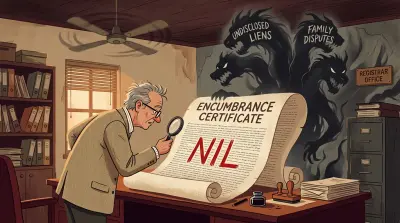
Encumbrances. Is there an active mortgage, lien, or court attachment? The encumbrance certificate is the primary instrument for this check. It extracts all registered transactions from the Sub-Registrar’s register for a given period. One critical caveat: it shows only registered encumbrances. A mortgage by deposit of title deeds - where a borrower deposits original documents with a lender instead of executing a registered mortgage deed - creates no public record and will not appear on any EC.
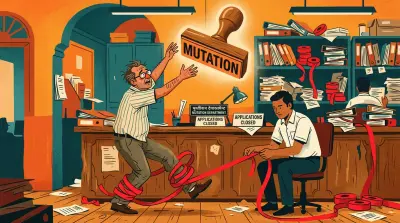
Revenue records. Does the government’s land record system recognise the current owner? Registration (through the Sub-Registrar) and revenue records (through the revenue department) are two separate systems that do not automatically sync. A sale deed does not update land records. Mutation must be filed separately. In Telangana, the current system is Bhu Bharati (bhubharati.telangana.gov.in), which replaced Dharani in April 2025.
Litigation. Is there a pending court case affecting the property? Court proceedings do not appear on an EC unless a lis pendens notice has been formally registered with the Sub-Registrar - and courts routinely fail to do this. The National Judicial Data Grid (njdg.ecourts.gov.in) is the only systematic way to search for active cases.
Tax and dues. Are property tax, water charges, and municipal dues current? These follow the property. Arrears do not reset when ownership changes - they transfer to the next owner.
What to Check and Where
Encumbrance Certificate
All major states now offer online EC searches through their IGRS (Inspector General of Registration and Stamps) portals. You need the property’s survey or plot number and the Sub-Registrar office jurisdiction.
| State | Portal | Records from |
|---|---|---|
| Telangana | registration.telangana.gov.in | 1983 |
| Andhra Pradesh | registration.ap.gov.in | 1983 |
| Karnataka | kaveri.karnataka.gov.in | April 2004 |
| Tamil Nadu | tnreginet.gov.in | ~1987 |
| Maharashtra | igrmaharashtra.gov.in | 1985 (Mumbai) |
| Kerala | pearl.registration.kerala.gov.in | ~2000 |
Request at least 13 years - the minimum banks require, covering the 12-year Limitation Act period. Before any sale or mortgage, request 30 years.
When reading the EC, trace entries in chronological order. Every mortgage should have a corresponding release or discharge entry further down. Every court attachment should have a vacating order. An unreleased mortgage means the property cannot be transferred cleanly, even if the underlying loan was repaid years ago and the bank simply never filed the paperwork to formally discharge it.
Revenue Records
Each state has its own portal. Search by survey number or owner name and verify that the current owner appears correctly, with the right extent and survey details.
- Telangana: bhubharati.telangana.gov.in
- Andhra Pradesh: meebhoomi.ap.gov.in
- Karnataka: landrecords.karnataka.gov.in (Bhoomi)
- Tamil Nadu: eservices.tn.gov.in
For the complete portal directory - every state’s URL, the exact access steps, and how to reach each one from outside India - use our state-by-state land records guide. This post is about what to verify; that one is the reference for where to pull each record.
If records still show a previous owner or a deceased person, mutation has not been completed. This causes problems even when you have the sale deed - banks flag the mismatch on loan applications, and in some states it can block further registration.
Litigation
Go to njdg.ecourts.gov.in and search by party name and state. It is an imperfect search - spelling variations can cause misses - but it catches active registered disputes. For properties in Hyderabad and Telangana, also check whether the survey number appears in any government acquisition notifications or HYDRAA enforcement proceedings.
Tax Dues
For Hyderabad, the GHMC portal lets you check dues by PTIN or door number. Other municipal corporations - CDMA in Andhra Pradesh towns, BBMP in Bengaluru, MCGM in Mumbai - have equivalent portals. Confirm that dues are nil and that the PTIN is in the current owner’s name, not a deceased or previous owner.
Clean Title vs Problem Title
| Dimension | Clean | Problem |
|---|---|---|
| Ownership chain | All transfers registered, unbroken back 30+ years | Gap in chain, missing link document, unregistered gift or partition |
| Encumbrances | Nil EC, or all mortgages discharged | Active mortgage, unreleased lien, court attachment |
| Revenue records | Owner’s name current in state land records | Previous owner in records, mutation pending |
| Litigation | No cases on NJDG | Active suit, lis pendens, family partition dispute |
| Tax dues | All dues nil, PTIN in current owner’s name | Arrears compounding, PTIN in old or deceased owner’s name |
| Buildings | Approved plan, occupancy certificate obtained | Unapproved construction, layout not sanctioned |
One problem row is enough to complicate a sale. Two or more usually mean the property is not transactable until the issues are resolved.
Title Problems That Surface at the Worst Moment
Unreleased equitable mortgage. The seller repaid a loan years ago and received the original documents back from the bank. But no formal release deed was ever executed and no entry was made in any Sub-Registrar register, because equitable mortgages generate no registered document in the first place. The EC looks clean. When the new buyer’s bank conducts due diligence, it discovers the original documents had been deposited - and no formal discharge exists on paper. The transaction stalls.
Mutation not done after inheritance. The heir paid property tax for years but in the previous generation’s name, because that was the PTIN on file. Revenue records still show the deceased parent. When a buyer applies for a home loan, the bank’s legal team flags the revenue record mismatch and will not proceed until mutation is evidenced.
Joint family share not released. A co-owner sold without a formal partition deed releasing the other co-owners’ shares. Every subsequent buyer has unknowingly purchased into a potential dispute. The title appears valid until a surviving co-owner surfaces with a claim - often timed to coincide with the property’s highest value.
Survey number mismatch. The survey number in the sale deed does not match what appears in current revenue records. This happens routinely after government resurveys, when partial plots were sold without formal subdivision orders, or through digitisation errors. Banks flag it on every home loan check. Correcting it requires a rectification deed or a revenue modification application - neither of which is quick if discovered at the time of a sale.
The Check You Can Do Yourself
A preliminary title check does not require a lawyer. Here is the whole sequence at a glance, then each step in detail:
| Step | What to check | Where | What a red flag looks like |
|---|---|---|---|
| 1 | Gather your core documents | Your own files | Missing link documents, or no sale deed at all |
| 2 | Pull a fresh EC (13-30 years) | State IGRS portal | A mortgage with no discharge entry, or a court attachment |
| 3 | Check revenue records | State land portal (Bhu Bharati, Meebhoomi, Bhoomi) | Name, survey number or extent does not match the sale deed |
| 4 | Search for litigation | NJDG (njdg.ecourts.gov.in) | An active suit or lis pendens against the owner or property |
| 5 | Confirm tax dues | Municipal portal (GHMC and equivalents) | Arrears, or the PTIN in a previous or deceased owner’s name |
Step 1. Locate your core documents: the sale deed, all available link documents going back as far as possible, the most recent EC, the mutation certificate, and property tax receipts for at least the last three years.
Step 2. Pull a fresh Encumbrance Certificate through the IGRS portal for your state. Compare every entry against the documents you have. Flag any mortgage without a corresponding discharge entry, any court attachment, any transaction you cannot trace to a document in your possession.
Step 3. Check revenue records on your state’s land portal. Verify the owner’s name, survey number, and extent match the sale deed. If they do not, note it - this needs to be resolved before any transaction.
Step 4. Search NJDG for the owner’s name and property address. Note any active cases.
Step 5. Confirm nil tax dues on the relevant municipal portal.
If all five come back clean, you have a sound preliminary picture. For a purchase or sale, a lawyer’s formal title opinion is still the right next step - but this check tells you whether there is anything significant before you commit to professional fees.
If You Are Buying: What to Demand From the Seller
The checks above work whether you are auditing your own property or vetting one you intend to buy. As a buyer, though, you are not just reading public records - you are asking the seller to hand over proof. Insist on these before any token money changes hands:
| What to ask for | Why it matters |
|---|---|
| A fresh 30-year Encumbrance Certificate | Shows mortgages, liens and attachments across the full limitation window, not just recent years |
| The complete set of link documents | Proves an unbroken chain of ownership; a missing link is the single most common defect |
| A current revenue extract with mutation done | Confirms the government land record names the seller, not a deceased or previous owner |
| The latest property tax receipt | Dues follow the property to you, so nil arrears must be verified, not assumed |
| Approved plan and occupancy certificate (for buildings) | Unapproved construction cannot be regularised at will and blocks resale and loans |
If the seller cannot produce any one of these, treat it as a reason to pause, not a formality to waive.
If the seller is a company rather than an individual, four further questions apply, and none of them is answered by the documents in that table: whether the company still legally exists, whether the person signing can bind it, whether the property is already charged to a lender, and who files the release after you pay. Our guide to buying property from a company works through each one.
Verifying a Title From Abroad
For NRIs, the checks are identical but the logistics are harder. The good news is that most of the record-based verification is fully online and can be run from anywhere: the Encumbrance Certificate through the state IGRS portal, revenue records through the state land portal, litigation on NJDG, and tax dues on the municipal site. The state-by-state guide linked above sets out the from-abroad access steps portal by portal.
What does not travel is anything physical. Obtaining certified copies of thirty-year-old link documents, inspecting the original deeds a seller claims to hold, and confirming who is actually in possession of the land all need someone on the ground. This is where a specific Power of Attorney holder or a local property lawyer earns their fee - not for the online checks you can run yourself, but for the physical verification you cannot do from another country. The trap to avoid is assuming a relative’s verbal “the papers are fine” is due diligence. It is not. Run the record checks yourself, then have a professional close the physical gaps.
Where a Structured Tool Goes Further
Running this across five portals in different regional languages, reconciling the results, and working out what each gap means in practice takes time. For signed-up users, Assetly’s Prabhakar AI consolidates these checks against Bhu Bharati, IGRS, and GHMC records and generates a structured title report - showing what is clear, what needs attention, and what is a hard blocker for any transaction.
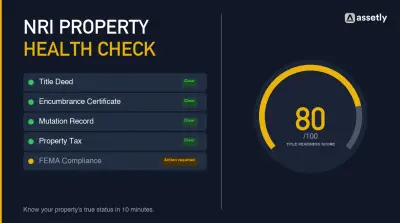
The free Title Readiness Check at assetlyhq.com/free-tools covers the document and encumbrance dimensions in under ten minutes. No account required for the initial check.
The Registration Misconception
One thing worth stating plainly before you run any of these checks: a registered sale deed does not prove you own the property. The Supreme Court confirmed this in K. Gopi v. Sub-Registrar (2025 INSC 462), which struck down a Tamil Nadu rule that allowed Sub-Registrars to demand proof of a seller’s title before registering a deed. Examining a seller’s title is not the Sub-Registrar’s statutory function. Registration records that a transaction was executed. It does not validate whether the seller had the legal right to sell in the first place.
Title verification is what fills that gap. A registered deed is the starting point. The EC, revenue records, litigation search, and link document review are what determine whether that starting point is sound.
For a broader look at all the dimensions of property risk - documents, encumbrances, taxes, compliance - the NRI Property Health Check covers all five in a single structured review.
Assetly is a property document management platform that helps Indian property owners organise, verify, and track their property documents digitally. Learn more at assetlyhq.com.