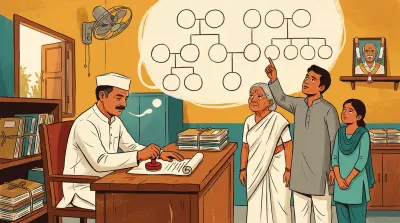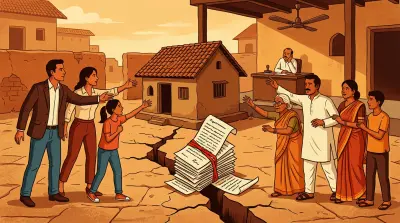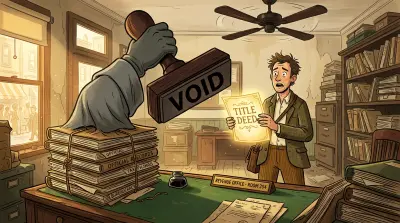


Four siblings. One flat in Mumbai. One parent who never wrote a will.
That is the starting point for thousands of property disputes every year in India. The parent assumed the children would “sort it out.” The children assumed there was a will somewhere. There was not. And now the flat sits frozen, caught between four competing claims, a court backlog that stretches years, and legal fees that eat into whatever the property is worth.
India has over 7 million pending property cases. A significant number of them come down to two missing pieces of paper: a will that was never written, or a succession certificate that was never obtained.
If the family already has some documents but still cannot move the property forward, see Why NRI Property Gets Stuck in Succession Disputes in India for the operational side of the problem.
These are the documents that decide who gets your property after you die. And if you are alive, they are the documents that decide whether your heirs spend six months or six years sorting things out.
If you want to transfer property during your lifetime rather than through a will, a registered gift deed is the alternative instrument to consider - with different tax consequences and very different rules on revocability. Our gift deed guide covers when each instrument makes sense.
Let us break them down.
The Four Documents You Need to Know
There are four documents that come into play when property passes from one person to another after death. People use the terms interchangeably, which causes confusion. They are not the same thing.
1. Will (Wasiyat in Muslim law)
A will is a written document where you state who should get your property after you die. Simple concept, but the legal requirements matter.
Under Section 63 of the Indian Succession Act, 1925, a valid will must be:
- Signed by the testator (the person making the will), or marked if they cannot sign
- Attested by two witnesses, each of whom has seen the testator sign or has received a personal acknowledgement of the signature
- Each witness must sign in the presence of the testator
That is it. No stamp paper required. No lawyer required. No registration required. You can write a will on a plain piece of paper, sign it in front of two witnesses, and it is legally valid.
But “legally valid” and “practically useful” are different things, as you will see shortly.
2. Probate
A probate is a court order that certifies a will is genuine. Think of it as the court putting its stamp on the will and saying: yes, this is real, this was the last will of the deceased, and they were of sound mind when they wrote it.
Until December 2025, probate was mandatory in the original civil jurisdictions of the High Courts of Kolkata, Mumbai, and Chennai. The Repealing and Amending Act, 2025 abolished that requirement by omitting Section 213 of the Indian Succession Act. Probate is now optional everywhere in India.
Optional, but still valuable. A probated will is very hard to challenge. An unprobated will can be contested by anyone who claims it is forged, that the testator was coerced, or that a later will exists. Probate shuts down most of these challenges before they begin.
3. Succession Certificate
A succession certificate is issued by a civil court under Part X of the Indian Succession Act (Sections 370 to 390). It is used when someone dies without a will (intestate), and the heirs need to claim the deceased’s movable assets: bank accounts, fixed deposits, shares, mutual funds, insurance payouts.
Key point: a succession certificate does not cover immovable property (land, flats, houses). It covers debts and securities owed to the deceased.
To get one, you file a petition under Section 372 before the District Judge, listing the time of death, the deceased’s residence, all family members and near relatives, and the specific debts or securities you want the certificate for. The court issues a public notice, waits for objections, and if nobody contests, grants the certificate.
4. Legal Heir Certificate
A legal heir certificate is issued by the local revenue authority (Tahsildar, MRO, or equivalent). It simply lists who the legal heirs of the deceased are. It does not grant any right to property by itself, but you need it for:
- Applying for mutation of property records
- Transferring utility connections
- Claiming government benefits (pension, provident fund)
- Supporting your application for a succession certificate
It is the simplest and quickest of the four documents. The exact name (legal heir certificate, family member certificate), the issuing office, and the time it takes all vary by state, so treat any single figure as indicative. Our dedicated guide covers how to get a legal heir certificate, state by state, and what it can and cannot prove.
Quick Comparison: Which Document When?
| Document | Issued by | Covers | Time to obtain | When you need it |
|---|---|---|---|---|
| Will | The property owner (while alive) | All property (movable and immovable) | N/A (created during lifetime) | Always. Every property owner should have one |
| Probate | Civil court | Validates the will | 6 months to 2 years | When the will is likely to be contested, or for high-value property |
| Succession certificate | Civil court (District Judge) | Movable assets only (bank accounts, shares, debts) | 3 to 6 months | When someone dies without a will, and heirs need to claim financial assets |
| Legal heir certificate | Revenue authority (Tahsildar/SDM) | Establishes who the heirs are | 15 to 30 days | For mutation, utility transfers, government benefits |
How to Make a Will for Indian Property
Making a will is one of the simplest legal acts in Indian law. There is no prescribed format. There is no minimum age other than being a “major” (18 years). You do not need a lawyer, though having one draft it reduces the risk of ambiguity.
Here is what a will for property should include:
Your identity. Full name, address, father’s name, date of birth. If you are an NRI, include your passport number and overseas address.
A declaration. State that you are of sound mind, acting voluntarily, and that this will revokes all previous wills. This last part matters. If you wrote a will ten years ago and write a new one today, you want it clear that the new one supersedes the old.
Property details. Describe each property with enough specificity that there is no confusion. Include: the full address, survey number or plot number, registration details (document number, book number, Sub-Registrar office), total area, and boundaries. If you own a flat, include the society name, flat number, floor, and wing. Vague descriptions cause disputes.
Who gets what. Name each beneficiary clearly with their relationship to you, full name, and address. If you want to divide a property among multiple heirs, state the exact shares.
An executor. Appoint someone you trust to carry out the will. This person will apply for probate (if needed), ensure the property is transferred, and handle any disputes. If you are an NRI, appointing someone in India as executor is practical.
Witness signatures. Two witnesses must sign. They should not be beneficiaries under the will, as that creates the kind of suspicious circumstances courts look at closely. More on that below.
Making a Will From Abroad (NRIs)
If you are an NRI, you can make a will for Indian property while sitting in any country. The will is valid under Indian law as long as it meets the requirements of Section 63 (signed by you, attested by two witnesses).
For extra legal protection:
- Get it attested at the Indian consulate or embassy. The consulate will verify your identity and attest the document. This creates an official record that is very difficult to challenge later.
- Register it in India. You can register your will at the Sub-Registrar’s office where the property is located. Since you cannot travel, your Power of Attorney holder can present the will for registration on your behalf.
- Keep the Indian property description precise. Include registration details from the original title deed or sale deed. The more specific, the harder it is for anyone to claim confusion about which property the will covers.
Registered vs Unregistered Will: What Is the Difference?
This is one of the most misunderstood areas in Indian property law.
Registration of a will is not mandatory. Section 18 of the Registration Act, 1908 places wills in the category of documents where registration is optional. An unregistered will is just as legally valid as a registered one, provided it meets the requirements of Section 63.
So why bother registering?
Because an unregistered will is dramatically easier to challenge. And the Supreme Court has laid out exactly how courts should approach contested wills.
In the landmark case H. Venkatachala Iyengar v. B.N. Thimmajamma (1958), the Supreme Court established the framework that courts still follow today:
“The onus must be on the propounder and in absence of suspicious circumstances surrounding the execution of the will, proof of testamentary capacity and signature of the testator as required by law may be sufficient to discharge the onus.”
But when suspicious circumstances exist, the bar goes up:
“Where, however, there are suspicious circumstances, the onus would be on the propounder to explain them to the satisfaction of the Court before the will can be accepted as genuine.”
What counts as suspicious? The court gave a clear example: if the propounder takes a prominent part in the execution of a will that confers substantial benefits on them, that itself is a suspicious circumstance, and the court should proceed “with an open but nevertheless vigilant and cautious mind.”
A registered will sidesteps many of these problems. The Sub-Registrar verifies the testator’s identity, the testator signs in front of the Sub-Registrar, and the document is stored in the official records. It does not make the will unchallengeable, but it removes the easiest grounds for challenge: that the signature was forged, that the testator did not know what they were signing, or that the will was fabricated after death.
For NRIs, this matters even more. You are not around to defend the will in person. Your witnesses may be abroad. A registered will, sitting in the Sub-Registrar’s records in India, speaks for itself.
The practical recommendation: Register your will. The cost is negligible (a few hundred rupees in most states), the process takes a couple of hours, and it eliminates the single biggest vulnerability of an unregistered will.
Succession Certificate: How to Get One
When someone dies without a will, their heirs need a succession certificate to claim the deceased’s movable assets. Here is the process in brief; our dedicated step-by-step guide to getting a succession certificate in India covers the court fees, timelines, and applying from abroad in full.
The process runs through the District Judge under Section 372 of the Indian Succession Act. You file a petition setting out the death, the heirs, and the specific debts and securities you want to claim. The court publishes a public notice inviting objections (usually a 45-day window) and, if nobody contests, grants the certificate once you pay the court fee. That fee is charged as a percentage of the value of the assets and varies by state, which is where the cost adds up. An uncontested certificate typically takes several months; a contested one can run to a year or two.
Rather than repeat all of it here, our dedicated guide covers the full succession certificate process, court fees by state, realistic timelines, and how NRIs apply from abroad.
One important limitation: A succession certificate covers only movable assets. For immovable property (land, flats), you need a legal heir certificate for mutation, and the property transfers through the applicable succession law, not through the certificate.
Religion-Specific Succession Rules
Which law governs your inheritance depends on your religion, not your citizenship or where you live. An NRI Hindu in California is governed by the Hindu Succession Act. An NRI Muslim in London is governed by Islamic succession law. Here is a brief comparison.
| Aspect | Hindu (HSA, 1956) | Muslim (Shariat Act) | Christian (ISA, 1925) | Parsi (ISA, 1925) |
|---|---|---|---|---|
| Will freedom | Can bequeath 100% of self-acquired property and own share in ancestral property by will | Can bequeath only one-third of estate by will; two-thirds goes by fixed shares | Can bequeath 100% by will | Can bequeath 100% by will |
| Intestate: widow’s share | Equal share with other Class I heirs | Fixed share (one-eighth if children exist, one-fourth if no children) | One-third if children exist, one-half if no children | Equal share with each child |
| Daughter’s rights | Equal to sons (post-2005 amendment) | Fixed share (typically half of a son’s share) | Equal to sons | Equal share with each child |
| Ancestral property | Daughters have coparcenary rights (equal to sons) since 2005 amendment | No concept of ancestral property; all property distributable | No concept of coparcenary | No concept of coparcenary |
| Governing law | Hindu Succession Act, 1956 (amended 2005) | Muslim Personal Law (Shariat Application Act, 1937) | Indian Succession Act, 1925 (Part V) | Indian Succession Act, 1925 (Part V) |
The one-third rule for Muslims deserves special attention. Under Islamic succession law, a Muslim can only bequeath one-third of their total estate by will (after payment of debts and funeral expenses). The remaining two-thirds must be distributed according to fixed shares prescribed by Islamic law. A bequest exceeding one-third is valid only if the other heirs consent after the testator’s death. Under Sunni law, bequests to legal heirs themselves require similar consent; Shia law permits bequests to heirs up to the one-third limit without consent.
For Hindus, the 2005 amendment to the Hindu Succession Act gave daughters equal coparcenary rights in ancestral property, the same as sons. This applies regardless of whether the daughter is married, unmarried, an NRI, or an OCI holder. If you are an NRI daughter who has been told you have no claim to ancestral property, that information is out of date.
NRI-Specific Considerations
If you are an NRI dealing with wills and succession for Indian property, there are several things that apply specifically to you.
FEMA does not restrict inheritance. While NRIs face restrictions on buying certain types of property under FEMA, inheritance is treated differently. You can inherit any type of property, including agricultural land, without RBI approval. The restrictions only apply when you want to sell inherited agricultural land (you can only sell to a person resident in India).
Your will should cover Indian and overseas assets separately. Many NRIs make the mistake of writing a single will covering everything. The problem: when you die, the probate process in one country may not be recognised in another. Consider having one will for your Indian assets (governed by Indian law) and a separate will for your overseas assets (governed by the law of your country of residence). Make sure neither will accidentally revokes the other.
Consulate attestation adds weight. Getting your will attested at the Indian consulate creates an official record that is hard to challenge. The consulate verifies your identity, the witnesses sign in front of a consular officer, and the attestation is recorded.
Power of Attorney for execution. Your executor in India will need a Power of Attorney to act on your behalf for succession formalities: applying for mutation, collecting bank deposits, dealing with housing societies. Make the PoA specific to these actions. A general PoA creates unnecessary risk.
Store documents securely and digitally. Your will, the original title deeds, encumbrance certificates, mutation records, and legal heir certificates should all be accessible to your family and executor when needed. Keeping originals in a bank locker in India is prudent, but your heirs may not have immediate access to the locker after death. Assetly lets you store digital copies of all these documents in one place, with access controls, so your family is never scrambling to locate papers across continents.
Common Mistakes
Not writing a will at all. This is the biggest one. The majority of Indians do not have a will. They assume the law will sort it out. The law will sort it out, but it will take years, cost lakhs in legal fees, and potentially destroy family relationships in the process. Writing a will takes an afternoon. Not writing one can cost a decade.
Writing a will but not getting it witnessed properly. Two witnesses must attest the will in the presence of the testator. If either witness is also a beneficiary, that creates a suspicious circumstance that courts will scrutinise. If the witnesses cannot be located years later when the will is needed, proving the will becomes harder. Choose witnesses who are younger than you, are not beneficiaries, and are likely to be reachable.
Assuming an unregistered will is enough. It is legally valid, but practically fragile. If someone produces a second will, or claims yours is forged, you (or rather, your heirs) will be fighting an uphill battle. Registration costs very little and provides an independent record at the Sub-Registrar’s office.
Not obtaining a succession certificate when needed. Banks will not release funds to heirs without proper documentation. If the deceased had significant bank deposits or share holdings and died without a will, you need a succession certificate. Delaying this means the assets sit frozen while the paperwork catches up.
Confusing mutation with ownership. After getting a succession certificate or establishing your right under a will, you still need to apply for mutation to update the revenue records. Mutation does not create ownership, but without it, you cannot pay property tax in your name, and selling the property becomes much harder. Our guide on inherited property for NRIs covers the full 90-day timeline.
Ignoring the one-third rule (Muslim families). If you are Muslim and have bequeathed more than one-third of your estate by will, the excess portion is invalid unless all heirs consent after your death. This catches families off guard, especially when the will was drafted without understanding Islamic succession law.
Assetly is a property document management platform that helps Indian property owners organise, verify, and track their property documents digitally. Learn more.