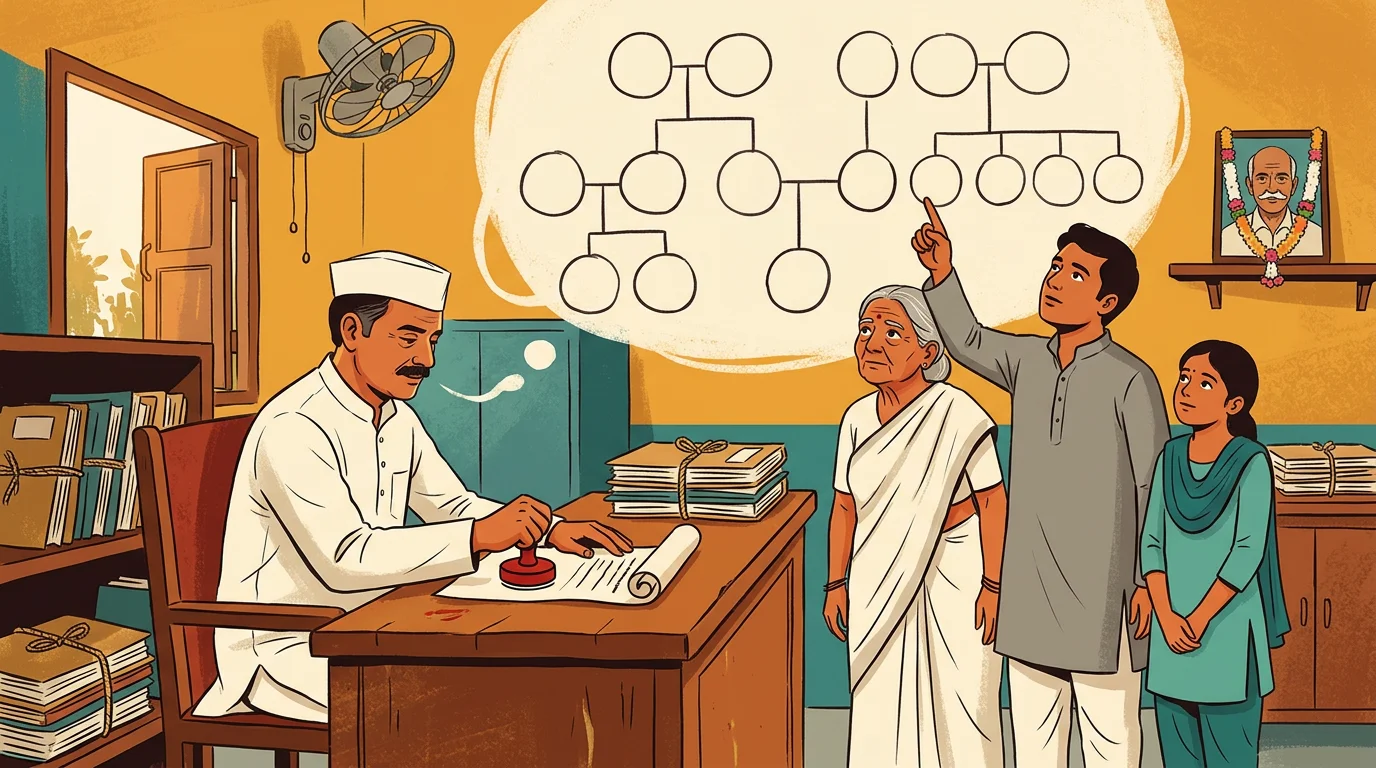

When someone dies and the family starts dealing with the paperwork, one document is asked for again and again: a bank wants it, the property tax office wants it, the pension department wants it, the mutation clerk wants it. It is the legal heir certificate. And because it is asked for so often, most families assume it does far more than it actually does. If you are not yet sure which route applies, begin with our decision guide to the documents needed after a property owner dies.
It does not transfer property. It does not decide who owns what. It does not settle a dispute between siblings. What it does is narrow and specific: it records who the surviving heirs of a deceased person are, so that administrative machinery, revenue offices, banks, employers, and utility providers, has an official answer to the question “who are this person’s family members?”
Getting that one thing clear saves months. This guide covers what the certificate is and is not, who can apply, how the process works in different states, what delays and rejections to expect, and how someone living abroad can get one.
What a Legal Heir Certificate Actually Proves
A legal heir certificate is an administrative document issued by the local revenue authority. It lists the deceased, the date of death, and the surviving legal heirs with their relationship to the deceased. That is the whole content.
It is used for a defined set of practical purposes:
- Applying for mutation of inherited property in revenue or municipal records
- Transferring utility connections (electricity, water, gas) into an heir’s name
- Claiming a deceased person’s pension, gratuity, provident fund, or family arrears
- Settling insurance and other service benefits
- Supporting an application for a compassionate government appointment
- Supporting a succession certificate petition in court
Here is the part families get wrong. The certificate does not confer title. It does not prove ownership, and it cannot be used to decide who inherits what when heirs disagree.
The clearest statement of this came from the Madras High Court in 2022. A Full Bench in P. Venkatachalam v. The Tahsildar, Kumarapalayam Taluk was asked what weight a Tahsildar’s certificate carries. The court held that such certificates “amount to nothing more than a relationship certificate reflecting the opinion of the Tahsildar as to the relationship of the applicant and others named therein with the deceased.” It added that the certificate does not by itself decide anyone’s legal rights and “cannot be equated to a succession certificate issued by a Court under Part X of the Indian Succession Act, 1925.”
Read that as the boundary line. The certificate answers who is family. It does not answer who owns the flat. If the second question is genuinely contested, no revenue office can resolve it. That belongs to a civil court applying the relevant succession law.
Legal Heir Certificate vs Succession Certificate
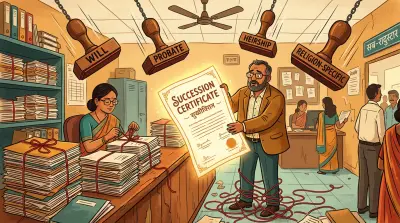
These two are constantly confused, and using the wrong one wastes months. They are different documents, from different authorities, for different jobs.
| Legal heir certificate | Succession certificate | |
|---|---|---|
| Issued by | Revenue authority (Tahsildar / MRO) | Civil court (District Judge) |
| Governed by | State revenue rules | Indian Succession Act, 1925 (Part X) |
| Covers | Records who the heirs are | Debts and securities: bank balances, shares, deposits |
| Used for | Mutation, pensions, utilities, government claims | Collecting movable financial assets |
| Time | Typically weeks | Typically several months |
| Cost | Nominal | Court fee as a percentage of asset value |
For a typical inherited estate you often need both: the legal heir certificate to get the property mutated into the heirs’ names, and a succession certificate for the deceased’s bank deposits or shares. Neither replaces the other, and neither, on its own, transfers a house. Our guide on the four documents that decide who gets your property sets out how wills, probate, and these two certificates fit together.
Who May Apply
The people entitled to apply are the direct legal heirs of the deceased: the surviving spouse, children (sons and daughters equally), and parents. In many states the definition follows Class I heirs under the applicable personal law. Where a Class I heir has themselves died, their children may step into that branch.
One applicant usually files on behalf of the family, but the application must declare all the heirs, not just the applicant. This is not optional. The certificate’s entire value rests on it being a complete list.
Issuing Authority and State-Specific Terminology
There is no single national legal heir certificate. It is a state revenue document, so the issuing authority, the portal, and even the name of the certificate change from state to state. The concept is the same everywhere; the label is not.
- Tamil Nadu issues a “legal heir certificate” (sometimes called a Varisu certificate) through the TN e-Sevai portal under the Revenue department. A Village Administrative Officer and Revenue Inspector verify the claim before the Tahsildar issues it.
- Andhra Pradesh uses the term “Family Member Certificate”, delivered through the AP Seva portal and the Grama-Ward Sachivalayam network, and issued by the Tahsildar.
- Telangana issues a “Family Membership Certificate” (widely referred to as the legal heir certificate) through MeeSeva, with the Tahsildar as the competent authority. For agricultural land, succession is handled separately through the Bhu Bharati portal (see below).
- Karnataka issues a “Surviving Family Member Certificate” through the Nadakacheri portal, issued by the Tahsildar.
Other states have their own equivalents through their respective revenue departments. The practical takeaway: do not fixate on the exact words on the certificate. Confirm that it comes from the revenue authority and that it lists every heir. That is what banks and mutation offices actually check.
Documents and the Family-Tree Declaration
The document set is short, but the family-tree declaration at its centre is the part that matters most. A representative list:
- Death certificate of the deceased
- Identity proof of the applicant (Aadhaar, voter ID, or passport)
- Address proof
- A self-declaration or affidavit listing all the legal heirs and their relationship to the deceased
- Ration card or other proof of the family unit, where the state asks for it
The affidavit or self-declaration is where you set out the full family tree. Take it seriously. The whole purpose of the exercise is to produce a complete, accurate list of heirs. An affidavit that omits a sibling, a half-sibling, a predeceased son’s children, or an estranged spouse is not a shortcut; it is a future dispute waiting to be filed.
The Process: Online and Offline
Most states now offer an online route through their citizen service portal, with an offline fallback at the revenue office or a service centre.
The typical flow:
- Register on the state portal and start an application under the Revenue department (or apply at a service centre or the Tahsildar’s office directly).
- Upload the death certificate, identity proof, and the affidavit listing all heirs.
- In several states, the heirs sign the application before the local revenue officer (for example, the Village Administrative Officer in Tamil Nadu).
- A field officer conducts a local verification, confirming the death and the family details on the ground.
- The Tahsildar reviews the verification and issues the certificate, which you download from the portal or collect from the office.
The online portal usually lets you track the application status, which is genuinely useful when an heir is following it from another city or country.
Field Verification and Objections
The step that most affects timing is field verification. A revenue officer, a Village Administrative Officer, Revenue Inspector, or their equivalent, physically checks that the applicant’s account is accurate: that the person has died, that the listed heirs are the real family, and that no obvious claimant has been left out.
This is also the point at which objections surface. If a neighbour, another relative, or a rival claimant raises a dispute during verification, the application stalls. The revenue office is not a court; it will not adjudicate a genuine heirship fight. If someone credibly contests who the heirs are, the office will typically decline to issue the certificate and effectively point the parties towards a civil court.
Realistic Timeline, Delay Points, and Rejection Reasons
There is no honest India-wide number for how long this takes, because it is not an India-wide process. What is fair to say:
- It usually takes anywhere from a couple of weeks to a month or more.
- States with mature digital delivery tend to be faster; manual districts are slower.
- Any specific day-count you are quoted, including on a portal, is best treated as indicative, not a guarantee.
The common delay and rejection points are practical, not legal:
- Incomplete documents - a missing death certificate, an unsigned affidavit, or an address proof that does not match.
- Field verification bottlenecks - the officer is overloaded, or an heir cannot be reached to confirm details.
- Disputed heirship - a real objection turns a routine filing into a stalemate.
- Class II heir applications - some offices are hesitant to issue certificates to more distant heirs, which was part of what prompted the Madras Full Bench to clarify the certificate’s limited scope.
If your certificate is on the critical path to a mutation or a sale, build in buffer time and file early.
Corrections and Appeals
If a certificate is issued with an error, a misspelt name, a wrong relationship, a missing heir, apply to the same revenue office for a correction, supported by documentary proof of the right particulars.
If the application is rejected or stalled, the practical escalation is up the revenue hierarchy, typically to the Revenue Divisional Officer or Sub-Collector, and, where a state provides one, through the district grievance mechanism. Ask the office for the reason for rejection in writing; most rejections are for fixable document or verification issues rather than a legal bar. Where the underlying problem is a genuine dispute about who the heirs are, no amount of escalation within the revenue system will fix it, and the honest advice is to take the heirship question to a civil court.
Using the Certificate for Property Mutation
The most common property use of the certificate is mutation: updating the revenue or municipal records to show the heirs as the recorded holders of the inherited property. You submit the certificate along with the death certificate, the title document, and the latest tax receipts.
Do not overread what this achieves. Mutation updates a record; it does not confer ownership. The Supreme Court put it plainly in Sawarni v. Inder Kaur (1996): “Mutation of a property in the revenue record does not create or extinguish title nor has it any presumptive value on title.” So the chain is honest but modest: the legal heir certificate establishes who the family is, mutation updates the record to match, and actual title still rests on the succession law and the underlying documents. When multiple heirs inherit a single property and want to divide it, the next step is usually a registered partition deed, not another certificate.
For Applicants Living Abroad
An NRI can obtain a legal heir certificate, but not from a laptop alone. Because the process involves local field verification, someone has to be reachable on the ground.
The workable route:
- Appoint a representative through a Power of Attorney. A trusted relative or a lawyer files the application, attends the office, and handles verification. Scope the PoA narrowly to this task rather than granting broad property authority.
- Get the PoA properly executed. Sign it abroad, then apostille it (in Hague Convention countries such as the UK, US, Australia, and Singapore) or have it attested at the Indian consulate (in countries like the UAE), and have it stamped in India.
- Assemble the family-tree list before filing. The single biggest NRI delay is not the office; it is the weeks lost gathering the death certificate from one relative and the heir details from another across time zones.
No Indian state currently guarantees a fully remote, zero-presence issuance, so assume a representative is needed for the physical steps. Keeping the death certificate, the affidavit, the title deed, and the eventual certificate organised digitally means your representative is never blocked waiting for a document. Assetly is built for exactly this: one place for the whole inherited-property document stack, reachable from anywhere.
Andhra Pradesh and Telangana in Practice
The two Telugu states are worth a closer look because they illustrate how the same document works under different names and systems.
In Andhra Pradesh, the equivalent document is the Family Member Certificate, applied for through the AP Seva portal and the Grama-Ward Sachivalayam network and issued by the Tahsildar. The Sachivalayam system pushed a lot of routine revenue services close to the citizen, which tends to make delivery quicker than a purely counter-based process.
In Telangana, the Family Membership Certificate is applied for through MeeSeva, with the Tahsildar as the competent authority. For agricultural land, succession does not run through the ordinary certificate route; it runs through the Bhu Bharati portal under the Telangana Bhu Bharati (Record of Rights in Land) Act, 2024 (Act No. 1 of 2025), which replaced the old Dharani system. There, the legal heirs of a deceased pattadar apply for succession to the Tahsildar, and the Act requires a joint statement by all the legal heirs for an intestate succession, with notice to family members before the record is mutated. That built-in “all heirs, together” requirement is the system encoding the same lesson this guide keeps returning to: the certificate is only as good as the completeness of the heir list behind it.
The One Rule to Remember
A legal heir certificate is a relationship certificate, no more and no less. It tells the world who the family is so that administrative life can continue: mutation, pensions, utilities, and the paperwork of settling an estate. It is quick, cheap, and necessary. But it does not own anything, transfer anything, or decide anything contested. Treat it as the key that opens the administrative doors, and use the right instrument, a will, a succession certificate, a partition deed, or a civil suit, for the questions it was never meant to answer.
Related Reading
- Will and Succession Certificate: The Documents That Decide Who Gets Your Property - how wills, probate, and both certificates fit together
- How to Get a Succession Certificate in India - the court document for bank balances and shares
- Mutation Record: The Document Most People Forget - what the certificate is most often used for
- Inherited Property in India? Here’s What NRIs Must Do - the full inheritance timeline
- How to Register a Family Partition Deed in India - the next step when several heirs inherit together
Assetly is a property document management platform that helps Indian property owners, including NRIs, organise, verify, and track their property documents digitally. Learn more at assetlyhq.com.