

Digital land record portals have made one thing much easier: checking your property records from anywhere in the world. In Telangana, you can look up your pattadar passbook on Bhu Bharati (formerly Dharani). In Andhra Pradesh, Meebhoomi shows your ROR-1B and Adangal. For NRIs and remote property owners, this is genuinely useful.
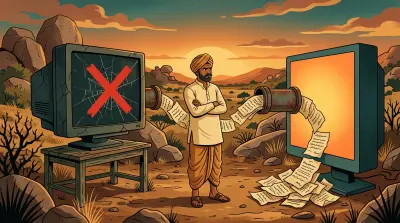
But these portals have a gap that most property owners do not think about. They let you check your records, but they do not alert you when your records change. If a revenue official updates an entry, issues a new passbook, or processes a mutation, you will not receive a notification. You will only find out if you happen to check.
Court cases from Telangana illustrate why this matters. In multiple instances, the High Court has found that land records were altered without the owner’s knowledge, sometimes while court orders were actively protecting the property. These are not hypothetical risks.
This guide covers the specific vulnerabilities that have been documented, and a practical checklist for monitoring your records in both states.
What Can Be Changed, and How
Digital land record portals are databases maintained by revenue officials. Like any database, they can be updated by people with access. And unlike a bank account, there is no two-factor authentication or owner approval required before records change.
Three types of changes have been documented in court cases:
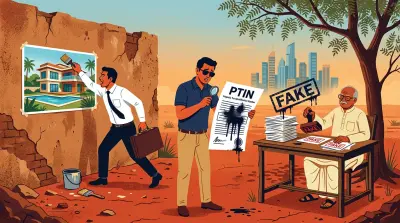
Ownership entries. In a 2024 Telangana High Court case, the court found that revenue officials processed an application and updated portal entries to show a different person as the pattadar (recorded owner) of agricultural land. The actual owner had held the land since 1998. The court declared the changes “illegal, null and void” and noted:
“These things cannot take place without the support and connivance of the revenue authorities.”
The court ordered the records restored and directed disciplinary action against the officials involved (Asian Tubes v. State of Telangana, 2024).
Pattadar passbooks. In a separate 2023 case, a Tahsildar issued new pattadar passbooks for agricultural land without serving notice on the actual owner, without conducting the mandatory field inspection required by CCLA guidelines, and after an earlier application for the same land had already been rejected. The passbooks were issued based on an unregistered sada bainama (simple sale agreement), which by itself does not transfer ownership. The court cancelled both passbooks (B. Anitha v. State of Telangana, 2023).
The same limit appeared again in 2026, when the High Court cancelled a Tahsildar’s attempt to validate three Sada Bainama transactions over an existing registered deed.
Registration of tampered documents. In a 2019 case, the Telangana High Court found that a Sub-Registrar had registered a deed where the word “sale” had been physically erased with whitener. The court noted:
“The word ‘sale’ is faintly visible between the words ‘absolute’ and ‘Deed’ but this word was also obliterated.”
The document showed multiple other erasures and insertions. The Sub-Registrar registered it anyway. Criminal proceedings against the Sub-Registrar continued (Suvishal Power Gen v. State of Telangana, 2019).
Why You Need to Check Proactively
These portals are designed for you to look up your records. They are not designed to notify you when something changes.
Bhu Bharati (Telangana): The portal sends SMS updates about application status and transaction progress. But there is no automatic alert when an ownership entry is modified. If you want to know whether your records are correct, you need to log in and check.
Meebhoomi (Andhra Pradesh): Pattadars who have linked their mobile numbers via OTP verification receive SMS alerts about some changes. But the coverage is not comprehensive, and many owners, particularly NRIs who may have Indian numbers they do not actively use, are not linked.
Both portals are improving. Telangana’s Bhu Bharati platform is adding better audit trails, and AP is rolling out QR-enabled passbooks. But for now, the responsibility to verify your records sits with you.
In the cases described above, the owners were not checking. By the time they discovered the changes, new passbooks had been issued and transactions had been recorded.
What You Should Do
Check your records regularly
For Telangana: Visit bhubharati.telangana.gov.in (formerly dharani.telangana.gov.in). Use “Know Your Land Status” and search by survey number or pattadar passbook number. Verify that your name, survey number, land extent, and land classification are all correct. While you are there, check the survey number against Telangana’s Section 22A prohibited-property registers so you know the parcel has not been flagged as government, endowment, or assigned land.
For Andhra Pradesh: Visit meebhoomi.ap.gov.in. Check your ROR-1B (ownership record) and Adangal (village account). You can search by Aadhaar number, account number, or survey number.
Do this at minimum every six months. If your property is in a high-value or peri-urban area, check quarterly.
Save dated copies every time you check
Download or screenshot your records each time. If your records are later altered, your own timestamped copies are evidence of what they used to show. Without a baseline, you cannot prove tampering.
Store these digitally with dates. Assetly lets you organise property documents with timestamps, accessible from anywhere, which is particularly useful for NRIs who need to compare records across checks.
Get encumbrance certificates regularly
An encumbrance certificate (EC) shows every transaction registered against your property: sales, mortgages, liens, court attachments.
For Telangana: Agricultural land ECs are available through the Bhu Bharati portal. For urban property, use the IGRS Telangana portal under “Encumbrance Search.” Records are available for transactions from 1 January 1983 onwards.
For AP: ECs are available through the Registration Department portal.
Get a fresh EC at least once a year. If a fraudulent transaction has been registered against your property (like the whited-out sale deed in the 2019 case), the EC is where it will show up.
Link your current mobile number
For AP’s Meebhoomi, ensure your active mobile number is linked to your land records via OTP verification. This enables whatever SMS alerts the system provides. If you are an NRI, consider using an Indian number that forwards to your overseas number, or check whether a family member’s number can be linked.
For Telangana’s Bhu Bharati, register your mobile number and Aadhaar when the system allows. The portal is still in transition, so check periodically for new features.
Engage a local contact
If you live abroad or in another state, have someone who can visit the MRO or Tahsildar office and physically verify your records. Online portals reflect what the database says. A physical visit can reveal pending applications, notices, or proceedings that have not yet been updated online.
In the court cases discussed above, the changes went undetected because no one was physically verifying the records at the local revenue office. A periodic check by a trusted contact adds a layer of protection that no portal can replace.
Act immediately on discrepancies
If your records show a different owner, a different extent, or a transaction you did not authorise:
- Get a certified copy of the altered record from the MRO/Tahsildar office (not just a portal screenshot)
- File a written complaint with the District Collector and the MRO, keeping a copy with acknowledgment
- File a complaint with the Anti-Corruption Bureau if official misconduct is suspected
- Consult a local property lawyer about filing for a stay or injunction to prevent further transactions
- If you have your own dated copies showing the correct records, preserve them as evidence
Speed matters. As the Madhya Pradesh High Court observed in a 2025 ruling about fraudulent mutations: “Immediately after getting mutation on the basis of will, the first thing which a person does is to alienate the land and in this manner, creates third party rights leading to a loss.” The longer an incorrect record stands, the more transactions can be layered on top of it.
The Bigger Picture
The Vattinagulapalli land dispute near Hyderabad’s ORR is a striking example of why proactive monitoring matters - the government admitted in court that original survey maps (Tippons) for the disputed land do not even exist, leaving owners with no authoritative reference for boundaries.
Both states are actively working to strengthen their land record systems. Telangana is transitioning to the Bhu Bharati platform with better audit trails and integration between revenue, registration, and survey records. A 2025 audit identified discrepancies in 4,848 transactions and the state is expanding its review across all districts. AP’s Meebhoomi is rolling out QR-enabled passbooks for instant mobile verification. These are meaningful steps forward.
But even the best portal cannot eliminate a fundamental reality: land records are maintained by people, and any system maintained by people requires oversight. The most effective oversight for your own property is you. For what can go wrong when nobody monitors government land for years, see how ₹1,200 crore of assigned land in Khanamet was encroached despite being on the prohibited list. And for where land monitoring technology is headed, read our guide on satellite imagery and AI-driven encroachment detection.
Digital governance has made land records far more accessible than they used to be. An NRI in London can now check their family’s agricultural land records in seconds. That access is the real opportunity. Use it regularly, save what you find, and compare it against what you saved last time. That habit, simple as it sounds, is the best protection available.
If you are managing property in Telangana or AP, our state-specific guides cover the full document requirements: Telangana property guide and Andhra Pradesh property guide. If you have not checked your Bhu Bharati records for Dharani-era errors, our step-by-step correction guide walks through what to verify and how the correction route works now that the one-year window has closed. For understanding why India’s property system creates these risks in the first place, start there.
Sources
- M/S Asian Tubes Pvt Ltd v. State of Telangana, W.P. No. 9522 of 2014, Telangana High Court, 3 December 2024. Indian Kanoon
- B. Anitha v. State of Telangana, Telangana High Court, 9 January 2023. Indian Kanoon
- M/S Suvishal Power Gen Ltd v. State of Telangana, Telangana High Court, 26 March 2019. Indian Kanoon
- Vijay Singh Yadav v. Smt Krishna Yadav, MP High Court Full Bench, 14 February 2025. Indian Kanoon
- Dharani portal audit findings, 2025. Deccan Chronicle; NewsMeter
Assetly is a property document management platform that helps Indian property owners organise, verify, and track their property documents digitally. Learn more.