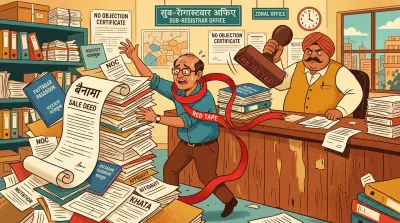


In 2019, a couple in Delhi bought a flat. Registered sale deed, clean title, everything in order. Two years later, they applied for mutation at the South Delhi Municipal Corporation and got a surprise: Rs 1,02,506 in outstanding property tax arrears going back to 2004.
Not their arrears. The previous owners’.
They went to court. In August 2024, the Delhi High Court dismissed their petition. Justice Purushaindra Kumar Kaurav held that “the substantive liability of the ‘owner’ to pay taxes cannot be defeated by the non-intimation under section 128(1) of DMC Act” - meaning the obligation survives even when the buyer failed to notify the corporation of the ownership change. Section 123 of the Delhi Municipal Corporation Act, 1957 makes property tax the first charge on a property, binding every successive owner.
They paid someone else’s 17-year-old tax bill.
This is how property tax arrears actually work in India. Not as a personal debt that disappears when property changes hands, but as a charge that follows the bricks.
Why Property Tax Is Different From Other Debts
Most debts belong to a person. Property tax belongs to a property.
Under Indian municipal law, property tax is treated as what lawyers call a “first charge” on immovable property. The Delhi High Court in Lakhmi Chand v. Municipal Corporation of Delhi (1987) explained this plainly:
“Section 123 of the Delhi Municipal Corporation Act, 1957, makes it clear that the property taxes are the first charge on the premises on which they are levied.”
A first charge means the municipality’s claim on your property takes priority over almost everything else, including a mortgage. If you owe a bank and owe the municipal corporation, the municipality gets paid first from any sale proceeds.
This principle exists in every major municipal law: Section 123 of the DMC Act in Delhi, Section 204 of the Mumbai Municipal Corporation Act, the equivalent provisions in the Karnataka Municipal Corporations Act, and the GHMC Act in Hyderabad.
The practical implication: when you buy property, you inherit its tax history. When the municipality comes to collect, they collect from whoever owns the property now, regardless of when the arrears accumulated.
The Enforcement Ladder
Municipal corporations do not spring to auction on day one of a missed payment. There is a process. Understanding it helps you know where you are on the escalation path.
Stage 1: Interest Starts Accruing Immediately
The moment a payment deadline passes, penalty interest begins. The rates vary by city:
| City | Penalty Rate | Annual Equivalent |
|---|---|---|
| Mumbai (BMC) | 2% per month on arrears | 24% per year |
| Hyderabad (GHMC) | 2% per month on arrears | 24% per year |
| Bengaluru (BBMP) | Up to 15% per year interest + 100% penalty after 2 years | - |
| Delhi (MCD) | 1% per month on arrears | 12% per year |
| Pune (PMC) | 2% per month from due date | 24% per year |
BBMP’s penalty structure deserves special attention. Under the BBMP (Amendment) Act, 2024 (Section 6), if you miss payments for two consecutive years, the corporation levies a 100% penalty on the outstanding amount, plus 15% annual interest from April 2025 onwards. Miss two years on a Rs 10,000 annual tax bill and you owe Rs 20,000 in principal alone, plus interest.
As of 2024, approximately 1.85 lakh property owners in Bengaluru were classified as “chronic defaulters” under this provision.
Stage 2: Demand Notices
After a payment deadline passes without payment, the municipality sends a formal demand notice. In most cities, this goes to the property address on record. Not to you personally. Not to your email. Not to your address in California or Dubai.
If the property is locked, tenant-occupied with a disinterested tenant, or simply not receiving mail, the notice arrives and nothing happens. The municipality has discharged its obligation. You have no idea.
Under the BBMP Act 2020, the process runs: Show Cause Notice, then Demand Notice, then Attachment Order. Each step gives the defaulter a window to pay. After the Attachment Order, the property can be sealed (for commercial properties) and movable assets seized.
Stage 3: Distraint of Movable Property
Before touching the building itself, most municipal acts allow the corporation to seize movable property. Furniture. Appliances. Vehicles. Equipment.
Under Sections 204, 205, and 206 of the Mumbai Municipal Corporation Act, after a 21-day final notice, officials can enter the premises and seize movable assets for public auction. The statute authorises “distraint and sale of movable property of the defaulter.”
The BBMP SOP similarly authorises authorised officers to seize movable property (Form 9) for public auction, with a minimum auction price fixed by the Zonal Joint Commissioner.
In 2013, BBMP reportedly issued a distraint notice against Wipro for Rs 16.47 crore in unpaid property tax. The threatened action: seizing computers and furniture from their offices. The incident drew wide attention because it illustrated that the power to seize movables is not theoretical - it is used against large corporate defaulters when negotiations fail.
Stage 4: Attachment and Auction of the Property
If movable property seizure does not recover the dues, or if there are no significant movables to seize, the corporation can attach the property itself. In most municipal acts, attachment means formally recording the municipality’s claim and preventing any transfer or encumbrance of the property.
The auction power exists in law, but municipalities have been slow to exercise it for smaller defaulters, partly because the process is lengthy and partly because public auctions of homes are politically difficult.
The BMC provides a clear picture of how this plays out in practice. The corporation has attached 3,945 properties since 2010, with a combined value of Rs 2,237 crore. As of 2024, it had conducted no auctions in a decade, despite the scale of default. In 2025, it finally initiated e-auction proceedings against 12 specific properties - most belonging to large commercial defaulters.
BBMP took a different approach. In 2024, it issued auction notices to the top 10 defaulters in each zone, publicly naming them, under Section 156(5) of the BBMP Act 2020. The public naming was itself an enforcement tool.
The pattern: municipalities have the legal power to auction properties. They use it selectively, primarily against large commercial defaulters. For individual residential properties, the more common enforcement tool is blocking transactions: you cannot sell, register, or obtain a no-dues certificate while arrears are outstanding.
Stage 5: The Transaction Block
This is where most property owners actually feel the consequences. Not auction. Blockage.
When you try to sell a property with outstanding property tax, the registration process hits a wall. Sub-registrars in most states require a no-dues certificate from the relevant municipal corporation before registering a sale deed. No certificate means no registration. The property is effectively frozen.
The same applies to mutation (updating revenue records after inheritance or purchase), obtaining an encumbrance certificate, and in many cities, even applying for a building plan approval or completion certificate for the structure.
For NRIs, this is often how accumulated arrears come to light: when they try to sell or transfer a property and discover years of unpaid tax sitting on the record.
How Arrears Compound: The Maths
Simple interest at 2% per month sounds modest. In practice, on five or ten years of compounding arrears, it becomes crushing.
Take a property in Hyderabad with an annual tax bill of Rs 8,000. The owner moves abroad in 2016. Nobody pays the tax. The GHMC charges 2% per month simple interest on the outstanding amount.
By 2026:
- Principal arrears: Rs 8,000 x 10 years = Rs 80,000
- Interest on Year 1 arrears (accumulated over 10 years at 2%/month): Rs 8,000 x 240% = Rs 19,200 additional
- Total for Year 1 dues alone: Rs 27,200
- Cumulative total across all 10 years: Roughly Rs 2.5 to 3 lakh, depending on whether each year’s interest compounds into the next
This is why GHMC in 2025 was sitting on Rs 10,000 crore in outstanding dues from 6.8 lakh properties, of which Rs 7,000 crore was accumulated interest - nearly three times the Rs 3,000 crore principal. The interest had dwarfed what was originally owed.
For Bangalore: miss two years under the BBMP (Amendment) Act, 2024, and you face a 100% penalty plus 15% annual interest. An Rs 8,000 annual bill, unpaid for two years, generates Rs 16,000 in penalty alone before any interest calculation. Then add 15% per year on the outstanding amount from Year 3.
Delhi is somewhat gentler: 1% per month (12% per year). But over a decade, Rs 8,000 annual dues generate roughly Rs 1.4 to 1.6 lakh in total liability.
The Problem Specific to NRIs
The municipal corporation does not know or care where you live. Demand notices go to the property address. If the property is vacant, the notices pile up unseen. If a tenant occupies it, they have no obligation to forward municipal notices to you in London or Houston.
Several structural problems compound this for NRIs:
The deceased-name trap. When a parent passes away and the property is not mutated into the heir’s name, property tax bills continue in the dead person’s name. Nobody receives them. Nobody pays. By the time the heir discovers the property, five or ten years of arrears have accumulated. The Shubha Bhattacharya ruling applies: the current owner is liable, regardless of who ran up the arrears.
The tenant-payment assumption. Many NRI rental agreements include a clause requiring tenants to pay property tax. When tenants do not pay, owners often do not find out until they return to India or try to sell. The municipal corporation does not pursue tenants. It pursues property owners.
The assessment revision blind spot. Municipal corporations periodically revise property valuations upwards and reassess tax. The new demand notice goes to the registered address. If you are abroad and the address on record is the property, you receive nothing. You continue paying last year’s amount, which is now a shortfall, which is technically arrears.
The OTP barrier. Several portals, notably GHMC in Hyderabad, require an OTP sent to a registered Indian mobile number to complete online payment. If your Indian SIM is inactive, you cannot pay even if you want to. Many NRIs discover this problem only when they try to pay overdue amounts.
The Buyer Liability Trap
The Shubha Bhattacharya case is worth dwelling on for anyone buying property in India.
The buyers purchased in 2019. The previous owners had owned the flat since 2005. The tax arrears stretched back to 2004. Nobody ran an explicit property tax check before the 2019 purchase. Two years after buying, they discovered Rs 1,02,506 in someone else’s tax history attached to their property.
The legal principle is established: property tax is a first charge. It attaches to the property, not the person. When you buy, you buy the tax history too.
The practical defence is straightforward: before signing any sale agreement, ask the seller for the last three to five years of property tax receipts. Check the municipal portal yourself by entering the property ID or account number. In most cities, this takes five minutes and shows all outstanding dues immediately. Request a formal no-dues certificate from the municipal corporation and ensure it is dated within 30 days of registration.
Our guide to selling property in India has the full document checklist for this process.
Amnesty Schemes: The Relief Window
The scale of accumulated arrears across Indian cities has pushed some municipal corporations to periodically offer one-time settlement (OTS) schemes that waive a significant portion of penalties.
GHMC (Hyderabad): In 2025, the corporation offered a 90% waiver on accumulated interest if property owners paid the full principal by March 31, 2025. Over 6.8 lakh properties were eligible. If you previously paid your dues in full (including interest), GHMC credited 90% of the interest paid toward future bills.
BMC (Mumbai): In 2025, the corporation offered a tiered penalty waiver: 75% waiver if paid before March 20, and 50% waiver for payments between March 21–31.
Kolkata (KMC): Introduced graded penalty waivers in 2024 based on the length of default.
Delhi (MCD): Ran the SUNIYO scheme in 2025, allowing defaulters to clear old dues by paying the current year’s assessment.
These schemes are worth watching for, but they are irregular and have strict deadlines. You cannot build a compliance strategy around them. They appear infrequently, close quickly, and often exclude properties with disputed assessments.
How to Settle Arrears from Abroad
If you have accumulated arrears, the process for clearing them:
Step 1: Pull the full statement. Every major municipal portal lets you check outstanding dues by entering your property ID. BBMP (Bangalore): bbmptax.karnataka.gov.in. GHMC (Hyderabad): onlinepayments.ghmc.gov.in. BMC (Mumbai): ptaxportal.mcgm.gov.in. MCD (Delhi): mcdonline.nic.in (verify this URL is current before use - the three Delhi municipal corporations merged in 2022 and portal URLs have changed). The portal will show year-by-year breakdown of principal and penalty.
Step 2: Check for active amnesty schemes. Before paying the full penalty amount, check whether your city is running or has announced an OTS scheme. Even a 50% penalty waiver on a large arrears amount can save significant money.
Step 3: Handle the OTP problem. If the portal requires an Indian mobile OTP and your SIM is inactive, you have two options: contact someone in India to receive the OTP (you do not need a formal PoA for a routine tax payment, just the property details and willingness to help), or roam your Indian number internationally for the duration.
Step 4: Pay from NRO/NRE or international card. BBMP and GHMC accept international Visa and Mastercard on their portals. BMC Mumbai’s portal generally works better with Indian bank net banking. If the portal rejects your payment method, use net banking through your NRO or NRE account.
Step 5: Download and store the receipt immediately. Municipal portals are notoriously unreliable. A receipt today may not be reproducible tomorrow if the system changes. Download it the moment the transaction completes.
Step 6: Apply for a no-dues certificate. After clearing all arrears, apply for a formal clearance certificate from the municipal corporation. This document will be needed for any future sale, registration, or mutation.
Step 7: Update your name in the records. If property tax is still assessed in a previous owner’s name (common after inheritance), file for mutation simultaneously. The no-dues certificate and the mutation application can run in parallel. Until mutation is done, future bills will continue going to the wrong person.
What You Should Do Now
Whether or not you have arrears, three things protect you from this problem:
Check your property’s tax status once a year. Treat it like checking your bank balance. Most portals take five minutes. Enter your property ID and confirm the outstanding amount is zero. Our annual property compliance checklist includes this as a standard item. For NRIs who cannot rely on remembering to check, continuous property monitoring covers tax status alerts automatically.
Keep every receipt. Property tax receipts are evidence of continuous ownership and regular compliance. They are asked for during property sales, loan applications, and mutation transfers. A property with a clean ten-year tax receipt trail is much easier to transact than one with gaps.
Before buying, verify the seller’s tax record. Spend five minutes on the municipal portal before you sign anything. The Shubha Bhattacharya family did not do this. A five-minute check in 2019 would have revealed the shortfall and allowed them to negotiate. Instead, they spent five years in litigation and eventually paid anyway.
Property tax is India’s smallest property compliance task. The annual amount is modest. The online portals work reasonably well. The consequence of ignoring it, compounding interest and buyer liability that follows the property for decades, is disproportionately large.
Assetly is a property document management platform that helps Indian property owners organise, verify, and track their property documents digitally. Learn more.