

Accamma Sam Jacob bought a plot in Bengaluru in 1994. She paid for it. She had a registered sale deed. The khata was transferred to her name.
Then she moved to Toronto and left the plot unattended.
Sixteen years later, in 2013, she filed a criminal complaint alleging that while she was overseas, a consortium of individuals had: created fraudulent sale deeds in their own names using forged General Powers of Attorney from the original landowners; formed a welfare society to collect original title documents from NRI buyers under the pretence of resolving “legal complications”; and obtained her signature on a confirmation deed by telling her the papers were for civil proceedings, not a transfer of her rights.
The prosecution also alleged that her original registered sale deed had been physically taken from her, on the pretence of photocopying, and returned as a colour copy. The original was gone.
This is Accamma Sam Jacob vs The State of Karnataka & Ors., Supreme Court of India, 2026 INSC 362.
The Plot, the Layout, and the Scheme
Survey No. 12, Doddagubbi Village, near Bengaluru, was developed into a residential layout called “Athina Township Stage I” by a developer named Joseph Chacko. Chacko had obtained General Powers of Attorney from the original landowners (Bajjappa and co-owners) to develop and sell plots.
Accamma purchased Plot No. 79, measuring 60 feet by 80 feet, through a registered sale deed executed by Chacko. The transaction was lawfully registered. Her khata was updated.
The prosecution alleged that from approximately 2006 onwards, K.S. Shankar Reddy and associates began a systematic effort to take control of Survey No. 12. The court’s summary of the alleged scheme runs across several phases:
Phase one. Associates allegedly entered the layout with heavy machinery in late 2006, demolished boundary walls, storm drains, and electrical poles, and replaced layout signboards with those of a company called “Cityscape Properties.”
Phase two. Three individuals (George Varghese, Jacob Thomas, and Raju C. Ninan) allegedly formed “Athina Township Welfare Society” and circulated an MoU (May 2007) asking NRI plot owners to hand over their original title documents. The stated reason was that legal complications required revenue record corrections. The prosecution alleged this was a pretext.
Phase three. In July 2009, Accamma discovered that sale deeds now existed in the name of K.V. Rajagopal Reddy for land that included her plot. When she raised this, she was allegedly asked to sign documents described as being “for civil proceedings.” Her original sale deed, she alleges, was taken for photocopying and returned as a colour copy.
Phase four. A confirmation deed, Document No. 975/2009-10, dated 20 July 2009, was subsequently produced bearing her alleged signature, purportedly confirming the transfer of her plot to Rajagopal Reddy. She maintains she never authorised this.
The Document Issue
The confirmation deed sits at the centre of this case because it illustrates a specific form of document manipulation that is harder to detect than outright forgery.
A forged signature on a document the owner never saw is one thing. What the prosecution alleged here is subtler: a document was placed in front of Accamma Sam Jacob and she signed it, but under misrepresentation about what she was actually signing.
A registered sale deed confers ownership. A confirmation deed, in legitimate use, might ratify an earlier arrangement or acknowledge receipt of consideration. But the same structure can be weaponised: if someone has a defective chain of title, a confirmation deed from the original lawful owner can be used to paper over the gap, creating the appearance of consent and continuity that did not, in the prosecution’s telling, actually exist.
The Supreme Court described this plainly in its judgment:
“Confirmation deeds purportedly bearing the signatures of certain NRI plot purchasers were created without lawful authority and were intended to retrospectively validate an otherwise defective chain of title in respect of Survey No.12.”
The physical seizure of the original sale deed compounds this. A registered sale deed is not just a record of a transaction. It is the primary document establishing your ownership. Losing the original does not extinguish your rights, but it makes them far harder to assert in a dispute, especially from ten thousand kilometres away.
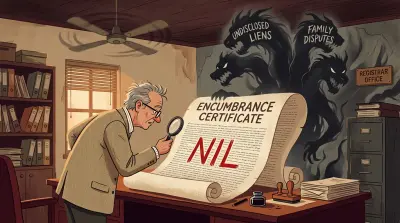
The encumbrance certificate for the property would, at some point, have shown these new transactions registered against Survey No. 12. An NRI checking their EC regularly through the Kaveri portal would have seen anomalies. Accamma appears to have discovered the deeds in Rajagopal Reddy’s name when she was already in Bengaluru in 2009.
How It Played Out
The XI Additional Chief Metropolitan Magistrate ordered a police investigation under Section 156(3) of the CrPC after Accamma filed her private complaint. FIR Crime No. 162/2013 was registered on 16 November 2013 against 16 accused, for offences including cheating, forgery, criminal breach of trust, document falsification, and criminal conspiracy.
The accused applied to the Karnataka High Court to quash the FIR. The High Court allowed the application in September 2016. Its reasoning: the dispute involved questions of title that required civil court adjudication first. The registered instruments in the accused’s names could not simply be ignored by a criminal court. Unless those instruments were cancelled by a civil court under Section 31 of the Specific Relief Act, 1963, the criminal proceedings should not proceed.
Accamma appealed to the Supreme Court.
The Supreme Court, in a judgment by Justice Sandeep Mehta (bench also comprising Justice Vikram Nath), reversed the High Court in April 2026. The FIR and criminal proceedings were revived and restored.
The legal battle is ongoing. The property remains effectively disputed.
What the Court Said
The Supreme Court’s core objection to the High Court’s approach was that it had evaluated the accused’s documents (their sale deeds, title papers) in order to conclude that the NRI complainant’s case lacked merit. That, the Supreme Court held, is not the High Court’s function at the FIR stage.
“[T]he High Court, while exercising its inherent jurisdiction, should not travel beyond the allegations contained in the complaint and the material placed by the complainant by delving into the defences sought to be projected by the accused-respondents.”
On the confirmation deed specifically, the judgment recorded Accamma’s case this way:
“[H]er signatures had been obtained on the misrepresentation that the same were required to swear affidavits and prepare papers for instituting civil proceedings.”
And on the broader alleged conspiracy:
“[T]he cumulative effect of the aforesaid transactions was to concentrate control over substantial portions of Survey No. 12 in persons or entities associated with the family of one K.C. Ramamurthy.”
The court also applied the principle from Neeharika Infrastructure (P) Ltd. v. State of Maharashtra (2021): criminal proceedings should not be quashed at the threshold unless the complaint, on its face, discloses no cognisable offence. Where facts are contested and investigation has barely begun, courts should be circumspect about shutting the process down.
The High Court’s civil-remedies-first reasoning was rejected directly. The existence of registered documents in the accused’s favour does not, by itself, immunise them from criminal investigation into how those documents came to exist.
The Pattern
The Athina Township scheme, as the prosecution has described it, is not a one-off improvisation. It follows a structure that property lawyers in Bengaluru and other high-growth Indian cities have seen repeatedly.
The ingredients are consistent: a residential layout developed under a General Power of Attorney from original landowners (creating potential ambiguity in the title chain); a large number of NRI buyers who purchased plots and then left; and a later attempt to exploit that absence by creating or manufacturing documents that concentrate ownership in new hands.
The welfare-society vehicle is a known instrument. The Joseph Chacko cases (Karnataka High Court, 2017; Supreme Court, November 2024) involve the same Athina Township layout and the same period of alleged activity. The Supreme Court’s November 2024 order in that batch preceded and informed the approach taken in Accamma’s case decided in April 2026. The court’s discussion of both batches of complaints as involving substantially the same layout and accused indicates this was a coordinated pattern affecting multiple plot owners in the same layout.
A comparable structural pattern appeared in the Nirmal Kaur case (Punjab and Haryana High Court, 2019), where a forged power of attorney allowed family members to represent NRI landowners in court proceedings they knew nothing about, ultimately transferring ownership and selling the property before the overseas owners discovered what had happened. That case is explored in detail here.
The common thread across both cases is the exploitation of distance. An NRI owner who has not visited their property for years, who does not have an independent copy of their title documents, and who receives a call from someone they half-recognise telling them to sign something “for civil proceedings”: that person is structurally vulnerable in a way that their counterpart living 500 metres from the plot is not.
What This Means for Property Owners
A registered sale deed is not self-defending. It records your ownership. It does not prevent others from registering competing documents against the same land. India’s registration system is transactional: it records what was presented to it. It does not adjudicate competing claims. As this post on sale deeds explains, registration creates a presumption of ownership, not a guarantee.
Confirmation deeds can be used against you. If someone presents you with papers, tells you they are for an unrelated purpose, and obtains your signature, that signature can later be attached to a document asserting your consent to something you never agreed to. The safeguard is simple but non-negotiable: never sign any property-related document without reading it completely and, where you are uncertain, having a lawyer review it first.
The absence of a physical original weakens your position. Courts work with documents. If your original sale deed has been replaced with a colour photocopy, and the accused hold a document chain that includes your alleged signature on a confirmation deed, the evidentiary battle becomes significantly more difficult. It can still be won, as the Supreme Court’s revival of Accamma’s case shows, but it becomes protracted and expensive.
Physical absence enables the scheme. The welfare society in this case specifically targeted NRI owners. The document collection was structured around the gap between an overseas owner’s trust and their lack of local oversight. India’s property dispute crisis is, in part, a geography problem for the NRI community.
Civil and criminal proceedings are not mutually exclusive. A common misdirection from those who have created fraudulent documents is to tell the original owner that this is a “civil matter” requiring a civil court order before anything else can happen. The Supreme Court has now, in this case and others, firmly rejected that framing. If the facts disclose cognisable criminal offences, a criminal investigation can proceed alongside or independently of any civil proceedings.
What You Should Do
These steps are not theoretical. They are the specific gaps this case illustrates.
1. Maintain your own certified copies, stored separately from originals. The original registered sale deed should be in your possession. Certified copies (obtained from the Sub-Registrar’s office) should be stored digitally. If someone takes your original for “photocopying,” you should have a certified copy that cannot be substituted. Platforms like Assetly are built specifically for this: upload your sale deed, EC, khata certificate, and mutation order, and access them from anywhere in the world.
2. Run an EC check every six to twelve months. The Encumbrance Certificate for your property in Karnataka is available through the Kaveri portal. Any registered transaction against your plot (a new sale deed, a mortgage, a confirmation deed, a lease) will appear here. If you see a transaction you did not authorise, that is your earliest warning. Do not wait until you visit India.
3. Never sign any document you have not read fully. This sounds obvious. The Accamma case shows it is not. When someone tells you a document is “just for civil proceedings” or “just an affidavit,” read every line before signing. If you cannot read the language, get a translation. If the other party is impatient, that impatience is itself a warning sign.
4. Limit the scope of any Power of Attorney you grant. If you need someone to manage your property in your absence, grant a Special Power of Attorney limited to specific acts: paying property tax, attending to municipal notices, collecting rent. A General Power of Attorney that authorises someone to “do all acts” in relation to your property is a document that can be used far beyond what you intended. See the Supreme Court’s guidance in Suraj Lamp & Industries v. State of Haryana (2011) on the limits of GPA-based property transfers.
5. Keep your Bhoomi RTC updated. Karnataka’s Bhoomi portal shows the current revenue record owner, mutation history, and any liabilities noted against your survey number. If a mutation has been effected in someone else’s name, you will see it here. Check it at least once a year.
6. If you discover an unauthorised document, act immediately. File a police complaint. File a civil suit for cancellation of the document under Section 31 of the Specific Relief Act. Obtain certified copies of the disputed documents from the Sub-Registrar. Do not wait to see whether the matter resolves itself. Delay in a scheme like this is an asset for the accused and a liability for you. For guidance on organising these documents before a dispute arises, see how to store and organise India property documents if you live abroad.
Related Reading
- Power of Attorney for India Property: What NRIs Must Know: what a GPA can and cannot do, and how to limit your exposure
- Encumbrance Certificate: The Document That Shows What You Don’t Know: how to run an EC check from abroad and what to look for
- When Family Forges Your Power of Attorney: The Nirmal Kaur Case: a parallel case from Punjab showing the same pattern of document manipulation against NRI landowners
- Why a Registered Sale Deed Does Not Guarantee Ownership in India: understanding India’s presumptive titling system
- Managing Property in Karnataka: A Guide for NRIs: Bhoomi, Kaveri, A-Khata vs B-Khata, and remote management
- India’s Property Dispute Crisis: the systemic context behind cases like this one
This post was written by the Assetly team. Assetly (assetlyhq.com) helps NRIs and Indian property owners securely store, organise, and track their property documents from anywhere in the world.