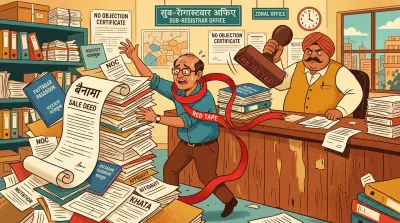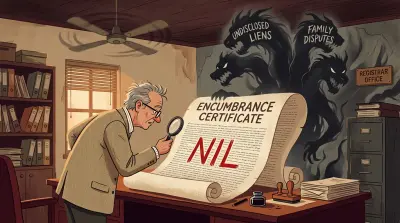
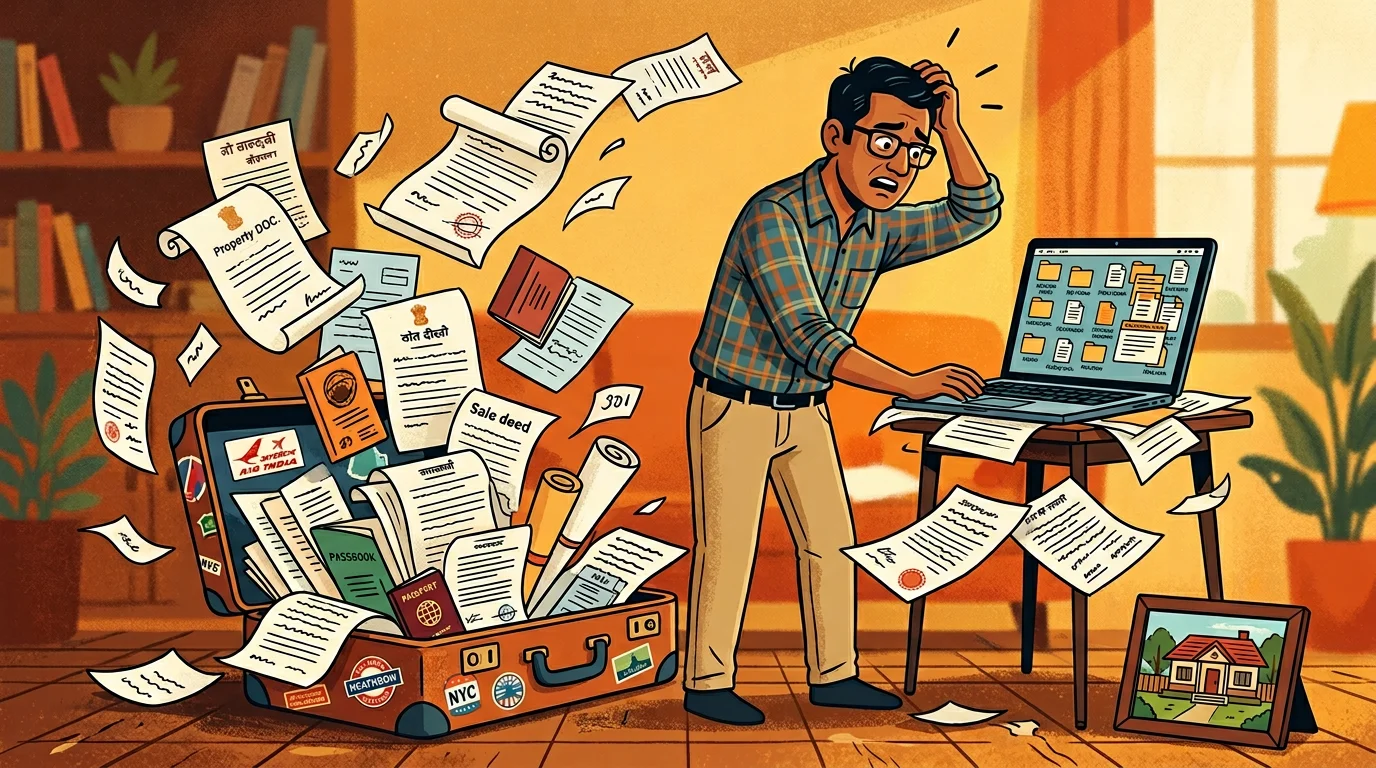

The average NRI has their sale deed buried in an email from 2014, their Encumbrance Certificate saved as a blurry photo a relative sent on WhatsApp, and their pattadar passbook nowhere findable. When a buyer’s lawyer or a bank asks for a complete document set, the panic begins - frantic calls to siblings in Chennai, searches through decade-old inboxes, and requests to government offices that take weeks to respond.
This is not a minor inconvenience. India carries over 6.6 million pending land and property cases, and a significant share of them involve disputes that became unresolvable precisely because the original owner could not produce the right documents at the right time. Managing property documents from abroad is one of the most overlooked risks NRIs carry. Here’s how to fix it, systematically.
The 12 Critical Documents Every India Property Owner Must Have
Whether you own an apartment in Bengaluru, agricultural land in Andhra Pradesh, or a plot in the outskirts of Pune, these are the documents you cannot afford to lose or leave untracked:
| # | Document | What It Proves |
|---|---|---|
| 1 | Sale Deed | Ownership transfer to you |
| 2 | Encumbrance Certificate (EC) | No outstanding loans or liabilities |
| 3 | Pattadar Passbook / Revenue Record | Land ownership (name varies by state - see below) |
| 4 | Khata Certificate | Municipal registration of property |
| 5 | Property Tax Receipts (latest 3 yrs) | Tax payment compliance |
| 6 | Link Documents (parent deeds) | Chain of ownership going back 30 years |
| 7 | Mutation Order | Government record of ownership change |
| 8 | Occupancy Certificate | Completion and habitation approval |
| 9 | Building Plan Approval | Sanctioned layout from authority |
| 10 | Society Share Certificate | For apartments in housing societies |
| 11 | Power of Attorney (if applicable) | Authorisation for someone to act on your behalf |
| 12 | Loan Closure / NOC Letter | Proof any prior mortgage is cleared |
For a deeper look at documents most owners overlook, read Beyond the Sale Deed: 5 Property Documents Most Owners Don’t Know They Need.
What These Documents Are Called by State
India’s land records are not standardised. The same underlying document has a different name - and lives on a different portal - depending on where your property sits. If you’re searching for the wrong term, you’ll find nothing.
| State | Revenue / Land Record | Mutation Record | Online Portal |
|---|---|---|---|
| Karnataka | RTC (Record of Rights, Tenancy and Crops) | Khata transfer | bhoomi.karnataka.gov.in |
| Tamil Nadu | Patta / Chitta | Patta transfer | tnreginet.gov.in |
| Kerala | Thandaper | Pokkuvaravu | erekha.kerala.gov.in |
| Andhra Pradesh | Pahani / Pattadar Passbook | Pattadar transfer | meebhoomi.ap.gov.in |
| Telangana | Pahani / Pattadar Passbook | Pattadar transfer | bhubharati.telangana.gov.in |
| Maharashtra | 7/12 Extract | Mutation entry | mahabhumi.gov.in |
| Punjab / Haryana | Jamabandi / Fard | Intkal | jamabandi.punjab.gov.in |
So when the 12-document checklist above says “Pattadar Passbook,” a Karnataka owner is looking for their RTC. A Maharashtra owner is looking for their 7/12 Extract. These are the same category of document - the authoritative government record of who owns what - just named differently.
Why Physical Copies Alone Don’t Work for NRIs
Most property owners in India store documents in a steel cupboard or with a lawyer. That worked when you lived nearby. When you’re in Dubai, Toronto, or Sydney, it creates a dependency chain: you call your parents, they call the lawyer, the lawyer is unavailable, and you’re three time zones away waiting.
Physical copies also face real risks: floods, fires, termites, and misplacement during family moves. Originals kept with tenants or caretakers can go missing without accountability. And for NRIs, flying back just to retrieve a document for due diligence is not a realistic option.
The problem isn’t just storage - it’s access and organisation. A scan buried in Google Drive with no label is nearly as useless as a paper copy in a cabinet 5,000 km away.
How to Audit What You Have - and Recover What’s Missing
Before you can organise, you need to know your gaps:
Start by checking whether the latest deed is backed by a complete sequence of earlier transfers. The chain-of-title guide explains how link documents connect one owner to the next, while the property documents beyond the sale deed guide covers the supporting records buyers and lenders commonly expect.
- List every property you own - including inherited properties, jointly held assets, and agricultural land.
- Match each property to the 12-document checklist. Mark what you have, what you think exists but can’t locate, and what’s definitively missing.
- Identify who holds originals - lawyer, parent, bank locker, your own cupboard.
- Flag time-sensitive gaps - an EC older than 30 years, missing tax receipts, or no mutation after inheritance are active liabilities.
Most missing documents can be recovered without travelling to India:
| Document | How to Recover It | Available Online? |
|---|---|---|
| Encumbrance Certificate | State Sub-Registrar portal | Yes, most states |
| Property Tax Receipt | Municipal corporation website | Yes |
| Certified Sale Deed copy | Application to Sub-Registrar (₹100–500) | Partial |
| Revenue Record / Mutation | Revenue / tahsildar office | Partial |
| Pattadar Passbook | Bhu Bharati (TS) / Meebhoomi (AP) | Yes |
The one document that genuinely requires legwork is a Mutation Certificate that was never updated after purchase or inheritance - it typically needs an in-person application or an authorised representative with a Power of Attorney. Start that process well before you need it.
For a complete list of annual tasks every NRI property owner should run through, see the NRI Property Annual Checklist.
How to Digitise and Organise Documents Properly
Digitising is more than scanning. Done poorly, it creates a different kind of chaos - hundreds of files named “IMG_20190812_143021.jpg.”
Do it right:
- Scan at 300 DPI minimum, colour, PDF format. WhatsApp-compressed images are not acceptable for legal or financial purposes.
- Name files logically:
[PropertyName]_[DocumentType]_[Year].pdf- e.g.,BangaloreFlatHS101_SaleDeed_2018.pdf - Create a folder hierarchy: one top-level folder per property, subfolders by document category.
- Store in at least two locations: a cloud service plus a local encrypted backup. Single-point storage creates risk.
- Track expiry and renewal dates: property tax receipts need annual updates; ECs need periodic refreshes; POAs have validity periods.
The challenge is maintaining this system over years, across multiple properties, while your life abroad gets busier.
How Assetly’s Document Vault Handles This for You
Assetly is built specifically for NRIs managing India property. The document vault isn’t generic cloud storage - it’s structured around how property documents actually work.
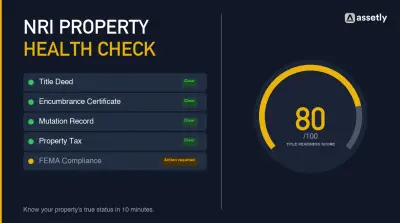
When you upload a sale deed, Assetly labels it, links it to the correct property, and places it in the right category automatically. The platform checks which of the 12 critical documents are present for each property and flags what’s missing - with a prompt to locate or re-obtain it. If a document has a renewal date - a POA, a tax receipt, an EC refresh - Assetly alerts you before it lapses.
When a document is requested - by a buyer’s lawyer, a bank, or a co-owner - you share a secure link directly from the vault. No WhatsApp forwards of scanned originals. No ambiguity about which version is current. No explaining to a relative in India which folder the file is in.
Everything is encrypted and cloud-stored, accessible from any device, anywhere in the world. See how Assetly works →
Assetly is a property document management platform for NRIs and remote property owners. The document vault is free to get started - sign up at app.assetlyhq.com.