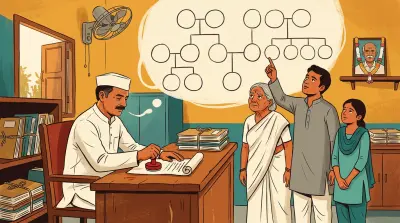
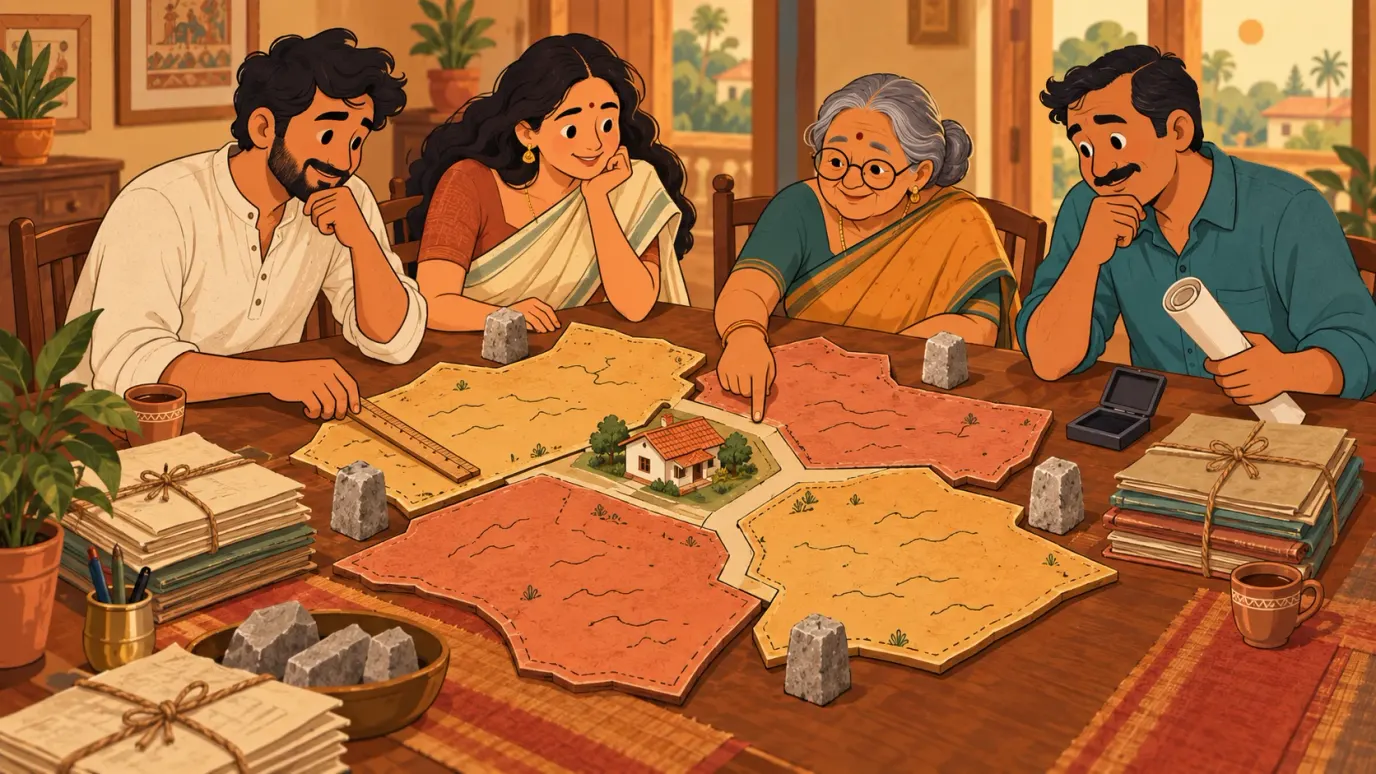

Your grandparents owned a house and six acres of land. Both have died. Their children are now discussing who gets the house, who gets which field and whether a deceased child’s family must also be included.
Where do you begin?
Not by dividing the acres. Not by counting the relatives at the meeting. Start by writing down every asset, checking who owned each one, and tracing what happened to each owner’s share after they died.
The entire process can be understood in six steps:
- List every property and find its ownership document.
- Write down the share held by each owner.
- For every owner who has died, identify the will or legal heirs.
- Carry that deceased owner’s share down to the correct heirs.
- Only then decide who receives which house, plot or parcel.
- Record the agreement and update the government records.
That is family partition in plain English. First work out who owns what. Then decide how the assets will be split.
A Simple Example: Grandparents Owned One House Together
Suppose Ravi and Lakshmi owned a house equally. Think of the house as 12 equal parts:
- Ravi owns 6 parts.
- Lakshmi owns 6 parts.
They have one son and one daughter. Ravi dies without a will. In this simple example, Ravi’s heirs are Lakshmi, the son and the daughter.
Only Ravi’s 6 parts are divided. Lakshmi keeps the 6 parts she already owns.
Ravi’s 6 parts are shared equally:
- Lakshmi receives 2 more parts, so she now owns 8.
- The son receives 2 parts.
- The daughter receives 2 parts.
Later, Lakshmi dies without a will. Her 8 parts are divided equally between the two children. Each receives 4 more parts.
The final position is simple:
- The son owns 6 of the 12 parts, or half the house.
- The daughter owns 6 of the 12 parts, or half the house.
The lesson is not the final number. It is the order: keep each living owner’s share separate, and divide only the share belonging to the person who died.
Real families may have a will, more heirs or a different succession law. Those facts can change the answer.
When Several Ancestors Co-owned the Same Land
Suppose three brothers owned 12 acres equally. Each brother’s branch starts with four acres.
- Brother A’s family divides A’s four acres.
- Brother B’s family divides B’s four acres.
- Brother C’s family divides C’s four acres.
Now suppose A left two children and B left four children. In this simplified example:
- A’s two children share A’s four acres, so each gets two acres.
- B’s four children share B’s four acres, so each gets one acre.
B’s children do not receive less because their branch matters less. They receive smaller individual portions because more people share the same four-acre branch.
So do not count every relative and divide all 12 acres by that number. First separate the three original shares. Then divide each share among the heirs of that owner.
Step 1: Make One List of All Family Assets
Create one row for each asset, even if the family is unsure whether it still owns it.
| Asset | Name on title document | Known share | Current position |
|---|---|---|---|
| Family house | Ravi and Lakshmi | 1/2 each | Both deceased |
| Agricultural land | Ravi and two brothers | 1/3 each | No registered partition found |
| Apartment | Lakshmi | 100% | Will reported, copy not found |
| Shop | Son and daughter | 1/2 each | Rented to a tenant |
Do not combine all assets into one calculation. The house, land, apartment and shop may have different owners and different inheritance histories.
For each asset, collect the sale deed, gift deed, grant, earlier partition deed or other document showing how it was acquired. Add the latest encumbrance certificate, revenue or municipal record, tax receipt and survey plan where relevant.
Step 2: Check What Kind of Property It Is
Families often use “family property”, “inherited property” and “ancestral property” as if they mean the same thing. They do not.
A living person’s own property
If a parent bought a property from their own funds and remains its sole owner, the children do not ordinarily receive shares merely because they may inherit it later. There is nothing for the children to partition during that owner’s lifetime unless the owner first creates co-ownership or another legal right.
Property inherited by several heirs
When an owner dies and several heirs inherit, they may become co-owners. Their shares can then be separated through partition or another suitable arrangement.
Property already owned by several ancestors
If grandparents, siblings or other relatives bought or held property together, begin with the fraction owned by each person. When one co-owner dies, only that person’s fraction passes to their heirs.
Hindu coparcenary property
This is the category commonly called ancestral or joint Hindu family property. It follows different rules from a parent’s self-acquired property. In a Mitakshara Hindu joint family, Section 6 of the Hindu Succession Act gives a daughter the same coparcenary status by birth as a son. The Supreme Court confirmed this in Vineeta Sharma v. Rakesh Sharma (2020).
Do not label property ancestral merely because it has remained in the family for a long time. The source and succession history must support that classification. Start with our plain-English guide to ancestral, inherited and self-acquired property, then use the detailed guide to ancestral property and daughters’ rights where coparcenary rights are involved.
Step 3: Build the Ownership and Family Tree Together
Begin with the name or names on the last reliable title document. For every owner, ask:
- Is this person alive?
- If the person died, on what date?
- Did they leave a valid will covering this asset?
- If there was no will, which succession law applies?
- Who were the heirs on the date of death?
- Did any of those heirs later die, transfer or release their share?
Your working sheet may look like this:
| Person | Alive or deceased | Original share | What happened to the share? | Evidence needed |
|---|---|---|---|---|
| Ravi | Deceased | 1/2 | Passed by intestate succession | Death certificate and complete heir list |
| Lakshmi | Deceased | 1/2 plus inherited share | Will or intestate succession to be checked | Death certificate and will search |
| Son | Alive | Share inherited from parents | Still held unless later transferred | Identity and transfer search |
| Daughter | Alive | Share inherited from parents | Still held unless later transferred | Identity and transfer search |
Include spouses, sons, daughters, the deceased’s mother where the governing law makes her an heir, and descendants of any child who died earlier. Also record later deaths, adoptions, second marriages, minors and heirs living abroad.
A legal heir or family member certificate may support mutation and other administrative work, but it does not by itself calculate the shares or decide ownership. A succession certificate is also not the standard title document for a house or land; it principally concerns debts and securities. Our will and succession certificate guide explains that distinction.
Step 4: Calculate Shares One Death at a Time
Do not jump from the original ancestor to the relatives alive today. Move through events in date order.
For each death:
- freeze the share owned by that person on the date of death;
- check whether a will controls that share;
- if there is no will, identify the applicable heirs under the relevant succession law;
- divide only the deceased person’s share among those heirs; and
- add the new fractions to any shares the heirs already owned.
Then repeat the process for the next death.
Our simple guide to calculating legal heirs’ property shares shows how sole ownership, co-ownership, predeceased branches and Hindu coparcenary property produce different results.
The applicable law matters. The Hindu Succession Act governs the intestate situations covered by that Act. The Indian Succession Act and other personal laws can produce different heir lists and fractions. Do not use a Hindu share calculator for every family.
The chain of title should support every step. A mutation entry or tax receipt may show whose name is used for administration, but it does not settle the legal shares. The Supreme Court reiterated in Jitendra Singh v. State of Madhya Pradesh (2021) that mutation does not confer “right, title or interest”.
When the calculation is complete, prepare one final table for each asset:
| Current owner | How the share arose | Final fraction before partition | Unresolved issue |
|---|---|---|---|
| Owner A | Original purchase plus inheritance | 1/2 | None |
| Owner B | Inheritance through Branch 1 | 1/4 | Earlier release deed to verify |
| Owner C | Inheritance through Branch 2 | 1/8 | Minor owner |
| Owner D | Inheritance through Branch 2 | 1/8 | Lives abroad |
Someone who says “I do not want my share” should not simply be deleted from the table. If they already own a fraction, giving it up usually requires the correct legal instrument. Our guide to partition deeds, family settlements and release deeds explains the options.
Step 5: Check How the Property Can Be Divided
Now compare the ownership table with the asset itself.
Land
Commission a proper survey before deciding allotments. Confirm the total measured extent, boundaries, access, encroachments, existing subdivisions, irrigation and any part affected by a road, acquisition or restriction. A deed cannot safely allot 12 acres if the family controls only 10.8 acres on the ground.
For agricultural land, state land laws may also restrict fragmentation or require a revenue subdivision. These are state-specific questions, not details that a national template can solve.
Houses and apartments
A building may be legally co-owned but physically awkward to divide. Ask whether each proposed portion has lawful and practical access, utilities, sanitation, parking and common-area rights. Specify who owns the land beneath the building, terrace rights, staircases, setbacks and future development rights.
If one heir receives the whole house, the others may receive different family assets or an equalisation payment. A valuation should make the trade-off visible.
Several properties of unequal value
Partition does not have to slice every asset into equal physical pieces. A family may allot the house to one branch, agricultural land to another and a commercial unit to a third, then use money to balance the values.
Record the valuation date, method and agreed adjustment. “We will settle the difference later” is not a division plan.
If the property cannot be divided
The practical options are usually:
- one co-owner buys out the others;
- the property is sold voluntarily and the net proceeds are divided;
- different assets are allotted to different owners with an equalisation payment; or
- the court is asked to resolve the partition.
Section 2 of the Partition Act, 1893 permits a court, in the circumstances stated there, to direct a sale where division cannot reasonably or conveniently be made and sale would be more beneficial for all shareholders. Section 3 also gives another shareholder an opportunity to seek purchase at a court valuation when a qualifying sale request is made. These provisions have conditions; they do not create an automatic right for any one co-owner to force an auction merely because the property is inconvenient.
Step 6: Decide How to Complete the Partition
If the family agrees
Where the owners agree on their shares and allotments, they can complete a consensual partition through a properly drafted and registered instrument.
The sequence is usually:
- verify title and encumbrances;
- establish the current co-owners and shares;
- survey and value the assets;
- agree the allotments and financial adjustments;
- draft schedules and plans precisely;
- pay the applicable state stamp duty and registration fee;
- execute and register the deed; and
- complete survey, mutation, tax and other record updates.
The registration requirements, deed clauses, documents and NRI execution route are covered in our detailed guide to registering a family partition deed.
A family arrangement can also settle genuine rival claims. The Supreme Court’s decision in Kale v. Deputy Director of Consolidation recognised bona fide, voluntary family arrangements intended to resolve family disputes. It also distinguished an oral arrangement or a later memorandum recording it from a document that itself creates rights in immovable property. That distinction is easy to misunderstand. Where the document is doing the legal work of dividing or relinquishing property, obtain state-specific advice and register the appropriate instrument rather than relying on its title.
If someone disagrees
One co-owner’s refusal prevents a consensual deed, but it does not necessarily eliminate another co-owner’s right to seek partition. The remedy is generally a civil suit for partition and separate possession, with all necessary parties and properties brought before the competent court.
Our guide to partitioning property without everyone’s consent explains what one co-owner can ask the court to do, what happens if the property cannot be divided and why an absent, deceased or minor co-owner cannot simply be left out.
Order XX Rule 18 of the Code of Civil Procedure governs decrees in partition suits. The Supreme Court has described the usual stages clearly:
- a preliminary decree declares who the eligible parties are and their shares; and
- a final decree carries out the partition by metes and bounds, often after a commissioner examines the property.
This distinction matters. A preliminary decree saying that you own one-third does not, by itself, identify a particular bedroom or survey subdivision as yours. The property becomes separately usable only when the later allotment and possession steps are completed.
Court proceedings are also the appropriate route when the family genuinely disputes the will, title, family relationships or earlier transfers. Revenue officials conducting mutation cannot conclusively try those title questions.
Step 7: Check Special Situations
A co-owner has died
Do not show the deceased person as a signatory. Trace that share to the person’s heirs or beneficiaries, establish who now represents it and bring the necessary parties into the transaction.
A co-owner is a minor
A guardian cannot treat the child’s property as their own bargaining chip. Questions about representing a minor, the benefit of the proposed partition and whether court approval is needed require specific advice. Do not rely on an adult-only deed template.
An owner lives abroad
An NRI or overseas co-owner may participate through a carefully limited Special Power of Attorney where the applicable process allows it. The document should identify the property and authorise the particular acts required. It may need notarisation, apostille or Indian consular attestation abroad, followed by stamping, authentication or registration steps in India. Our property Power of Attorney guide covers the document trail.
The property is mortgaged or under litigation
Partition among co-owners does not erase a bank’s security, an attachment or somebody else’s existing right. Obtain a current encumbrance certificate, but remember that an EC only reports transactions captured in the registration system. Review the loan file, court searches and original documents as the circumstances require.
The family relies on an old oral division
Collect contemporaneous public evidence before acting on it: old mutation proceedings, separate tax assessments, survey subdivisions, court records and documents showing long separate possession. Oral-partition claims are fact-sensitive and especially vulnerable when raised years later. The safer forward-looking course, while everyone agrees, is to formalise the position correctly. Our guide to the risks of oral family partitions explains why.
Step 8: Prepare a Clear Partition Deed
The operative part of a partition must be precise enough for a surveyor, Sub-Registrar, revenue official and future buyer to understand the same division.
The deed and its schedules should address, as applicable:
- the source and chain of ownership;
- every party and the capacity in which they sign;
- the share held before partition;
- the property excluded from the partition, if any;
- the exact asset or portion allotted to each party;
- survey numbers, subdivisions, measurements and four boundaries;
- an annexed plan tied to the written schedule;
- access, passage, staircase, parking and utility rights;
- common areas and responsibility for maintenance;
- mortgages, leases, taxes and other liabilities;
- equalisation payments and proof or timing of payment;
- delivery of possession;
- custody of the original title documents; and
- cooperation with survey, mutation and tax-record changes.
A generic deed saying “the parties take equal portions” leaves the difficult question unanswered.
Step 9: Register the Partition Deed
Under Sections 17 and 49 of the Registration Act, a document that itself creates, declares, assigns, limits or extinguishes rights in immovable property generally requires registration, and failure to register restricts its effect and admissibility.
Stamp duty and registration fees are controlled by state law and can depend on the relationship between the parties, the value of the separated share and the instrument used. Confirm the current official schedule for the state on the date of execution. A nationwide cost table becomes stale quickly and can be actively misleading.
Registration is not a substitute for a correct ownership analysis. It records the transaction presented to the registering authority; it does not guarantee that an omitted heir, defective title or understated extent has disappeared.
Step 10: Update the Property Records
The family is not done when it leaves the Sub-Registrar’s office.
Each allottee should work through a post-partition checklist:
- obtain the registered deed and preserve a certified digital copy;
- complete survey subdivision or boundary demarcation where required;
- apply for mutation of the relevant revenue or municipal record;
- update property-tax assessment and utility records;
- update apartment association or society records;
- obtain a fresh EC after the registered transaction is indexed;
- record who holds each original link document; and
- update estate plans so the newly separated property is described correctly.
Mutation is an alignment step, not a new source of ownership. The registered instrument or court decree and the earlier title chain remain central.
Documents to Collect Before Partition
Before paying for a deed draft, assemble one working file with five sections:
1. People
Family tree, identity documents, contact details, alive/deceased status, representation and any minor or overseas owner.
2. Ownership
The last undisputed title, every later transfer or death, the current co-owner table and the reasoning behind every fraction.
3. Property
Title deeds, link documents, revenue and municipal records, EC, tax receipts, survey plans, photographs and a list of physical discrepancies.
4. Proposed division
Valuations, allotment plan, common rights, liabilities, equalisation payments and unresolved objections.
5. Completion
The instrument to be executed, stamp and registration requirements, survey subdivision, mutation, tax updates and custody of originals.
Assetly can help eligible owners organise this document trail and coordinate supported ownership-transfer work. It does not replace a court’s determination where title, heirship or the validity of a will is genuinely disputed.
Common Mistakes to Avoid
Starting with a deed template. The deed is the output. Ownership, people, shares and measurements are the inputs.
Treating the revenue record as the title. Mutation can be useful and still be legally inconclusive about ownership.
Calling every inherited property ancestral. The label changes who may claim a birthright. Establish the legal source.
Negotiating physical portions before calculating shares. A room or plot cannot be fairly allotted until the underlying fractions and values are clear.
Leaving out the branch of a deceased heir. That omission does not become safe merely because the remaining relatives agree.
Using an NOC where a registered transfer is required. Consent to mutation or sale is not always the same as legally surrendering ownership.
Ignoring access and common rights. A landlocked plot or floor without staircase rights is not a clean allotment.
Stopping after registration. Unchanged survey, tax and revenue records recreate confusion for the next sale or generation.
The Simple Order to Follow
A sound family partition moves in one direction:
title → people → shares → survey and value → allotment → instrument or decree → aligned records
Reverse that order and the family may register a beautifully drafted answer to the wrong ownership question.
Partition works best when it is treated as a documented project rather than a single visit to a lawyer or Sub-Registrar. Establish who owns what first. Only then decide who receives which asset.
Related Reading
- How to Register a Family Partition Deed in India - documents, drafting, registration and post-registration work for an agreed partition
- Partition Deed vs Family Settlement vs Relinquishment Deed - choose the instrument that matches what the family is actually doing
- Ancestral Property and Daughters’ Rights - understand birthrights and the limits of old oral-partition claims
- How to Get a Legal Heir Certificate in India - what the certificate establishes and what it does not
- Family Property in India: How to Protect It Before Disputes Start - why informal divisions become difficult to prove over time
Assetly helps Indian property owners organise, verify and track their property documents digitally, including when family members live in different cities or countries. Learn more at assetlyhq.com.