
Vattinagulapalli Series: This is Part 3 of 3. Part 1: The Dispute Explained | Part 2: 7 Lessons Every Property Owner Should Know
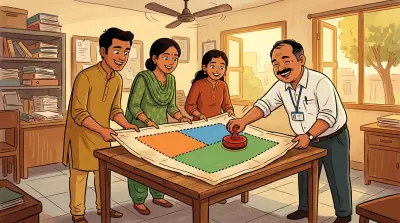
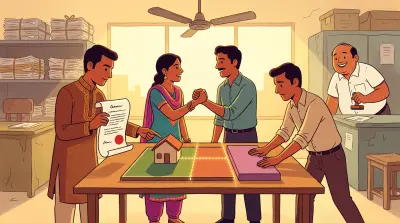
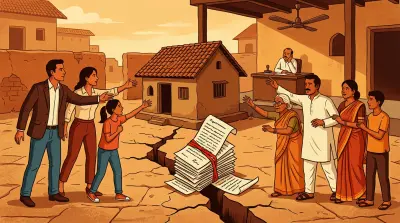
Your grandfather bought land. Your father and his brothers divided it informally: this portion for you, that portion for me. Everyone agreed. Everyone shook hands. No one signed anything.
This is how property is divided in most Indian families. And it is also how most property disputes begin.
The Scale of the Problem
India has millions of pending property cases in its courts. That is not a typo. Property disputes make up roughly 66% of all civil litigation in the country, and the average case takes 20 years to resolve.
Here is the part that does not make headlines: a huge proportion of these disputes are not between strangers. They are between siblings, cousins, uncles, and nephews. People who grew up in the same house, ate at the same table, and attended each other’s weddings. Families.
The reason is almost always the same. Someone divided property by agreement instead of by document. It worked for a while. Then it stopped working.
How a Family Arrangement Falls Apart
Think of an oral partition like splitting a shared Netflix account by agreeing who watches what. You take the action films, your brother takes the comedies, your sister takes the dramas. Everyone is happy. No one writes it down.
Then Netflix raises its prices. Suddenly that account is worth fighting over. Your brother starts watching your action films. Your sister says she was promised access to everything. And you have no proof of the original arrangement because it was never recorded.
Now replace the Netflix account with ancestral land worth crores. That is the situation millions of Indian families find themselves in.
Indian law does recognise oral partitions. Courts have upheld them repeatedly. But here is the catch: the person claiming an oral partition happened bears the entire burden of proof. You need witnesses who were present at the time. You need evidence that each party took separate possession. You need separate tax payment records. You need something, anything, that shows the partition actually occurred.
After 20 or 30 years, the witnesses are dead or have moved away. Tax receipts are lost. Memories differ. And what was once a clear family understanding becomes a courtroom battle over who remembers what.
When Land Values Skyrocket, Handshakes Collapse
The Vattinagulapalli land dispute near Hyderabad’s ORR is a textbook illustration of what happens when informal family arrangements collide with rising property values.
The Shah family (descendants of Late Damodar Das) has held land in Vattinagulapally since 1969. Multiple family members are registered as pattadars on Bhu Bharati across different survey numbers: Pallavi Shah, Priyanka Shah, Radika Shah, Akshay Shah, Apoorva Shah, Sudhir Shah, Amrit Shah, and Satish Kumar. We verified this on Telangana’s Bhu Bharati portal. The family spans 10 or more pattadars across 8 survey numbers.
For decades, this arrangement apparently worked. The land was agricultural, the values were modest, and family members coexisted across adjacent parcels.
Then Hyderabad’s Outer Ring Road arrived. IT parks, gated communities, and commercial development surrounded the once-rural village. Land that might have been worth a few crore in the early 2000s is now estimated at ₹600 to ₹1,400 crore. When the stakes went from modest to massive, boundary disputes emerged. Different branches of the family took opposing positions. FIRs were filed. A compound wall was demolished at midnight by masked men with bulldozers.
Court records describe the family as having “shared landholdings and co-ownership interests.” That is the kind of language that emerges when informal arrangements were never formalised into individual titles. The original understanding, whatever it was, was not reflected clearly enough in official records to prevent what followed.
This is not a commentary on who is right or wrong in the Vattinagulapalli case. Both sides have their claims and their records. But the pattern is universal: informal divisions work fine when property is worth little, and break down catastrophically when property is worth a lot.
The Second-Generation Problem
The first generation that divided land informally at least knew the arrangement. They were there. They shook hands. They walked the boundaries together.
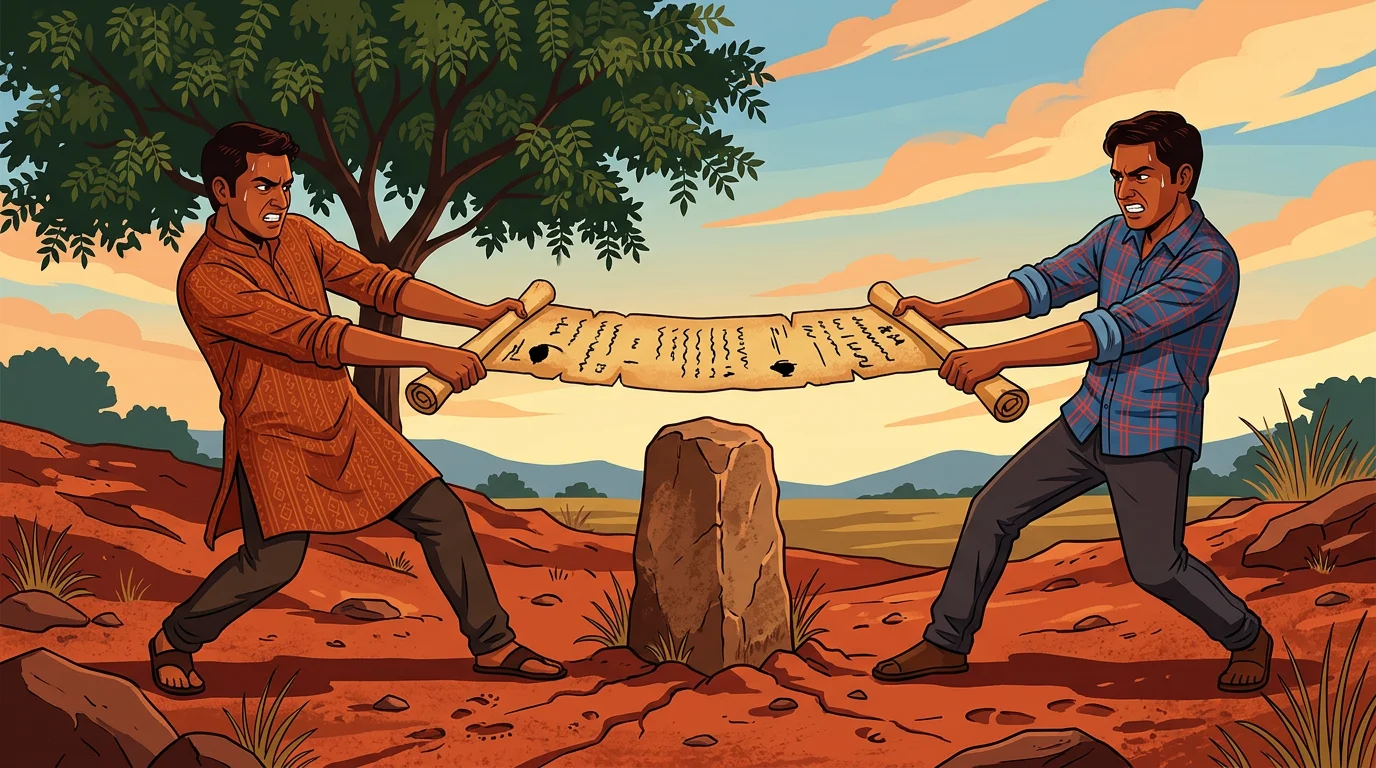
The second and third generations inherit a situation they did not create and may not fully understand. Your father knew his brother got “the north side.” You inherited “the north side” without knowing exactly where it ends. Your cousin inherited “the south side” and has a different memory of where it begins.
This is compounded by a mathematical reality. Your grandfather had three sons. Each son had two or three children. By the third generation, a single plot of land has nine or more claimants, many of whom have never met each other and some of whom live in different countries.
Without a registered partition deed, without updated revenue records, without clear survey sketches, there is simply no way to resolve competing claims without a court. And courts, as we have established, take 20 years on average.
Why NRIs Are Particularly Vulnerable
If you are an NRI who has inherited ancestral property, you are in a uniquely difficult position.
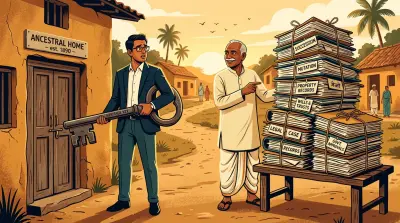
Your siblings or cousins back in India have physical possession of the property. They walk past it, they know the local revenue officials, they can show up at the Tahsildar’s office in person. You cannot. You are 10,000 kilometres away, managing your life in another country, trusting that the family arrangement your parents described to you is being honoured.
Here is what often goes wrong:
Your name may not be on the revenue records. If the oral partition was never followed up with mutation (the process of updating revenue records to reflect a change in ownership), the land might still be in your grandfather’s name. Or worse, only in the name of the family member who happened to apply for mutation first. Revenue records are not proof of ownership, but they create a powerful presumption. The person whose name is on the record has an enormous practical advantage over the person whose name is not.
You may not know what the records actually say. When was the last time you checked your pattadar status on the state land records portal? If the answer is “never,” you are not alone. Most NRIs have no idea what their land records show until a dispute forces them to look.
Distance makes you an easy target. This is not about malice (though fraud happens). It is about the fact that the family member who is physically present has more information, more access, and more influence over local processes than the one who is not. Over time, this asymmetry compounds.
How to Protect Yourself: A Checklist
If you have inherited or jointly own property in India, especially through an informal family arrangement, here is what you should do. None of this is complicated. All of it is cheaper than a lawsuit.
1. Get a registered partition deed
This is the single most important thing on this list. Even if everyone in the family gets along beautifully today, get the partition in writing and get it registered. A registered partition deed costs a few thousand rupees in stamp duty and registration fees. A partition suit costs lakhs in legal fees and decades of your life.
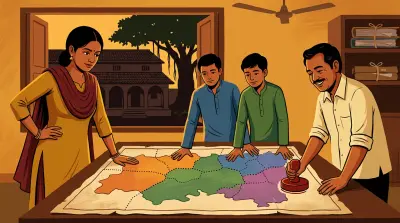
A partition deed is a legal document (signed by all co-owners, registered at the Sub-Registrar’s office) that describes exactly which physical portion of the property belongs to whom. It should clearly describe each person’s share with survey numbers, measurements, and boundaries. Once registered, it is a public record that cannot be easily disputed.
2. Update revenue records
After the partition deed is registered, apply for mutation so that the revenue records reflect your individual ownership. Mutation does not create ownership. The Supreme Court has been clear about that. But it creates a practical presumption that matters enormously when disputes arise. A property mutated in your name is far harder for someone else to claim than one still in your grandfather’s name.
3. Get fresh survey sketches
Boundaries on paper and boundaries on the ground are not always the same thing. If government acquisition (like a highway or metro project) has carved through the original plot, or if road widening has changed the frontage, the physical boundaries may not match old survey records. Get a licensed surveyor to demarcate your specific portion and create a fresh sketch. Keep it.
4. Get an encumbrance certificate
An encumbrance certificate shows every registered transaction on a property over a given period: sales, mortgages, liens, court orders. Get one covering at least 30 years. It will tell you if anyone has taken a loan against the property, if there are undisclosed claims, or if a transaction happened that you did not know about.
5. Check digital land records
Most states now have online portals for land records. In Telangana, use Bhu Bharati. In Andhra Pradesh, use Meebhoomi. In Karnataka, use Bhoomi. Pull up your survey number and verify that your name is there, the land extent is correct, and the classification matches what you expect. Do this at least every six months.
6. Digitise everything
Every document you have (sale deeds, partition deeds, tax receipts, survey sketches, encumbrance certificates) should exist in digital form, stored somewhere you can access from anywhere. Physical documents stored in a family locker in India are useless to you if you need them urgently from abroad. Assetly is built for exactly this purpose, giving property owners a single digital location for all their documents.
7. Get legal advice early
If you sense that a family arrangement is becoming contested, even mildly, talk to a property lawyer before positions harden. The window for a negotiated settlement is always larger at the beginning of a disagreement than at the end. Once FIRs are filed and court cases begin, resolution becomes exponentially more expensive and slower.
The Will Question
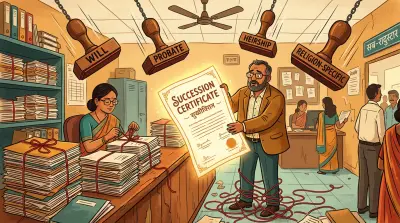
Many family property disputes are triggered by a death without a will. When the patriarch or matriarch dies intestate (without a will), the property devolves to all legal heirs equally under the applicable succession law. For Hindus, the Hindu Succession Act gives equal rights to sons, daughters, the surviving spouse, and the mother.
Equal rights in law, however, does not mean equal portions on the ground. Who gets the flat? Who gets the land? Who gets the commercial property? Without a will that specifies these details, or a family settlement that all parties agree to, these questions have no answer except the one a court eventually provides: years and lakhs of rupees later. If the family is choosing between formalising the division, recording a settlement, or having one heir step back, our guide on partition deed vs family settlement vs relinquishment deed explains which instrument fits.
If you are reading this and you own property in India, write a will. If your parents own property in India, have the conversation about a will. It is uncomfortable. It is also far less uncomfortable than a partition suit.
The Bottom Line
Family disputes do not start with bulldozers at midnight. They start with handshake agreements that worked fine for one generation but fall apart under the next. They start with the assumption that “we are family, we do not need paperwork.” They start with the belief that everyone will always agree, that values will never change, that no one will ever get greedy or desperate or simply forgetful.
The cheapest legal document you will ever pay for is a registered partition deed. Our step-by-step guide to registering a family partition deed covers the process, costs, and how NRIs can do it from abroad. Get it before you need it.
Related Reading:
- Did You Inherit a Ceiling Problem? Agricultural Land Compliance Guide: how oral partitions interact with the 1973 Land Ceiling Act, and what heirs need to check
- India’s Property Crisis in Numbers: the full scale of the problem
- Partition Deed vs Family Settlement vs Relinquishment Deed: which instrument to use to divide, record, or surrender a share
- The Vattinagulapalli Land Dispute Explained: a case study in what goes wrong
- Inherited Property in India? Here’s What NRIs Must Do: step-by-step guide for NRI heirs
- Will and Succession Certificate Guide: the documents that decide who gets your property
- An Unregistered Gift Deed Cost a Hyderabad Family 25 Years in Court: why registration matters
- Mutation Records Explained: what mutation does and does not prove
- Encumbrance Certificate Guide: how to check for hidden claims on your property
Assetly (assetlyhq.com) helps Indian property owners, especially NRIs, organise, verify, and track their property documents digitally.