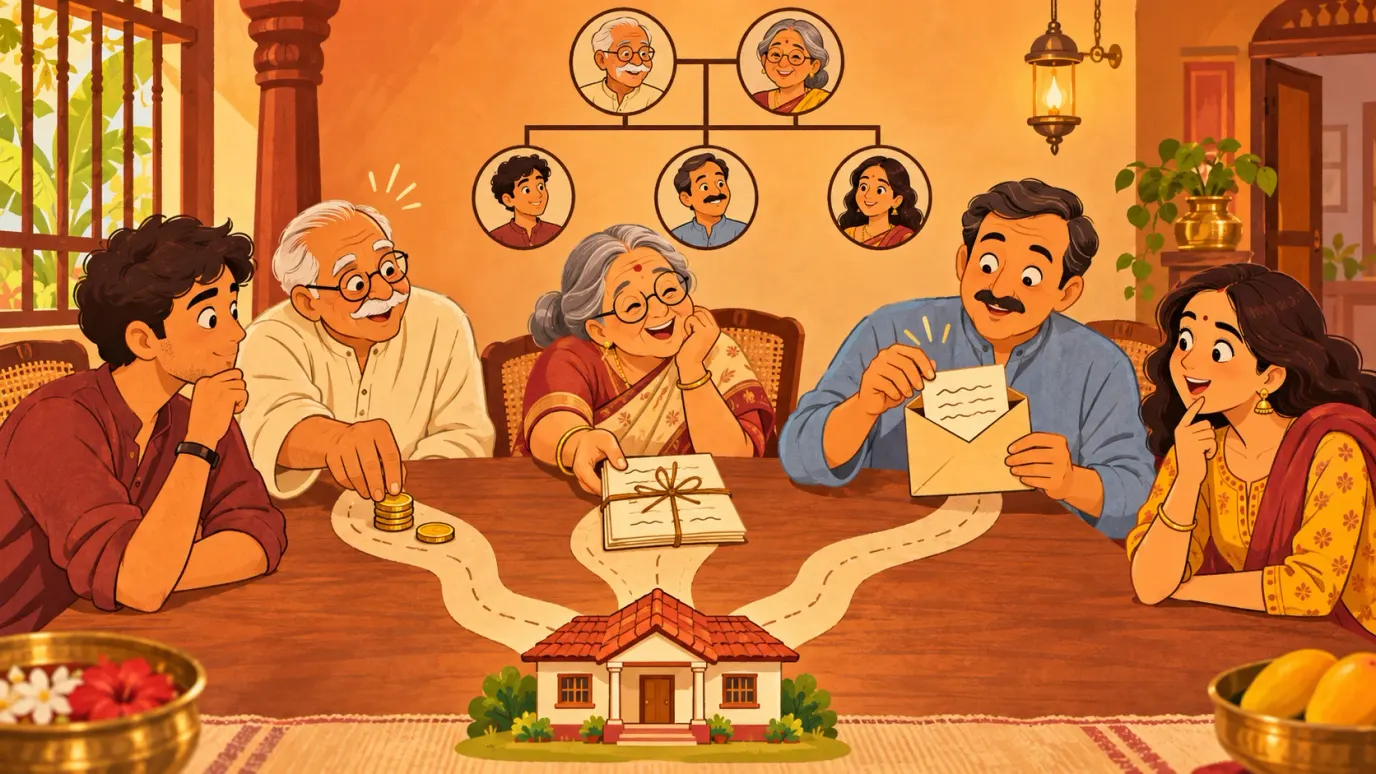

Your grandfather owned a house. Your father later became its owner. You grew up hearing the same sentence: “This is ancestral property.”
That sentence may be right. It may also be completely wrong.
A property does not become ancestral simply because it belonged to an ancestor. A property inherited from a parent is not automatically ancestral. And a property a person did not personally buy can still be their separate property.
The first question is not, “How old is this property?”
It is: How did this particular owner obtain this particular property?
That one question determines whether children already have a share by birth, whether the owner can give away the whole property and what must be divided after the owner dies.
This guide primarily explains the Hindu Succession Act and Mitakshara coparcenary rules. Other succession laws do not use the same ancestral-property calculation.
The Difference in One Table
| Property type | How it usually arises | Do children automatically have a birthright? | Can the owner dispose of the whole property? |
|---|---|---|---|
| Self-acquired property | Purchased or otherwise acquired in the person’s individual capacity without aid from joint-family property | Ordinarily no | Ordinarily yes, if the person is the sole absolute owner |
| Separate or individual property | May come through purchase, gift, will or Section 8 succession | Ordinarily no | Ordinarily yes, subject to the instrument and other legal restrictions |
| Inherited property | Received after another person dies | Not automatically | Depends on how it devolved and whether an earlier coparcenary interest existed |
| Coparcenary property | Property held within a qualifying Mitakshara coparcenary | Yes, for eligible coparceners | No one can dispose of other coparceners’ shares; a coparcener may deal with their own disposable interest |
The most important row is inherited property. “Inherited” tells you how the property arrived. It does not, by itself, tell you whether the recipient’s children now have birthrights in it.
Self-Acquired and Separate Property
Self-acquired property is property a person purchases or otherwise acquires in their individual capacity using their own funds, without aid from joint-family property or an adequate joint-family nucleus.
Suppose Ravi earns a salary and buys a flat solely in his name using his savings and a home loan. The flat is ordinarily his self-acquired property. His son and daughter do not own it merely because they are his children.
If Ravi is its sole absolute owner, he can ordinarily:
- live in it or rent it;
- sell it;
- make a registered gift of it; or
- leave it through a valid will.
If Ravi dies without a will while still owning it, his applicable legal heirs inherit it. That right arises on his death. It is different from owning a share by birth while Ravi is alive.
“Separate property” is the wider and safer expression. A person might receive a house under a will or gift rather than buy it themselves. They did not personally acquire it from earnings, but the instrument may still give it to them individually and absolutely.
So do not force every property into only two labels: ancestral or self-acquired. Separate property can arrive through several routes.
Inherited Property
Inherited property simply means property received because someone died.
What happens next depends on the legal route.
Suppose a grandfather bought a house from his own income. He dies after the Hindu Succession Act came into force, without a will. His son inherits a share under Section 8 of the Hindu Succession Act.
That inherited share does not automatically become coparcenary property between the son and the son’s children. The Supreme Court explained in M. Arumugam v Ammaniammal that property devolving under Section 8 is “the individual property of the person who inherits the same.”
If several heirs inherit under Section 8, Section 19 ordinarily makes them owners of their respective shares as tenants-in-common. In plain English, each owns a defined fraction even though the physical property may still be undivided. Their children do not automatically form a new coparcenary merely because the property once belonged to a grandfather.
This is where many family calculations go wrong:
Grandfather owned it → father inherited it → therefore it is ancestral.
That conclusion skips the most important step: under which provision and in what capacity did the father inherit it?
Ancestral and Coparcenary Property
People often use “ancestral property” and “coparcenary property” as if they mean exactly the same thing. They overlap, but the practical legal question is narrower: is this asset part of a qualifying Mitakshara coparcenary?
A coparcenary is a smaller ownership group within a Hindu joint family. Eligible coparceners have an interest in qualifying property by birth. Since the 2005 amendment to Section 6, a daughter of a coparcener has the same status, rights and liabilities as a son.
The Supreme Court confirmed in Vineeta Sharma v Rakesh Sharma that the father did not have to be alive on 9 September 2005. The Court put the principle plainly: “The daughters cannot be deprived of their right of equality.”
This does not mean every daughter owns a share in every property held by her father. It means she has equal birthrights where the property is genuinely coparcenary property.
Our detailed guide on daughters’ rights in ancestral property explains the 2005 amendment, protected earlier transactions and partition evidence.
The Four-Generation Shortcut Is Misleading
You will often hear that ancestral property is property coming through four generations of the male line.
That phrase is a historical shorthand for the traditional reach of a Mitakshara coparcenary. It is not a waiting period. Property does not become ancestral after the fourth death, and a family does not create coparcenary property merely by holding an asset for four generations.
Ask what happened at every link:
- Who first bought or held the property?
- Was it already coparcenary property?
- When did each owner die?
- Did the property pass through Section 8, Section 6, a will, a gift or a partition?
- Did any document say the recipient took it for their family branch rather than individually?
The dates matter. Arshnoor Singh v Harpal Kaur explains why succession opening before the 1956 Act may produce a different property character from succession under Section 8 after the Act.
That is why a family tree without a title timeline is incomplete.
A Simple Comparison
Example 1: The Father Bought the House
Mahesh buys a house using his own salary. He has a son and daughter.
The house is ordinarily Mahesh’s self-acquired property. Neither child can demand a partition merely because they were born. Mahesh may ordinarily sell, gift or will the house.
If he dies without a will, the heirs determined by the applicable succession law inherit what he still owns.
Example 2: The Father Inherited Under Section 8
Mahesh’s father bought a house from his own funds and dies without a will after 1956. Mahesh inherits one share under Section 8 alongside the other heirs.
Mahesh holds that inherited share in his individual capacity. His children do not receive an automatic birthright in it merely because the original owner was their grandfather.
Example 3: The Property Was Already Coparcenary Property
The family instead proves that the land was part of an existing Mitakshara coparcenary and remained undivided.
Eligible sons and daughters have interests by birth. When one coparcener dies, Section 6 is applied first to identify that person’s interest. Only that interest then passes under a will or intestate succession.
Do not divide the whole coparcenary property as if the deceased had owned it alone. Our legal-heir share calculation guide shows this sequence with a simple example.
Property Received Through a Gift or Will
A gift or will from a parent does not automatically make the property ancestral.
The document must be read. In C.N. Arunachala Mudaliar v C.A. Muruganatha Mudaliar, the Supreme Court explained that there is no automatic presumption about whether a father intended property given to a son to be held individually or for the family branch.
A valid gift of immovable property ordinarily requires a registered instrument signed for the donor, attested by at least two witnesses and accepted during the donor’s lifetime, under Sections 122 and 123 of the Transfer of Property Act.
A will operates after death. Section 30 of the Hindu Succession Act permits testamentary disposal of property capable of being disposed of, including a Hindu’s disposable interest in Mitakshara coparcenary property.
But no person can use a will or gift to transfer a share already belonging to somebody else. A coparcener may deal with their own legally disposable interest, not the entire family’s interests.
Property Owned by a Woman
Property belonging to a female Hindu is not controlled by her husband or sons merely because it came from her family.
Section 14 of the Hindu Succession Act generally treats property possessed by a female Hindu as property held by her as full owner, subject to the Act’s limited exception for a restricted estate created by a particular instrument or order.
If she dies without a will, Sections 15 and 16 determine succession. In some situations where she leaves no son or daughter and no surviving child of a predeceased son or daughter, the source from which she inherited the property changes the route: property inherited from her father or mother devolves upon the heirs of her father, while property inherited from her husband or father-in-law devolves upon the heirs of her husband.
Do not assume that property inherited by a woman becomes ancestral property for her children during her lifetime. First recognise her ownership; then apply the correct succession rule if she dies owning it.
Documents That Actually Answer the Question
Classify each property separately. A family may have one self-acquired flat, one inherited plot and one coparcenary agricultural parcel.
For each asset, collect:
- the current title deed and every earlier link deed;
- the original purchase deed and evidence of the purchase funds;
- death certificates showing when each succession opened;
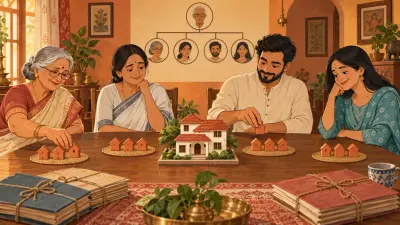
- the full family tree;
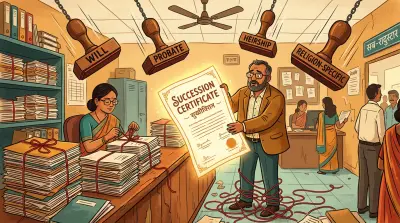
- any will and related probate or administration papers;
- registered gift, partition, settlement and release deeds;
- court decrees affecting ownership;
- encumbrance and certified registration records;
- records showing whether joint-family funds paid for the property;
- survey numbers, boundaries, extents and subdivision records; and
- mutation, pattadar or municipal records as supporting evidence.
Mutation does not settle the classification. In Jitendra Singh v State of Madhya Pradesh, the Supreme Court reiterated that a mutation entry “does not confer any right, title or interest.”
A shared surname, common home or joint family also does not prove that a particular asset is joint-family property. There is no presumption merely because the family is joint. The person asserting joint-family character bears the initial burden; if they prove an adequate joint-family nucleus from which the purchase could have been made, the evidential burden may then shift to the person claiming self-acquisition, as the Supreme Court recently restated in Mangala Gowri v Veeramma.
A Five-Question Classification Test
For every property, write down:
- Who is named in the first reliable title document?
- How did that person acquire it: purchase, inheritance, gift, will or partition?
- If inherited, when did the earlier owner die and which legal provision applied?
- Was the property already part of a coparcenary before that event?
- Do the documents give the recipient an individual interest or an interest for the family branch?
Only after answering those questions should you calculate shares or begin a partition.
The complete family property partition guide places this classification step inside the larger process of building the ownership tree, calculating shares, surveying the property and completing the correct deed.
Common Mistakes
“It belonged to my grandfather, so it is ancestral.” Not enough. Trace how it reached the present owner.
“Inherited and ancestral mean the same thing.” They do not. One describes receipt after death; the other concerns a particular form of birthright property.
“Four generations make it ancestral.” The phrase is descriptive history, not an automatic conversion rule.
“Only sons have birthrights.” Outdated. Daughters are coparceners on the same statutory footing as sons.
“The pattadar record proves who owns it.” It is useful evidence, but it is not conclusive title.
“A will can give away the whole ancestral property.” A person can dispose only of the interest legally available to them.
“The entire family must have one property type.” Classification is asset-specific. Different family properties can fall into different categories.
Related Reading
- Family Property Partition in India - the full sequence from asset list to separate records
- How to Calculate Legal Heirs’ Shares - simple examples for individual, co-owned and coparcenary property
- Daughters’ Rights in Ancestral Property - the Section 6 rule and the Vineeta Sharma judgment
- Inherited Property in India - the documents and follow-up work after inheritance
- Will and Succession Documents - where wills, probate and heirship records fit
Assetly helps Indian property owners organise, verify and track title, heirship and land records before a family property is transferred or partitioned. Learn more.