
Pull up your family’s land record in Telangana or Andhra Pradesh and you will usually see one name. One pattadar. One owner. It looks settled.
It often isn’t.
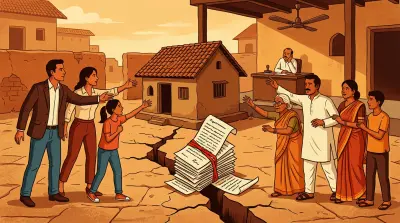
A large share of family land in India is not owned by whoever’s name sits in the record. It is owned by birth, by several people at once, and since 2020 that list expressly includes daughters, equally with sons. The record does not show them. The law does not need it to. That gap, between what the document says and what the law grants, is where a great many of India’s long-running family land battles begin.
For anyone who owns or expects to inherit family land, this is the quiet risk sitting under it. You may hold a share you never formally claimed. Or you may be about to buy “clear” family land that three other people can still assert a birthright in. Neither shows up in a quick look at the record, and if you live in another city or abroad, you may not even see the problem forming.
If the owner has already died, begin by mapping the will, heirs, assets and record updates with our inheritance document decision guide.
Here is how the law actually decides who owns ancestral property, what the Supreme Court settled in 2020, and why the land record is the last place that truth appears.
Ancestral property is not the same as inherited property
People use “ancestral” loosely. The law does not.
Ancestral (coparcenary) property is property inherited from your father, father’s father, or father’s father’s father, up to four generations of the male line, that has stayed undivided. In a Hindu joint family governed by Mitakshara law, the people with a share in it are called coparceners, and they get that share by birth. Not on anyone’s death. By birth.
Self-acquired property is what a person earns, buys, or receives by gift or will. It is theirs absolutely. They can sell it, gift it, or will it to anyone, and their children have no birthright in it while they are alive.
The whole ownership question turns on which bucket a property falls in. If family land is self-acquired, the owner decides who gets it. If it is ancestral and undivided, several people already own it, whatever the record says, and no single one of them can give away more than his or her own share.
The Supreme Court described the coparcenary right as “unobstructed heritage,” a right that vests by birth rather than waiting on the owner’s death:
“…is significant to note that under section 6 by birth, right is given that is called unobstructed heritage. It is not the obstructed heritage depending upon the owner’s death.” (Vineeta Sharma v. Rakesh Sharma, para 44)
That single idea, a right by birth, is what makes the next part so important.
Since 2020, daughters are coparceners too, equally
For a long time daughters were left out of the coparcenary. The Hindu Succession (Amendment) Act, 2005 changed the text of Section 6 to bring them in. But courts then split on who exactly qualified, and families spent years arguing over the fine print.
Two Supreme Court benches contradicted each other:
| Case | Year | What it said |
|---|---|---|
| Prakash v. Phulavati | 2016 | The amendment is prospective. A daughter gets rights only if both she and her father were alive on 9 September 2005. |
| Danamma v. Amar | 2018 | Gave two daughters a share even though the father had died in 2001, without overruling Phulavati. |
Lower courts could not reconcile the two. So a three-judge bench took up the question in Vineeta Sharma v. Rakesh Sharma, decided on 11 August 2020, and settled it. The core holding, in the court’s own words:
“(i) The provisions contained in substituted Section 6 of the Hindu Succession Act, 1956 confer status of coparcener on the daughter born before or after amendment in the same manner as son with same rights and liabilities. … (iii) Since the right in coparcenary is by birth, it is not necessary that father coparcener should be living as on 9.9.2005.” (para 129)
Read that again if your family has ever said “but your father passed away before all this.” Under the current law, it does not matter. A daughter’s right comes from being born into the family, not from her father surviving to a particular date. The court expressly overruled Phulavati and partly overruled Danamma to bring every High Court in line.
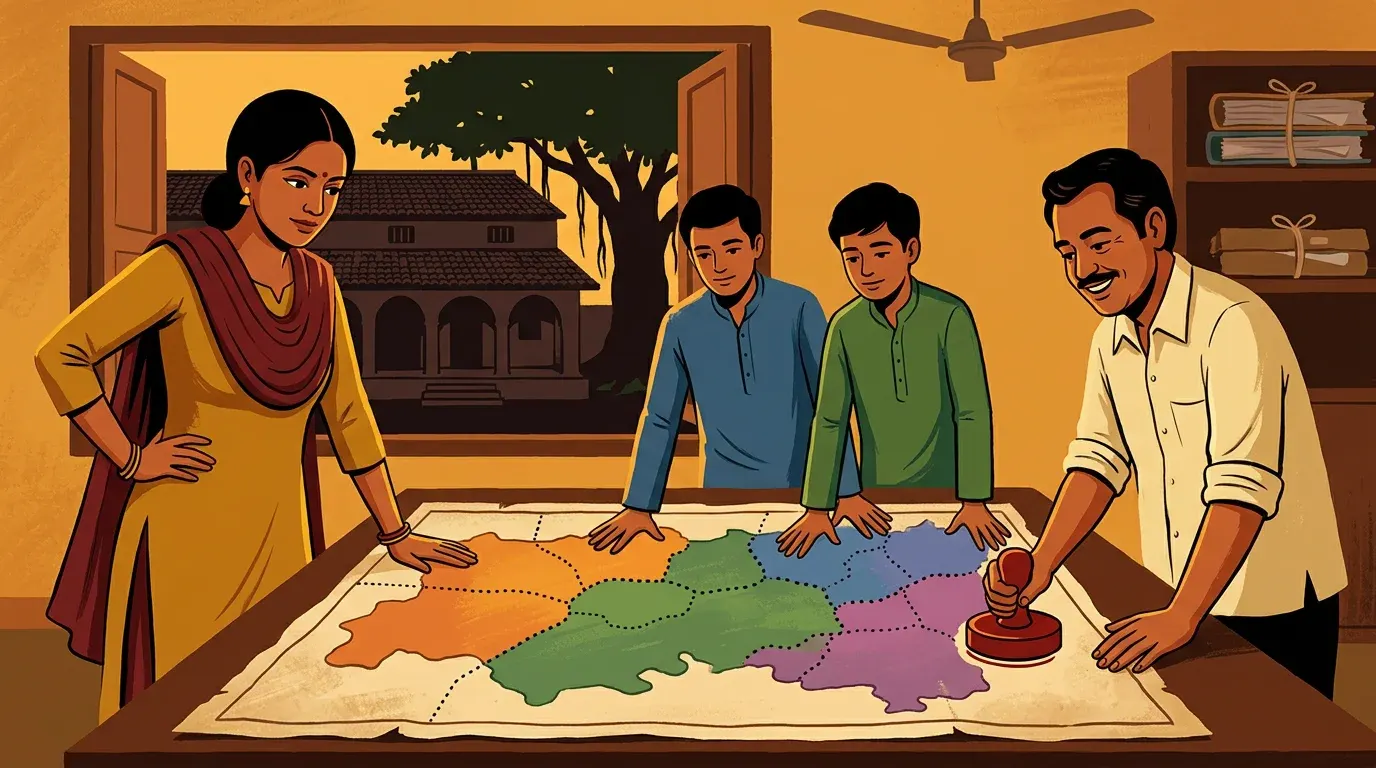
The practical effect: in undivided ancestral property, a daughter today holds the same share as a son. If your grandfather’s land was never formally partitioned, your aunts, your sisters, and you (if you are a daughter) may each hold an equal coparcenary share, sitting invisibly behind a record that names one man.
The document trap: an oral partition usually counts for nothing
Families rarely partition land on paper. Someone takes the north field, someone builds on the front plot, everyone “knows” who got what. For decades that felt like a settled division.
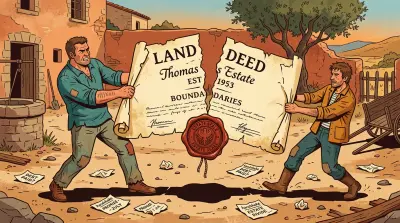
After Vineeta Sharma, it usually isn’t. The court was blunt about what a partition has to be to defeat a coparcener’s claim:
“…a plea of oral partition cannot be accepted as the statutory recognised mode of partition effected by a deed of partition duly registered under the provisions of the Registration Act, 1908 or effected by a decree of a court. However, in exceptional cases where plea of oral partition is supported by public documents… it may be accepted. A plea of partition based on oral evidence alone cannot be accepted and to be rejected outrightly.” (para 129(v))
This mirrors the Explanation to Section 6(5) of the Act, which defines a valid partition as one “made by execution of a deed of partition duly registered under the Registration Act, 1908 or partition effected by a decree of a court.”
So unless the family division was captured in a registered partition deed or a court decree (and completed before 20 December 2004 to sit outside the amendment), the coparcenary is treated as still undivided. Everyone’s birthright share, including every daughter’s, is still live. A handshake and a boundary wall did not remove it. If your family has papers, know the difference between a registered partition deed, a family settlement, and a relinquishment deed, because only some of them actually move ownership. This is also why oral partition is such a common trigger for disputes.
Why the land record still shows one name
Here is where the law collides with the paperwork, and where NRIs get caught.
A coparcenary share exists by operation of law. It does not need a land record to be real, and it does not appear in one until somebody files a mutation (a name transfer). Records get updated only when a person applies, with a death certificate, a legal heir or family member certificate, and, for a division, a registered partition deed or decree.
That leaves a lot of room for the record to lag the law:
- Historic mutations were often done in the name of the eldest male or the karta alone.
- Daughters’ post-2005 rights predate almost every record update.
- Records follow registered instruments, and most family divisions were oral, which now do not count.
- An undivided coparcener is simply invisible until someone bothers to record the division.
In Telangana, inheritance and succession mutations run through the Dharani portal (now migrating to the Bhu Bharathi system), with the death certificate, legal-heir documents, and the pattadar passbook. In Andhra Pradesh, ownership shows in the RoR 1-B and possession in the Adangal, updated through Webland and MeeSeva. In both states, when there are multiple heirs the mutation is meant to record all of them, but in practice the record frequently keeps showing the person who last transacted.
The takeaway is uncomfortable but simple: a single name in Dharani or Webland is not proof that person is the sole owner. Without a registered partition deed or a court decree behind it, other coparceners still hold enforceable shares the record does not show. This is the same lesson as the difference between a mutation entry and real title: the record is evidence, not ownership.
What this means if you own or are buying family land
Two very different people need to read this carefully.
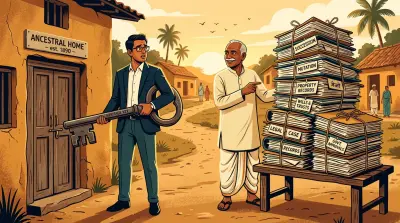
If you inherited family land. You may already own a share you have never claimed, especially if you are a daughter and the family assumed the sons would “handle it.” That share does not expire just because you live abroad and have not visited in fifteen years. But it also will not protect itself. If a relative gets the land mutated into a single name, or a PoA holder sells it, unwinding that means litigation, often from far away, over many years.
If you are buying “family land.” The seller’s clean-looking record can hide three or four coparceners who never signed away anything. If even one of them, a daughter married into another town, an NRI sibling, later asserts a birthright, your purchase is exposed. This is the same structural weakness behind invalid GPA sales: the paper looked fine, the title underneath did not.
A specific trap for daughters: a relinquishment or release deed, sometimes signed under family pressure at a wedding or a funeral, can give up a coparcenary share for good. If you signed one without understanding it, or if a sister is being asked to sign one now, treat it as the serious transfer of ownership that it is.
Common mistakes people make
- Assuming “ancestral” and “inherited” mean the same thing. They carry different rights.
- Believing a will can defeat a daughter’s coparcenary share. It cannot touch anyone’s birthright share, only the testator’s own.
- Treating a decades-old oral partition as final. Unregistered, it usually is not.
- Reading a single-name land record as proof of sole ownership.
- Letting a partition suit slide because “the family is joint anyway.” While the family stays joint there is generally no limitation on seeking partition, but if the others prove ouster (open, hostile, exclusive possession denying your co-ownership for more than 12 years), the door can close.
How to establish or protect an ancestral share from abroad
You do not need to fly home to start, but you do need the documents in order.
- Prove the lineage and the death. Obtain the death certificate of the last undivided holder and a legal heir or family member certificate from the revenue authority, plus a clear family tree showing your line.
- Pin down the property’s character. Establish whether the land is genuinely ancestral and undivided, or self-acquired. Trace the chain of title and pull the encumbrance certificate to see what has actually been registered against it.
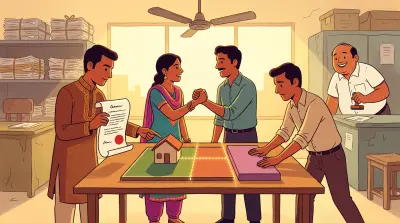
- Achieve a lawful division. Either sign a registered partition deed with all coparceners, or, if the family resists, file a partition suit and get a court decree. After Vineeta Sharma, a daughter’s claim holds even if the father died before 2005, unless a registered partition or decree from before 20 December 2004 defeats it.
- Update the record. Apply for mutation (Dharani or Bhu Bharathi in Telangana, Webland in Andhra Pradesh) so the record finally reflects the real owners.
- Be careful with Power of Attorney. If you must act through a relative, use a registered, specific, revocable PoA limited to defined acts, properly notarised or apostilled and stamped in India. A broad general PoA in the wrong hands is how many of these disputes start.
Because so much of this is a documentation problem before it is a legal one, keeping every relevant paper (title chain, EC, death and heir certificates, any partition or relinquishment deed, mutation status) organised and monitored in one place is what lets an NRI act early instead of reacting to a crisis. This is the gap Assetly is built for: organising, verifying, and tracking property documents from abroad, so a hidden claim surfaces on your terms.
A note on who this applies to
The coparcenary rules above govern Hindus, Buddhists, Jains, and Sikhs. Muslim succession follows Muslim personal (Shariat) law, and Christians and Parsis follow the Indian Succession Act, 1925, with different rules and shares. Separately, when a Hindu dies without a will, the property passes to Class I heirs (including the son, daughter, widow, and mother) who inherit simultaneously and equally. That intestate framework is worth understanding alongside these coparcenary rights, and we cover it in our guide to inherited property for NRIs and NRI succession disputes.
Assetly is a property document management platform that helps NRIs and remote owners organise, verify, and monitor their property in India from anywhere. Learn more.