
When a property owner dies, families are often given a shopping list of documents before anyone has asked the important questions. Was there a will? Is the asset a flat, agricultural land or a bank deposit? Are all the heirs in agreement? Is the owner’s name correctly recorded? Each answer sends the case down a different path.
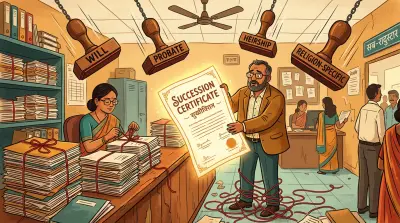
That is why there is no single “inheritance certificate” for India. A death certificate proves the death. A legal heir certificate records family relationships. A succession certificate deals with debts and securities. Mutation updates public records. A release or partition changes how co-heirs hold the property. Treating these documents as interchangeable is an expensive way to lose six months.
This guide helps you choose the first step. It is a practical map, not a substitute for advice on a disputed estate or on the personal law that applies to your family.
The five questions to answer before applying for anything
Open a single case file and answer these questions in writing:
- What exactly did the deceased own? List each flat, plot and parcel separately. Add bank accounts, deposits, shares and other financial assets as a different group.
- How was each asset held? Sole name, joint ownership, Hindu Undivided Family, partnership, company or trust can change the analysis.
- Is there a will? Find the original, not a photograph forwarded on WhatsApp. Note the executors, witnesses and every later codicil.
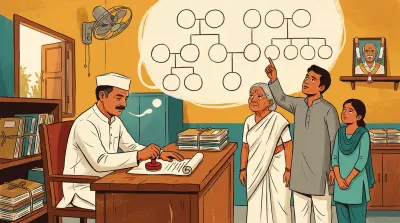
- Who may inherit? Record the complete family tree, including a predeceased child’s branch. Do not begin with the relatives who happen to be available locally.
- Is anyone disputing the will, the family tree or the shares? An administrative certificate cannot settle a genuine title dispute.
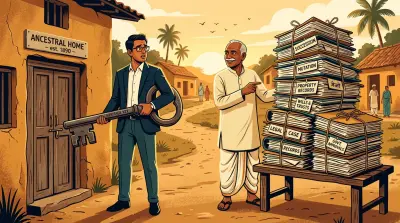
Also collect the original acquisition deed, the latest property tax receipt, the current revenue or municipal entry, society records for a flat, loan papers and any prior partition, gift or release deed. Our inherited property guide for NRIs explains how to build this base file from abroad.
The decision tree
| Situation | Usually start with | What it does not do |
|---|---|---|
| Every case | Registered death certificate and asset file | Decide the heirs or their shares |
| There is a will | Original will and advice on its proof or administration | Make every mutation automatic |
| No will, family relationship must be recorded | Legal heir, surviving member or family member certificate used by that state | Confer title or decide a dispute |
| Bank deposits, shares or debts require a court grant | Succession certificate under Part X, if appropriate | Transfer a house, flat or land |
| Rights are clear and records need updating | Mutation in each relevant record | Create title by itself |
| Several heirs want separate ownership | Registered partition, release or suitable family arrangement | Cure a false family tree or invalid title |
The sequence is rarely “get every certificate”. It is “identify the asset and legal route, then obtain only the proof the receiving authority reasonably requires”.
Step 1: register the death and secure the property file
The death certificate is the common starting point. Obtain several certified copies or verifiable digital copies because banks, courts, societies and revenue offices may each ask for one.
At the same time, secure the originals. This is especially important when siblings live in different cities or countries. Make a scan of every page, record who holds each original and do not hand a complete file to an intermediary without an inventory.
Check whether the deceased was the recorded owner everywhere. A sale deed may be in one name while property tax, revenue and society records still show an earlier owner. That mismatch does not necessarily destroy title, but it adds a record-correction step before the heirs can reach a clean sale.
Step 2: if there is a will, verify it before acting on it
A will names the intended beneficiaries and often an executor. It should be read with the title documents and applicable succession law. Do not assume that registration alone makes a will immune from challenge, or that an unregistered will is automatically invalid.
The practical questions are whether this is the final will, whether it was properly executed, whether the assets are correctly described, and whether any heir is likely to contest capacity, coercion or authenticity. A receiving authority may ask for probate, letters of administration or another court order depending on the circumstances and the law currently in force. Because the statutory position on compulsory probate changed in late 2025, use the current text and local court practice, not an old checklist copied from the internet.
If the will is disputed, a Tahsildar, municipal officer or housing society cannot conduct a full title trial. Get case-specific legal advice before relatives create competing mutations or attempt a sale.
Step 3: if there is no will, establish the heirs under the applicable law
When someone dies intestate, the heirs and their shares are determined by the personal succession law applicable to the deceased. The convenient family assumption is not the legal answer. Daughters cannot simply be omitted, a widow’s rights do not disappear because she lives elsewhere, and the children of a predeceased heir may represent that branch.
A state revenue authority may issue a legal heir certificate, surviving member certificate or family member certificate. The name and process vary. Its administrative function is to record the relationship between the deceased and the listed family members. It is useful for mutation, pensions, utilities and supporting records.
It is not a judgment awarding the property. As our legal heir certificate guide explains, an incomplete or contested certificate is not a shortcut around a civil dispute.
Step 4: use a succession certificate only for its actual job
The phrase “succession certificate” sounds broad, but the statute is narrow. Part X of the Indian Succession Act deals with debts and securities. Section 372 requires the petition to identify the debts and securities for which the certificate is sought. Section 374 says the grant specifies those assets and the powers to receive interest, dividends, or negotiate and transfer securities.
That makes a succession certificate relevant when a bank, company or debtor needs a court-backed person to whom it can safely pay. It may cover deposits, shares, debentures or money owed to the deceased, depending on the case. The District Judge with the jurisdiction specified in section 371 grants it, and section 380 gives the certificate effect throughout India.
It does not transfer title to immovable property. If the only asset is a plot or flat, asking for a succession certificate may be asking the court for the wrong instrument. See the complete succession certificate guide for the court process and costs.
Step 5: mutate the right records, but do not confuse mutation with title
After the rights are established, update the records that apply to the asset. That may include land revenue records, municipal property tax, the housing society or apartment association, and utility accounts. Agricultural and urban properties can follow different workflows even within one state.
Mutation matters because stale records create operational problems. Tax notices go to the wrong person, online extracts show the deceased owner, and a buyer sees an unexplained break in the record trail.
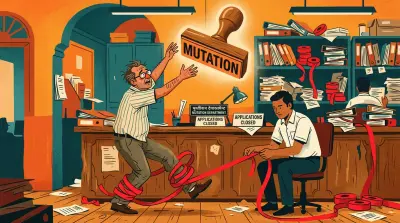
But mutation is not a conveyance. The Supreme Court has repeatedly explained that a revenue mutation neither creates nor extinguishes title and is primarily fiscal. The source of an heir’s right is the valid will or applicable succession law, supported where necessary by a court order or later family instrument. Our mutation, khata and patta guide covers this distinction in detail.
Step 6: decide how multiple heirs will hold the property
If several people inherit, mutation in all their names may be only an interim state. Before a sale, mortgage or redevelopment, the family must decide whether they will continue as co-owners or separate their rights.
Common routes include:
- A release or relinquishment deed, where one co-heir gives up a share in favour of another
- A partition deed, which divides jointly held property into defined shares or assets
- A properly structured family settlement, where a wider arrangement resolves competing family claims
- A civil suit for partition or declaration when agreement is impossible
The correct instrument depends on existing title, consideration, possession and state stamp and registration law. A notarised no-objection letter is not automatically a replacement for a registrable deed. Read our comparison of partition deeds, family settlements and relinquishment deeds before choosing one.
A practical sequence for an NRI family
Suppose a parent in Hyderabad dies owning a flat, some shares and a bank deposit. One child lives in India and another in the United States.
The family should first obtain the death certificate, secure the flat’s deed and locate the will. If there is no will, they identify every heir under the applicable succession law and obtain the Telangana family member certificate if the relevant authorities require it. They update the municipal and association records on the strength of the actual succession documents. For the shares and deposit, they ask each institution what it will accept and consider a succession certificate if the institution requires a court grant.
If the overseas child wants the Indian sibling to own the flat, the family then chooses and registers the appropriate release, partition or settlement instrument. The NRI may act through a properly authenticated and stamped power of attorney, but the authority must expressly cover the intended acts.
Notice what the family does not do: it does not obtain one “succession certificate” and expect it to transfer every asset.
Mistakes that make an inheritance file harder to fix
- Applying for a succession certificate solely to transfer land
- Omitting an estranged or overseas heir from the family tree
- Treating a nominee as the final beneficial owner without checking succession rights
- Assuming mutation proves ownership
- Selling before every heir’s share and authority to sign are clear
- Using a general power of attorney that does not cover the required court or registration act
- Relying on a decades-old probate checklist after the 2025 statutory change
- Updating only one record and leaving revenue, municipal and society records inconsistent
The shortest useful checklist
Start with facts, not forms:
- Death certificate
- Original title and asset papers
- Final will, if any
- Complete family tree and identity records
- Asset-by-asset classification: immovable property versus debts and securities
- Advice on the applicable succession law and any court grant
- Mutation and other record updates
- Registered family instrument if co-heirs are separating their rights
The right document is the one that solves the next legal or administrative problem. Everything else is paperwork without a destination.
If you already have some of the documents but cannot see what is missing, run Assetly’s free Title Readiness Check. It reviews the ownership document, mutation, Encumbrance Certificate, tax and dispute position, then gives you a personalised list of gaps and next steps. You can also browse all Assetly free property tools.