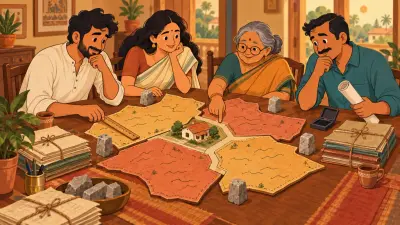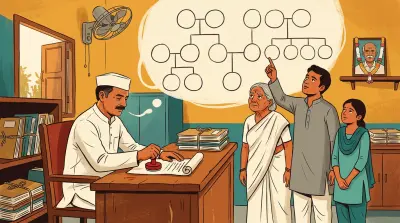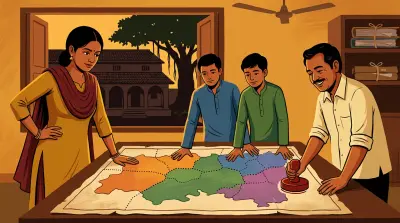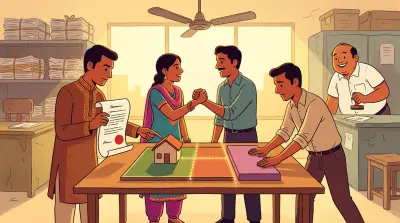
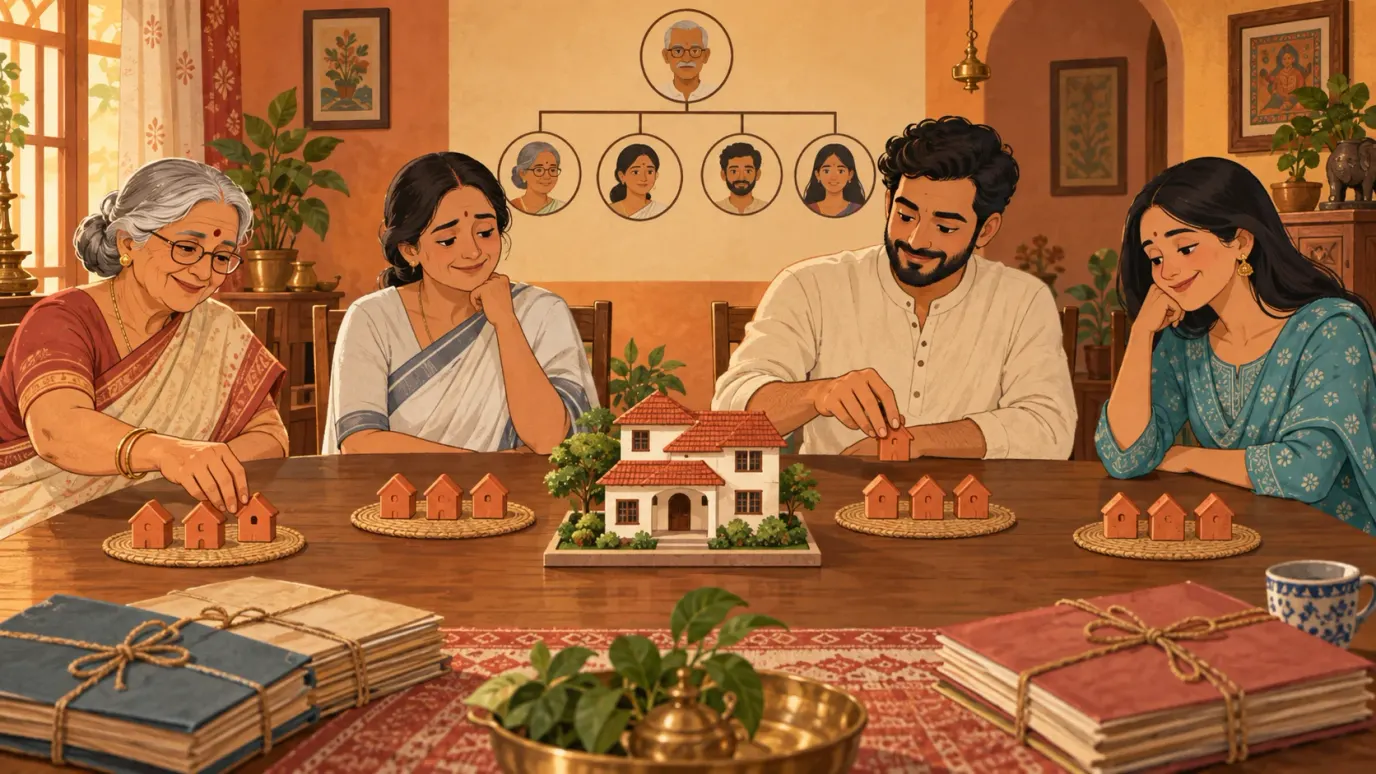

A father dies owning a house. He leaves behind his wife, mother, son and daughter.
Does the son get half? Do the two children divide everything? Does the wife already own the house because she lives there? Do the grandchildren also receive shares?
For this simple example, the answer is much easier: first confirm that the father owned the whole house, then divide it into four equal shares. The wife, mother, son and daughter each receive one-fourth.
That answer changes if the father owned only part of the house, left a valid will, held undivided Hindu family property in which children had rights by birth, or had a child who died before him.
So do not start with a fraction. Start with the facts.
The Five Questions to Answer First
Before calculating anyone’s share, answer these questions in order:
- Which property are you calculating? A house, plot and agricultural land may have different owners.
- How much did the deceased person own? It may be the whole property or only a fraction.
- Is there a valid will covering that property? “Intestate” simply means dying without a valid will. If there is a will, the no-will rules may not control that asset.
- When did the owner die? Succession rights are usually determined using the law and family position on the date of death.
- Which succession law applies? Religion, the form of marriage and certain statutory or customary exceptions can change the answer.
Step 1: Identify Which Succession Law Applies
India does not have one inheritance table for every family. Before listing the heirs or doing any arithmetic, identify the law governing each asset or property interest in that person’s estate.
Start with these records:
- the deceased person’s religion and any conversion history;
- the marriage certificate and the law under which the marriage was solemnised or registered;
- any valid will;
- the date of death;
- whether the person belonged to a Scheduled Tribe or community governed by a special custom; and
- the state and type of property, especially for agricultural or protected land.
The family surname is not enough. The mutation record is not enough. Use the person’s actual legal and family history.
A Brief Guide to the Main Succession Laws
This table gives you the starting point in everyday language. It does not calculate the final shares.
| Family situation | Main starting law | In simple terms |
|---|---|---|
| Hindu, Buddhist, Jain or Sikh | Hindu Succession Act, 1956 | The law has separate rules for a man’s property, a woman’s property and certain undivided Hindu family property. Most examples in this guide use this law. |
| Muslim | Muslim Personal Law (Shariat) Application Act, 1937 and applicable Muslim personal law | Do not divide the property equally by simply counting the relatives. The answer depends on exactly which relatives survive. Agricultural land may also require a state-specific check. |
| Indian Christian | Indian Succession Act, 1925 | If a person leaves a spouse and children, the spouse generally receives one-third and the remaining two-thirds goes to the children or their family branches. Other family situations give different results. |
| Parsi | Indian Succession Act, 1925 | The same Act contains a separate set of rules specifically for Parsis. Do not use the Christian or Hindu calculation. |
| Marriage under the Special Marriage Act | Special Marriage Act, 1954 | The law used for succession can depend on the religion of both spouses. Check the marriage certificate and both spouses’ religions before choosing a formula. |
Hindu succession
The worked examples below mainly use the Hindu Succession Act. It applies to the people covered by Section 2, including Hindus, Buddhists, Jains and Sikhs, subject to the Act’s terms and exclusions.
Start by asking how the property was owned.
Separately owned property is property the deceased owned personally, either completely or as a stated share with other owners. Only that person’s ownership is inherited.
Coparcenary property is a special category of undivided Hindu family property in which eligible family members can have rights by birth. “Mitakshara” is the name of the Hindu-law system under which this birthright arrangement operates for most Hindu joint families. It does not mean every property that has been in a family for many years.
For separately owned property, identify the heirs and divide the deceased person’s share. For coparcenary property, first work out what portion belonged to the deceased within the family property, then distribute only that portion to the heirs.
Muslim succession
Section 2 of the central Shariat Application Act makes Muslim personal law the rule of decision for the matters it lists, including intestate succession, where the parties are Muslims. The central text expressly saves questions relating to agricultural land, and the India Code text records state amendments. Agricultural land therefore requires a state-specific check before applying a general inheritance formula.
The 1937 Act does not itself contain one table of fractions for every family. The applicable rules can depend on the school of Muslim law and on exactly which relatives are alive when the owner dies. The presence of one relative may change or exclude another relative’s share.
In practical terms, the calculation starts in this order:
- identify the property that remained in the deceased person’s estate;
- account for funeral expenses;
- pay legally enforceable debts;
- deal with valid bequests within the limits of the applicable law; and
- distribute what remains among the legal heirs under the applicable Muslim succession rules.
In Zoharbee v Imam Khan, the Supreme Court explained the Sunni-law framework relevant to that case. Certain relatives first receive the fixed shares that apply to that family. The balance, if any, is then dealt with under the rules for relatives entitled to the residue and, where relevant, more remote relatives. These are sometimes called “sharers”, “residuaries” and “distant kindred”, but a family does not need to memorise those labels before seeking a calculation.
There is another important difference from Hindu joint-family property. A Muslim heir does not receive a Hindu-style birth share merely because the property came from an ancestor. The right to inherit arises when the owner dies. For that reason, do not reuse a Hindu succession calculator or assume that every son-and-daughter combination can be divided using one standard ratio. First record the complete family tree, debts, bequests, property type and applicable school of law.
Christian succession
For an Indian Christian dying without a valid will, Part V of the Indian Succession Act provides the starting rules. First identify whether the deceased left a spouse and any direct descendants.
- Spouse and direct descendants: the spouse ordinarily receives one-third. The remaining two-thirds goes to the children or, in the appropriate case, to the family branch of a child who died earlier.
- Spouse, no direct descendants, but other close relatives: the spouse ordinarily receives one-half. The other half passes under the Act’s order for relatives.
- Spouse and no qualifying relatives: the spouse receives the whole estate.
- No spouse: the estate first goes to direct descendants. If there are none, the Act moves through the other relatives in its stated order.
The Act uses the phrase “lineal descendants”. In simple terms, these are descendants in a direct line, such as children, grandchildren and great-grandchildren. If there are no such descendants, the calculation changes.
Simple example: Maria dies without a will, leaving her husband and two living children. Her husband receives one-third. The remaining two-thirds is divided equally between the children, so each child also receives one-third.
When a child died earlier: David leaves his wife, one living daughter and two children of a son who died before David. His wife receives one-third. The remaining two-thirds is divided into two branches: one for the living daughter and one for the late son’s family. The daughter receives one-third of the whole estate. The late son’s one-third branch is divided between his two children, so each grandchild receives one-sixth.
This branch method is not a rule that grandchildren always take through their parent. If there are no surviving children and all surviving grandchildren are at the same level, a different provision may require them to share equally. The exact family tree still matters.
Parsi succession
Parsi succession where there is no valid will is also found in the Indian Succession Act, but in its own set of provisions. The basic starting points are:
- a surviving spouse and each living child ordinarily receive equal shares;
- if there are children but no surviving spouse, the children ordinarily share equally;
- if one or both parents also survive with the spouse and children, each parent receives half of a child’s share; and
- if a child died before the owner, Section 53 determines how that child’s family may receive the child’s branch. The route is not identical in every family situation.
Simple example: A Parsi owner dies without a will, leaving a spouse, two children and both parents. Give one unit each to the spouse and the two children, and half a unit to each parent. There are four units in total. The spouse receives one-fourth, each child receives one-fourth, and each parent receives one-eighth.
If there are no direct descendants, Sections 54 and 55 and the Second Schedule set out a different order involving the spouse and other relatives. Do not keep using the spouse-and-children example after the family facts have changed.
Keep Parsi succession separate from the Act’s general Christian rules. The same statute contains both, but the calculation is not the same.
Marriage under the Special Marriage Act
Marriage under the Special Marriage Act does not produce the same succession answer for every couple.
Under Section 21, the Indian Succession Act generally governs succession to the property of people married under the Special Marriage Act and their children. For this purpose, the separate Parsi intestacy chapter is left out.
Interfaith example: A Hindu and a Christian marry under the Special Marriage Act. Section 21 generally brings succession within the Indian Succession Act. Do not automatically apply the Hindu Succession Act merely because the deceased spouse was Hindu.
Section 21A creates an important exception when both spouses are within the Hindu, Buddhist, Sikh or Jain group. They do not have to profess exactly the same religion. A Hindu-Sikh couple can also fall within this exception.
Example within that group: Two Hindus marry under the Special Marriage Act. Their choice of that marriage law does not by itself move their inheritance to the Indian Succession Act. Their ordinary applicable succession law must still be identified, which will commonly be the Hindu Succession Act.
The practical check is simple: read the marriage certificate, record both spouses’ religions and then apply Sections 21 and 21A before choosing an inheritance table.
Special and customary situations
Section 2(2) of the Hindu Succession Act excludes members of Scheduled Tribes unless the Central Government has directed otherwise by notification. Some family histories may also involve customary rules, special local laws or old transactions completed under an earlier legal position.
The practical lesson is simple: identify the succession law before identifying the shares. Once the governing law is clear, the rest of the calculation becomes structured rather than speculative.
Example 1: One Owner, Four Heirs
Suppose Arun bought a house in his own name. He dies without a will. He leaves:
- his wife;
- his mother;
- one son; and
- one daughter.
Under Sections 8 to 10 and the Schedule of the Hindu Succession Act, these family members are Class I heirs in this example. “Class I” simply means the law’s first-priority group of heirs. Each receives one share.
Think of the house as 12 equal parts:
| Heir | Share | Parts out of 12 |
|---|---|---|
| Wife | 1/4 | 3 |
| Mother | 1/4 | 3 |
| Son | 1/4 | 3 |
| Daughter | 1/4 | 3 |
The daughter does not receive less because she is married. The mother is not left out because the deceased had a wife and children. The grandchildren do not receive separate shares through a son or daughter who is alive in this example.
Example 2: The Deceased Owned Only Half
Now suppose Arun and his wife Meera bought the house together, with the sale deed giving each of them a half share.
Arun dies without a will, leaving the same four heirs: Meera, his mother, his son and his daughter.
Do not divide the whole house among four people. Arun owned only half.
Think of the house as 16 equal parts:
- Meera already owns 8 parts.
- Arun’s 8 parts are divided among his four heirs.
- Each heir receives 2 of Arun’s parts.
The position after Arun’s death is:
| Person | Share after inheritance |
|---|---|
| Meera | 10/16, because she keeps her 8 and inherits 2 |
| Arun’s mother | 2/16 |
| Son | 2/16 |
| Daughter | 2/16 |
This is the most useful rule in the article: only the deceased owner’s share is inherited. A living co-owner keeps what they already own.
The same rule applies when several ancestors co-owned land. If three brothers owned land equally, begin with each brother’s one-third. Trace each one-third through that brother’s heirs instead of dividing the entire property by the total number of relatives alive today.
Our complete family property partition guide explains how to connect this calculation to the family tree and the eventual physical division.
Who Receives a Share When a Male Hindu Dies Without a Will?
Section 8 places the heirs listed in Class I of the Schedule first. Section 9 says Class I heirs take simultaneously and exclude the later classes.
For many families, the most common Class I heirs are:
- widow;
- mother;
- son;
- daughter; and
- specified descendants of a son or daughter who died before the owner, and the widow or widows specified within a predeceased son’s branch.
This is not the complete statutory list. Use the Schedule when the family includes predeceased children, later generations or less familiar relationships.
The basic Section 10 rules
- The widow receives one share. If there is more than one legally recognised widow, they take one share together.
- Each surviving son receives one share.
- Each surviving daughter receives one share.
- The deceased’s mother receives one share.
- The branch of each son or daughter who died before the deceased receives one share, divided within that branch under the statutory rules.
The word branch matters. A family does not always divide the property by the number of people standing in the room.
Example 3: A Child Died Before the Owner
Suppose Dev dies without a will. He leaves his wife, one living son and two children of a daughter who died before him. For this example, assume there are no other Class I heirs.
Dev’s estate is divided into three top-level shares:
- Dev’s wife receives one share.
- The living son receives one share.
- The predeceased daughter’s branch receives one share.
Her two children divide the branch share between them.
Using 12 equal parts:
| Heir or branch | Parts out of 12 |
|---|---|
| Dev’s wife | 4 |
| Living son | 4 |
| Predeceased daughter’s branch | 4 |
| Each grandchild in that branch | 2 |
The two grandchildren do not each receive the same share as the living son. Together, they take the share represented by their mother’s branch.
When a Female Hindu Dies Without a Will
Do not copy the male-heir table.
Sections 15 and 16 of the Hindu Succession Act contain a separate order for a female Hindu who dies intestate. The first entry ordinarily includes her sons and daughters, including children of a predeceased son or daughter, and her husband.
Suppose Leela owned an apartment entirely in her own name. She dies without a will, leaving her husband, one son and one daughter. In this basic example, each receives one-third.
But Section 15 also contains special rules connected to the source from which she inherited property, particularly where she leaves no son or daughter or children of a predeceased child. Property inherited from her parents and property inherited from her husband or father-in-law may then follow different routes.
The safe rule is simple: for a female owner’s estate, do a fresh Section 15 analysis. Do not assume her heirs are calculated using the same table as a male owner’s estate.
When the Property Is Hindu Coparcenary Property
Coparcenary property, the special type of undivided Hindu family property described earlier, needs an extra calculation before inheritance begins.
Under the substituted Section 6 of the Hindu Succession Act, the daughter of a coparcener in a Mitakshara joint Hindu family is a coparcener by birth in the same manner as a son, with the same rights and liabilities. In Vineeta Sharma v. Rakesh Sharma, the Supreme Court stated: “The daughters cannot be deprived of their right of equality conferred upon them by Section 6.”
Here is a simplified calculation. A coparcenary consists of a widowed father, one son and one daughter. The father’s mother has also died. Treat the property as six equal parts.
First: identify the father’s interest
- Father: 2 parts
- Son: 2 parts
- Daughter: 2 parts
Second: inherit the father’s 2 parts
The father dies without a will, leaving the son and daughter as his Class I heirs in this example. His 2 parts are divided equally. Each child receives one additional part.
| Person | Existing coparcenary parts | Inherited from father | Final parts out of 6 |
|---|---|---|---|
| Son | 2 | 1 | 3 |
| Daughter | 2 | 1 | 3 |
This assumes the property really is coparcenary property and that the stated people are the relevant coparceners, meaning family members who hold this birthright, and heirs. Where the deceased leaves a widow or other family members, the first calculation can change. Get the family structure checked before using a fraction.
Do not call every old or inherited property ancestral. Our guide to ancestral, inherited and self-acquired property shows how Section 8 inheritance differs from a birthright, while the guide to daughters’ rights in ancestral property explains the Section 6 position in detail.
A Will Changes the Calculation
All the examples above assume there is no valid will covering the property.
A will may distribute the deceased person’s property differently, subject to the law applicable to that person and any challenge to the will. But a will can deal only with what the person was legally entitled to dispose of. A co-owner cannot use a will to give away another co-owner’s share.
Before using an intestate formula, check whether a will exists, whether it identifies the property, whether it is the last valid will and whether it covers the deceased’s entire share.
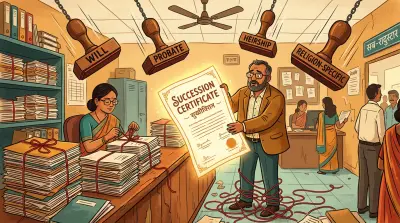
A legal heir certificate and a succession certificate do different jobs. Neither automatically overrides a will or calculates ownership. Read our guide to wills, legal heir certificates and succession certificates before choosing a document.
A Legal Heir Certificate Does Not Calculate the Shares
A legal heir or family member certificate helps record the deceased person’s family relationships for administrative work. It may support a mutation application.
But the certificate is not the calculation itself.
You still need to connect:
- the title document showing the deceased person’s interest;
- the date of death;
- the valid will or applicable succession law; and
- every later death, release or transfer affecting that share.
Mutation is also not the calculation. It updates the revenue or municipal record. It does not, by itself, create title or cure an omitted heir.
A Simple Worksheet for Each Property
Use one worksheet for each house, plot or parcel:
| Question | What to record |
|---|---|
| Who is named on the title? | Every owner and the share stated in the document |
| Who has died? | Date of death and share held on that date |
| Is there a will? | Which property and share it covers |
| Which law applies? | Hindu Succession Act or another applicable law |
| Who were the heirs on that date? | Complete list, including relevant branches |
| Did an heir later die? | Trace that heir’s share through the next succession |
| Was any share transferred? | Registered release, gift, sale, partition or court order |
| What remains unresolved? | Missing will, disputed relationship, omitted heir or unclear title |
Calculate deaths in date order. Do not jump directly from a grandparent named on an old deed to the relatives alive today. If an heir later died, their inherited share becomes part of their own estate and needs a new calculation.
Common Calculation Mistakes
Dividing by the total number of relatives. Descendants may inherit through different ancestral branches. Start with the original owners’ shares.
Dividing the whole property when the deceased was a co-owner. Isolate the deceased person’s fraction first.
Forgetting the dead person’s mother. If a Hindu man dies without a will and his own mother is still alive, she normally inherits alongside his wife and children. For example, if he leaves his wife, mother, son and daughter, each receives one-fourth of his separately owned property.
Giving sons more than daughters. A surviving son and daughter each take one share under Section 10. Section 6 also gives daughters equal coparcenary status by birth in the circumstances it covers.
Counting grandchildren while their parent is alive. In the basic Section 10 calculation, the living son or daughter takes the share. The branch rule becomes relevant when that child predeceased the owner.
Using the male succession table for a female owner. Sections 15 and 16 require a separate calculation.
Treating a verbal refusal as a transfer. First calculate the heir’s legal share. If that owner wants to give it up, use the correct legal instrument. Our comparison of partition, family settlement and relinquishment deeds explains the difference.
From Shares to an Actual Division
The calculation tells you each person’s legal fraction. It does not tell you who gets the front bedroom, which survey subdivision belongs to which branch, or whether one person may keep the whole house.
The owners can value and survey the assets, agree physical allotments, use other assets or money to balance unequal allotments, and record the result in the correct instrument. If they cannot agree, a co-owner may have to seek partition through a civil court.
Begin with our step-by-step family partition guide, then use the detailed guide to registering a family partition deed when the owners agree.
- Inheritance calculation: who owns what percentage?
- Partition: which actual asset or physical portion will each owner receive?
Keep those two questions separate and the process becomes much easier to understand.
Related Reading
- Family Property Partition in India: Complete Guide - move from the ownership and family trees to a practical division
- How to Get a Legal Heir Certificate - understand what the certificate proves and what it does not
- Ancestral Property and Daughters’ Rights - distinguish coparcenary property from other inherited property
- Will, Legal Heir Certificate or Succession Certificate? - choose the document that matches the asset and situation
- Partition Deed vs Family Settlement vs Relinquishment Deed - record the family’s chosen outcome correctly
Assetly helps Indian property owners organise, verify and track property documents digitally, including when family members live in different cities or countries. Learn more at assetlyhq.com.