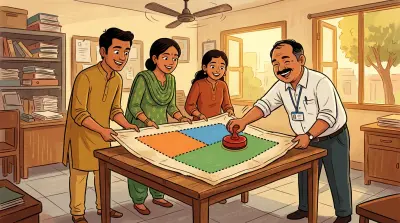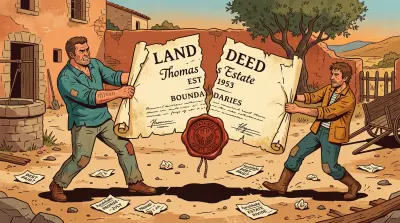


Three sisters inherit a 12-acre parcel in equal shares.
Two want to keep it together. The third wants her four acres separated.
Can the other two permanently stop her because they have the majority?
Ordinarily, no. A co-owner does not need every other co-owner’s agreement to ask a civil court to separate their lawful share.
But the third sister also cannot walk to the eastern side, draw a line around four acres and declare that exact portion hers. Until a lawful partition identifies the physical allotment, she owns an undivided one-third interest, not a self-selected parcel.
That is the central distinction:
Consent is needed for an agreed division. Unanimous consent is not normally needed to ask a court to separate your share.
If Everyone Agrees
When all affected co-owners agree, they can decide:
- the shares they accept;
- which property or portion goes to each person;
- whether one owner will receive money to balance unequal assets;
- who keeps common passages, wells or access roads;
- how loans, taxes, rent and original documents will be handled; and
- which deed correctly records the arrangement.
The parties can then execute and register the appropriate partition or settlement instrument. Our guide to partition deeds, family settlements and release deeds explains the difference.
A voluntary deed dealing with the whole property should include every affected owner. A person cannot sign for another adult owner without valid authority, and an owner who does not sign does not lose their share merely because everyone else signed.
If One Person Refuses
One refusing co-owner can prevent a fully agreed deed. They do not normally have an absolute right to keep every other owner trapped in joint ownership forever.
An entitled co-owner may file a partition suit seeking:
- a declaration of the parties and their shares;
- division of the property where lawful and practical; and
- separate possession of the portion ultimately allotted to them.
In Vineeta Sharma v Rakesh Sharma, the Supreme Court reproduced an earlier explanation from Shub Karan Bubna v Sita Saran Bubna: “Separation of share(s) is a species of ‘partition’.” One co-owner may separate their share while the others continue to own their remaining portion jointly.
This does not mean the claimant automatically wins the fraction they demand. They must prove the title, family or transfer history and legal basis of their share. Other owners may dispute the classification of the property, the list of heirs, an earlier partition or the claimant’s calculation.
What One Co-owner Can and Cannot Do
| A co-owner may ordinarily | A co-owner cannot do alone |
|---|---|
| Ask to negotiate a division or buyout | Transfer the shares belonging to everyone else |
| Seek separation of their lawful share through court | Select a particular room, floor or plot as their own before allotment |
| Transfer their own undivided interest, subject to law | Sign a voluntary partition deed on behalf of another adult without authority |
| Ask the court to consider a practical solution for an indivisible property | Leave out an affected heir and expect the decree or deed to bind that heir |
| Continue jointly with some owners after separating from others | Surrender or compromise a minor’s property without proper representation and scrutiny |
The word “undivided” matters. Before partition, the co-owner’s fraction runs through the whole property. It is not concentrated in the bedroom they use or the field they cultivate.
How a Partition Suit Works
The exact procedure depends on the property, state and court, but the basic sequence is:
1. Establish the property and owners
The claimant produces the title chain, succession documents, family tree and property description. Every co-owner whose interest may be affected should be identified.
If a deceased owner appears in the title, first determine who inherited that person’s share. Our legal-heir share calculation guide explains why the deceased owner’s fraction must be isolated before it is divided among heirs.
2. Join and serve the affected parties
All necessary co-owners should be made parties and given notice. A court case is not a lawful shortcut for hiding the proceeding from an inconvenient sibling.
In Rajendhiran v Muthaiaimmal (2025), the litigation involved an alleged oral partition and co-sharers who had not been joined. The case is a practical warning: build the complete ownership tree before asking for division.
3. The court declares the shares
For property other than the revenue-paying estates treated separately by the Code, Order XX Rule 18 of the Code of Civil Procedure permits the court to pass a preliminary decree declaring the parties’ rights and giving directions for the next stage.
A preliminary decree answers “what fraction belongs to whom?” It usually does not place boundary stones on the ground.
4. The property is divided or another solution is considered
A commissioner, survey process or revenue authority may be involved depending on the property. Measurements, access and existing structures must be considered.
In the same Shub Karan Bubna passage reproduced in Vineeta Sharma, the Court explained that “the suit continues to be pending until partition.” The process is not complete merely because a judgment states the fractions.
5. The final allotment is recorded
The final decree or other court-approved outcome identifies the actual allotment, sale or compensation arrangement. Possession, survey subdivision, mutation and municipal updates then follow.
Our complete family property partition guide explains the ownership, survey and record-update work around the legal process.
If the Property Cannot Be Divided
A single small house cannot always be split into usable pieces. A narrow plot may lose access if cut down the middle. Local fragmentation or agricultural-land rules may also restrict subdivision.
Possible outcomes can include:
- one owner retaining the property and compensating the others;
- sale of the property and distribution of the proceeds;
- physical division of one portion and sale of another; or
- an agreed buyout before the court process is completed.
The Partition Act, 1893 contains a specific court-sale route. Under Section 2, when division cannot reasonably be made and sale would be more beneficial, the court may order sale if shareholders holding at least one-half request it. This is a discretionary remedy with conditions. It is not a rule that half the owners must agree before any partition suit can be filed.
Section 3 also permits another shareholder to seek purchase of the requesting shareholder’s interest at a valuation determined through the court process.
In Badri Narain Choudhary v Nilratan Sarkar, the Supreme Court recognised that a court can devise a feasible method where a small property cannot sensibly be divided, including allotment to one party with fair compensation to the other.
Can One Sibling Sell Their Share?
Section 44 of the Transfer of Property Act generally permits a legally competent co-owner to transfer their own undivided share.
The buyer steps into that owner’s position. The buyer does not acquire the whole property and does not automatically receive a particular physical portion. They may seek partition, subject to the same title questions and restrictions.
There is an important protection for an undivided family dwelling house. A stranger who buys a co-owner’s share is not thereby entitled to enter and jointly possess the family home. In Dorab Cawasji Warden v Coomi Sorab Warden, the Supreme Court explained that the stranger purchaser’s remedy is partition.
The Partition Act also gives a family shareholder a potential right to seek purchase of an outsider’s share when the outsider sues for partition of an undivided family dwelling house, subject to Section 4’s conditions.
Selling an undivided share is therefore legally different from conveying exclusive title to “the eastern four acres” or “the first floor”. Until allotment, the seller cannot bind the other owners to recognise that exact portion as the buyer’s separate property. The transfer is limited to the seller’s undivided interest and remains subject to partition.
If a Co-owner Lives Abroad
An overseas address does not remove an owner’s share. Silence is not consent.
If a partition suit is filed, the overseas co-owner must be properly joined and served. Order V Rule 25 of the Code of Civil Procedure specifically addresses service on a defendant residing outside India who has no authorised agent in India.
An NRI or remote owner may often act through a lawyer and, for appropriate acts, a carefully drafted power of attorney. But do not assume a power of attorney eliminates every need for personal involvement. Evidence, cross-examination or a court direction may require additional participation.
For a voluntary partition, a power of attorney should identify the property and expressly authorise negotiation, execution, registration and follow-up. A vague general authority is a poor foundation for permanently dividing valuable land.
If a Co-owner Has Died
A dead person’s name cannot sign a deed, and their share does not disappear.
If the co-owner died before the suit, identify and join the people who inherited that share. If a party dies during the case, substitution of legal representatives is governed by Order XXII of the Code of Civil Procedure and must be handled within the applicable procedure and timelines.
This is why a legal heir or family member certificate may help establish relationships but does not, by itself, calculate or transfer ownership.
If a Minor Owns a Share
A minor cannot personally sign away property rights. In court, Order XXXII of the Code of Civil Procedure requires representation through a next friend or guardian for the suit.
The court must protect the minor’s interest. A family cannot treat an adult guardian’s convenience as a substitute for fairness to the child.
The Supreme Court in Kakumanu Peda Subbayya v Kakumanu Akkamma recognised that a partition suit may be brought for a Hindu minor through a representative, but the court must consider whether the action benefits the minor.
Any settlement, buyout or sale affecting a minor’s share should receive specific legal scrutiny. “Everyone in the family agreed” is not enough.
A Simple Example
Return to the three sisters and their 12 acres.
- Each sister owns an undivided one-third.
- The two sisters who prefer joint ownership cannot permanently force the third to remain joint.
- The third can ask for her share to be separated.
- If lawful subdivision is possible, her one-third may be allotted and the other two can continue owning the balance together.
- If subdivision is not workable, the parties or court must consider another legally available arrangement.
- Before allotment, the third sister cannot give a buyer exclusive title to a particular eastern four-acre block or bind the other sisters to recognise it as the buyer’s separate property. Any transfer is limited to her undivided interest and remains subject to partition.
One person can seek separation. One person cannot invent the physical division.
Documents to Prepare
Whether you are negotiating or considering court action, collect:
- the current title deed and complete link documents;
- death certificates, wills and heirship evidence;
- a complete ownership and family tree;
- the encumbrance certificate;
- mutation, pattadar, khata or municipal records;
- property-tax records;
- survey sketch, extent and current measurements;
- mortgage, lease and acquisition documents;
- copies of earlier partition, settlement, gift or release deeds;
- details of pending litigation; and
- current addresses for every co-owner, including overseas addresses.
Do this before positions harden. Families often spend months arguing about who is “cooperating” before confirming who legally owns the property.
The Practical Choice
If everyone agrees, document the division correctly and complete registration and record updates. The partition deed registration guide explains that route.
If one owner disagrees, try a written proposal, valuation and mediation. A buyout or adjusted allotment may preserve more value than physically splitting the asset.
If agreement is impossible, the refusing owner cannot simply be erased from the paperwork. A partition suit, with independent legal advice and every necessary party before the court, is the lawful route to seek separation.
Related Reading
- Family Property Partition in India - the complete ownership-to-records workflow
- How to Calculate Legal Heirs’ Shares - isolate the deceased owner’s interest before dividing it
- Partition Deed, Settlement or Release Deed - choose the correct document when the family agrees
- How to Register a Family Partition Deed - registration and post-registration steps
- How Informal Family Partitions Become Disputes - the risks of leaving the arrangement undocumented
Assetly helps Indian property owners organise title, heirship, survey and ownership-transfer records for an agreed family partition. Contested matters require independent legal advice. Learn more.