

A home in Kukatpally. A registered sale deed going back to 1989. A bank mortgage taken years ago and formally released in 2017, leaving nothing owed. On paper, the title chain is complete and clean, the kind you would happily buy into.
And yet the survey number it sits on shows up on the state’s prohibited list, under the court-case register.
Both things are true at once. That contradiction is the whole story of what is happening in Telangana right now, and it is worth understanding before you buy, sell, or mortgage any property in the state.
Quick answer: Section 22A lets the registration department refuse documents involving specified prohibited properties. If you have the survey number, use the checker above, then verify the result on the live Registration and Stamps portal for urban or non-agricultural property or Bhu Bharati for agricultural land. If the entry appears wrong, note the exact clause or register before filing a grievance. The reason for the listing determines the remedy.
What Is 22A Land in Telangana?
Section 22A of the Registration Act, 1908, as adopted in Telangana, is a short provision with a large effect. It prohibits registration of specified classes of documents. The statutory text reproduced by the Telangana High Court separates these into clauses (a) to (e), covering restrictions created by other statutes, unauthorised transfers of government or institutional property, ceiling-surplus land, and properties covered by a government notification.
Think of it as a locked drawer at the Sub-Registrar’s office. If your survey number is inside that drawer, the registering officer must refuse the classes of documents covered by the applicable Section 22A clause or notification, no matter how good your papers look. The refusal is not a judgment call once the legal restriction applies.
In plain language, the categories the list is meant to hold include:
- Government land, owned by the state or centre
- Endowment and Waqf land held by religious or charitable institutions
- Assigned land, given to landless poor families and non-transferable to private buyers
- Ceiling-surplus land taken under the land ceiling laws
- Certain land under court or revenue attachment
- Property covered by a clause 22A(1)(e) government notification
Read that list and the intent is clearly sound. It stops someone quietly selling temple land, or a plot the government gave to a landless family, or a parcel a court has frozen. The problem is not the idea. The problem is what got swept in alongside it.
Close to a crore acres, and a lot of them are homes
Over the past year the revenue department has rebuilt this list on a scale that is hard to picture. Reporting by The Federal puts nearly 90 lakh acres under the prohibited category. When the department described the revised list, the figure climbed past one crore acres, out of Telangana’s roughly 2.5 crore total.
Here is the arithmetic that should make any owner pause. Pattadar passbooks exist for about 1.53 crore acres. The remaining roughly one crore acres, the land without a clean passbook trail, is what has largely been pushed into the prohibited bucket.
The department’s own breakdown of the revised list runs to around 77 lakh acres of government, assigned, forest, endowment, irrigation, and road land, plus about 18 lakh acres of agricultural land without pattadar passbooks and roughly 3 lakh acres converted from agricultural to non-agricultural use.
That last slice is where ordinary homeowners live. Estimates reported in the Telangana press suggest something in the order of 18 lakh houses and 9 lakh house sites have been caught, unable to be sold or transferred, because of mapping and classification errors rather than any real defect in title.
Affected pockets are not remote villages. They include Banjara Hills, Kukatpally, Nizampet, and Miyapur, some of the most developed and expensive parts of Hyderabad, built on plots that came with HUDA, HMDA, and Housing Board approvals decades ago.
What we measured inside the village register
Those state-wide figures describe the government’s full inventory, including its own land. We wanted to know how much of it lands on recorded private holdings, so we checked the Bhu Bharati prohibited-property register for all 10,890 revenue villages in a single pass on 13 August 2026 and matched each flagged survey number to the extent recorded against it.
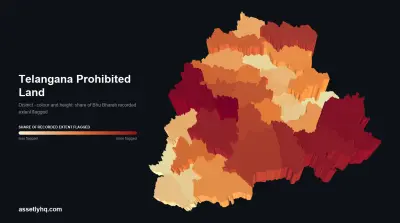
16,25,256 acres inside the Bhu Bharati register carry a prohibited flag: 9.26 percent of the 1.75 crore acres of extent that register records. That is a smaller number than the one crore acres above, and deliberately so. It excludes the roughly 77 lakh acres of government, forest, endowment and irrigation land that was never a private holding, and counts only land that has an extent and a pattadar name against it.
Two findings are worth an owner’s attention.
It is not mostly assigned land. Assigned land is non-transferable by law, so you would expect it to account for most of the flags. It does not. Ordinary agricultural land makes up 79.2 percent of the flagged extent; assigned land is 16.5 percent.
Converted land is the most-flagged category. 22.3 percent of NALA extent, the agricultural land converted for non-agricultural use, carries a flag, against 8.8 percent of agricultural land. NALA parcels are the ones sold as development plots. The category most likely to be offered to a buyer is the category most likely to be locked.
Geographically it concentrates where the buying is. By share of recorded extent, Medchal-Malkajigiri leads at 19.8 percent, then Sangareddy at 16.5, Bhadradri Kothagudem at 15.1, Rangareddy at 14.1 and Khammam at 14.0. At mandal level, and counting agricultural land only, Ramachandrapuram in Sangareddy reaches 53.7 percent, Uppal 51.3 percent and Serilingampalle 51.2 percent. This matches what the press reporting describes from the other direction: the affected pockets are developed, expensive and close in.
The spread inside any district is wide, which is the practical point. 817 villages carry no flag at all, 4,215 sit below 5 percent, and 157 are above 50 percent. A district average tells you how carefully to check. Only a survey-number check tells you about your parcel.
The full district and mandal breakdown, with method and limits, is in our analysis of Telangana’s prohibited land, and you can find your own village on the prohibited land map.
22A land in Hyderabad: what is different about checking a city property
Section 22A is a registration restriction, not an agricultural-land rule, so a flat, an independent house or an approved plot inside the city is as capable of being caught as farmland. What changes in Hyderabad is not the law but the identifier you search with. The register is organised around the survey number of the parent parcel your building sits on, so a door number, a flat number or a GHMC property tax identification number will not return a result, and “Hyderabad” is a metro name rather than a location the search understands - it wants the district and revenue village written on your deed.
That is enough to get most city owners to the right search. The categories that actually reach urban property, what your own sale deed already declares about them, and why Hyderabad spans four separate district entries are covered in 22A lands in Hyderabad.
How a clean title still lands on the list
This is the part that confuses people, so it is worth being precise.
The prohibited list works at the level of the survey number, not the individual plot or door number. A single large survey number might have been government land, or ceiling-surplus land, or under some old dispute at some point in its history. When it was flagged, everything sitting on that survey number inherited the flag, including plots that were carved out, approved, registered, and lived in for thirty years.
So the two facts from that Kukatpally home stop contradicting each other. The registered title chain describes one specific plot and its owners over time. The 22A entry describes the survey number the plot belongs to, and the register that survey number was added to. A clean chain of sale deeds does not clear a survey-number-level flag. They are answering different questions.
Officials have been candid about how this happened. A retired chief commissioner quoted by The Federal put it plainly: “the mechanical implementation of government orders has resulted in private properties being included in the prohibited list.” The bulk-flagging traces back to the 2017-18 Land Records Updation Programme and the 2020 rollout of the Dharani portal, when survey numbers were added against old High Court directions and government orders without checking parcel by parcel.
If you want the fuller story of how Telangana’s records moved from Dharani to the current Bhu Bharati system, we have covered the transition and what changed for owners separately.
Why a 22A flag hurts more than it looks
An entry on the prohibited list is not a fine you pay and move past. It quietly locks the property out of the two things that give it liquidity.
You cannot register a transfer. No sale, no gift, no partition, no settlement gets past the Sub-Registrar while the flag stands. Thousands of owners across the state have found this out at the worst possible moment, sitting at the registration counter with a buyer, money already exchanged, only to have the document refused.
And you cannot mortgage it. Banks treat a 22A parcel as non-marketable title and decline the loan. So the property cannot be sold and cannot be borrowed against. For a family whose main asset is that one house, it is frozen capital.
This sits inside a much larger pattern of Indian property being tied up not by fraud but by paperwork and process, which we mapped in our look at the wider property dispute crisis.
How to Check 22A Land in Telangana
The lesson for buyers is uncomfortable but simple. A verified title chain is necessary and no longer sufficient. You have to check the survey number against the prohibited list as a separate step.
Here is how to do it yourself, free, in a couple of minutes. One caveat before you start: as of 12 August 2026 the official search carries a notice that prohibition data is under review, and our guide to where the Telangana 22A list actually sits explains what each source covers while that is the case.
For non-agricultural and urban property, open the Telangana Registration and Stamps prohibited-property search, then enter the district, mandal, village, and survey number. If the parcel is listed, record the clause or register shown against it.
For agricultural land, use the official Bhu Bharati portal, search the land details by survey number, and read the prohibited status column.
Two details matter more than most guides mention.
First, note which register the survey number sits under. A parcel on the court-case register is a different problem from one wrongly tagged as assigned or endowment land, and the fix is different for each. In the Kukatpally example, the flag was specifically a court-case register entry against the survey number.
Second, the flag is dated. Portal status can change after a correction, court order, or new notification. Screenshot it, note the date, and re-check close to registration. For the broader habit of catching silent record changes, see our guide on monitoring your Telangana land records.
If you are checking a property you may inherit or one held in a relative’s name and you do not have the survey number to hand, searching by owner name is the practical route. That is one of the checks Assetly’s find-family-land search is built to run for AP and Telangana parcels.
What to Do If Your Property Is in the 22A List
If the property is genuinely government, endowment, assigned, or ceiling-surplus land, the flag is doing its job and there is no shortcut. But if you hold a clean registered title to an approved plot and it has been swept in by a survey-number error, there is a route out.
-
Assemble the proof. Your registered sale deed and the chain behind it, the pattadar passbook, the layout or building approval (HUDA, HMDA, GHMC, or Housing Board), and any earlier records showing private ownership.
-
Use the dedicated grievance. Log in to Bhu Bharati, open ROR Corrections, and select Grievance relating to inclusion in prohibited properties list. The official Bhu Bharati manual shows that the form asks whether the survey number should be removed from the CARD prohibited list, accepts a reason and supporting documents, and generates an application number before Meeseva eKYC.
-
Escalate the right issue. If the application is rejected or stalls, obtain the written status and get advice on the correct appeal, representation, or court remedy. The next step depends on whether the dispute concerns government title, an originating statute, an institution, a court order, or a clause 22A(1)(e) notification.
For the form fields, evidence checklist, category-by-category routes, and what to do after a rejection, read How to Remove a Property from Telangana’s 22A List.
Keep every version of your records as you go. If a parcel was flagged, then cleared, then re-listed in a later revision, a dated trail of what the portal said and when is what protects you. Tools like Assetly help by storing those dated copies and flagging when a status changes, which matters most for owners who are not in Hyderabad to check in person.
The honest takeaway
Section 22A is a good idea being applied with a blunt instrument. The goal, stopping the sale of land that was never anyone’s to sell, is worth defending. The execution, flagging survey numbers in bulk and catching lakhs of legitimate homes, is what owners are now paying for in frozen sales and refused loans.
Until the list is cleaned up, treat the prohibited-list check as a non-negotiable step, right alongside reading the encumbrance certificate and verifying the title. A property can have a spotless deed history and still be unregistrable today. In Telangana in 2026, both facts can be true about the same house.
Assetly is a property document management platform that helps Indian property owners, including NRIs, organise, verify, and track their property documents digitally. Learn more.