

If you have searched for a Telangana 22A prohibited list to download, the honest answer is that no single such file exists, and the official online search is not currently returning data.
That is not a dead end. It is a description of how Section 22A actually works, and understanding it changes what you should be looking for.
What the official search says right now
The Registration and Stamps Department publishes a Prohibited Properties page at registration.telangana.gov.in. It is headed “SECTION 22A (1):PROHIBITION DETAILS” and asks for four mandatory fields:
- District
- Mandal
- Village/Town
- SRO OFFICE
You then press Fetch.
Two things are worth noticing before you use it. First, there is no survey number field. The search is scoped to a village and a Sub-Registrar Office, not to your individual parcel. Second, and more importantly, the page currently carries this notice:
“Prohibition data is under review. it will be published soon…”
Checked on 12 August 2026, and still standing when rechecked on 18 August. Bhu Bharati, the Revenue Department’s portal, lists a Prohibited Lands Details service among its Information Services, but that service links to the same registration department page. So the two official online routes converge on one search, and that search is not presently serving prohibition data. What the revenue portal does still hold, including a survey-number prohibition check wired into its own mutation flow, is set out in what Bhu Bharati’s prohibited land details actually show.
This is very likely why so many people end up hunting for a PDF. The portal that should answer the question is telling them to come back later.
Why “the list” was never one document
Even when the search is fully live, it does not represent a single register that you could download. Section 22A(1) covers several distinct categories, and they do not all work the same way.
The Registration and Stamps Department’s own FAQ sets out the categories, and the distinction that matters most is between clauses (a) to (d) and clause (e):
- Clauses (a) to (d) prohibit registration by category. They cover property whose transfer is barred by statute, unauthorised transfers of government property, certain long leases of religious endowment property, and land declared surplus under the ceiling legislation. No notification is required for these to bite.
- Clause (e) is different. It is the route by which the State Government notifies specific properties in which government, local body, educational, cultural, religious or charitable interests are likely to be adversely affected.
On clause (e), the department’s FAQ states:
“For the purpose of clause (e) of sub - section (1), the State Government shall publish a notification after obtaining reasons for and full description of properties furnished by the District Collectors concerned.”
Read those two together and the practical consequence is stark. A property can be prohibited without appearing on any published list, because clauses (a) to (d) operate on classification rather than on enumeration. If your land is recorded as government, assigned, endowment, Waqf or ceiling-surplus land, the Sub-Registrar is bound whether or not a document with your survey number on it was ever issued.
That is why “show me the list” is the wrong question, and “which category does this parcel fall under, and on what record” is the right one.
What does exist, and where it sits
Three separate things get called “the 22A list”, and they are not interchangeable.
The registration department’s search. The village and SRO scoped search described above. When it is serving data, it is the closest thing to an authoritative online position, because it reflects what the registering officer is working from.
Clause (e) notifications. These are government notifications with, in the department’s own words, a “full description of properties”. Because the underlying descriptions come from the District Collectors, the Collectorate is the natural place to ask what a specific notification covers.
District and village PDFs. Some district administrations have published village-level prohibited property lists as documents. These circulate widely, and they are genuinely useful, but treat them as snapshots. A PDF reflects the position on the day it was compiled and published. It is evidence of what was listed then, not proof of what is listed now, and it will not capture a clause (a) to (d) classification that was never enumerated.
If you are handed one of these PDFs by a broker or a seller, the questions to ask are when it was published, by whom, and whether anything has changed since.
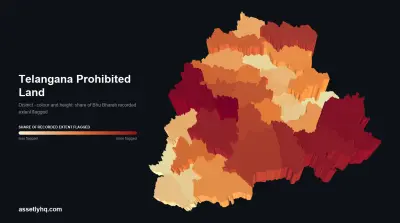
None of the three tells you how much land is affected overall. For that we measured the register ourselves: Telangana’s prohibited land, district by district.
What the prohibition actually does
It helps to be precise about the consequence, because “prohibited” is doing more work than most listings admit.
A Section 22A entry is a registration restriction. When it applies, the Sub-Registrar is bound to refuse the document. There is no discretion at the counter and no fee that resolves it. A sale agreement, an advance paid, a possession handover and a signed deed can all exist while registration remains impossible, which is exactly the position buyers find themselves in when the check is left until the appointment.
The department is blunter still about the underlying categories. Its registration procedure page states:
“Purchase or otherwise dealing with the government, assigned, wakf, endowment, scheduled areas (1 of 1970 Act) lands is prohibited and entails criminal proceedings.”
That is worth reading twice. The risk on these categories is not only that a transaction fails to register. Dealing in them is described as attracting criminal proceedings, which is a different order of problem from a document being returned.
Buying versus already owning
The two situations need different work, and conflating them wastes time.
If you are buying, the question is whether the parcel is capable of being registered to you, and you want the answer before money moves. Establish the survey number and the land classification first, then check the survey number against the available Telangana prohibited-property registers and verify the result on the live government portal. Build the checks into the agreement and the payment schedule rather than the week of registration.
If you already own, the question is usually why an entry exists and what removes it. That depends entirely on the category. A court-case entry, a government-land classification and a clause (e) notification do not share one remedy, and the evidence each requires is different. Identify the category before you file anything.
The classification behind the entry is the thing to chase
Because clauses (a) to (d) turn on how the land is classified, the revenue record often tells you more than any list will.
Bhu Bharati’s Details of Land service shows the land classification alongside the pattadar and extent. If the classification reads as government, assigned or endowment land, that is the fact doing the work, and it will not be resolved by proving that a survey number is missing from a PDF. Our guide to checking and correcting Bhu Bharati land-record errors covers what to preserve when a classification looks wrong, and where Telangana land records moved after Dharani explains which current service answers which question.
This distinction also explains a pattern that confuses a lot of owners. During the 2017-18 records updation and the Dharani rollout, whole survey numbers were flagged in bulk. A home with an unbroken registered title chain can still sit under a parent survey number carrying a government or assigned classification. Our Section 22A guide covers how that happened, and removing a wrongful 22A entry covers the correction route once you know which category you are arguing about.
A workable sequence while the search is under review
- Establish the parcel precisely. District, mandal, revenue village, survey number and subdivision. Survey numbers repeat across villages, so a district alone identifies nothing. If you only have an owner’s name, start with checking a property owner’s name in Telangana and work back to the survey number.
- Read the land classification on the revenue record, not just the ownership entry. This is where clauses (a) to (d) live.
- Check the official page anyway, and date what you see. The notice may lift at any time, and a dated screenshot of an unavailable search is itself worth keeping.
- Ask the Sub-Registrar Office for the property. Registration is refused at that counter, so the SRO holds the operative position.
- Ask the District Collectorate about any clause (e) notification, since the property descriptions behind those notifications originate there.
- Keep every result with its date. A position that is correct today may not be correct at registration, and a dated record is what lets you show the difference.
What a nil result does not prove
If a search, a PDF or a village list turns up nothing for your survey number, three things are true at once, and all three should temper the conclusion.
The official search is under review, so an empty response may reflect the state of publication rather than the state of your land. Clauses (a) to (d) never generate a list, so a parcel prohibited on classification will not appear in one. And any document you were given reflects a publication date that has already passed.
None of that makes checking pointless. It makes a nil result one input rather than a verdict. Read it alongside the encumbrance certificate, the registered title chain, the revenue record and any current litigation, and be honest with yourself about which of those you have actually seen.
The people who get caught are rarely the ones who found a prohibition entry. They are the ones who found nothing and treated that as an answer.
Assetly helps property owners organise, verify and track their property documents digitally.