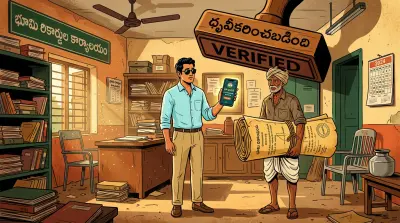

You search a Telangana survey number and see the word prohibited. The sale deed is in your family name. The Encumbrance Certificate looks normal. Property tax has been paid for years. Yet the Sub-Registrar will not accept the document you are trying to register.
The first instinct is to ask, “How do I remove my property from the 22A list?” That is the right practical question, but there is no single answer for every property. Section 22A contains several legal categories. A wrong data entry, a government-land claim, an endowment entry, a court attachment, and a gazetted notification are different problems even when the portal shows the same red flag.
The official starting point is clear: Telangana’s Bhu Bharati portal has a dedicated service called Grievance relating to inclusion in prohibited properties list. The government’s user manual shows how to select the survey number, request removal from the CARD prohibited list, upload documents, submit, and complete eKYC at Meeseva. Whether the request succeeds depends on why the property was listed and what your evidence proves.
This guide helps you identify that reason before you file.
Step 1: Confirm the Exact 22A Entry
Do not begin with a generic complaint that your private property is prohibited. Save the exact record you are challenging.
Use the checker above to record the exact survey, match relationship, register category, and available coverage, plus any source date shown. Then recheck the live government portal before relying on the result or filing a grievance.
Both official routes end at the same place. Bhu Bharati’s Prohibited Lands Details entry is a signpost that links out to the Telangana Registration and Stamps prohibited-property search, so there is no separate revenue-side search to try. What Bhu Bharati does hold, and why a blank result there is not clearance, is covered in what Bhu Bharati’s prohibited land details actually show. Search by survey number and subdivision, not only by plot number, door number, or property-tax identification number.
Record these details:
- District, mandal, village, survey number, and subdivision
- Extent shown as prohibited
- Section 22A clause, property category, or register name
- Department, notification, government order, or court case cited
- Date of the search and a saved copy or screenshot
- Whether the entire survey number or only part of it is affected
If you do not know the survey number, find it in the registered deed, pattadar passbook, Pahani, approved layout, or municipal records. A search by owner or family name can help identify possible rural agricultural parcels, but you still need to match the result against the deed before filing anything.
For the definition, checking routes, and why an urban home can inherit a parent survey’s flag, first read Telangana Section 22A: Check a Property and Fix a Wrong Entry.
Step 2: Identify Why the Property Is Prohibited
The Telangana High Court’s reproduction of Section 22A begins with the rule that specified classes of documents “shall be prohibited from registration”. It then divides the restriction into clauses (a) to (e). That clause determines what you must disprove or resolve.
| Entry type | What it usually means | What the grievance must address |
|---|---|---|
| 22A(1)(a) | Another state or central law prohibits the transfer | The restriction under that originating law must have ended, been wrongly applied, or been removed by the competent authority |
| 22A(1)(b) | The record treats the property as owned by the state or central government | Evidence and an order establishing that the land is private, or that the government classification is wrong |
| 22A(1)(c) | The property is recorded as belonging to a religious, charitable, endowment, or Waqf institution | The relevant institution’s records and the decision of the legally competent authority |
| 22A(1)(d) | The land is shown as ceiling-surplus | A ceiling authority, tribunal, or court record establishing the correct status |
| 22A(1)(e) | A government notification prohibits registration in a stated public interest | The notification and schedule must be checked against the property, followed by the notified review or grievance route |
| Court-case or attachment register | A court or authority has restrained dealing with the property | The actual case number, order, parties, land schedule, and present status of the restraint |
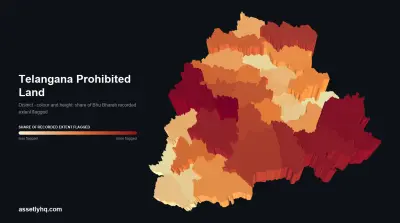
The category also tells you how ordinary your situation is. Across the Bhu Bharati register, assigned land is only about a sixth of Telangana’s prohibited extent while plain agricultural land is close to four-fifths of it, so a flag on ordinary patta farmland is the common case, not the exception.
This is why a clean Encumbrance Certificate is not enough. An EC records registered transactions for a period. It does not decide whether the government owns the land, whether a ceiling order applies, whether an institution claims it, or whether a separate notification blocks registration.
Clause 22A(1)(e) also has an important publication requirement. Telangana High Court guidance states that properties under clause (e) should be notified in the Official Gazette and that the notification and property list should be made available through the registration system. If your search result says clause (e), ask for the exact notification and check whether your survey number, subdivision, boundaries, and extent actually fall within its schedule. The High Court judgment discussing those publication safeguards is useful context for a lawyer or representative reviewing the entry.
Step 3: Build Evidence for That Specific Category
Start with a core property file, then add the document that answers the listed reason.
Core documents
- Current registered deed and earlier link deeds showing the title chain
- Latest Pahani, Record of Rights, or pattadar passbook details
- Encumbrance Certificate covering an appropriate search period
- Survey sketch, subdivision record, or approved layout connecting the plot to the survey number
- Identity and communication details matching the applicant
- Copy of the prohibited-property search result
Evidence that may decide the category
For a government-land classification, look for old revenue records, mutation proceedings, pattadar passbooks, assignment or alienation records, tribunal decisions, and final court orders. A sale deed proves that a transaction was registered. It does not automatically defeat an earlier government title claim.
For an approved urban plot inside a larger survey number, include the approved layout, allotment or development records, plot boundaries, building permission where relevant, and the chain linking the plot to the parent survey. Explain why the particular plot and extent are outside the legal basis for the flag.
For a court-case entry, obtain the case number and the operative order. Check whether the parties and land schedule match your property, whether the order covered the whole survey number, and whether it is still in force. Do not describe a pending case as closed merely because the EC is silent. These entries are not rare: our count of the state’s court-cases register found just over 2 lakh entries spread across roughly 47 percent of Telangana’s villages, and about 86 percent of them record the same reason - covered by court stay.
For clause 22A(1)(e), attach the notification or government order, the property schedule, and the record that supports exclusion or review. In 2025 the state constituted a committee through G.O. Ms. No. 98 to consider grievances connected with clause 22A(1)(e). A 2026 Telangana High Court order records that committee route. It does not mean every prohibited entry automatically goes to that committee, so match your clause first.
If the documents disagree with each other, create a one-page chronology: acquisition, mutations, approvals, relevant orders, the date the flag appeared, previous grievances, and the outcome of each. A decision-maker should be able to see the exact mismatch without reconstructing thirty years of records from an unsorted bundle.
Step 4: File the Official Bhu Bharati Grievance
The government manual sets out this sequence:
- Visit Bhu Bharati and create an account or log in with your registered mobile number and OTP.
- From the citizen dashboard, open ROR Corrections.
- Choose Grievance relating to inclusion in prohibited properties list and select Proceed.
- Fetch the property using the pattadar passbook number, or enter the required location and land details if there is no passbook number.
- Enter Aadhaar details, select the affected survey number, and explain why the grievance should be allowed.
- Answer whether the survey number should be removed from the CARD prohibited list, then state the reason for removal.
- Enter communication and document details, upload the supporting records, and submit.
- Save the generated application number.
- Complete the pending eKYC step at Meeseva so the application can move to departmental processing.
The portal’s published service flow describes three stages: citizen data entry, Meeseva eKYC, and forwarding to the department. It does not publish one guaranteed decision time for all 22A categories.
Write the reason field like a compact case, not an emotional appeal. Identify the entry, say why it is wrong or no longer applicable, name the document that proves each point, and state the precise correction requested. Keep a copy of everything submitted and the Meeseva acknowledgement.
Step 5: Track the Application and Get a Written Outcome
Check the citizen dashboard using the application number. If the department asks for clarification, answer with indexed documents and keep proof of submission.
If the application remains pending, seek a written status from the authority handling it. If it is rejected, obtain the order and its reasons. Those reasons tell you whether the next step is to supply missing evidence, approach the authority responsible for the original classification, use a statutory appeal, ask a committee to consider a clause (e) grievance, or seek court review.
Do not rely on an oral assurance that the list will be updated. After a favourable order, check both the relevant land record and the live Registration and Stamps prohibited-property search. A decision on paper and a portal update are two separate milestones.
When Legal Advice Becomes Necessary
Consider a Telangana property lawyer when:
- The government or an institution disputes your title
- The entry is based on a government notification or old proceeding you cannot obtain
- A court order or attachment is cited
- The application is rejected despite a final tribunal or court order in your favour
- The authority does not act on a complete application
- The survey number covers many plots with different histories
- A sale or loan is time-sensitive and the buyer needs a defensible status opinion
A writ petition is not the automatic second step for every unanswered portal request. Courts often expect the competent authority to examine the evidence first. A lawyer should identify the statutory route, the correct respondent, and the specific relief based on the rejection or delay.
What Not to Do
Do not pay an intermediary who promises deletion without reviewing the clause and source record. Do not upload a large bundle of unrelated papers and hope the department finds the decisive page. Do not execute an unregistered workaround while the flag remains. Do not tell a buyer that an application number means the restriction has been removed.
Most importantly, do not ask only whether the property is “in 22A”. Ask why, under which clause or register, for what extent, and on whose order. Once those four questions are answered, the official grievance stops being a generic request and becomes a documented correction case.
Assetly helps Indian property owners organise, verify, and track their property documents digitally. This guide is general information, not legal advice. Learn more.