

There is a particular kind of bad news in Indian property, and it arrives late.
You have done the checks. The title looks clean. The encumbrance certificate came back fine. The seller has a pattadar passbook with their name on it, and the survey number is not on the prohibited list.
And then the registration still does not happen, because somewhere, in a case you have never heard of, between parties you have never met, a court passed an order that touches this exact piece of land.
We wanted to know how common that is. So we went through Telangana’s court-cases register, village by village, all 10,915 of them.
Nearly half the state came back with something.
What this register is
Telangana’s registration department maintains a list of properties affected by court orders, kept separately from the Section 22-A prohibited list.
The distinction matters, so hold onto it. The prohibited list works by category. The state notifies a type of land, government, forest, endowment, assigned, and every survey number in that bucket is barred. The court-cases register works the opposite way. It is property by property, each one attached to a specific order in a specific case.
One is a rule. The other is a list of individual accidents.
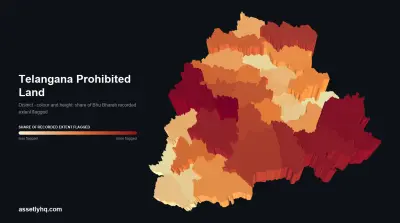
Just over 5,100 of Telangana’s 10,915 villages, about 47 percent, carry at least one entry.
Across those villages there are just over 2 lakh distinct entries. And in about 86 percent of them, the recorded reason is the same three words: covered by court stay.
Where it clusters
If you have read our analysis of Telangana’s prohibited land, the shape of this table will feel familiar.
| District | Villages affected | Share |
|---|---|---|
| Medchal-Malkajgiri | 155 of 167 | 92.8% |
| Rangareddy | 515 of 618 | 83.3% |
| Yadadri Bhuvanagiri | 264 of 318 | 83.0% |
| Jangaon | 146 of 177 | 82.5% |
| Nalgonda | 452 of 567 | 79.7% |
| Nagarkurnool | 244 of 351 | 69.5% |
| Peddapalli | 147 of 212 | 69.3% |
| Karimnagar | 141 of 210 | 67.1% |
In Medchal-Malkajgiri, twelve villages out of 167 are clean. Everything else has something.
Now, here is the part worth pausing on. That earlier analysis measured a completely different thing, on a completely different register, in a completely different unit. It measured how many acres carry a prohibited flag. This one counts how many villages have a court entry.
Two unrelated datasets, two unrelated questions. And both of them put Medchal-Malkajgiri at the top, with Rangareddy just behind.
Zoom to mandal level and the overlap gets harder to dismiss. The heaviest concentrations of court entries sit in Maheshwaram, Srilingampalle, Abdullapurmet, Uppal, Gandipet, Shamshabad and Ghatkesar. Uppal and Serilingampalle were also among the most heavily flagged mandals on the prohibited-land side.
The land around Hyderabad is the land people are buying. It is also, on two independent measures, the land most likely to have something attached to it.
We are not claiming one causes the other. The duller explanation is probably right: land that becomes valuable attracts claims, and land that has been changing hands for decades has more history to argue about. But if you are buying in the growth ring, the practical reading is the same either way.
It is not just farmland
Roughly a fifth of the entries, about 41,700, are house or urban properties rather than agricultural land.
That fifth is easy to miss, because those properties are not identified by survey number. They are identified by door number, ward and block. Only about a third of the urban entries carry a usable survey number at all, while nearly nine in ten carry a door number.
This is the gap in most people’s checking. The agricultural land register does not cover flats, houses inside municipal limits, or approved layout plots. If you own one of those and you have only ever checked land records, you have been looking at a register your property was never in. Rangareddy and Hyderabad carry the most urban entries, roughly 10,400 and 8,500. Hyderabad’s are recorded against sub-registrar office, ward-block and door number rather than any village.
These are not old dusty cases
The oldest order in the register dates to 1982. But the distribution leans hard towards the present.
- More than half of all dated entries carry an order from 2021 or later
- Roughly three-quarters are from 2016 onwards
- Under one in twelve predates 2010
So this is not a historical residue slowly being cleaned up. It is mostly live litigation, and it is accumulating.
That accumulation is the part worth sitting with. Property cases in India are famously slow, and a stay that takes years to resolve is a property that cannot be sold for years. Our look at why Indian property disputes run so long covers the timelines behind that. A register entry is the visible tip of it.
What this does and does not tell you
It does not say anyone did anything wrong. An entry means a court passed an order affecting a property. Most often that is a stay, which freezes the position while a case runs. It is not a judgment, and it says nothing about who will eventually win. Plenty of these will resolve in the current owner’s favour.
It does not tell you your property is affected. These are village-level counts. A village with entries is not a village where every parcel is stuck. The number tells you how much care the area deserves, not what your parcel’s status is.
It is a snapshot. Orders get passed and vacated continuously. Anything you rely on for a transaction has to come from the live register on the day.
We deliberately have not put an acreage on it. The register records extents in a mix of units and formats, including an acres-and-guntas notation that is easy to misread as a decimal. Counting properties and villages is something the data supports cleanly. Converting to a headline acreage figure is not, so we have left it out rather than publish a number we cannot stand behind.
What to actually do
Check the court-cases register, not just the prohibited list. They are different registers on the same portal. A clean result on one says nothing about the other. This is the single most common gap we see, and it applies to tools as much as to portals: our free 22-A check reads the six Section 22A(1) sub-clause registers and deliberately does not cover this one, because the state serves it from a different endpoint as an HTML table rather than as part of the prohibited store. Assetly reads the court-cases register separately, against a saved Telangana property on a covered plan, and where a source cannot be read it is reported as unavailable rather than as a clean result.
If you own an urban property, check by door number. Searching by survey number will quietly miss most urban entries, because most of them do not have one.
Ask what the order actually says. An entry gives you a case reference and a date. Whether it is a stay in a partition suit between siblings or an injunction in a land-acquisition dispute changes everything about how long it will take and whether it affects you.
Remember the register only shows what reached it. A suit can be pending without any entry appearing here, and buying into one still binds you under the doctrine of lis pendens. A clean result is a good sign, not a guarantee.
Do not treat an encumbrance certificate as covering this. An EC shows registered transactions. A court order restricting a property is not a registered transaction, so a clean EC and a live stay can coexist quite happily.
Check before the advance, not before the registration. Almost every painful version of this story involves money that moved first.
The register is public and it is free to search. The awkward part is that most people do not know it exists as a separate thing, and find out only when a sale that should have taken an afternoon stops dead at the counter.
Method
The figures come from Telangana’s own court-cases register, covering all 10,915 revenue villages. Every village resolved to either a positive entry or a confirmed empty result, with empty results independently re-confirmed before being counted as clean, because the portal occasionally serves an empty page for a village that does have entries.
Entry counts are de-duplicated across the full set of parcel identifiers the register carries, which matters more than it sounds: survey number alone is not enough, because subdivision, plot, door and ward-block numbers distinguish genuinely different properties that would otherwise collapse into one. Counted that way, true duplicates are under 2 percent of rows. Hyderabad district is served without village attribution, so its entries are counted at district level and excluded from village-share rankings rather than assigned to a village they cannot be traced to.
Assetly helps property owners organise their documents and keep track of changes affecting their property. Learn more.