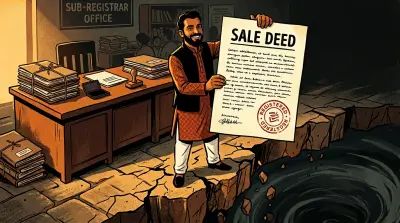


In December 1992, a Punjabi farmer named Daljit Singh filed a suit over a plot of land in Punjab. Two weeks later, on 8 January 1993, the same plot was sold to someone else for Rs 6,45,937. That buyer, Shingara Singh, registered the sale deed, paid full consideration, and walked away believing the land was his.
Thirty-one years later, in October 2024, the Supreme Court of India confirmed that Shingara Singh never owned the land at all. Daljit Singh did.
The doctrine that took the land away from a paying, registered, bona fide buyer is called lis pendens. It sits in Section 52 of the Transfer of Property Act, 1882, and for any NRI buying Indian property today it is the single most invisible risk on the title checklist. Encumbrance certificates do not show it. Sub-Registrar records do not flag it. Bhu Bharati and Meebhoomi do not warn you about it. The only place it lives is in the cause lists of district and high courts, and almost no NRI buyer ever looks there.
This is what Shingara Singh v. Daljit Singh, 2024 INSC 770, decided 14 October 2024, actually means for anyone buying Indian property remotely.
The 1990 Agreement That Was Never Executed
The facts of the case run like this.
On 17 August 1990, Daljit Singh entered into an agreement to sell with one Janraj Singh to buy a piece of land for Rs 7,94,000. He paid Rs 40,000 as earnest money. The agreement set the date for execution of the sale deed as 30 November 1992.
On the appointed date, Daljit Singh arrived at the Sub-Registrar’s office with the balance amount. Janraj Singh did not turn up. Two months later, on 24 December 1992, Daljit Singh filed a suit for specific performance of the agreement to sell. The suit was civil litigation in the proper sense, registered, with court fees paid, and listed in the cause list.
Fifteen days after the suit was filed, on 8 January 1993, Janraj Singh sold the same land to Shingara Singh for Rs 6,45,937. The sale deed was registered. Shingara Singh paid the full amount.
For the next three decades, the case worked its way through trial court, first appellate court, and the High Court. The trial courts initially favoured Daljit Singh only to the extent of refunding his Rs 40,000 earnest money - they reasoned that the land had already been sold to Shingara Singh, who was a bona fide purchaser, and specific performance was no longer possible. The Punjab and Haryana High Court reversed this. It held that the sale to Shingara Singh during the pendency of the suit was hit by lis pendens, was therefore not effective against Daljit Singh’s claim, and that specific performance of the original 1990 agreement could be decreed.
Shingara Singh, his Rs 6,45,937 already paid, appealed to the Supreme Court.
What Section 52 Actually Says
Before we get to what the Supreme Court did with the appeal, the statute itself is worth reading.
Section 52 of the Transfer of Property Act, 1882, says that during the pendency of any suit in which any right to immovable property is directly and specifically in question, the property cannot be transferred or otherwise dealt with by any party to the suit so as to affect the rights of any other party under any decree that may be made in the suit, except under the authority of the court.
In plain English: once a lawsuit over a piece of property is filed and is being litigated, anyone who buys that property during the lawsuit takes it subject to whatever the court eventually decides. The transfer is not automatically void. It is valid as between the seller and the buyer. But it is not effective against the rights of whoever wins the lawsuit.
The doctrine is older than the statute. The principle was articulated by Turner LJ in the 1857 English case Bellamy v. Sabine. The Indian Supreme Court has quoted it many times. The original justification was blunt:
“it would plainly be impossible that any suit could be brought to a successful termination if alienations pendente lite were permitted to prevail.”
If a defendant could quietly sell the property mid-suit to a third party, and the buyer could then claim to be a bona fide purchaser unaffected by the eventual decree, no litigation about property would ever end. Each adverse ruling could be defeated by a fresh sale to a fresh “innocent” buyer the day before judgment.
The Supreme Court’s Reasoning in October 2024
The two-judge bench of Justice Hrishikesh Roy and Justice Prashant Kumar Mishra, speaking through Justice Mishra, was unequivocal.
Quoting its earlier ruling in Usha Sinha v. Dina Ram, the court repeated that:
“a purchaser of suit property during the pendency of litigation has no right to resist or obstruct execution of decree.”
Quoting Sanjay Verma v. Manik Roy:
“A transferee pendente lite is bound by the decree just as much as he was a party to the suit.”
And on whether the buyer’s good faith makes any difference, the court was direct:
“The principle of lis pendens embodied in Section 52 of the TP Act being a principle of public policy, no question of good faith or bona fide arises.”
The earlier ruling in Chander Bhan was applied:
“defence of bona fide purchasers for valuable consideration is liable to be rejected.”
The court affirmed the High Court’s judgment. Specific performance of the 1990 agreement to sell was decreed in favour of Daljit Singh. The 1993 sale deed in favour of Shingara Singh was subordinated to the decree. The Rs 6,45,937 Shingara Singh had paid was gone, recoverable only as a money claim against Janraj Singh, the seller, who had by then ceased to be a useful defendant.
The Three Defences That Do Not Work
Read the 2024 judgment alongside the body of lis pendens cases the Supreme Court has built up over the last seventy years, and a pattern emerges. There are three defences that buyers consistently raise, and all three consistently fail.
“I did not know about the lawsuit.” Lack of notice is irrelevant. The doctrine attaches to the property the moment the suit is filed. Whether the buyer knew, could have known, or could not possibly have known makes no legal difference.
“I paid the full price and acted in good faith.” Bona fide purchaser status is not a defence to lis pendens. It is a defence under the Specific Relief Act and a few other provisions, but not against Section 52.
“My sale deed was properly registered.” Registration does not cure the defect. Registration only proves that the buyer paid stamp duty and the document is on the public record. It does not establish that the seller had clear title at the time of sale, and where the seller’s title was already subject to a pending suit, the buyer’s registered deed is subordinate to the eventual decree. This is the same principle the Supreme Court applied in the Mahnoor Fatima Imran line of cases, covered in our analysis of the May 2025 ruling on registered deeds with broken upstream chains.
The combination of these three failures is what makes lis pendens uniquely dangerous. The defences a careful buyer thinks should work simply do not exist.
Why This Risk Is Heavier for NRI Buyers
A resident buyer in India has some natural protections against lis pendens that an NRI buyer does not. They live in the locality. They can ask neighbours whether the property has been the subject of disputes. They can drive past the plot and see if there is any obvious activity, occupation, or notice posted on the gate. They can sit through a few hearings at the local district court without booking a flight. None of this is perfect, but it adds friction to the seller’s ability to hide a pending suit.
An NRI buyer has almost none of these checks available. The diligence is done by a power of attorney holder, a lawyer engaged remotely, or a family member, often based on document copies sent by email. The buyer’s confidence comes from three documents: the encumbrance certificate, the title chain, and the property card. None of these documents shows a pending civil suit.
The result is structural. Sellers who know their property is under a pending suit have an incentive to sell quickly, to a buyer who is too distant to detect the problem, before the plaintiff secures interim relief or a final decree. Court-record searches across district and high court cause lists are the only reliable defence, and almost no NRI buyer commissions one as part of their pre-purchase diligence.
The 2024 Shingara Singh ruling sharpens the consequences of missing this step. The Supreme Court has now confirmed, in language that leaves no wiggle room, that there is no rescue at the end. The buyer’s money is gone, the property goes to whoever wins the original suit, and the only recovery route is a separate damages claim against a seller who, by this point, is usually untraceable.
What an NRI Buyer Actually Needs to Check
A complete pre-purchase diligence stack against lis pendens has four layers.
Encumbrance certificate for thirteen to thirty years. This catches registered charges, mortgages, post-decree attachments, and prior sale deeds. It does not catch pending suits. It is necessary, but it is not sufficient.
eCourts and NJDG search for the seller’s name. The National Judicial Data Grid at njdg.ecourts.gov.in allows search by party name across district courts in India. A search for the seller’s full name, and the names of any prior owners in the title chain, will surface most pending civil suits where they are listed as a party. The search is free and can be done from abroad. The output is a list of case numbers, jurisdictions, and current status. This is the single highest-yield step most NRI buyers skip.
Property-specific litigation search by an Indian advocate. Some pending suits do not show up under the seller’s name search. A suit filed by a third party may name multiple defendants and the search interface may not surface it cleanly. A lawyer with court access in the relevant district can pull up the cause lists, search by property survey number where the court files allow, and provide a written certificate that no pending suit affects the property as of the date of the search.
Sub-Registrar enquiry for caveats and Section 22A notifications. In Telangana and Andhra Pradesh, the Sub-Registrar maintains a list of survey numbers blocked under Section 22A of the Registration Act. Telangana also publishes a separate court-cases register, and our count found that nearly half its villages carry at least one entry. These overlap with but are not identical to pending suits. A direct enquiry with the relevant Sub-Registrar before registration catches a category of issue that does not appear in the EC or in the court search.
The cost of running all four checks for a single property is typically between Rs 5,000 and Rs 25,000 depending on locality and the complexity of the title chain. Set against the price of the property and the consequences of getting it wrong, the diligence is the cheapest line item in the transaction.
What Happens If You Are Already Caught
NRI buyers who have already purchased a property that turns out to be under a pending suit have three practical options, none of them attractive.
The first is to wait for the suit to conclude and hope the original plaintiff loses. This is not a strategy as much as it is a delay. If the plaintiff wins, the buyer’s deed is set aside in execution, as happened to Shingara Singh.
The second is to attempt to settle with the original plaintiff before judgment. This is the most expensive route but the only one that preserves the property. It usually means paying the plaintiff a sum that recognises their claim, in exchange for a withdrawal of the suit or a consent decree that affirms the buyer’s title.
The third is to sue the original seller for refund and damages. This is the route the Supreme Court’s ruling effectively confines an unsuccessful buyer to. It is slow, the seller is often untraceable or judgment-proof, and recovery in practice is partial at best.
The doctrine is unforgiving by design. The cheapest version of all three options is to not buy the property in the first place. That is the version that requires the title diligence to be done properly, before the cheque is written.
The broader pattern of how Indian property disputes accumulate and become difficult to reverse is laid out in our overview of the India property dispute crisis.
Assetly is a property document and compliance platform for NRIs and remote property owners in Telangana and Andhra Pradesh. assetlyhq.com.