

A buyer is ready. The price is agreed. The advance is discussed. Then the buyer’s lawyer asks for the occupancy certificate, and there isn’t one. Two weeks later the buyer’s bank refuses to finance the purchase, and the deal is gone.
The seller did nothing dishonest. They simply discovered, in the middle of a negotiation, a problem that had been sitting in their file for years.
This is the pattern almost every failed NRI property sale follows. It is rarely the price that kills the deal. It is the documents. And the cruel part is the timing: the problem surfaces at the exact moment you have the least bargaining power to fix it, with a buyer watching the clock and a bank waiting for a clean file.
Transaction readiness is the opposite approach. Instead of discovering the gaps when a buyer’s lawyer does, you find them first, on your own timeline, and close them before the property ever goes on the market. This post explains what that means in practice, what the buyer’s side actually checks, and how Assetly’s transaction readiness service does the work for owners who are several thousand kilometres away.
Anatomy of a Failed NRI Sale
Picture a flat in Hyderabad, owned by an NRI in New Jersey who inherited it from a parent. On paper, it is a clean asset. In reality, three things are quietly wrong, and none of them is visible until someone goes looking.
First, mutation was never done after the parent passed away. The government revenue records still show the deceased owner’s name, not the seller’s. Second, the encumbrance certificate shows a home loan from 2011 that was repaid but never formally discharged, so the charge still sits on the record. Third, the building never received an occupancy certificate, because the builder cut a corner two decades ago and nobody noticed.
The seller knows none of this. They list the flat, find a buyer in a month, and feel relieved. Then the buyer’s lawyer starts due diligence.
The mutation gap raises the first question: why do the revenue records not show the seller’s name? The undischarged mortgage raises the second: is this property still encumbered? The missing occupancy certificate raises the third, and it is fatal, because the buyer’s bank will not lend against a building with no occupancy certificate. No loan means no buyer.
Each of these would have taken weeks to fix in advance and cost very little. Discovered mid-negotiation, they cost the entire deal. The buyer walks, the property goes stale on the market, and the seller starts again, now explaining to the next buyer why the last one pulled out.
None of this was bad luck. It was an absence of preparation.
What the Buyer’s Side Actually Checks
Before a buyer signs, two parties run their own checks: the buyer’s lawyer, who is protecting the buyer from a defective title, and the buyer’s bank, which will not release a loan against a property it cannot verify. Knowing what they look for tells you exactly what to prepare. Here is the combined checklist they work through, and our full pre-sale document guide covers how to obtain each one.
- Title chain for 30 years. Every registered document through which the property changed hands. A single broken link flags an imperfect title. See our guide to the chain of title and link documents.
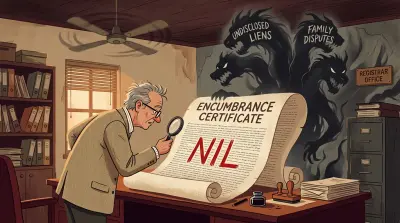
- Encumbrance certificate. The transaction log of the property. An undischarged mortgage or a court attachment is an immediate red flag, even if the underlying debt was cleared years ago.
- Mutation in the seller’s name. Whether the revenue records actually show the seller as the current owner.
- Property tax receipts. At least three years, fully paid. Arrears can attach to the property and become the buyer’s liability.
- Approved building plan. Confirmation the structure was built with permission, and that it matches what was sanctioned.
- Occupancy certificate. Proof the building is legally fit for occupation. Without it, banks usually refuse to lend.
- RERA records. For flats in registered projects, the completion certificate, the OC, and any complaints filed against the builder.
- Society NOC. For apartments in co-operative societies, a no-objection certificate and cleared maintenance dues.
- Litigation and attachment search. Court records and the EC checked for any pending case or charge involving the property or the seller.
- Seller identity and authority. PAN, OCI or passport, and, where someone signs on the seller’s behalf, a valid registered Power of Attorney. An NRI-executed PoA must be attested at the Indian Embassy or apostilled, then registered in India.
- FEMA position. Whether the property was acquired in line with FEMA rules and whether repatriation of the proceeds has been planned. A buyer’s bank will not disburse if the FEMA paperwork is missing.
- TDS and Form 13. For an NRI seller, the buyer must deduct TDS at 12.5% on the sale price, not 1%. A Lower Deduction Certificate under Section 197, applied for using Form 13, can reduce that withholding, but only if it is arranged well before registration.
The first ten are where any deal can stall. The last two are where NRI deals stall specifically, because most resident buyers have never purchased from an NRI and have no idea the rules are different until the registration desk tells them so.
The seller’s obligations here are not just commercial. Section 55 of the Transfer of Property Act, 1882 requires the seller to disclose any material defect in the title and to discharge all encumbrances before the sale. Concealing a known defect is treated as fraud, which lets the buyer unwind the sale later. This is part of why India’s property market carries the dispute load it does: a large share of litigation traces back to gaps that were never closed before a transaction.
What Transaction Readiness Actually Means
Transaction readiness is a simple idea with an unforgiving condition attached: every check the buyer’s side will run, you run first, and you finish before you list.
Not after you find a buyer. Not during negotiation, when a missing certificate becomes a reason to drop the price. Before. The whole value sits in the timing. A gap you find in March, with no buyer waiting, is a routine task you resolve at your own pace. The same gap found in September, with a buyer and a bank watching, is a crisis that costs you either the deal or your negotiating position.
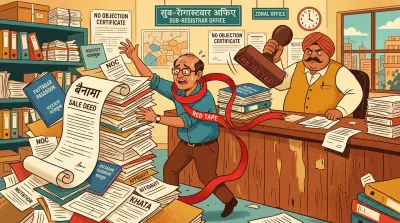
For an owner living in India, getting ready is tedious but doable. You can visit the Sub-Registrar, chase the municipal office, sit in the society’s committee meeting. For an NRI, none of that is available. You cannot walk into a revenue office in Hyderabad from New Jersey. You depend on a relative, a Power of Attorney holder, or a lawyer, and you are usually working across a time difference of nine or ten hours. Every step that takes a resident a morning takes an NRI a week of coordination.
That distance is exactly the problem a transaction readiness service is built to remove.
How Assetly Runs Transaction Readiness
Assetly’s transaction readiness service turns the buyer’s checklist into a process you can run remotely, in two stages: assess, then close the gaps.
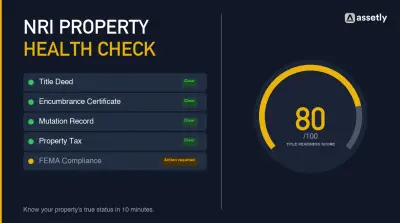
The assessment. Prabhakar, Assetly’s AI title assistant, runs a structured readiness check across four dimensions: the ownership chain, encumbrances, revenue records, and pending litigation. It is a guided question-and-answer flow rather than a form to decode, and most assessments finish in under ten minutes. You can start one for free at assetlyhq.com/free-tools.
What it delivers. The assessment produces three things:
- A readiness report that shows, in plain language, what is clear and what is not.
- A gap list of every missing or inconsistent item: the undischarged mortgage on the EC, the mutation that was never updated, the occupancy certificate nobody can find.
- A fix guide that tells you what to do about each gap and in what order, so you are not guessing which problem to solve first.
This is the part that matters for an NRI. You get the same diagnosis a buyer’s lawyer would reach, except you get it months earlier and with a plan attached, instead of an ultimatum.
Closing the gaps. A diagnosis only helps if you can act on it from abroad, so the fixes are available as on-demand services delivered to your document vault, with no need to be in India. Document procurement packs start at 20 dollars and run up to around 200 dollars for a full title-and-boundary review with a legal report, with delivery typically between five and fourteen working days depending on the pack and the responsiveness of the relevant government office. A 30-year EC, missing link documents, a survey sketch, or a lawyer’s title report can each be ordered against your property record and added to the file as it arrives.
The end state is what Assetly calls a Verified property: a complete, organised, gap-free document set that stands up to a buyer’s lawyer and a bank’s underwriter on the first request. When the buyer’s lawyer asks for the EC at what is 10 PM your time, you share it in seconds rather than calling someone in India to photograph it.
List With Confidence, or Discover Problems Mid-Deal
The real difference transaction readiness makes is not a shorter document list. It is who controls the timing.
Without it, the buyer’s lawyer sets the agenda. They find the gap, they decide how serious it is, and they hand the buyer a reason to walk, renegotiate, or stall. You are reacting, at a disadvantage, often from the wrong continent.
With it, you set the agenda. You walk into the market with a file that has already passed the inspection the buyer is about to run. There is nothing for the lawyer to find, because you found it first and fixed it. The deal closes on price and terms, which is where you have the upper hand, instead of stalling on documents, which is where you do not.
For a resident seller, that is a convenience. For an NRI selling from abroad, where every fix takes weeks of remote coordination, it is the difference between a sale that completes and one that quietly dies in due diligence.
How to Get Started
If you are even thinking about selling in the next year, the move is to assess now, while you have time on your side.
- Run the readiness check. Start a free transaction readiness assessment with Prabhakar at assetlyhq.com/free-tools. Ten minutes tells you where you stand.
- Read the gap list. See exactly which of the buyer’s twelve checks you would pass today and which you would fail.
- Close the gaps. Order the documents and corrections you need, delivered to your vault, without travelling to India.
- List with a Verified file. Go to market knowing the buyer’s lawyer will find nothing you have not already handled.
The seller who lost their buyer over a missing occupancy certificate did not have a bad property. They had an unprepared one. Transaction readiness is simply the decision to find that out on your own schedule, instead of in front of a buyer who is about to walk away.
Related Reading
- Documents You Need Before Selling Property in India - the full pre-sale document audit and how to obtain each one.
- Selling Property in India as an NRI: The Complete Guide - the end-to-end process, from listing to repatriation.
- Capital Gains Tax on Property Sale by NRI - TDS, Section 197, Form 13, and how to avoid over-withholding.
- The NRI Property Health Check - a year-round diagnostic for owners who are not selling yet.
- Encumbrance Certificate: The Complete Guide - what the EC reveals and why buyers ask for it first.
Assetly helps Indian property owners, especially NRIs, organise, verify, and prepare their property documents from anywhere in the world.