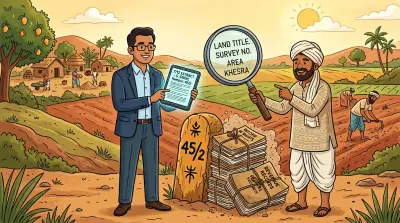


Gujarat will sell you a residential plot. The Gujarat Land Revenue Code may still classify the same plot as agricultural. The Gujarat Tenancy and Agricultural Lands Act may bar you, as a non-agriculturist, from buying it at all. All three statements can be true about the same piece of land on the same morning.
This is the Gujarat property paradox. The state has built one of the more functional digital land record systems in India. Anyror and iORA together cover most of what an NRI needs without a single office visit. But layered on top of that infrastructure is a tenure framework that traces back to the Bombay Land Revenue Code of 1879 and the Bombay Tenancy and Agricultural Lands Act of 1948. Both are still substantially in force. Both have been recently tested in the Gujarat High Court. Both create traps that a remote owner cannot see from Houston, London, or Dubai without doing the right checks.
This guide covers what is different about managing property in Gujarat, and what to do about it from abroad.
The Land Records System: Anyror and iORA
Gujarat splits its digital land records across two portals. Knowing which one to use for which task saves more time than any other single thing.
Anyror at anyror.gujarat.gov.in is the view layer. It holds the village land records:
- VF 7/12, the Record of Rights. Gujarat’s equivalent of Maharashtra’s Satbara Utara or Karnataka’s RTC. It shows the survey number, current pattadar, extent, classification (irrigated, dry, garden, etc.), and any noted encumbrances or tenancy.
- VF 8A, the khata or holder’s account, listing all survey numbers held by one pattadar in a village.
- VF 6, the mutation register, showing the chain of mutation entries including 135-D notices that mark a new transfer.
Select district, taluka, village, and survey number, complete a captcha, and view the record. No login. Unsigned copies are free.
For a deeper walk-through of how to read a 7/12 extract column by column, see our guide to land revenue records. Gujarat’s 7/12 is structurally very close to Maharashtra’s.
iORA at iora.gujarat.gov.in is the transaction layer. This is where you apply for things, not just look them up:
- Digitally signed (legally admissible) copies of the 7/12 and property cards
- NA conversion under Section 65 of the Gujarat Land Revenue Code, 1879
- Section 73AA tribal-land transfer permission
- Premium payment for tenure conversion (new tenure to old tenure)
- Mutation applications, rural and urban
- Hayati hakdakhal (mutation by inheritance) and bona-fide purchaser permissions
- Survey number corrections
The unsigned 7/12 from Anyror is fine for personal due diligence. For anything you will hand to a bank, a buyer, or a court, a digitally signed copy is the one that counts. Both Anyror (digitally signed RoR) and iORA (signed RoR and property cards alongside the transactional services) issue these.
For urban property in Ahmedabad, Surat, Vadodara, and other municipal corporations, the rural 7/12 is replaced by the City Survey property card, maintained by the Settlement Commissioner and Director of Land Records at landrecords.gujarat.gov.in/city-survey. The identifier shifts from a survey number to a City Survey Number, and on land that has gone through a Town Planning Scheme it becomes a Final Plot (FP) Number. Anyror has an urban records module that mirrors the City Survey records for online viewing.
NA Conversion: Gujarat’s Single Biggest Plot-Buyer Risk
This is the issue that catches more NRI plot buyers in Gujarat than anything else.
Under Section 65 of the Gujarat Land Revenue Code, 1879, agricultural land cannot be used for residential, commercial, or industrial purposes without prior written permission from the District Collector. This is called NA conversion. The Collector calculates a premium based on the Jantri (Gujarat’s circle rate) and the proposed use. Commercial premium is higher than residential.
The trap is that “title clear” and “NA done” are two different things. A plot can have a perfect chain of registered sale deeds going back fifty years, an encumbrance certificate showing no liabilities, and still be agricultural land in revenue records. The seller may genuinely believe the title is clean. The buyer’s lawyer may certify the title is clean. Neither answers the NA question.
Without NA conversion, three things go wrong:
- The local planning authority will refuse a building plan approval.
- Banks will refuse a home loan on the plot.
- The property cannot be legally built on, and any structure already on it carries demolition risk.
Two recent reforms have made this easier to navigate. NA applications now run through iORA with a 10-day target turnaround for residential conversion. And in 2025, the Gujarat government announced that land falling within an approved Town Planning Scheme would be treated as deemed NA, removing the separate conversion step for plots inside notified TP schemes. Municipal corporation areas and certain authority jurisdictions have their own carve-outs, so the deeming benefit is not universal. For any plot, the question to ask the seller is specific: either “show me the NA order from the Collector” or “show me proof that this plot falls within a TP scheme treated as deemed NA.”
If a Gujarat plot you already own has no NA order and is not in a TP scheme, an NA application through iORA is the cleanest fix. NRIs can file it through a registered PoA holder.
Section 63: The Non-Agriculturist Restriction
If NA conversion is the most common Gujarat trap, Section 63 of the Bombay Tenancy and Agricultural Lands Act, 1948 is the most consequential one. It restricts who can own agricultural land in the first place.
Section 63 says no sale, gift, exchange, lease, or mortgage of agricultural land shall be valid in favour of a person who is not an “agriculturist” without prior permission of the Collector. A 1973 amendment further says that even where the Collector is asked for permission, it cannot be granted if the buyer’s non-agricultural annual income exceeds Rs 5,000. That income threshold has never been revised. Practically, it means almost no salaried buyer, and certainly no NRI, can clear Section 63 for an agricultural purchase.
Karnataka had similar restrictions in Sections 79A and 79B of its Land Reforms Act, but repealed them in 2020. Gujarat has not. Section 63 is alive and being actively enforced. In Dashrath Farms Pvt Ltd v. State of Gujarat (Gujarat High Court, 2023), the court confirmed that corporate entities also cannot acquire agriculturist status, and that lands acquired in violation of Section 63 are liable to vest in the State.
For NRIs the layering is important. FEMA already bars NRIs and OCIs from purchasing agricultural land, plantation property, or farmhouses anywhere in India (RBI Master Direction on Acquisition and Transfer of Immovable Property, last reissued June 2022). Inheritance of agricultural land is allowed under FEMA. But even where FEMA is technically navigable, such as inherited agricultural land, Section 63 still controls what you can do with it afterwards. You may inherit cleanly and then find you cannot sell to a non-agriculturist buyer without Collector permission, and that the local non-agriculturist buyer cannot get that permission if they earn more than Rs 5,000 a year outside farming.
The practical move for any NRI looking at a Gujarat plot: confirm in writing that the land is non-agricultural in revenue records or has a current NA order. If it shows agricultural, do not proceed without a specialist Gujarat property lawyer. For the federal layer, our FEMA rules for NRI property guide and the can NRIs buy agricultural land guide cover the full picture.
Tribal Land: Sections 73A and 73AA
A third tenure layer applies to large parts of eastern and southern Gujarat. The Bombay Land Revenue Code, as amended by the Bombay Land Revenue (Gujarat Amendment) Act, 1976, introduced Sections 73A and 73AA. The effect is that in scheduled tribal areas, no transfer of land by a tribal occupant is valid without prior permission from the Collector. The restriction applies to all transfers, including to other tribals, and is absolute for transfers to non-tribals. A transfer made without permission is void, and the tribal transferor or their successor can apply within two years for restoration of possession.
The notified scheduled areas, per the Tribal Development Department, cover the entirety of The Dangs district and notified talukas in Dahod, Panchmahal, Sabarkantha, Banaskantha, Chhota Udepur, Narmada, Tapi, Mahisagar, and Valsad. The exact list is updated by notification, so always check the current position before any purchase in these districts. Resort properties around Saputara and second-home plots near the Statue of Unity in Kevadia (Narmada district) fall within this zone and have generated repeat disputes.
NRI buyers attracted to weekend-home pricing in these districts should treat any plot as restricted until the seller produces a current Collector permission under Section 73AA. The permission, where granted, attaches to the specific transfer. It does not generally clear future transfers. iORA accepts Section 73AA applications online, but the underlying decision sits with the Collector.
Inami Land and Tenure Conversion
The fourth Gujarat-specific layer is inami land. Under the Gujarat Devasthan Inams Abolition Act, 1969, and parallel statutes in Saurashtra and Kutch, religious and personal inam tenures were abolished and the land became liable for revenue, often subject to regulated regrant with transfer restrictions. Land that descends from inami tenure may show as “new tenure” or “restricted tenure” on the 7/12. Sale of new tenure land typically requires Collector permission and payment of a premium to convert to “old tenure” (freely transferable).
For NRIs inheriting older family land in Gujarat, this is worth checking. A new tenure marking on the 7/12 is not a deal-breaker, but it is a step that has to be completed before the land can be freely sold. The premium and the conversion application both run through iORA.
Stamp Duty and Registration
Gujarat’s stamp duty in 2026 totals 4.9% on most property registrations, comprising 3.5% basic stamp duty plus 1.4% surcharge. Registration fee is 1% on top.
The “women’s concession” in Gujarat is reported with two components, and secondary sources do not fully agree on whether both are currently in force. The component every source confirms is a 100% waiver of the 1% registration fee for transactions where the buyer is a woman or all the co-buyers are women. Some sources additionally describe a 1% reduction in the basic stamp duty rate (effectively 3.9% for women), while others state the 4.9% rate applies to all buyers. For an NRI structuring a purchase in a spouse’s name, the registration-fee saving is certain at around 1% of the consideration, and the additional stamp-duty cut may or may not be available depending on the current notification. Confirm on garvi.gujarat.gov.in or with the Sub-Registrar before transacting.
The Jantri rate, Gujarat’s circle rate, is the minimum value at which a transaction must be registered. The Jantri was revised in 2023 after nearly a decade without change, and revisions since have been more frequent. Registering below Jantri attracts deemed gift tax for the buyer and capital gains exposure for the seller on the differential. For a fuller picture of how circle rates interact with stamp duty across states, see Circle Rate and Stamp Duty: A Seller’s Guide.
Registration itself runs through the GARVI portal at garvi.gujarat.gov.in, which handles Public Data Entry, appointment booking at the Sub-Registrar, e-stamping, market value lookup, and certified copies of Index-2. Aadhaar biometric capture at the Sub-Registrar Office is mandatory for all parties or their PoA holders. NRIs register either by appearing in person at the SRO during a visit, or by executing the transaction through a registered Power of Attorney holder. A PoA executed abroad must be notarised, apostilled or attested by the Indian consulate, sent to India, adjudicated for stamp duty, and registered at the local Sub-Registrar before it can be used for a property transaction.
For encumbrance certificate searches, GARVI provides a free EC service. A 30-year EC is the standard pre-transaction check. The encumbrance certificate guide covers what an EC will and will not show.
Property Tax: AMC, SMC, VMC, RMC
Like Maharashtra, Gujarat does not have a single statewide property tax portal. Each municipal corporation runs its own. The four NRIs encounter most often:
- Ahmedabad (AMC) at
ahmedabadcity.gov.in. Search dues without login atahmedabadcity.gov.in/PTAX/DuesSearch. For FY 2026-27, AMC offered a combined rebate of up to 15%: 12% for advance payment, 1% for online payment, and a further 2% for three consecutive years of online advance payment. The advance-payment rebate ran during a set window (9 April to 31 May 2026 for FY 2026-27). Window dates and percentages are revised each year, so confirm the current year’s dates on the AMC portal before you rely on them. - Surat (SMC) at
suratmunicipal.gov.in/OnlineServices. Search by tenement number. - Vadodara (VMC) at
vmc.gov.in/proptax/frmptaxmain.aspx. Search by census number. - Rajkot (RMC) at
rmc.gov.in/TaxBill. Half-year deadlines are 31 March and 15 October, with 18% interest plus a 0.5% notice fee on default.
Common NRI traps repeat across all four corporations:
- Tax bills continue in the previous owner’s name if the property tax record was never transferred after sale. The transfer is a separate municipal step from sale registration. Arrears accumulate silently. The fix is a name-change application at the relevant ward office with the registered sale deed and the previous owner’s NOC.
- Bills are sent to the property address by default, not the registered owner’s email. Notices for hearings, arrears, or attachment can sit in a postbox for years. Update your contact details on the municipal record at the time of the name change.
- Society maintenance is separate from municipal tax. NRIs assuming the society handles everything will find the society pays its own building tax but not the individual flat owner’s municipal property tax.
For a detailed view of what happens when municipal property tax goes unpaid for years, see Property Tax Arrears in India.
GujRERA and the OC Question
For any under-construction or recently completed project, the Gujarat Real Estate Regulatory Authority at gujrera.gujarat.gov.in is the verification source. The portal lists registration numbers, sanctioned plans, promoter financial disclosures, and quarterly project progress reports. Buying from an unregistered project removes all RERA protections, including penalty interest on delays.
One Gujarat-specific issue worth flagging: the sequencing of sale deed registration and Occupancy Certificate. Builders frequently push buyers to register the sale deed before the OC is in hand. Under RERA Section 17, the intended sequence is OC first, then conveyance. The Sub-Registrar will still register a sale deed without an OC, which creates a misleading sense of completion. Our case-study post on sale deed registration before OC in Gujarat covers what to do if a builder is pushing you to sign without OC, and what GujRERA can do about it.
What NRIs Need to Do Differently
Before buying any Gujarat property:
- Pull a digitally signed 7/12 (rural) or City Survey property card (urban) from iORA. Confirm the current pattadar and the land classification.
- If the land is classified agricultural, ask for the NA order under Section 65 or proof of deemed-NA status under a TP scheme. Without either, do not proceed for a residential or commercial purpose.
- Check whether the property falls in a notified scheduled tribal area. If yes, ask for the Section 73AA Collector permission.
- Pull a 30-year EC from GARVI.
- For any project under construction or under five years old, verify GujRERA registration and OC status.
- For apartments, confirm that the underlying land was correctly converted to NA before the building was approved.
After buying:
- File mutation through iORA. Registration does not automatically update the 7/12 or the City Survey record.
- Apply for property tax name change at the relevant municipal corporation. Update your contact email and a working Indian phone number on the record.
- Download a fresh 7/12 or property card and confirm the mutation entry has carried through.
- Store the registered sale deed, NA order (if applicable), 7/12 or property card, EC, GujRERA documents, and tax receipts digitally in one place. Platforms like Assetly provide a vault for Gujarat property documents accessible from abroad.
If you already own a Gujarat property:
- Pull a current 7/12 from Anyror. Confirm your name appears as pattadar. If not, the mutation was never completed; file through iORA.
- For older inherited land, check the tenure column. New tenure or restricted tenure entries need conversion to old tenure before a clean sale.
- Verify municipal property tax has no arrears at the relevant portal.
- For any agricultural land in the family record, do not assume it can be casually sold. Section 63 still controls.
Portals at a Glance
| Portal | URL | Purpose |
|---|---|---|
| Anyror | anyror.gujarat.gov.in | View 7/12, 8A, 6 (rural); City Survey records (urban) |
| iORA | iora.gujarat.gov.in | NA conversion, mutation, 73AA permission, signed copies |
| GARVI | garvi.gujarat.gov.in | Registration, e-stamping, EC, market value, appointments |
| City Survey | landrecords.gujarat.gov.in/city-survey | Urban property card, CTS and FP numbers |
| GujRERA | gujrera.gujarat.gov.in | Project verification, builder track record, OC filings |
| AMC | ahmedabadcity.gov.in/PTAX/DuesSearch | Ahmedabad property tax |
| SMC | suratmunicipal.gov.in/OnlineServices | Surat property tax |
| VMC | vmc.gov.in/proptax/frmptaxmain.aspx | Vadodara property tax |
| RMC | rmc.gov.in/TaxBill | Rajkot property tax |
Related Reading
- Managing Property in Maharashtra: A Guide for NRIs. The parallel state guide for Maharashtra, with the 7/12 extract, Deemed Conveyance, and society AGM angles that complement Gujarat’s tenure-heavy framework.
- Managing Property in Karnataka: A Guide for NRIs. The Karnataka guide, with the A-Khata vs B-Khata and DC conversion picture. Useful comparison since Karnataka repealed its equivalent of Section 63 in 2020 and Gujarat did not.
- Sale Deed Before Occupancy Certificate in Gujarat. The Gujarat-specific case study on builders pushing sale deed registration before OC, and what GujRERA can do.
- Land Revenue Records: 7/12 Extract, RTC, Pahani. A column-by-column read of the 7/12, which Gujarat shares structurally with Maharashtra.
- Can NRIs Buy Agricultural Land in India?. The FEMA-side picture on what NRIs can and cannot acquire, sitting alongside the Section 63 layer this post covers.
- Circle Rate and Stamp Duty: A Seller’s Guide. How Jantri-equivalent circle rates interact with stamp duty across states.
- India’s Property Dispute Crisis. The broader context for why Indian property due diligence is unusually demanding.
Assetly is a property document management platform for Indian property owners and NRIs. Store, organise, and track your Gujarat property documents, from 7/12 extracts to City Survey property cards to NA orders and municipal tax receipts, with access from anywhere. Learn more at assetlyhq.com.