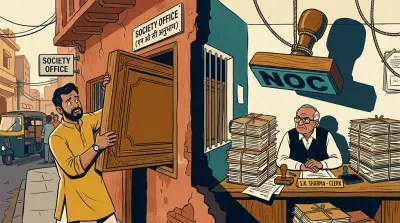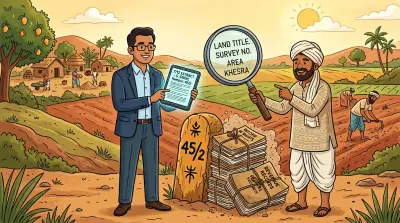


Most Mumbai flat owners do not own the land their flat sits on. Their society does not own it either. The original developer or the pre-development landowner still holds title to the underlying plot, decades after the building was completed and every flat was sold.
This is not a curiosity. It is the single most consequential title risk in Maharashtra, and it affects the majority of older Co-operative Housing Societies across Mumbai, Thane, and Pune. For an NRI flat owner, it is the kind of risk you cannot see from abroad until you try to redevelop, sell, or take a top-up loan and discover the society cannot produce a conveyance deed.
Maharashtra has the largest property market in India and one of the most developed digital infrastructures for land records. But the structural risks here are different from the agricultural-land traps of Karnataka or the Dharani errors of Telangana. They are urban, society-based, and largely invisible until they bite. This guide covers what is different about managing property in Maharashtra, with a focus on the risks remote owners most often miss.
The Deemed Conveyance Problem
When a developer builds a residential project in Maharashtra, the Maharashtra Ownership of Flats Act, 1963 (MOFA) requires the promoter to convey the land and the building to the Co-operative Housing Society formed by the flat purchasers within four months of the society’s formation, or within four months of receiving the occupancy certificate, whichever is later.
In practice, this almost never happens.
Conveying the land means the developer loses control over future redevelopment, future floor-space-index unlocking, and any unutilised TDR (Transferable Development Rights). For a developer, conveying is leaving money on the table for the next twenty or thirty years. So the conveyance is quietly skipped. The society is formed, members start living in their flats, life goes on. Nobody mentions that the land title is still with the developer.
The legal remedy is Deemed Conveyance. Introduced through the 2008 amendment to MOFA, it allows the society to apply to the District Deputy Registrar of Co-operative Societies for a unilateral conveyance order when the developer has failed to execute conveyance within the statutory period. The order, once granted, is treated as a conveyance deed and registered with the Sub-Registrar.
The application requires the society to produce:
- The registration certificate of the society
- A list of members with their flat details
- Building plan approvals and the occupancy certificate
- A title and search report for the land
- A copy of the development agreement or the original sale agreement between the landowner and the developer
For an NRI, the practical implication is this: if you own a flat in a Mumbai or Pune CHS that was formed more than four months ago and the society does not have a registered conveyance deed in its name, the building you live in technically sits on land the society does not own. Before any redevelopment, before any sale, before any major refinancing, this becomes a blocking issue.
Ask your society managing committee three questions:
- Does the society have a registered conveyance deed from the original landowner or developer?
- If not, has Deemed Conveyance been applied for, and what is the status?
- Who is the current legal owner of the land as shown on the Property Card?
If the answers are no, no, and the developer, the society is in the same position as roughly half of Mumbai’s older housing societies. The Maharashtra Housing Department has, over multiple years, run special campaigns to push pending Deemed Conveyance cases, but progress is slow. Push your society to file. The longer the delay, the harder it gets to assemble the documentary record needed.
Land Records: 7/12 Extract and the Property Card
Maharashtra splits its land records into two systems, urban and rural. Which one applies depends on whether your property is inside a municipal area with a city survey.
For rural land, the primary record is the 7/12 extract, known locally as the Satbara Utara. It combines Form 7 (rights of the holder) and Form 12 (crop and tenancy details) into a single document. The 7/12 extract is accessible through the Mahabhulekh portal at bhulekh.mahabhumi.gov.in. Select your district, taluka, village, and survey number to view and download the record.
For a deep walkthrough on how to read a 7/12 extract and what each column tells you, see our guide to land revenue records, 7/12 extracts, RTC and Pahani.
For urban property in Mumbai, Pune, Thane, and other municipalities with a city survey, the equivalent record is the Property Card, also called the PR Card or CTS Property Card. This is issued by the City Survey Office and shows:
- The CTS (City Survey) number
- The current owner’s name and how they acquired the property
- The area in square metres
- Any noted mutations or encumbrances
- Whether the land is freehold, leasehold, or government-owned
You can pull a Property Card online through mahabhumi.gov.in under the e-PCR service or apply at the City Survey Office for a certified copy.
One critical difference from other states: for a Mumbai flat, the Property Card is in the name of the society (or the developer, if conveyance was never completed), not the individual flat owner. Your name appears on the share certificate issued by the society and on the registered sale deed, but you will not find it on the Property Card directly. This is normal for a CHS structure. It is also why the Deemed Conveyance question above matters so much: if the Property Card shows the developer as the owner, the society has not actually received its conveyance.
Property Tax: MCGM, PMC, and Other Municipal Portals
Property tax in Maharashtra is administered by the municipal corporation of each city. There is no statewide property tax portal. For NRIs with multiple properties across Maharashtra, this means dealing with multiple separate portals.
Mumbai (MCGM / BMC): Pay through portal.mcgm.gov.in. The MCGM tax system is based on Capital Value, effective from April 2010, which uses the Ready Reckoner Rate of the property’s location as the base. Search by Property Account Number, ward, or owner name. The portal accepts international cards and net banking. Tax is billed annually with 30 June as the standard due date, and a 2% per month penalty applies on late payment.
Pune (PMC): Pay through propertytax.punecorporation.org. The PMC tax is calculated on Annual Rateable Value (ARV) using built-up area, usage type, and zone. A 5% to 10% rebate applies for early payment before 31 May, depending on the property type. Search by Property ID, owner name, or address.
Thane (TMC): Pay through thanecity.gov.in. Thane uses a Capital Value system similar to Mumbai. Tax is split into two instalments with discounts for early bulk payment.
Pimpri-Chinchwad (PCMC): Pay through pcmcindia.gov.in. Separate from Pune city. Many IT-corridor properties in Hinjawadi and Akurdi sit under PCMC, not PMC.
Common NRI traps on property tax in Maharashtra:
- Tax bills go to the previous owner’s name. If you bought a flat and never had the property tax record transferred (a step separate from sale registration and society share transfer), the bills continue to be issued in the previous owner’s name. Arrears silently accumulate. The fix is to apply for a name change on the property tax record at the local ward office or via the municipal portal, attaching the registered sale deed, society share certificate, and a property tax NOC from the previous owner.
- Society maintenance is not municipal tax. The monthly maintenance you pay to the society does not include municipal property tax. These are separate dues. NRIs often assume the society is handling everything; it is not.
- Disconnection and recovery. Sustained non-payment of municipal property tax can lead to property attachment notices and disconnection of water supply by the municipal corporation. The property tax arrears guide covers what happens when dues accumulate and how to settle them from abroad.
Stamp Duty and Registration
Maharashtra’s stamp duty rates in 2026 are among the highest in India, but the relief for female buyers and the structure of the metro cess are worth understanding.
For Mumbai, the total is 6% for male buyers and 5% for female buyers, comprising a 5% stamp duty (or 4% for women) plus a 1% metro cess. For municipal corporation areas outside Mumbai such as Pune, Thane, Nashik, and Nagpur, the total is generally 7% for men and 6% for women, including local body tax and metro cess where applicable. Rural panchayat areas are lower.
Registration fee is 1% of the agreement value, capped at Rs 30,000.
The Ready Reckoner Rate, set annually by IGR Maharashtra and effective from 1 April, is the minimum value at which the registration must be done. Buying below the Ready Reckoner attracts deemed gift tax on the buyer and capital gains liability on the seller for the differential. For a deeper view on how circle rates and ready reckoner rates interact with stamp duty across states, see this guide.
For Encumbrance Certificates and registration searches, use the IGR Maharashtra portal at igrmaharashtra.gov.in. The e-Search service covers registered documents from 1985 onwards for Mumbai and varying start dates for other districts.
SRA, MHADA, and the Title Restrictions NRIs Miss
Three categories of Mumbai property carry transfer restrictions that are easy to overlook in a normal due-diligence run.
SRA (Slum Rehabilitation Authority) properties. Buildings constructed under the SRA scheme are subject to a 10-year lock-in from the date of allotment, during which the rehabilitation tenement cannot be sold, transferred, or rented to non-eligible parties. After the lock-in, transfer is permitted but requires SRA NOC and payment of transfer charges. SRA flats often trade in the resale market at a discount precisely because of these restrictions. If you are buying a flat in a building that looks newly constructed but is in a redeveloped slum area, ask whether any tenements in the building are SRA component flats and, if so, whether the lock-in has expired and SRA NOC has been obtained.
MHADA (Maharashtra Housing and Area Development Authority) properties. MHADA flats, including buildings under cessed property redevelopment and MHADA-allotted housing, require MHADA NOC for transfer. The transfer fee is typically a fixed percentage of the Ready Reckoner Value. Original allottees often have additional restrictions. Verify the chain of MHADA NOCs in the document trail. A flat sold without MHADA NOC may be regularised later, but the buyer carries the regularisation risk and cost.
Cessed buildings. Old buildings in South and Central Mumbai that pay repair cess to MHADA fall under the Maharashtra Housing and Area Development Act, 1976. Tenancy and ownership structures in cessed buildings can be complex, with statutory tenants holding rights that survive ownership changes. Buying a flat in a cessed building requires careful tenancy due diligence.
MahaRERA verification. For any under-construction or recently completed project, verify MahaRERA registration at maharera.maharashtra.gov.in. The portal lists registration numbers, completion timelines, complaint history, and the promoter’s financial disclosures. Buying from an unregistered promoter strips you of MahaRERA protections, including the right to penalty interest on delays and assured refund mechanisms.
Society AGM Voting Rights and Maintenance Arrears
For NRIs who own flats in Maharashtra societies, two practical issues come up repeatedly: voting rights at the AGM, and how unpaid maintenance is enforced.
AGM voting. Under the Maharashtra Co-operative Societies Act, 1960 and the Model Bye-Laws issued under it, only the registered member of the society can vote at the AGM. A member who cannot attend in person can appoint a proxy in writing, subject to the limits in the bye-laws. Typically the proxy must be another member of the same society, or in some bye-laws a family member. NRIs commonly appoint a parent or sibling who is also a co-owner or a registered associate member.
If you are the sole registered member and have no co-owner in the society, your spouse or family member can be added as an associate member by filing a simple application and paying the prescribed fee. The associate member can vote in the absence of the principal member. This matters for big decisions: redevelopment proposals, deed of apartment versus deed of conveyance, society election of office bearers. Missing these votes from abroad leaves an NRI member with no say in decisions that affect the value of the flat.
Maintenance arrears. Maintenance charges are governed by the Model Bye-Laws of Co-operative Housing Societies and the Act. The bye-laws permit the society to charge interest on arrears, generally at 21% per annum, calculated from the due date until the date of payment. Sustained non-payment triggers two enforcement paths:
- Internal society action. The managing committee can issue notices, suspend non-essential services such as the lift and clubhouse access (water supply is generally judicially protected), and refuse to issue an NOC for sale or rental.
- Recovery certificate under Section 101. The society can file an application before the Deputy Registrar of Co-operative Societies for a recovery certificate. Once issued, the certificate is enforceable as if it were a civil court decree, allowing attachment of movable assets and a charge on the flat itself.
NRIs sometimes set up an autopay for society maintenance and assume it will run uninterrupted. Then a bank changes the mandate, or the society revises charges and the autopay fails for the differential. Six months later the arrears are large enough that the managing committee starts proceedings. Set a quarterly check from abroad, or have a family member monitor the society’s monthly bills.
For more on the broader society NOC and CHS framework, our document decoder covers the transfer process, fee caps under the bye-laws, and what to do when societies obstruct transfers.
What NRIs Need to Do Differently
Before buying any Maharashtra property:
- Confirm the property’s Ready Reckoner Rate at
igrmaharashtra.gov.inand ensure the agreement value is at or above it. - For a flat, ask the society for the registered conveyance deed. If none exists, ask whether Deemed Conveyance has been applied for and what stage it is at. Treat the absence of both as a flag, not a deal-breaker, but factor the resolution timeline into your decision.
- Pull a 30-year EC from the IGR Maharashtra e-Search.
- For urban property, pull the Property Card via
mahabhumi.gov.inand confirm the recorded owner. - Check MahaRERA registration if the project is under-construction or less than five years old.
- For redevelopment projects, ask whether the underlying land has clear conveyance to the society.
- Identify if the property is SRA, MHADA, cessed, or a pure private freehold and verify all required NOCs are in the document chain.
After buying:
- Apply for property tax name transfer at the relevant municipal corporation (MCGM, PMC, TMC, etc.). This is separate from sale registration and society share transfer.
- File mutation in the 7/12 extract or Property Card via the talathi or City Survey Office.
- Get yourself or a family member registered as a society member or associate member to preserve AGM voting rights.
- Set up reliable payment mechanisms for municipal property tax and society maintenance, with a quarterly review.
If you already own a Maharashtra property:
- Pull a fresh Property Card or 7/12 extract from
mahabhumi.gov.in. Confirm your name (or your society’s name) is recorded. - Pull a current EC from
igrmaharashtra.gov.into confirm no unauthorised registrations against your property. - Ask your society for the status of conveyance or Deemed Conveyance.
- Check municipal property tax dues at the relevant portal.
- Verify your name on the society register and confirm associate member arrangements for AGM voting.
Portals at a Glance
| Portal | URL | Purpose |
|---|---|---|
| IGR Maharashtra | igrmaharashtra.gov.in | Registration, EC e-Search, Ready Reckoner Rate, Deemed Conveyance forms |
| Mahabhulekh | bhulekh.mahabhumi.gov.in | 7/12 extract for rural land |
| Mahabhumi e-PCR | mahabhumi.gov.in | Property Card for urban property |
| MCGM | portal.mcgm.gov.in | Mumbai property tax payment and Property Account search |
| PMC | propertytax.punecorporation.org | Pune property tax payment |
| PCMC | pcmcindia.gov.in | Pimpri-Chinchwad property tax (Hinjawadi, Akurdi corridors) |
| TMC | thanecity.gov.in | Thane property tax |
| MahaRERA | maharera.maharashtra.gov.in | Builder and project registration verification |
Related Reading
- Managing Property in Karnataka: A Guide for NRIs. The parallel state guide for Karnataka NRIs, covering Bhoomi, Kaveri, A-Khata vs B-Khata, and DC conversion.
- Managing Property in Gujarat: A Guide for NRIs. The Gujarat state guide, covering Anyror, iORA, NA conversion under Section 65, the still-active Section 63 restriction, and tribal land rules.
- Society NOC and Flat Sale Transfer. The CHS NOC process, fee caps, and what to do when societies obstruct sales, with deep coverage of Maharashtra Co-operative Societies Act provisions.
- Land Revenue Records: 7/12 Extract, RTC, Pahani. A deeper walkthrough of how to read a 7/12 extract, line by line.
- Circle Rate and Stamp Duty: A Seller’s Guide. How Ready Reckoner Rates work, the COVID stamp duty cut case study, and state-by-state rates.
- Property Tax Arrears in India. What happens when municipal property tax goes unpaid and how to settle arrears from abroad.
- India’s Property Dispute Crisis. The broader context for why Indian property due diligence is unusually demanding.
Assetly is a property document management platform for Indian property owners and NRIs. Store, organise, and track your Maharashtra property documents, from 7/12 extracts to Property Cards to society share certificates and municipal tax receipts, with access from anywhere. Learn more at assetlyhq.com.