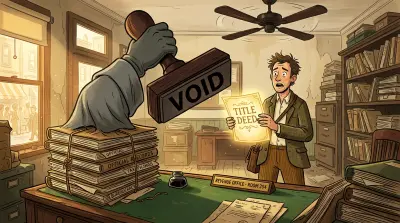
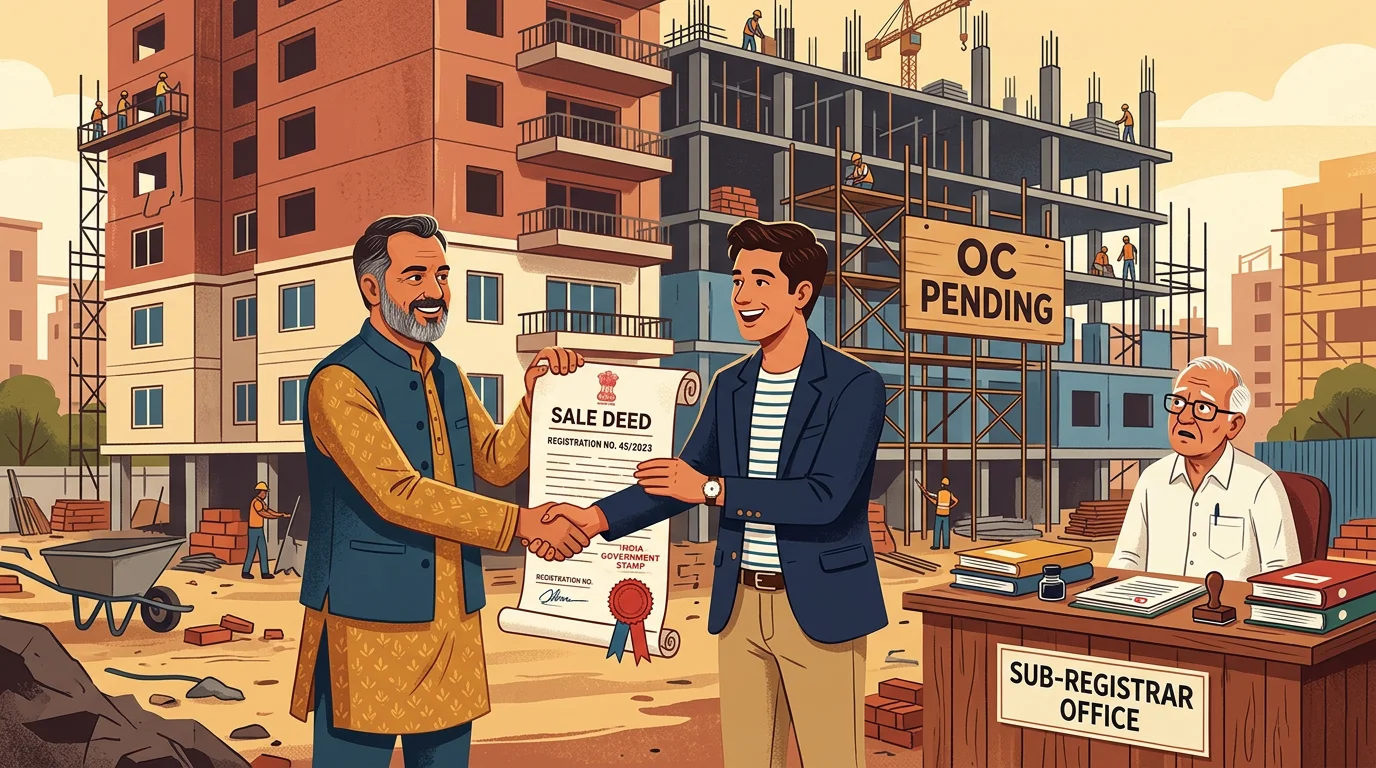

The builder called with good news: your flat is ready, the sale deed is prepared, and they want you to come in for registration next week. There is just one thing missing. The Occupancy Certificate. The builder says it is “in process” and will come in a few months.
Should you sign?
This question comes up constantly with Gujarat buyers, and the answer matters more than most people realise. Signing a sale deed before the Occupancy Certificate arrives is not a minor administrative detail. It can affect your loan, your right to occupy the flat legally, and your ability to sell or inherit the property later.
Here is what RERA actually says, what Gujarat’s rules add to it, and what you can do if you are already in this situation.
What RERA Says About the Sequence
The Real Estate (Regulation and Development) Act, 2016 lays out a clear order of events for handing over a flat. Two sections define it.
Section 11(4)(b) puts the responsibility for obtaining the Occupancy Certificate squarely on the builder:
“be responsible to obtain the completion certificate or the occupancy certificate, or both, as applicable, from the relevant competent authority as per local laws or other laws for the time being in force and to make it available to the allottees individually or to the association of allottees, as the case may be”
The builder cannot outsource this. Cannot ask you to go get it yourself. The obligation belongs entirely to the promoter.
Section 17(1) then sets the timeline for executing the conveyance deed (the registered sale deed):
“in the absence of any local law, conveyance deed in favour of the allottee…shall be carried out by the promoter within three months from date of issue of occupancy certificate.”
Read together, these two sections describe a sequence: the builder gets the OC, and then within three months, executes the registered sale deed and hands over possession.
Can Sale Deed Be Registered Before Occupancy Certificate Under RERA?
Here is where it gets important.
RERA does not contain a line that says: “a builder shall not register a sale deed before obtaining an Occupancy Certificate.”
The Registration Act, 1908 - which governs what a sub-registrar will or will not stamp and register - also does not make OC a precondition. So when your builder takes you to the sub-registrar’s office and a sale deed gets registered before the OC exists, the registration is technically valid. The document exists. The sub-registrar accepted it.
What RERA does instead is keep the builder on the hook regardless.
So the short answer to the search query is:
- Yes, a sale deed can be registered before Occupancy Certificate in Gujarat.
- No, that does not mean the builder has complied with RERA.
- No, it does not mean you have received lawful possession.
Section 17’s three-month clock starts at OC - it tells you when the builder must have the deed done, not that the deed cannot happen earlier. But Section 18 is the real deterrent. It gives buyers an unconditional right to interest on all payments made, for every day possession is delayed beyond the agreed date.
The Supreme Court made this crystal clear in Newtech Promoters and Developers Pvt. Ltd. vs State of Uttar Pradesh (2021):
“The unqualified right of the allottee to seek refund referred under Section 18(1)(a) and Section 19(4) of the Act is not dependent on any contingencies or stipulations thereof. The legislature has consciously provided this right of refund on demand as an unconditional absolute right to the allottee, if the promoter fails to give possession of the apartment, plot or building within the time stipulated.”
A registered sale deed without OC does not break that right. The builder signs the deed, pockets the full payment - and the Section 18 interest meter keeps running until the OC arrives and lawful possession is handed over.
What “Possession” Means Under RERA
This distinction matters because builders often argue that handing over keys alongside the sale deed counts as possession. It does not, unless the Occupancy Certificate is in hand.
The Bombay High Court addressed exactly this in Keyana Estate LLP vs Paresh Parihar (2025), where it held that offering keys to a buyer without first satisfying the conditions under which the Occupancy Certificate was issued does not count as valid possession under RERA. The builder’s obligation remains unmet until the OC conditions are fully complied with and the flat is genuinely fit for habitation.
Gujarat courts follow the same reasoning. The OC is not a formality that comes after possession. It is a prerequisite for lawful possession. A flat without OC cannot legally be occupied. You cannot get a home loan against it. You cannot regularise utility connections. You cannot sell it easily later.
RERA Section 11(4)(a) - whose constitutional validity was upheld by the Supreme Court in Pioneer Urban Land and Infrastructure vs Union of India (2019) - makes clear that the builder’s obligations survive the execution of the conveyance deed: the promoter’s responsibility for structural defects “shall continue even after the conveyance deed of all the apartments, plots or buildings, as the case may be, to the allottees are executed.”
Signing the sale deed does not close the file on your builder’s obligations.
Gujarat-Specific Context
Gujarat operates through GujRERA (gujrera.gujarat.gov.in). All real estate projects in Gujarat above the prescribed threshold must be registered there, and the builder is required to upload project documents including OC/CC once obtained.
One important Gujarat carve-out: projects that received a Completion Certificate before 1 May 2017 (RERA’s commencement date) are exempt from RERA registration entirely. The Gujarat High Court confirmed this in Hiren Sureshbhai Patel vs State of Gujarat (February 2023), holding that RERA’s adjudicating officer has no jurisdiction over projects completed before the Act commenced. If your flat is in a project that received its CC before May 2017, your dispute lies with the civil courts and consumer forums, not GujRERA.
For any project registered after May 2017, GujRERA’s jurisdiction applies in full.
Gujarat does not currently have a separate state rule requiring sub-registrars to verify OC before registering a sale deed - unlike some other states that have amended their registration procedures. This means the practical risk falls entirely on the buyer to check whether OC exists before signing.
What This Means If You Are Already in This Situation
If your builder has already registered a sale deed and handed over keys without an OC, you are not without options.
You have not waived your right to OC. The Pioneer Urban Land judgment confirms that builder obligations run even after the sale deed. Demand the OC in writing. If the builder does not provide it within a reasonable period, file a complaint with GujRERA.
You can claim interest from the original possession date. The date for calculating interest under Section 18 is the possession date in your agreement, not the date you physically received the keys. If the builder missed that date and has still not provided lawful possession (with OC), the interest clock has been running since that original date.
Refuse to accept possession formally until OC is in hand. If the builder calls you for a “possession ceremony” but cannot produce the OC, do not sign the possession letter. The Keyana Estate ruling establishes that an offer of possession without OC conditions being met does not discharge the builder’s obligation. You can decline, and your interest entitlement continues. The Supreme Court reinforced this nationally in February 2026: see our case study on the Parsvnath ruling for the full implications.
Check GujRERA’s project page. Go to gujrera.gujarat.gov.in, search for your project, and check whether the builder has uploaded the OC. Builders are required to update project status on the portal. If the project shows as complete but no OC is uploaded, that is itself a non-compliance you can raise in a complaint.
If the Builder Is Pressuring You to Sign
Builders sometimes argue that waiting for OC before the sale deed will cost you - in stamp duty (if rates go up), in loan disbursement timing, or in possession delays. These are legitimate concerns but they should not override your right to proper documentation.
A few practical steps:
- Ask for the OC in writing before signing. If the builder says it is “expected soon,” ask for the exact date and get it in the sale agreement itself, with a penalty clause for delay.
- Check the RERA project page before the registration appointment. The OC status should be visible on GujRERA.
- Do not sign a possession letter without OC even if you have already signed the sale deed. Possession and conveyance are separate acts.
- File a GujRERA complaint if the OC is more than three months overdue from the agreed possession date. You can do this online through the portal.
- Consult a property lawyer before registering, if the OC timeline is uncertain. The fee is modest compared to the trouble of chasing an OC for years post-registration.
- Store all correspondence about the OC digitally - emails, WhatsApp messages, letters from the builder - so you have a documented record if a complaint becomes necessary. Property document platforms like Assetly (assetlyhq.com) can help NRIs organise these records alongside their title documents for easy access across time zones.
The broader issue, as documented in India’s property dispute crisis, is that most property disputes trace back to documentation gaps that seemed minor at the time of signing. An OC is not a technicality. It is the document that says the building is legally fit for you to live in.
For the broader document context, see our guide to Occupancy Certificate and Completion Certificate and our explainer on RERA obligations when selling a flat. For the full picture on managing Gujarat property remotely, including the land record portals, NA conversion under Section 65, and the Section 63 restriction on non-agriculturist buyers, see our Gujarat NRI property guide.
Assetly is a property document management platform that helps Indian property owners, including NRIs, organise and track their property documents - OC, sale deed, RERA correspondence, and more - from anywhere. Learn more at assetlyhq.com.