

On 7 April 2025, the Supreme Court of India issued a ruling that originated from a Tamil Nadu Sub-Registrar’s office. A man named K. Gopi had executed a sale deed. The Sub-Registrar refused to register it because the seller could not produce the original documents proving how he had acquired the property. The Madras High Court upheld the refusal.
The Supreme Court did not. In K. Gopi v. The Sub-Registrar (2025 INSC 462), the court held that a registering officer “has no adjudicatory power to decide whether the executant has any title.” Rule 55A(i) of the Tamil Nadu Registration Rules - the provision that allowed the refusal - was declared ultra vires the Registration Act, 1908, and struck down.
It is a useful entry point for understanding Tamil Nadu’s property system, because it captures a tension that runs through all of it: the gap between what registration looks like (a government official, a stamp, a public record) and what it actually guarantees (the transaction was recorded; nothing more).
The Land Records System
Tamil Nadu splits property records between two state departments and two separate portal systems, depending on whether the land is urban or rural. Getting this distinction right is the first thing any buyer or remote owner needs to do.
Rural Land: Patta, Chitta, and the Bhoomi System
For land outside town survey areas, the primary revenue document is the Patta. It is issued by the Tahsildar (a revenue officer) and records the owner’s name, survey number, land extent, classification (wet land, dry land, or natham), and the tax assessed.
All of this is available through the eServices Tamil Nadu portal at eservices.tn.gov.in. From anywhere in the world, you can download:
- The current Patta extract for any rural survey number (a nominal fee applies)
- The A-Register extract - the foundational village register of all land parcels
- The FMB (Field Measurement Book) sketch - the cadastral map showing physical boundaries
- A poramboke land verification for any survey number
One important caveat that many buyers miss: a Patta is not a title document. Courts in Tamil Nadu, the Madras High Court, and the Supreme Court have repeatedly held that a Patta creates a presumption of possession but is not conclusive proof of ownership. You need the registered sale deed chain - who sold to whom, going back to a clear root of title - to establish marketable title. A property with an updated Patta but a broken sale deed chain is not a clean property.
Urban Land: Town Survey Land Records (TSLR)
When a revenue village is brought under the Town Survey system, the Survey Department conducts a fresh survey and creates an entirely new set of records: Town Survey Land Records (TSLR). The urban plots get new TSLR numbers, separate from the old rural survey numbers.
The TSLR Extract from eservices.tn.gov.in is the correct document for urban properties, not the rural Patta. This matters because the two systems do not always align: a property may have a rural survey number and a TSLR number that cover different boundaries, or land classification can change when included in the Town Survey.
Buyers who rely only on a rural Patta for an urban property in Chennai, Coimbatore, or Madurai may be looking at records that are no longer current. Always check which system applies to your property - rural (Patta) or urban (TSLR) - and pull the correct extract.
Encumbrance Certificates via TNREGINET
The TNREGINET portal at tnreginet.gov.in handles registration records and encumbrance certificates. Unusually for an Indian state, Tamil Nadu offers free EC searches. You can search by sub-registrar office, village, and survey number, specify any time period, and download the results without visiting an office.
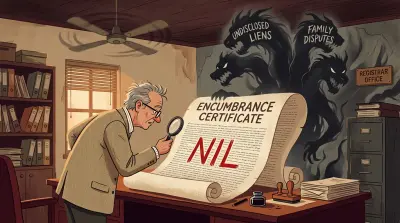
The encumbrance certificate shows all registered transactions on the property - sale deeds, gift deeds, mortgages, leases, court attachments - for the period you search. For any purchase, search at least 30 years. This is where you see whether the seller’s acquisition, and the acquisitions before it, are clean.
TNREGINET also provides guideline value (the government’s minimum reference for stamp duty), certified copies of registered documents, and appointment booking at sub-registrar offices.
The Poramboke Problem
“Poramboke” is Tamil for government land not assigned to any private owner: roads, water bodies, grazing land (Meikkal Poramboke), temple land, cremation grounds, waste land. These parcels should appear as government/poramboke in revenue records.
They do not always. Revenue officials, acting with corrupt intent or through administrative error, sometimes convert poramboke parcels to private Patta. A buyer purchases based on the Patta, gets a registered sale deed, and later the government files proceedings under the Tamil Nadu Land Encroachment Act, 1905.
Section 14 of that Act bars civil court jurisdiction. The government can evict summarily. And because the Patta was fraudulently or erroneously issued, the registered sale deed does not protect the buyer - the Madras High Court has consistently upheld this principle in poramboke eviction proceedings.
The most common version of this in recent years involves water bodies. Chennai and surrounding districts have hundreds of lakes and tanks. Their Full Tank Level (FTL) boundaries were recorded as poramboke in revenue records. As the city expanded, developers encroached on these boundaries, had records manipulated, and sold plots to buyers who had no idea they were purchasing what was effectively a lake bed. The Tamil Nadu government has been cancelling Pattas over water bodies since a 2015 Madras High Court order requiring protection of these areas.
The practical defence is simple. The eServices portal at eservices.tn.gov.in has a “Verify Government / Private (Poramboke) Land” feature. Enter the district, taluk, village, and survey number. If the result shows “Government” or “Poramboke,” do not buy. This check takes two minutes and should be done before any rural or semi-urban Tamil Nadu purchase.
The Urban Land Ceiling Ghost
The Tamil Nadu Urban Land (Ceiling and Regulation) Act, 1978 imposed a 500 square metre ceiling on vacant urban land. It was repealed in 1999. But its effects on property titles persist.
The Act required owners of urban plots above 500 square metres to declare the excess and surrender it to the government. Many did not comply. Some sold the property during the Act’s operation without disclosing the ceiling status. Some executed sale deeds for properties that were subject to proceedings under the Act.
The Supreme Court’s 2020 ruling in Ferrodous Estates (Pvt) Ltd. v. P. Gopirathnam (AIR 2020 SC 5041) involved a 1980 sale agreement for Chennai land (8 grounds 2,354 sq. ft) where the Urban Land Ceiling question was central to the dispute - resolved only in 2020, four decades later. By then the 1978 Act had been repealed, and the court granted specific performance of the original transaction. The case illustrates how properties subject to the 1978 Act continued generating disputes decades after the Act’s repeal.
Any Chennai property that changed hands in the 1980s or 1990s needs a ceiling check. Your property lawyer should confirm whether the property was subject to ceiling proceedings under the 1978 Act and, if so, whether the issue was resolved. This is not standard due diligence that buyers think to request. It should be.
The K. Gopi Ruling and NRI Property Transactions
Rule 55A(i) of the Tamil Nadu Registration Rules was Tamil Nadu’s attempt at an anti-fraud check. Before registering a sale deed, the Sub-Registrar could demand that the presenting party (the buyer’s attorney in NRI transactions) produce the original deed by which the seller had acquired the property. If the original was unavailable - abroad, in a bank locker, or simply lost - the registration could be refused.
For NRIs, this rule was a persistent obstacle. Original title documents are often kept abroad, in Indian safe deposits, or with lawyers. NRI attorneys coming to register a purchase would be turned away because the seller’s original title documents were not available.
The Supreme Court’s ruling in K. Gopi v. The Sub-Registrar (2025 INSC 462) struck this rule down. The court confirmed that a Sub-Registrar’s role is procedural: verify the parties’ identity, confirm execution, check stamp duty. The Sub-Registrar has no power to adjudicate on the seller’s title, and no authority to demand original title documents as a precondition for registration.
The ruling opened the way for NRI transactions that had been blocked across Tamil Nadu under Rule 55A(i). Madras High Court cases citing K. Gopi to set aside earlier refusals began appearing within weeks of the judgment.
For NRIs managing property in Tamil Nadu, this is directly relevant. PoA attorneys can now register sale deeds without having to produce original title documents. Legitimate transactions are easier.
The caveat, which applies to buyers rather than sellers: registration still does not verify the seller’s title. The Sub-Registrar’s inability to demand original documents means the burden of due diligence - checking the title chain, verifying the EC, confirming there are no litigation holds - falls entirely on the buyer. That burden was already there. K. Gopi just makes it more explicit.
CMDA and DTCP: The Approval Question
Within Chennai’s metropolitan area, the CMDA (Chennai Metropolitan Development Authority) governs construction approvals. Outside Chennai, the DTCP (Directorate of Town and Country Planning) handles layout and building approvals for the rest of Tamil Nadu.
Before buying in Chennai, verify the CMDA zoning for your property. CMDA’s Master Plan designates areas as residential, commercial, industrial, or no-development zones. A property in a “No Development Zone” or designated “Open Space Reservation” area cannot be legally constructed upon or expanded.
CMDA enforcement is active. The Ramaraj Naidu case (ITAT Chennai, 2019) documented a property with an approved plan but unapproved additional construction that was subject to CMDA demolition proceedings. Unlike Karnataka, Tamil Nadu has no Akrama Sakrama-style regularisation scheme to retrospectively legalise unapproved construction.
For apartment purchases, verify that the project is registered with TNRERA at rera.tn.gov.in. RERA registration is mandatory for all residential projects above a threshold. Without RERA registration, the mandatory protections - staged payment schedules, escrow of buyer funds, penalties for delays - do not apply.
CRZ Restrictions for Coastal Properties
Tamil Nadu’s coastline runs from Chennai down through Mahabalipuram, Pondicherry border, Nagapattinam, Rameswaram, and Kanyakumari. The Coastal Regulation Zone notification imposes construction restrictions within specified distances from the High Tide Line.
For CRZ-III areas (rural coastal areas): a 200-metre No Development Zone applies. For CRZ-II areas (urban coastal areas): construction is allowed on the landward side of existing authorised structures, but no new construction seaward of the existing building line.
Real estate agents along the East Coast Road (ECR, the Chennai-Mahabalipuram corridor) and near Pondicherry sometimes market coastal plots without disclosing CRZ restrictions. After purchase, owners discover they cannot construct, renovate, or extend. Courts and the National Green Tribunal have upheld demolition orders for CRZ violations in Tamil Nadu. Properties within CRZ boundaries also cannot be mortgaged for standard home loans through most banks.
Before buying any coastal Tamil Nadu property, ask the seller for the CRZ clearance documents and verify the property’s position relative to the High Tide Line with the Tamil Nadu Coastal Zone Management Authority. If the seller cannot produce these, treat it as a red flag.
TNHB Properties: The Allotment Letter Trap
The Tamil Nadu Housing Board (TNHB) was a major provider of housing plots and flats in Chennai from the 1970s through the 2000s. TNHB allottees received an Allotment Letter - not a sale deed - when they took possession. The registered sale deed was to be executed after full payment of the price.
Many allottees paid the price in instalments, moved in, and never completed the formal sale deed. The property exists. The allottee lives there. But without a registered sale deed, the Patta cannot be transferred, and the property sits in a legal grey zone.
NRIs who inherited a TNHB allotment from a parent face this directly. The allotment letter is not a registered document that transfers title. The first step is to have the allotment re-issued in the heir’s name by TNHB, and then execute a proper registered sale deed. Only then can Patta transfer and subsequent transactions proceed normally.
Patta Transfer: How It Works
After buying or inheriting property in Tamil Nadu, updating the Patta to your name is a separate step from registration. The application goes to the Tahsildar and can now be filed online through eservices.tn.gov.in for a Rs 60 fee, or at a Common Service Centre.
Documents needed: the registered sale deed (or succession/inheritance documents for inherited property), the previous Patta, a recent EC, and ID proof. An NRI can authorise a PoA holder to make the application.
The Tahsildar may call the applicant or representative for verification. The target timeline under Tamil Nadu’s citizens’ services charter is 30 days, but delays are common and the actual time depends on the taluk’s backlog and whether the records show any discrepancies.
Get the Patta updated promptly. Without it, property tax bills continue in the previous owner’s name, bank transactions hit friction, and any subsequent sale faces questions about the gap between the sale deed and the revenue records. Check for guidance on mutation across states.
What NRIs Should Do
Before buying:
Run the poramboke check on eservices.tn.gov.in. Enter the survey number and confirm it is classified as private land, not government or poramboke.
Confirm whether the property is in the Town Survey system (TSLR) or the rural Patta system, and pull the correct record. Verify both if there is any ambiguity.
Download a 30-year EC from TNREGINET. Read the full chain of transactions.
For any Chennai property, verify the CMDA zone and confirm there are no ceiling proceedings under the 1978 Urban Land Ceiling Act.
For coastal properties, ask for CRZ documentation before signing anything.
Commission a title search from a local property lawyer. The poramboke check and EC are starting points, not substitutes.
After buying:
File for Patta transfer within 30 days of registration. Do this online or through a PoA holder before leaving India.
Register for GCC (Chennai) or local municipal corporation property tax in your name. Download the tax receipt and store it digitally.
For apartments, confirm the building has CMDA/DTCP approval and an occupancy certificate. If you are buying into an unoccupied building that lacks an OC, understand that the OC is the developer’s problem to solve - but until it is solved, your property’s title is incomplete.
For ongoing management:
Pull a fresh Patta and EC check once a year. The eServices and TNREGINET portals make both possible remotely and for minimal cost. If an unexpected transaction appears on the EC, you want to know about it while there is still time to challenge it.
Pay property tax annually. The Greater Chennai Corporation (GCC) portal and equivalent municipal portals for other cities are generally accessible from abroad. Keep every receipt.
Use Assetly (assetlyhq.com) to store and organise all documents - Patta, TSLR extract, EC, sale deed, tax receipts - in one accessible digital vault. For NRIs who cannot visit a government office to retrieve documents, having dated digital copies of all records is the difference between a quick resolution and months of correspondence.
Portals at a Glance
| Purpose | Portal |
|---|---|
| Patta, TSLR, FMB, A-Register, Poramboke check | eservices.tn.gov.in |
| EC search (free), Guideline Value, Document status | tnreginet.gov.in |
| TNRERA - apartment project verification | rera.tn.gov.in |
| Chennai Corporation property tax | gcc.tn.gov.in |
Related Reading
- What Is an Encumbrance Certificate? - how to read the TNREGINET EC and what it does and does not show
- Your Registered Sale Deed Does Not Prove Ownership - the K. Gopi case in full, and what registration actually guarantees
- How to Give Power of Attorney for Property Without Losing It - post-K. Gopi PoA guidance for NRI property transactions
- Mutation Record: The Document Most People Forget - why Patta transfer matters and how it works
- Managing Property in Karnataka: A Guide for NRIs - the neighbouring-state guide, with A-Khata versus B-Khata, RTC, and DC conversion for remote owners
- FEMA Rules Every NRI Property Owner Must Know - agricultural land restrictions and repatriation rules that apply in Tamil Nadu
- India’s Property Dispute Crisis - why property disputes dominate Indian courts and what drives it systemically
Assetly is a property document management platform for Indian property owners and NRIs. Organise your Tamil Nadu property documents, from Patta to EC to tax receipts, in one secure digital vault accessible from anywhere. Learn more at assetlyhq.com.