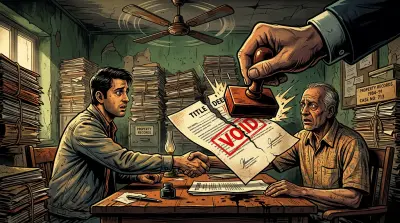


The words “ULC land” on a Hyderabad property file can refer to a law that was repealed years ago and a problem that is still capable of stopping a sale today.
That apparent contradiction is the whole issue. Undivided Andhra Pradesh adopted the Urban Land (Ceiling and Regulation) Repeal Act with effect from 27 March 2008. But repeal did not turn every parcel touched by the old law into clear private land. Where the government had already completed the legally required process and taken possession, the Repeal Act preserved the result. Where it had not, the pending proceeding could abate.
For a buyer, that makes one question more important than the label: what exactly happened to this survey number and extent before 27 March 2008?
This guide explains the documents that answer that question, why a registered sale deed is not enough and how ULC differs from agricultural ceiling land, Section 22A and LRS.
ULC land meaning in Telangana
The Urban Land (Ceiling and Regulation) Act, 1976 applied to vacant land in specified urban agglomerations. Its purpose was to limit large concentrations of urban vacant land. A holder had to disclose covered holdings; the competent authority would examine the declaration, identify any excess and follow the statutory process for that excess to vest in the state.
In a Telangana property file, “ULC” may therefore describe several very different situations:
| What the file may show | What it means for a buyer |
|---|---|
| A declaration or Ceiling Case was opened | There is a ULC history to investigate; it does not alone prove government ownership |
| Excess land was identified or notified | The proceeding advanced, but the later possession record still matters after repeal |
| Government lawfully took possession | The saved government claim may prevent a private transfer |
| Proceedings were unfinished and possession was not taken by 27 March 2008 | The proceeding may have abated under the Repeal Act |
| A later allotment, exemption, regularisation or court order exists | Its scope, conditions, beneficiary and exact land extent must be checked |
Do not compress those categories into “ULC clear” or “ULC affected” based on a broker’s statement. The Ceiling Case file, survey identity and possession history decide which category fits.
The 2008 repeal did not erase every ULC history
The central Urban Land (Ceiling and Regulation) Repeal Act, 1999 saved certain completed consequences of the old law and caused many pending proceedings to abate. Undivided Andhra Pradesh brought the repeal into force with effect from 27 March 2008.
The practical dividing line is often whether the state had taken actual possession before that date. A notification saying land had vested and a paper panchanama saying possession was taken are relevant documents, but they are not automatically the end of the factual inquiry.
That is why old ULC disputes continue to appear in Telangana courts. They are usually not arguments about whether the Act still imposes a new ceiling. They are arguments about what was validly completed before repeal and what the surviving records prove.
What the 2025 Fatehnagar Supreme Court case clarified
In February 2025, the Supreme Court decided M/s A.P. Electrical Equipment Corporation v. Tahsildar & Others, a dispute concerning a large extent in Fatehnagar, Hyderabad. The state relied on notices and a panchanama to say it had taken possession before repeal. The landholder pointed to continuing physical possession, a functioning factory, residential buildings and serious problems in the documents relied on by the government.
The Court restored the Single Judge’s decision in favour of the landholder. It emphasised that possession under the ULC and Repeal Acts means actual physical possession, not merely a paper assertion. It also held that the High Court can examine the evidence when possession is the decisive mixed question of law and fact. Read the official Supreme Court judgment.
The buyer lesson is narrower than “old ULC entries do not matter”. They matter enough to require the full file. The case shows why neither side can safely rely on one portal entry, one notification or present occupation without reconstructing the statutory sequence.
The ULC documents to ask for
Start with the exact property identity in the current deed. Record the district, mandal, village, survey number and subdivision. For an urban parcel, also capture any town-survey number, block, ward, plot number and extent. Old ULC proceedings can cover a parent survey or a larger holding, while the property being sold is only one later plot within it.
Ask the seller for:
- The ULC Ceiling Case number. It is often written as a CC number in government forms and orders.
- The declaration and draft or final statement. These show the holder and the land that the authority examined.
- The Section 10 notifications and notices. The sequence can include publication, a request to surrender and an order authorising possession.
- The possession record or panchanama. Check the date, exact extent, boundaries, officials, witnesses and what was physically on the land.
- Any exemption, allotment or regularisation order. Confirm the beneficiary, payment conditions, permitted use and whether the order covers this plot rather than neighbouring land.
- Every court order concerning the ULC proceeding. A pending case, interim order and final judgment do not have the same effect.
- The current prohibited-property result and revenue or municipal record. These help reveal present conflicts but do not replace the original ULC file.
The Telangana government still publishes an application format for allotment of excess land taken into government possession. The form itself is instructive: it asks for the CC number, survey and town-survey details, block, ward, plot, occupied extent and registered documents. That is the level of identity a serious review needs.
How to check a plot before paying an advance
1. Resolve the survey identity
Match the present plot to its parent survey and subdivision. Compare the sale deed schedule, sanctioned layout, survey sketch and municipal or revenue description. If the seller cannot connect a plotted address to the parent survey affected by the ULC case, stop before paying.
2. Check the current prohibited status
Use the Telangana prohibited-property check with the official district, mandal, village and survey number. Also check the current government land-record and registration routes that apply to the property.
A clear result is useful, but it is not a historical ULC clearance certificate. A flagged result needs the stated category and source, not an assumption that every prohibition is a ULC matter. Our Section 22A guide explains how to read those categories.
3. Obtain the competent authority’s case file
Have a Telangana property lawyer obtain or inspect the file held by the relevant ULC competent authority or district administration. The review should answer:
- Which person and total holding were examined?
- Which exact survey numbers and extents were declared excess?
- Were the required notices served?
- Does the government claim voluntary surrender or forced possession?
- What evidence records actual possession before 27 March 2008?
- Did a later order alter, exempt, allot or regularise the land?
- Do later sale deeds describe the same land, or merely use a similar plot number?
4. Search the title chain and court history
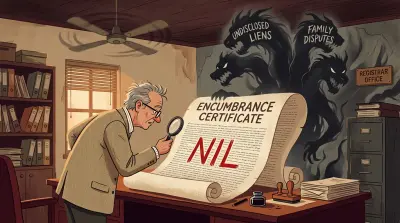
Obtain the EC for a sufficient period and inspect every link deed, but remember that an Encumbrance Certificate has limits. Search court records using the parties, CC number, survey number and relevant government authorities. If litigation exists, read the operative final order rather than relying on a case-status label.
5. Make the agreement conditional
Where the file needs clarification, do not use a routine non-refundable advance clause. A lawyer can make the transaction conditional on production and verification of the ULC orders, clean prohibited status and any required government or court confirmation. An indemnity can support a claim against the seller, but it cannot force the government to recognise a private title.
What does not prove that ULC land is clear
These documents may be genuine and still leave the ULC question unanswered:
- a registered sale deed;
- a nil or apparently clean EC;
- property-tax assessment and paid receipts;
- electricity or water connection;
- a sanctioned building or layout document relating to a wider project;
- long physical possession;
- a bank loan sanctioned years ago; or
- an LRS application or payment receipt.
Each answers a different question. None substitutes for the Ceiling Case and possession record.
ULC, agricultural ceiling, Section 22A and LRS are different
| Issue | Core question | Why it is different |
|---|---|---|
| Urban Land Ceiling (ULC) | What happened under the repealed 1976 urban vacant-land law before 27 March 2008? | Historical proceedings and actual possession are central |
| Agricultural land ceiling | Did a person or family exceed the agricultural holding permitted by the 1973 land-reforms law? | It is a separate, still-relevant agricultural regime |
| Section 22A prohibited status | Is registration currently barred under a prohibited category or notification? | It is the present registration restriction and can arise for several reasons |
| LRS | Can a plot in an unapproved layout be regularised under the planning scheme? | It deals with layout approval, not ownership of ceiling-surplus land |
The distinction has a direct consequence for plot owners. Telangana’s 2020 LRS rules exclude ceiling-surplus land and government land entered in the Revenue Department’s prohibitory register. Paying LRS charges cannot cure a ULC title problem.
For agricultural ceiling issues, use our separate guide to the Telangana Land Reforms ceiling law. Mixing the two regimes is one of the fastest ways to ask the wrong office for the wrong document.
A decision table for buyers
| What you find | Practical response |
|---|---|
| No ULC reference, clean current checks and a verified title chain | Continue ordinary legal, survey and planning due diligence |
| ULC CC number exists, but the seller has no final file | Pause and obtain the competent authority’s records |
| Government claims possession before repeal | Do not proceed without specialist review of the complete possession record and later orders |
| Court order says proceedings abated because possession was not taken | Confirm finality, exact survey identity, extent and implementation in current records |
| Allotment or regularisation order is produced | Verify the beneficiary, conditions, payment, extent and authority directly |
| Survey number remains prohibited or the records conflict | Treat the property as unresolved; do not rely on an advance refund promise |
The practical rule
ULC is not cleared by the passage of time, by construction on the land or by repeating that the Act was repealed. It is cleared, for transaction purposes, by reconstructing the old proceeding and connecting its legal result to the exact parcel being sold.
Start with the survey identity. Find the Ceiling Case. Establish whether lawful actual possession was taken before 27 March 2008. Then reconcile that answer with the current prohibited-property record, title chain and court orders.
If the seller cannot produce that chain, the missing document is not a minor paperwork gap. It is the central ownership risk in the transaction.
Assetly helps property owners organise title records, preserve government documents and identify unresolved property checks. It does not issue ULC clearance or replace legal advice.