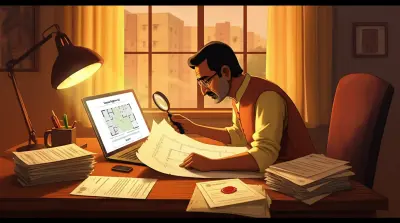


To check a Telangana LRS application status, open APPLICATION SEARCH on the official LRS portal. Use the application number from the acknowledgement where possible, save the result with the date and confirm that the applicant, plot, survey number and authority match your file.
A Telangana plot owner can possess an LRS application number, an acknowledgement and one or more payment receipts, yet still have no clear answer to the question that matters: is the plot regularised?
The documents are related, but they do not prove the same thing. An application shows that a request was filed. A receipt shows payment activity. An objection shows that the authority found a question or shortfall. The final proceeding or approval is what records the authority’s decision.
That distinction matters when a plot is being sold, financed, inherited or prepared for construction. A broker may say “LRS paid” as if it settles the issue. A buyer’s bank or lawyer will want the actual authority record.
This guide explains how to reconstruct an LRS case from official evidence, what the Telangana portal says about common eligibility boundaries, and when the problem is not really an LRS problem at all.
What each LRS status actually proves
Start with the official Telangana LRS portal, not a broker’s screenshot or an unofficial status site. Keep the application acknowledgement beside you and enter the identifier exactly as issued. The live flow may require a citizen login, OTP or CAPTCHA, and those requirements can change.
If you do not have the application number - because an agent, a relative or a previous owner filed it - our free Telangana LRS status check searches by applicant name as well as by application number, which is the case the official portal handles least well. Verify whatever it returns on the government portal before you rely on it.
When the result appears, save a dated copy and read the wording literally. Use this status-to-action map first; the companion L1, L2, L3 and L4 process guide explains the internal scrutiny levels without turning this page into a duplicate.
| Status or record | What it establishes | Next step |
|---|---|---|
| Application received or submitted | The portal has a filing linked to that identifier | Match the plot details and preserve the acknowledgement |
| Payment or fee recorded | A particular payment reached the case | Reconcile every receipt with the portal balance; do not call it approved |
| Pending at L1, L2, L3 or L4 | The file is in an official scrutiny queue | Read the exact department or level and follow up on that stage |
| Reverted, shortfall or objection | The authority needs more review, evidence or correction | Obtain the notice and answer each point with the matching document |
| Final proceeding or approved order | The authority recorded a decision for the identified case | Verify the plot particulars and preserve the signed proceeding |
| No result or missing status | The chosen search did not surface a matching application | Recheck the acknowledgement, try the authorised alternative route and escalate with evidence |
Confirm that the applicant name, plot number, survey number, extent and authority match your deed and application. A status tied to the wrong plot is not useful evidence merely because the application number is valid.
What Telangana LRS Is Designed to Address
The Layout Regularisation Scheme is a planning-law process for certain plots in unapproved or unauthorised layouts. It is not a general property amnesty. The official Telangana LRS portal holds the application, status, payment and government-order functions for the scheme.
The government’s LRS citizen FAQ describes the scheme in the context of unapproved layouts and also identifies cases that need closer scrutiny, such as land affected by roads, open spaces or other planning reservations. The exact outcome depends on the plot, the layout, the competent authority and the rules governing that application.
The scheme should therefore be kept separate from four other questions:
- Title: Did the seller have a valid ownership interest to transfer?
- Encumbrances: Does the registered transaction history show mortgages, attachments or competing dealings?
- Land use and conversion: Was the land lawfully converted or classified for the proposed use where required?
- Building permission: Is the specific construction sanctioned under the current planning rules?
An LRS approval does not answer all four. A missing LRS approval does not automatically tell you which of the four is the real blocker.
LRS payment status is not LRS approval
Rebate deadline (updated 16 October 2026): the 25 percent rebate on LRS charges for 2020 applicants with dues outstanding runs to 30 November 2026, extended from 31 July. If your file shows a fee intimated and unpaid, that is the date to plan around. Rebate terms change, so confirm on lrs.telangana.gov.in before you pay.
Treat the file as a sequence rather than a pile of PDFs. If the status you are reading is a stage rather than a document, such as “Pending at L1 - IR, RE, TP”, our companion guide explains what each level of scrutiny does and what moves a file on from it.
1. The Application and Acknowledgement
The application records what the applicant told the authority: the plot, layout, ownership, dimensions, location and supporting documents. The official LRS user guide shows the information and uploads collected by the portal.
Preserve the submitted application or acknowledgement, not only the application number. If the plot number, survey number, extent or authority was entered incorrectly, the later status may be technically linked to the application but practically useless for the plot being reviewed.
2. Payment Receipts
Keep every receipt with the payment date, amount, transaction reference and application number visible. Payments may represent different stages or computations. Do not combine them into a statement such as “LRS fully paid” unless the official record supports that conclusion.
The distinction is not academic. Across the municipal LRS records we measured, 98,785 applications had paid ₹237 crore between them and were still not approved, and 74,983 that had started paying still carried an outstanding balance.
A receipt proves payment. It does not, by itself, prove eligibility, completion of scrutiny or final approval.
3. Shortfall, Objection, or Deficiency Notices
This is often the most useful document in a stuck case because it tells you what the authority actually questioned. Common categories can include missing ownership evidence, inconsistent plot measurements, payment shortfall, a layout-plan issue, or a planning reservation.
Read the notice literally. Match every point to a document or explanation. Do not answer a measurement objection with another payment receipt or a title-chain objection with a layout brochure.
4. Final Proceedings or Approval
The final authority record should identify the application and property and state the decision. Verify that it matches the plot being sold or managed. Names, survey numbers, plot number, extent and local authority should line up with the deed and current property file.
If the owner only has an application and receipts, describe the case as an application in process or an unclear case. Calling it approved creates a false sense of certainty.
The LRS Case-Review Checklist
Collect these items before asking an architect, lawyer, authority office or service provider to review the case:
- LRS application and acknowledgement
- Every payment receipt and transaction reference
- Registered sale deed and relevant link documents
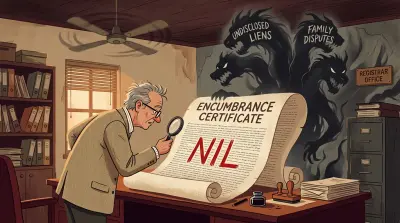
- Latest encumbrance certificate
- Ownership or revenue record relevant to the plot
- Layout plan showing the plot and surrounding roads or open spaces
- Plot measurements and boundary schedule
- Any objection, shortfall, rejection or authority correspondence
- Any final proceeding or approval claimed by the seller
Name files with their date and purpose. “Receipt-final-new.pdf” is difficult to audit. “2026-02-14-LRS-payment-receipt.pdf” preserves the sequence.
When the Plot and Application Do Not Match
Small mismatches deserve attention because layout cases depend on spatial facts. Compare:
- Plot number in the deed against the application
- Survey number and subdivision against the layout plan
- Extent in square yards or square metres
- Boundary descriptions
- Road width and access shown on the plan
- Applicant or owner name
- Local authority and village or municipality
A spelling difference may be harmless. A different survey subdivision, extent or plot number is not. Record what differs and find the document that explains the change.
For buyers, this is part of the broader layout approval verification exercise. An approval associated with a neighbouring phase or a different survey number does not protect your plot.
Roads, Open Spaces, Water Bodies, and Other Planning Constraints
Some cases cannot be solved by uploading a clearer deed. A plot may overlap a proposed road, designated open space, water-body boundary, buffer or other planning reservation. Those are planning and location questions.
Compare the official layout and master-plan evidence with the physical plot. Around Hyderabad, also check the separate risks explained in our guide to lake FTL and buffer zones. LRS should never be used as a substitute for that location-specific review.
Where the authority’s objection is spatial, get a qualified planner, surveyor or lawyer to identify the affected extent. Do not assume that paying an additional amount can cure every land-use or reservation problem.
Finding the application when you do not have the number
The official route is the LRS portal at lrs.telangana.gov.in. Its top-level menu carries an APPLICATION SEARCH item, and that is the citizen-facing lookup. You do not need a login to reach it.
The search page opens with a single choice: “Do you want to search with application number or other details?”, offering Application Number or Other Details. That structure tells you what matters before you start.
If you have the application number, use it. It is the unambiguous identifier, and it is printed on the acknowledgement generated when the application was submitted. If the application was filed by an agent, a relative or a previous owner, the acknowledgement is the document to ask them for. It is worth more to you than a verbal assurance that “it has been applied”.
If you do not have it, the Other Details route exists, but treat it as a fallback rather than the normal path. A search on secondary details can return nothing for an application that genuinely exists, simply because a name, a mobile number or a plot description was recorded differently at submission than the way you are entering it now.
Two things to keep in mind when you read the result:
- A status is a processing state, not a decision. Seeing an application move through the system does not mean regularisation has been granted. The evidence hierarchy earlier in this guide still applies: only a final proceeding or approval settles the question.
- Save what you see, with the date. Take a dated screenshot or PDF of the status screen each time you check. If the record later changes or the portal stops returning the application, that dated copy is the only contemporaneous evidence you will have.
If the Status Is Missing or the Portal Is Not Responding
An empty or failed portal response is not proof that no application exists. It can mean:
- The identifier was entered incorrectly
- The application is associated with another mobile number or authority
- Older data has not been surfaced in the current view
- The portal is temporarily failing
- The application genuinely cannot be found
Keep the failure evidence, verify the exact application number from the acknowledgement, and use the contact or grievance route shown on the official portal. If visiting an office, carry a one-page chronology and copies of the core documents instead of asking staff to infer the history from a folder of screenshots.
Buying or Selling a Plot with an LRS Claim
For a buyer, “LRS applied” is a disclosure, not comfort. Ask for the application, receipts, status and final proceeding. Add an appropriate condition to the agreement if the transaction depends on a defined approval or document being produced.
For a seller, organise the file before listing the plot. A clean chronology is more credible than a claim that someone at the office said approval would arrive soon.
In either case, continue the normal title review. Registration history, EC, revenue records, boundaries and seller authority remain separate. The guide on why a registered sale deed does not by itself prove clean title explains that boundary.
The Practical Rule
An LRS case is not understood until the plot, the application, the money trail, the objections and the final authority record can be connected to one another.
Start with official documents. Describe the current status precisely. Separate planning regularisation from title and building permission. That approach may reveal a straightforward missing document, or it may show that the issue needs planning or legal advice. Either result is more useful than treating a receipt as an approval.
Related Reading
- How to Check if a Property Layout Approval Is Valid
- Approved Building Plan and Layout Approval Explained
- How to Check Lake FTL and Buffer Zones Before Buying
- Encumbrance Certificate Guide
- Mutation Record: The Property Document Most People Forget
Assetly helps property owners organise official documents, track unresolved property work, and coordinate supported services from one property record.