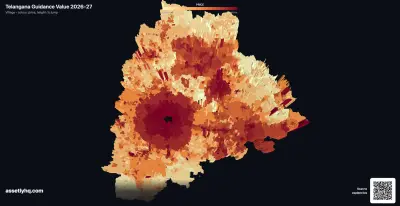


If you own a plot or a flat in Telangana - rather than farmland - the government already has a number for it. Not the per-acre agricultural guidance value that was revised this year, but a separate per-square-yard unit rate that the registration department uses to value open plots, urban land, and buildings. It is the floor under your stamp duty, and most owners have never seen it.
We pulled the official IGRS unit rates for the entire state: roughly 84,800 localities across more than 10,600 revenue villages, plus the Hyderabad (GHMC) market down to the ward-block. The picture it paints is sharp and lopsided. Across the state the median open-plot rate is about Rs 1,100 per square yard. In central Hyderabad it reaches Rs 1,16,000. Almost the entire premium sits in one corner of the map.
Here is what land costs across Telangana, where the expensive land is, and how far the government’s number sits from the real one.
New to the idea? The per-square-yard unit rate and the per-acre guidance value are both “market values” in the registration system, under different names and units. Our guide explains what guidance value and circle rate actually are. This post is the analysis of the urban, non-agricultural side - the companion to our agricultural guidance value 2026-27 analysis.
How we measured this. These are the Telangana registration department’s (IGRS) current unit rates for non-agricultural land and buildings, captured in June 2026 directly from the official portal. Unlike the agricultural revision, the urban portal publishes only the current value, with no recorded previous figure - so this is a snapshot of what land costs now, not a measure of how much it changed. We aggregate each village’s localities to a median rate per square yard, and treat Hyderabad’s GHMC area, which is organised by ward and not by village, separately.
Most Telangana Land Is Cheap - the Premium Is a Thin Sliver
The median tells you the middle, but the spread tells the story. Here is how the state’s mapped villages distribute by their median open-plot rate:
| Median open-plot rate | Number of villages | Share |
|---|---|---|
| Under Rs 1,000 / sq.yd | 4,273 | 43.4% |
| Rs 1,000 to 1,999 / sq.yd | 4,112 | 41.7% |
| Rs 2,000 to 4,999 / sq.yd | 1,300 | 13.2% |
| Rs 5,000 to 9,999 / sq.yd | 91 | 0.9% |
| Rs 10,000 / sq.yd and above | 75 | 0.8% |
Eighty-five percent of villages sit under Rs 2,000 per square yard. Only about 1.7 percent - roughly 166 villages - cross Rs 5,000. The expensive land that defines Hyderabad’s reputation is statistically a rounding error against the rural baseline, where a square yard of officially-rated open land still costs less than Rs 1,000.
This is the opposite shape of the agricultural revision, where the whole state moved up together. Here, the floor is low and flat almost everywhere, and a handful of pockets spike far above it.
The Gradient Is Almost Entirely Hyderabad
Rank the districts by their median open-plot rate and the concentration is stark:
| District | Median rate (Rs / sq.yd) | Highest village rate |
|---|---|---|
| Hyderabad (GHMC) | 33,500 | 1,16,000 |
| Medchal-Malkajigiri | 4,100 | 26,300 |
| Rangareddy | 3,200 | 78,600 |
| Yadadri Bhuvanagiri | 2,000 | 7,400 |
| Wanaparthy | 1,550 | 5,500 |
| Sangareddy | 1,300 | 19,000 |
| (most other districts) | 1,100 - 1,300 | - |
| Nirmal, Adilabad, Mancherial | 600 - 700 | - |
Hyderabad’s median is about thirty times the state median. After it, the rate falls off a cliff: the two districts that wrap the city - Medchal-Malkajigiri and Rangareddy - hold the only other meaningful premium, and everything beyond the capital’s orbit clusters between Rs 1,100 and Rs 1,300, sliding down to Rs 600 in the far north. Land value in Telangana, officially, is a story about one city and its immediate fringe.

The Most Expensive Plots: the Western IT Corridor
Outside the GHMC core, the priciest open-plot rates form a tight cluster on Hyderabad’s western edge - the Financial District and Gachibowli belt, almost all of it in Rangareddy, with a few pockets spilling into neighbouring Medchal-Malkajigiri:
| Village | Mandal | Median rate (Rs / sq.yd) |
|---|---|---|
| Kokapet | Gandipet | 47,600 |
| Manikonda (Jagir) | Gandipet | 40,300 |
| Puppalguda | Gandipet | 36,800 |
| Bahadurguda | Shamshabad | 31,500 |
| Chandanagar | Moinabad | 28,400 |
| Nizampet | Bachupally | 26,300 |
These are the names every Hyderabad buyer recognises - Kokapet, Manikonda, Puppalguda - the open-plot frontier next to the city’s IT and Financial District employment. The highest village rate in the dataset, about Rs 78,600 per square yard, is reached in a handful of villages - on the western IT corridor around Miyapur and on the southern airport-and-Pharma-City growth axis in Kandukur mandal. At the mandal level the leaders are Bachupally (Rs 22,600), Hayathnagar (Rs 21,400), and Gandipet (Rs 18,400) - the arc of fast-developing suburbs ringing the city.
Everywhere else, even district headquarters and large towns rarely clear Rs 5,000 per square yard on the official rate.
Inside Hyderabad: the GHMC Ceiling
Hyderabad’s core is not organised as villages - it is registered by division, ward, and block - so it has no farmland-style rows and sits apart from the village map. Within it, the 2,874 localities we captured range from about Rs 14,000 to Rs 1,16,000 per square yard, with a median near Rs 33,500.
The Rs 1.16 lakh ceiling runs along the central business spine: the Ameerpet, Punjagutta, Khairatabad, Banjara Hills, and Jubilee Hills corridor, where commercial frontage and prime residential land meet. Interestingly, the Secunderabad division carries the highest median (about Rs 48,000), reflecting its dense, uniformly central character, while the larger Hyderabad division spans the full range from suburban fringe to the Rs 1.16 lakh peak.

Because the city’s registration wards do not match any standard map boundary, the explorer shows Hyderabad as a single high district on the map and puts the locality-level detail in a searchable panel - so you can still look up Madhapur, Kondapur, or your own colony by name.
The Government’s Number Is Not the Market’s
The most important thing to understand about every figure above: these are government floors, not market prices. The unit rate exists to set a minimum for stamp duty and registration, and because it is revised only occasionally, it trails the real market - often by a wide margin in the fastest-moving areas.
Take Manikonda. Its government open-plot rate is about Rs 40,300 per square yard (roughly Rs 4,480 per square foot of land). Actual open-plot transactions there run closer to Rs 70,000 to Rs 1,20,000 per square yard. The official number is real and useful - it is exactly what you compute stamp duty on - but it is somewhere around 40 to 60 percent of what the plot would actually sell for. In stable and rural areas the gap narrows sharply; in the IT corridor it is at its widest.
So read the map for two different jobs: to estimate your registration cost (use the government rate directly), and to understand relative value across areas (the pattern is accurate even where the absolute number lags).
Flats and Buildings Are Priced Separately
Land is rated per square yard; built-up property - apartments and buildings - is rated per square foot, by floor. Across the Hyderabad apartment data, the government ground-floor rate ranges from about Rs 2,700 to Rs 8,400 per square foot, with a median near Rs 5,300. Upper floors are valued slightly differently. As with land, a builder’s quoted price will typically sit above this registration floor, but the floor is what sets the minimum duty on your sale deed.
See Your Own Area on the Map
A table of districts is a summary. The real value is local: two colonies in the same mandal can be priced very differently. The Telangana land value explorer renders this entire dataset as an interactive 3D map. Switch to the Open plots layer, drill from district to mandal to village, search any village or Hyderabad locality, and read the exact rate per square yard - plus the priciest pocket within each area and the apartment rate where it exists.
It is built on the same data behind every figure in this post, so the number you see on the map is your actual registration floor.
What This Means If You Own a Plot or Flat
If you are buying, your stamp duty and registration charge is calculated on the higher of the government unit rate or your purchase price. In most of the state that floor is modest; in the Hyderabad corridor it is substantial, and you should budget the duty on the official rate before you commit.
If you are selling, the unit rate is your floor. Registering below it can trigger deemed-income tax under the Income Tax Act - for the seller on the shortfall, and for the buyer too once the gap is large enough - no matter the price actually paid. If you believe the rate overstates a specific plot - rare on the urban side, where it usually lags - use the formal valuation route rather than under-registering. The mechanics are in our guide to circle rate, market value, and stamp duty.
If you are holding, there is no immediate cash impact, but the unit rate is the deemed-sale floor that shadows your capital gains whenever you eventually sell - worth knowing before you plan a sale around a number in your head.
If you manage the property from a distance, an open plot is exactly the kind of asset whose paperwork drifts. Confirm the rate on the explorer and the registration portal, and keep your sale deed, encumbrance certificate, and tax receipts organised so a registration is a quick recalculation, not a scramble. For the full workflow, see our Hyderabad property registration guide.
The Takeaway
Telangana’s open-plot and urban land values are a study in concentration: a low, flat floor under almost the whole state - most villages under Rs 2,000 per square yard - and a steep climb that is almost entirely Hyderabad and its western IT fringe, topping out at Rs 1.16 lakh per square yard in the city core. Wherever your plot sits, the government already has a number on it, it sets your duty, and it is usually below what the land would fetch.
Find your area. Read the official rate. You will know your floor before you ever reach the registration counter.
Assetly helps property owners track ownership, store documents, and stay on top of values like guidance and unit rates across years.