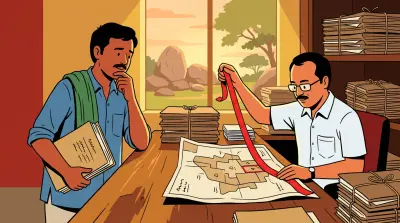


Four sale deeds were refused. The purchasers said the land was private patta land supported by an occupancy-rights certificate, revenue entries and an earlier no-objection certificate. The Telangana Endowments Department said the same survey numbers belonged to Sri Gattupathi Venkateshwara Swamy Temple.
That is the dispute behind Sheelam Nirmala and others v. State of Telangana, decided by a single judge of the Telangana High Court on 30 October 2026. The immediate question was not who ultimately owned the land. It was narrower: could registration authorities refuse the documents on the material before them when no Gazette notification identifying the properties had been shown?
The single judge said no, set aside the refusal orders and directed registration if the documents were otherwise in order. Days later, a division bench hearing the Endowments Department’s appeal directed the parties to maintain status quo.
That second development changes how the first order must be read. This is an unresolved dispute, not a final declaration that the purchasers have clear title or that the land is free for registration. It is useful because it shows the documents an owner should demand when a Section 22-A restriction is justified by an institutional claim.
The land and the competing records
The four writ petitions concerned parts of Survey Nos. 556, 557, 558 and 585 in Chinthapalli Village and Mandal, Nalgonda district. Together, the original survey extents discussed in the order totalled 18 acres and 32 guntas.
The purchasers’ chain relied on several layers of record:
- an old Sethwar describing the land as Kairathi-inam land;
- an occupancy-rights certificate issued after abolition of the inam;
- mutation and pattadar records;
- a registered agreement of sale-cum-GPA from 2006;
- a 2009 no-objection certificate from the Revenue Divisional Officer describing the survey numbers as patta land; and
- a sale deed registered in 2009 after that NOC.
The Endowments Department put forward a different history. It said the land was endowed for the benefit of an ancient temple and that occupancy rights, revenue entries and later transactions could not turn institutional property into private land. Its 2006 communication asked the registration authorities not to accept sale deeds over the disputed survey numbers.
This is why a list entry cannot be assessed by looking at only one document. A pattadar passbook may support the person shown in the revenue record. A registered deed may show a transaction. Neither necessarily answers whether an older inam or endowment claim legally controls the land.
Why registration was refused
When later sale deeds were presented in 2013, the Sub-Registrar registered portions in other survey numbers but refused the portions falling in Survey Nos. 556, 557, 558 and 585. The refusal referred to the prohibitory list and departmental communications asserting the temple claim.
The purchasers challenged the refusal through appeals before the District Registrar. Those appeals were dismissed in 2015, which led to the four writ petitions decided in 2026.
By then, the dispute had been running for more than a decade. That timeline is itself a practical warning. A prohibition discovered at registration is rarely a small counter-level defect. If the entry rests on a contested institutional claim, it can carry years of administrative appeals, writ proceedings and title litigation.
What the single judge actually held
The 30 October 2026 common order focused on the legal basis for the refusal. It relied on earlier decisions holding that registration could not be denied merely through departmental correspondence where the legally required notification had not been published.
The judge recorded three important points:
- The properties had not been shown in a Gazette notification under the provision relied on by the purchasers.
- Internal communications between the Endowments and Revenue authorities were not enough, on the facts before the court, to sustain the refusal.
- If the Endowments Department claimed title, it could approach the Endowments Tribunal to establish that claim.
The four refusal orders and the appellate orders were therefore set aside. The registration authorities were directed to register the sale deeds if otherwise in order and in accordance with law.
That last qualification matters. A court direction to receive and register an otherwise valid document is not a judgment declaring perfect title. Registration and ownership are related but different questions. The order did not convert a disputed institutional-title claim into an uncontested private title.
The appeal means the outcome is not final
The Endowments Department appealed. On 3 November 2026, a division bench directed maintenance of status quo and adjourned the matter for further hearing, according to reporting on the appellate proceedings.
Until the appeal is decided or the interim direction changes, owners should not cite the single-judge order as if it conclusively permits registration of similarly classified land. The division bench has not yet supplied a final rule resolving the dispute.
The responsible reading is:
- the single judge found the particular refusal mechanism legally insufficient;
- the Endowments Department’s ownership claim was not finally extinguished;
- the appellate court paused the practical effect while it considers the challenge; and
- a different survey number or Section 22-A category can produce a different result.
Why this is not a universal Gazette rule
Telangana Section 22-A contains several categories. Some operate because the property falls within a statutory or ownership category. Clause 22-A(1)(e), by contrast, concerns properties specifically notified by the State Government and carries a publication process.
That distinction is explained in our guide to where the Telangana 22-A prohibited list actually sits. It is important here because a short summary such as “no Gazette, no prohibition” would be unsafe.
The Chinthapalli order considered the particular refusal orders, the communications relied on, the prior private records and the arguments placed before the court. It is also under appeal. It should not be converted into a general claim that every government, Waqf, endowment, assigned-land or ceiling entry becomes invalid unless the owner’s survey number appears in a Gazette.
If a property is shown as endowment land, ask two separate questions:
- What exact Section 22-A clause, statute or proceeding supports the registration restriction?
- What record supports the institution’s ownership claim?
The first concerns whether the Sub-Registrar can accept the document. The second concerns whether the seller has title to transfer. Winning the first question does not automatically win the second.
What an owner should obtain after a Section 22-A refusal
Do not leave the Sub-Registrar’s office with only an oral explanation. Ask for the written refusal order and preserve the document-presentation details.
Build a file containing:
- the refusal order and any appellate order;
- the current prohibited-property result for the exact survey number and subdivision;
- the clause, category or register cited;
- every departmental letter, Gazette notification, government order or court order relied on;
- the registered deed and earlier link documents;
- the current revenue record, pattadar passbook and land classification;
- occupancy-rights or inam proceedings where relevant;
- the survey sketch and extent comparison; and
- any earlier NOC or registration involving the same parcel.
Then compare the identifiers. A letter mentioning the parent survey number may not describe the same subdivision or extent presented for registration. Conversely, a deed for a small plot does not escape an institutional claim merely because it has its own plot number.
Use the Telangana prohibited-property checker as a first screen, then verify the result against the current government record. Save the date and coverage shown with the result.
Grievance, tribunal or court: the reason decides the route
Telangana’s Bhu Bharati portal provides a grievance for inclusion in the prohibited-properties list. It can be the right starting point for a data or classification error, but filing a grievance does not itself lift the restriction.
An endowment dispute can require more. If the institution asserts ownership, the competent tribunal or court may need to decide the title question. If the problem is the registration authority’s legal basis for refusing a document, the remedy may instead concern the refusal order. If a Gazette notification covers the parcel, the notification and its review mechanism must be examined.
Our guide to removing a property from Telangana’s 22-A list maps those category-specific routes. The core lesson from Chinthapalli is not “file the same writ petition”. It is “identify which legal decision you actually need”.
What buyers should learn from the case
The purchasers in this dispute had more than a recent sale deed. The record included revenue entries, an occupancy-rights certificate, an RDO no-objection certificate and an earlier registered transaction. Even that stack did not prevent later refusal and a long-running institutional claim.
Before buying land with an inam, endowment or temple-history issue:
- Trace the title before and after abolition of the inam.
- Obtain the occupancy-rights proceedings, not only a passbook entry referring to them.
- Check whether the institution disputes the certificate or claims that it was legally unavailable.
- Search the survey number in the current prohibited-property records.
- Ask the SRO for the basis of any restriction before signing or paying a large advance.
- Treat an old NOC as historical evidence, not a promise that registration will be accepted today.
The broad checking workflow is in Telangana Section 22-A: check a property and fix a wrong entry.
The honest takeaway
The Nalgonda case is not a victory story. It is a lesson in separating three things that property owners often merge:
- a registration restriction under Section 22-A;
- an administrative record such as a passbook, ORC or NOC; and
- the underlying title dispute between private purchasers and a religious institution.
The single judge found that the refusal orders could not stand on the material and procedure before the court. The Endowments Department appealed, and the division bench ordered status quo. The final position is therefore still open.
For an owner, the useful action is not to assume that one court headline clears every prohibited property. It is to obtain the exact entry, the exact clause and every document behind it. That is how you find out whether the real problem is a wrong list entry, a missing publication step, or a title claim that must be decided elsewhere.
This article explains reported court proceedings and does not provide legal advice. The appellate position may change after publication; check the latest case status and obtain advice on the specific property before acting.