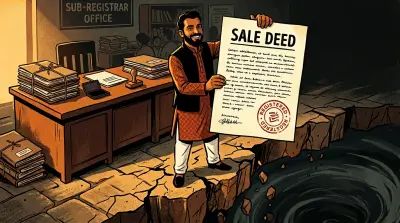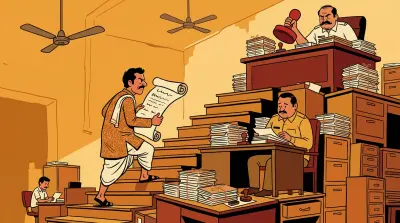


In August 2007, Palle Sabitha obtained a registered sale deed for agricultural land in Yadadri-Bhuvanagiri district. Eight months later, a Tahsildar validated a rival claim over the same land.
The rival claim did not rest on another registered deed. It rested on three successive informal transactions: one said to have been made in 1981, another in 1986 and a third in 2000. The Tahsildar regularised the whole chain in one proceeding and issued the resulting certificate without notifying Sabitha, even though her registered deed already existed.
The dispute then travelled through the revenue hierarchy for years. On 29 September 2026, the Telangana High Court set the entire chain of revenue orders aside.
The judgment in Palle Sabitha v. State of Telangana, W.P. No. 36866 of 2021 is not a declaration that Sabitha conclusively owns the land. The court was careful not to decide title. Its ruling is narrower and, for property owners, more useful: a revenue officer cannot use a summary regularisation process to decide a contested title, erase the practical effect of an existing registered deed or validate later informal sales when the first transaction in their chain is itself disputed.
Two chains claimed the same parcel
Both sides traced their story back to the same original pattadar, Ghani Sabera Begum.
Sabitha relied on registered Sale Deed Document No. 3692 of 2007, dated 23 August 2007. She said Ghani Sabera and another vendor had executed it in her favour and that she had possessed the land since the purchase.
The competing claimant relied on three unregistered transactions:
- An alleged Sada sale deed dated 18 December 1981 from Ghani Sabera to Mohd. Chinna Mahaboob Ali.
- A second alleged Sada sale deed dated 28 December 1986 from Mahaboob Ali to Oruganti Rajaiah and others.
- A further alleged sale dated 10 February 2000 from Rajaiah to the competing claimant.
That sequence mattered. The 2000 claimant could receive only whatever title the 1986 seller had. The 1986 buyers could receive only whatever the 1981 buyer had. If the 1981 transaction was not established, everything after it stood on a missing foundation.
Yet the original proceeding treated the three transactions as one chain capable of being validated at once. On 27 April 2008, the Tahsildar issued a Form 13-B certificate under Section 5-A of the former Telangana Record of Rights law.
The timing made the problem sharper. The validation came after Sabitha’s registered deed, but she received no notice. The original pattadar through whom both sides claimed was not notified either.
The first appeal identified six defects
Sabitha appealed to the Revenue Divisional Officer. In June 2010, the RDO cancelled the certificate and sent the matter back for a fresh enquiry.
The RDO recorded six problems. They included the failure to notify the original holder and the people said to be part of the informal chain, inconsistencies in the local inspection records, uncertainty over whether the first buyer claimed through purchase or protected tenancy, and a failure to check whether the alleged occupants were recorded before the statutory cut-off.
Those were not cosmetic omissions. Notice is how a person with an existing interest learns that someone else is asking the State to recognise a competing transaction. A local inspection cannot substitute for hearing the person whose registered deed is at risk.
After the remand, the Tahsildar again validated the claim in December 2010. The RDO upheld that result in 2015, and the Special Tribunal declined to interfere in 2021. Sabitha then approached the High Court.
What a Sada Bainama enquiry can actually decide
The former Section 5-A created an administrative route to regularise certain transfers made through unregistered documents. Rule 22 required an enquiry and notice to people believed to have an interest in the land.
The point of that machinery was to recognise an otherwise eligible informal transaction. It was not to turn a Tahsildar into a civil court.
The respondents argued that the revenue officer could summon witnesses, examine them on oath, inspect the land and require documents. Those powers sound judicial, but the High Court drew a line between powers used to gather evidence and jurisdiction to decide ownership.
The Tahsildar could investigate whether a document met the conditions for regularisation. The officer could not finally decide whether the original pattadar had executed a disputed 1981 sale, which claimant had better title, or which party truly possessed the land. Those are civil-court questions.
The court described the Tahsildar’s powers as procedural and evidence-gathering. They did not enlarge the limited purpose of the regularisation proceeding.
That distinction matters under the current Bhu Bharati system too. A revenue proceeding can update or regularise a record when the statutory conditions are met. It cannot safely resolve a genuine ownership contest merely because officials have taken statements or visited the property.
Why the first transaction controlled everything
Property ownership travels as a chain. Each person can ordinarily transfer only the interest they actually have. Lawyers express this through the maxim nemo dat quod non habet: nobody can give what they do not possess.
The competing claimant’s case therefore depended on the alleged 1981 sale. The 1986 and 2000 papers could not create an independent title if the first buyer never validly acquired one.
The revenue authorities had themselves recognised that the first transaction was disputed. Once that happened, they could not avoid the foundational problem by validating the later documents together. Possession evidence, village statements and later revenue entries could not answer whether Ghani Sabera had actually executed the first sale.
This is the practical danger in any long informal chain. The last buyer may have paid money, occupied the land and genuinely believed the person selling it was entitled to do so. But good faith at the end does not repair a missing legal transfer at the beginning.
The registered deed changed the procedural burden
A registered deed is not infallible. Registration records an instrument; it does not guarantee that the seller had perfect title. Assetly’s earlier case study on why a registered sale deed alone does not prove ownership explains that distinction.
But registration is still a solemn legal act. A subsisting registered instrument carries a strong presumption of validity and cannot be treated as meaningless in an administrative side proceeding.
The High Court reasoned that even a civil court should not casually declare a registered instrument a sham. A Tahsildar exercising limited summary powers certainly could not produce the same result indirectly, especially without notifying the deed holder.
The problem was not simply that an informal paper competed with a registered one. It was that the administrative orders effectively displaced the registered deed while the deed itself was never properly put in issue before a court capable of deciding title.
The High Court identified three failures
The judgment reduced the problem to three connected failures:
- The validation rested on a foundational 1981 transaction that the authorities themselves found disputed.
- It regularised three successive unregistered instruments together without first establishing the transaction at the root.
- It was made without notice to the holder of an existing registered deed over the same land.
The court held that the Tahsildar had exceeded the limited jurisdiction available under Section 5-A and Rule 22. It set aside the Special Tribunal’s 2021 decision, the RDO’s 2015 order, the Tahsildar’s 2010 proceedings and the original 2008 validation.
What the judgment did not decide
This boundary is essential. The High Court did not award title to Sabitha. It did not rule that the three informal transactions were fabricated. It did not decide possession or the effect of two later transfers mentioned in the record.
Instead, it gave the parties liberty to approach the competent civil court. That court can hear the full dispute, test witnesses and documents, and decide title independently. The High Court expressly left every substantive claim open.
So the lesson is not “registered deed always wins”. The lesson is “a disputed title must be decided in the proper forum”. Sabitha’s deed prevented the revenue process from silently deciding the contest against her; it did not eliminate the contest.
What registered-deed holders should do
If you discover a competing mutation, passbook or Sada Bainama application, the useful response is documentary and immediate.
Get the complete file. Obtain certified copies of the application, notices, local inspection report, statements, order and any certificate issued. A portal screenshot rarely shows how the entry came into existence.
Match the land description. Compare district, mandal, village, survey number, subdivision, extent and boundaries across your deed, its link documents and the competing record. Similar names and part-survey extents cause avoidable confusion.
Trace both chains to their root. Do not compare only your deed with the other side’s latest paper. Ask how each seller acquired the property. Our guide to building a chain of title explains what a defensible sequence looks like.
Check whether notice was actually served. Record-of-rights proceedings often turn on whether interested people were identified and heard. Preserve proof of your address and any defect in service.
Use the correct challenge route. Depending on the order and governing law, that may be an appeal through the revenue hierarchy, a writ challenge to an authority acting beyond its powers, or a civil suit for title and injunction. The Bhu Bharati appeal guide explains the administrative ladder, but a genuine title dispute needs case-specific legal advice.
Do not assume the online record will alert you. The most important practical feature of this case is that the registered-deed holder learned of a competing administrative claim only after an order had already been made. The guide to catching Telangana land-record changes early covers the records worth checking periodically.
The owner-level lesson
This case is not an argument against Sada Bainama regularisation. Telangana needs a lawful route for genuine historic buyers who paid, took possession and were left outside the formal record. The current system exists because large numbers of rural families otherwise remain trapped with informal papers.
But regularisation cannot become a shortcut around a contested root transaction. Where another person holds a registered deed, where the original seller denies the first paper, or where two chains cover the same survey number, the authority must stop treating the matter as a routine record update.
For an owner, the protection is not the deed alone. It is the deed plus the documents behind it, a current record trail, evidence of possession and enough monitoring to object before a competing claim becomes embedded in the revenue file.
The Telangana High Court did not decide who owned this land. It decided who could not decide that question. In a system where an administrative entry can freeze a sale or redirect a passbook, that distinction is protection worth understanding.
Related Reading
- Sada Bainama Regularisation in Telangana - When an undisputed informal purchase may qualify for regularisation
- Digital Land Record Tampering: How to Catch It - How to monitor changes before they harden into a dispute
- Does a Registered Sale Deed Prove Ownership? - What registration establishes and what it does not
- How to Build a Chain of Title - Trace ownership beyond the latest deed
- Bhu Bharati Appeals and the Land Tribunal - The administrative challenge ladder
Assetly helps Indian property owners organise deeds, link documents and record checks so ownership gaps can be found before a transaction or dispute. Run the free Title Readiness Check.