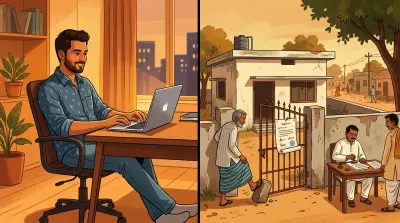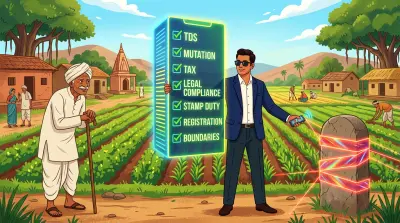


Most NRI property problems do not announce themselves. They build up quietly. A missed tax payment here. An encumbrance that appears in the records there. A caretaker who slowly stops responding. By the time you notice, months or even years have passed, and what would have been a phone call to fix has become a legal problem.
The good news is that these problems almost always leave early signs. You just have to know what to look for, and you have to be willing to act when you see one. Below are five signs that should never be ignored. If any of them apply to your property in Hyderabad, Telangana or Andhra Pradesh right now, treat it as a prompt to check today, not next month.
1. You have not received a property tax receipt in over a year
This is the most common silent failure, and the most expensive. If a full year has gone by without a property tax receipt landing in your inbox or being shared by your caretaker, the most likely explanation is simple: nobody is paying it.
What it might mean. Either the person you assumed was paying has stopped, an auto-debit has failed, or the responsibility was never clearly handed to anyone. Property tax does not pause because you are abroad. In Hyderabad, GHMC charges penalty interest of 2 percent per month on arrears, which adds roughly 24 percent over a single year. Worse, the municipality treats unpaid tax as the first charge on the property, and there is no obligation to notify an NRI owner with an inactive Indian SIM. The dues simply accumulate.
What to do immediately. Pull up your municipal portal and check the outstanding amount against your PTIN. For Hyderabad that is the GHMC property tax portal. Pay what is due, and look for any active one-time settlement scheme that waives accumulated interest before you clear the balance.
How Assetly helps. Assetly stores your PTIN, tax receipts and payment history in one place and flags when a payment cycle has passed without a receipt, so a silent gap surfaces in weeks rather than at the point of sale.
2. Your caretaker or property manager has gone silent for 3+ months
A caretaker who stops responding is rarely just busy. Three months of silence is a signal, not a coincidence.
What it might mean. At best, the person has lost interest and your property is now unattended, which means tax may be unpaid, a tenant may have stopped or started paying someone else, and any physical change to the property is going unreported. At worst, silence is deliberate, because the person no longer wants you asking questions about a property they have started treating as their own. The longer the silence runs, the more it costs you to find out what has actually happened on the ground.
What to do immediately. Do not wait for the caretaker to resurface. Arrange an independent visit through a relative, a lawyer’s clerk, or a paid inspection service, and ask for dated photographs of the property and its boundary. Cross-check the tax and electricity bill status yourself online rather than relying on their word.
How Assetly helps. Assetly keeps your tax, document and record status visible independently of any one person, and its on-the-ground monitoring (CCTV, gate and boundary wall watch) shows you the property directly, so a manager going quiet no longer leaves you blind. You can see the objective status of your property without depending on someone choosing to reply.
3. You checked Dharani, Bhu Bharati or IGRS and found a name change or new encumbrance
If you logged in to a portal and saw something you do not recognise, a different name against the record, or an encumbrance you never created, stop and treat it as urgent.
What it might mean. An unauthorised mutation or a name change in the revenue record can be the first visible step in an attempt to transfer or claim your property. A new encumbrance on your Encumbrance Certificate means a transaction, mortgage, court attachment, or charge has been registered against the property. Some entries are harmless administrative updates. Others are the early paper trail of fraud or a dispute you have not been told about. The difference matters, and only the underlying document tells you which it is.
What to do immediately. Download a current EC from the Telangana IGRS portal at registration.telangana.gov.in (or Meebhoomi and the AP registration portal for Andhra Pradesh) and read every entry, then compare it against your own records. If an entry is unexplained, get the registered document copy that created it before doing anything else. Our guide to reading and acting on encumbrance entries explains what each type means.
How Assetly helps. Assetly monitors your EC and revenue record on a recurring basis and flags a new entry within days, rather than leaving you to discover it the next time you happen to log in.
4. A neighbour or relative mentioned someone is ‘using’ part of your property
A casual remark from a relative that “someone has put up a shed at the back” or that “a family is staying there now” is one of the most dangerous signs on this list, precisely because it sounds minor.
What it might mean. Physical occupation that you do not challenge is the raw material of an adverse possession claim. The Supreme Court, in Ravinder Kaur Grewal vs Manjit Kaur (2019), confirmed that open, continuous and hostile occupation for 12 years can extinguish the true owner’s title entirely. For an NRI, the danger is not ignorance of the law, it is that the 12-year clock starts the day someone takes possession, and you cannot see it ticking from abroad. Vacant plots and inherited land are the most exposed.
What to do immediately. Document the current state of the property with dated photographs and establish in writing that the occupation is not authorised. Send a legal notice if needed. Acting early, while the occupation is recent, is far cheaper and far more likely to succeed than acting after years have passed. Our guide to protecting land from encroachment sets out the steps in order.
How Assetly helps. This is exactly what Assetly’s physical monitoring is built for. Satellite-based boundary change detection compares your registered boundary at intervals and flags new construction or cleared land, while CCTV, gate and boundary wall monitoring give you a direct view of who is on the property. Physical encroachment is caught as it happens, not years later when it has hardened into a legal claim.
5. You are planning to sell but have not checked the title in over 2 years
Deciding to sell is not the moment to discover a problem with your title. Yet that is exactly when most NRIs first look, and by then there is no time to fix anything.
What it might mean. Two years is long enough for an arrear to accumulate, for a mutation to fall out of step with the registration record, for an original document to go missing, or for a dispute to be quietly filed. Any of these can collapse a sale at the last minute or force you to accept a lower price from a buyer who senses the urgency. A buyer’s lawyer will find these gaps during due diligence; the only question is whether you find them first.
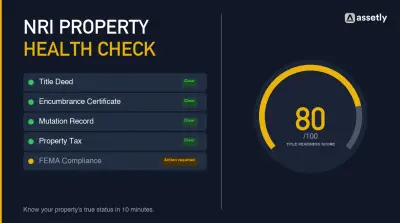
What to do immediately. Run a full title check now, before you list. Confirm the chain of title, pull a fresh EC, verify the mutation is in your name, and account for every original document. If anything is missing or inconsistent, you want months to correct it, not days. Our NRI property health check walks through the full diagnostic in around ten minutes.
How Assetly helps. Assetly’s free Title Readiness and NRI Compliance tools let you assess title and document readiness before you ever speak to a buyer, so you go into a sale knowing your position rather than hoping for the best.
The common thread: none of these announce themselves
Every sign on this list shares one feature. No government portal will reach out to tell you. There is no SMS when a mutation is filed against your land, no alert when your tax slips into arrears, no notification when someone starts building on your boundary. The system is entirely pull-based. It waits for you to check.
That is the real reason NRI property problems grow in silence. Not because the warning signs are subtle, but because nobody is watching for them on your behalf. Assetly is built to be that watch: it monitors your records for unauthorised changes and your physical property through satellite, CCTV, gate and boundary wall coverage, so the signs reach you instead of you having to go looking. For the fuller picture of how these risks compound, our guide to monitoring your India property remotely goes deeper.
If even one of these five signs applies to your property, the right response is the same: check today, while it is still a small problem. Open Assetly and run a free first property check. It takes about ten minutes and tells you where you actually stand. Start at assetlyhq.com/free-tools.
Assetly is a property document management and monitoring platform for NRI and remote property owners. It organises your documents, monitors your property records, and alerts you when something needs attention. Learn more at assetlyhq.com.