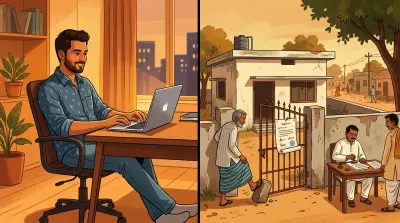
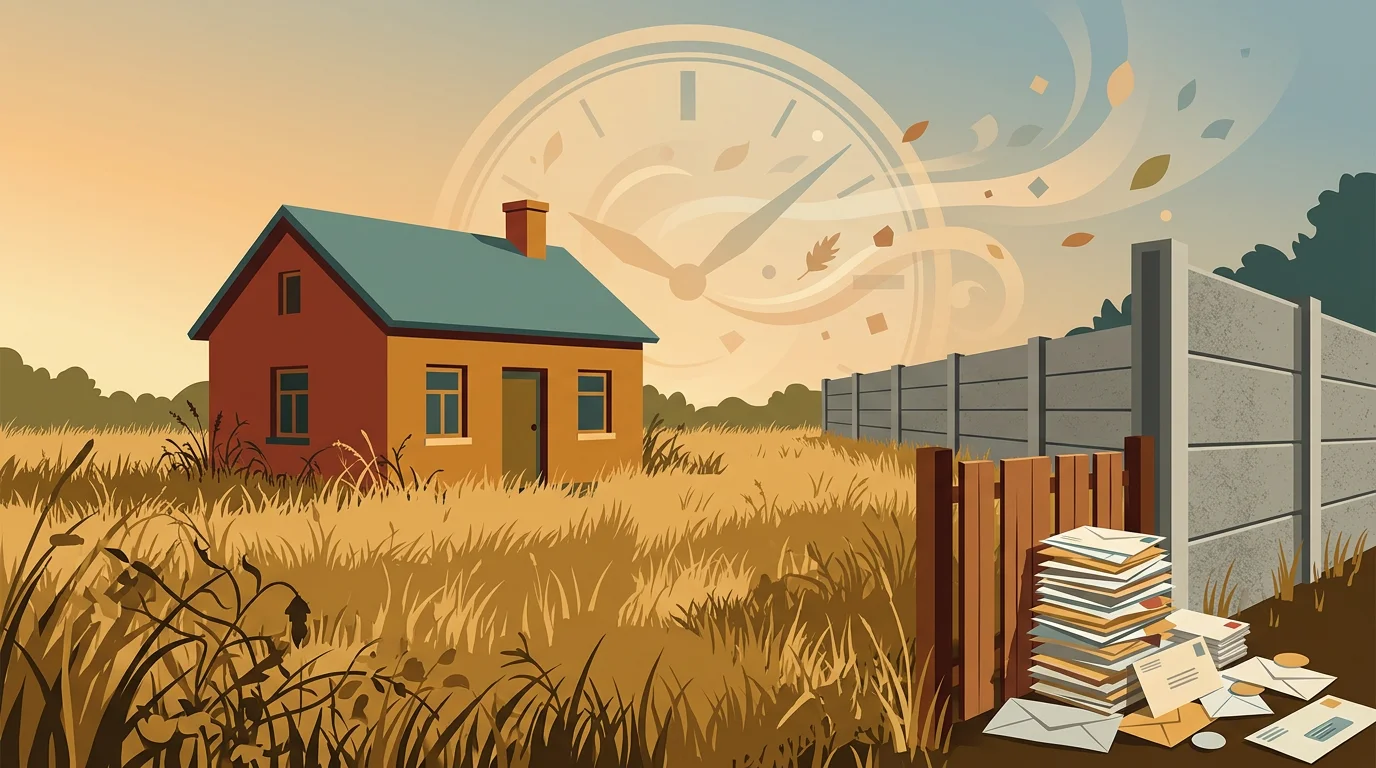

Most NRIs who ignore their India property do not mean to. It almost never starts with a decision. It starts with a thought: I will deal with it when I next visit. The visit gets pushed. Work, children, the cost of a long flight. A year passes, then another. The property sits there, on the outskirts of Hyderabad or in a layout near Vijayawada, doing what land does when nobody is watching it.
The mistake is assuming that doing nothing keeps things the same. It does not. An ignored property does not stay frozen at the moment you stopped paying attention. It drifts, quietly, and the drift compounds.
Here is what that drift actually looks like, traced year by year through a single ordinary case. None of it is dramatic. That is the point.
Year 1: The tax stops being paid
In the first year, the only thing that changes is something that stops happening. Nobody pays the property tax.
It is rarely a deliberate decision. The cousin who used to pay it moved cities. The auto-debit was linked to an account that was closed. The responsibility was assumed by everyone and held by no one. Property tax does not pause because the owner is abroad, and the municipality has no obligation to chase an NRI with an inactive Indian SIM. The dues simply begin to accumulate.
In Hyderabad, GHMC charges penalty interest of 2 percent per month on arrears, roughly 24 percent over a single year. On a modest annual demand, year one quietly adds a few thousand rupees in penalty on top of the tax itself. Small. Easily missed. Completely invisible from eight time zones away, because no receipt arriving in an inbox looks exactly like a receipt that was quietly never generated.
This is the cheapest year to fix the problem, and the one in which almost nobody does.
Year 2: The records still show the previous owner
The second year exposes something that was already wrong but had not yet mattered: the mutation was never completed.
When the property last changed hands, whether by purchase, gift, or inheritance, the registration was done but the revenue record was never updated to reflect the new owner. The sale deed sits in a drawer; the Dharani or Bhu Bharati entry, or the Meebhoomi pattadar passbook in Andhra Pradesh, still carries the previous owner’s name. Registration proves the transaction happened. Mutation is what tells the revenue department who owns the property now, and who the tax bill belongs to.
For a year or two this gap does nothing. Then it quietly does everything. The municipal record and the revenue record now disagree about who the owner is. Any future transaction will stall on that contradiction, and a buyer’s lawyer will treat it as a red flag. The fix in year two is a straightforward mutation correction, filed with the right documents. Left alone, it becomes the loose thread that unravels everything in year five.
Year 3: The boundary moves
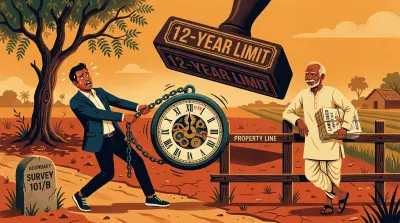
In the third year, something physical happens for the first time. A neighbour extends his compound wall, and the new wall sits about eight feet inside the plot.
Maybe it was an honest mistake about where the line fell. Maybe it was a calculated bet that nobody would notice. From abroad, it makes no difference, because there is no one to notice. The land is vacant. No relative drives past it. No caretaker reports it, because there is no caretaker. The wall goes up over a weekend and becomes, to anyone looking, simply where the boundary is.
This is the most dangerous year on the timeline, and the quietest. Uncontested physical occupation is the raw material of an adverse possession claim. The Supreme Court, in Ravinder Kaur Grewal vs Manjit Kaur (2019), confirmed that open, continuous, and hostile possession for 12 years can extinguish the true owner’s title entirely. The 12-year clock starts the day the wall goes up. The owner abroad cannot see it ticking. Caught in year three, this is a survey, a conversation, and if needed a legal notice. The steps to take when land is encroached are far cheaper to follow while the encroachment is fresh than after a decade has hardened it into a claim.
Year 4: An old piece of paper resurfaces
By the fourth year, the property has a reputation locally as land that nobody is watching. That reputation attracts attention.
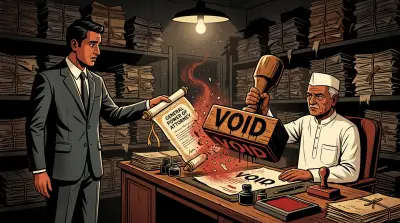
A distant relative, the kind every family has, locates an old General Power of Attorney signed years earlier for some forgotten purpose and never formally revoked. It might have been given to manage a tenancy, or to represent the family at a registration. It was never meant to convey ownership, and in law it does not. The Supreme Court settled that in Suraj Lamp & Industries vs State of Haryana (2012): a GPA does not transfer title, only a registered sale deed does.
But a GPA that was never revoked is still a usable-looking instrument in the wrong hands. It can be presented to attempt a registration, to raise a loan against the property, or simply to file a claim that the real owner then has to defend. The legal weakness of the claim is cold comfort. Fighting it means engaging a lawyer in India, gathering documents that are scattered across drawers and cities, and proving a negative from abroad. A claim built on a worthless GPA still costs real years and real money to clear.
Year 5: Everything arrives at once
The fifth year begins with a decision: it is time to sell. A buyer is interested. A price is discussed. And then the buyer’s lawyer begins due diligence, and four years of silence land on the table in a single week.
The Encumbrance Certificate shows the relative’s claim. The revenue record still names a previous owner because the mutation was never done. The latest survey, which the buyer commissions, shows the plot is eight feet narrower than the deed describes. And the property tax, untouched for four years, has compounded into arrears that the buyer’s lawyer correctly points out are the first charge on the property and the buyer’s liability at sale.
The sale does not happen. The price the owner was counting on evaporates, because no buyer pays full value for a property with a live claim, a broken chain of title, a disputed boundary, and an arrears tab attached. Each of these, taken alone and caught early, was an afternoon’s work. Together, discovered at the worst possible moment, they are a multi-year cleanup that has to be finished before the property can be sold at all.
The damage is in the sequence
Look back over those five years and notice what is missing. There was no single catastrophic event. No fraud ring, no forged document, no disaster. Just a tax payment that stopped, a form nobody filed, a wall, and an old piece of paper. Every one of them was small, and every one could have been fixed in an afternoon. What turned them into a lost sale was simply that nobody saw them, so they were left to pile up and feed off each other.
This is the structural problem with owning property in India from abroad. The system is entirely pull-based. No portal sends an alert when tax slips into arrears, when a mutation is filed, when a boundary changes, or when a case is registered. The owner has to go and look, and the owner who has decided to “deal with it on the next visit” is precisely the owner who never looks. For the fuller picture of how these risks compound and what each portal can and cannot tell you, our guide to monitoring your India property remotely goes deeper.
If you had to pick the one intervention that mattered most across these five years, it would not be the expensive cleanup at the end. It would be a simple watch that flagged the unpaid tax in year one and the stale mutation in year two, while both were still trivial. Everything that followed grew out of those first two years going unseen.
You do not need to reach year two
This is exactly the gap Assetly is built to close. It keeps your sale deed, mutation record, tax receipts, and Encumbrance Certificate in one place, and it monitors them so a missed tax cycle, a new EC entry, or a revenue-record change reaches you in weeks rather than at the point of sale. Its satellite and on-ground monitoring watch the boundary itself, so a wall that moves eight feet is caught when it goes up, not when a buyer’s surveyor finds it years later.
The owner in this story did not need to do much. They needed to know, in year one, that the tax had stopped, and in year two, that the records still named someone else. A property that is watched never reaches year three.
It takes about ten minutes to set up Assetly monitoring, and then you never have to worry again. Start with a free first property check at assetlyhq.com/free-tools.
Assetly is a property document management and monitoring platform for NRI and remote property owners. It organises your documents, monitors your property records, and alerts you when something needs attention. Learn more at assetlyhq.com.