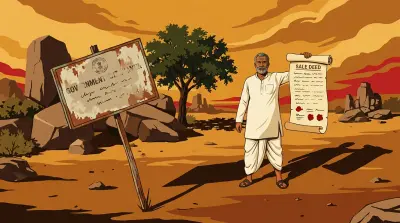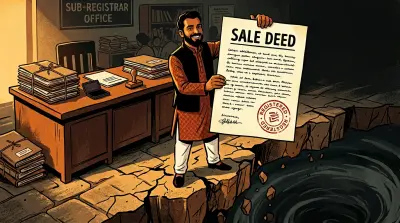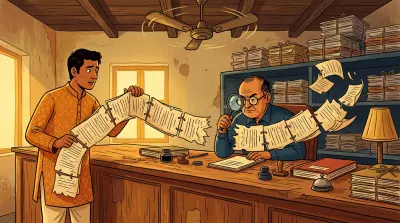
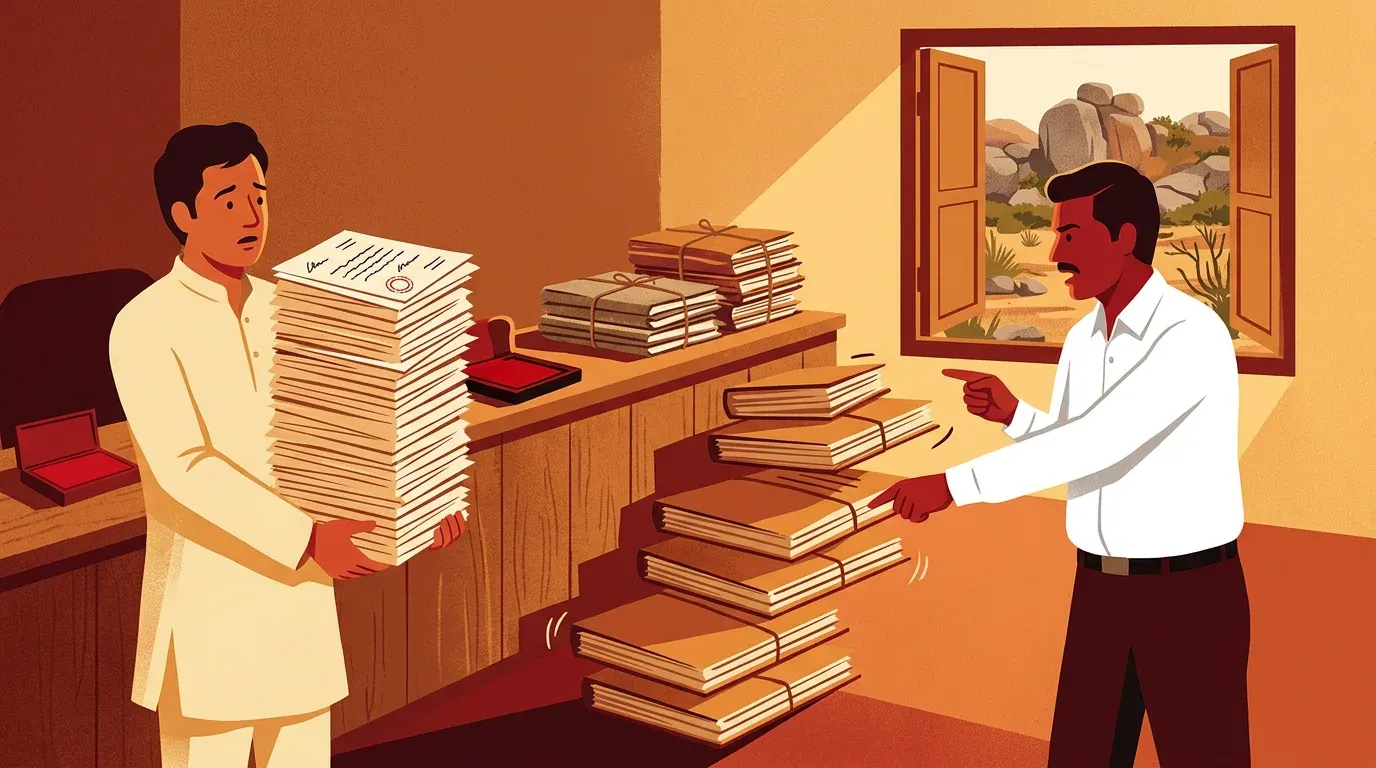

550 acres and 39 guntas. Three competing stories of ownership. Revenue entries, a Nizam-era firman, an oral gift, registered powers of attorney, sale agreements and a newly produced account of a 1918 auction.
The document that mattered most was the one nobody could produce: a lawful order transferring the land out of government ownership.
On 29 October 2026, the Supreme Court dismissed a batch of appeals concerning Survey Nos. 100 and 101 in Miyapur village, now part of Hyderabad’s western growth corridor. The Court upheld the State of Telangana’s title in Bandari Ramchander v Maitri Cooperative Housing Society Ltd and brought a dispute that had reached the High Court in the 1990s to a decisive close.
News reports now describe plans to develop and auction part of the land for a possible ₹40,000 crore. That number is attention-grabbing. The more useful story for a property owner sits inside the 44-page Supreme Court judgment: official-looking documents do not all carry equal legal weight.
The document issue: an entry appeared without the order behind it
Think of a title chain as a flight of stairs. Every owner must stand on a valid step created by the owner before them. A revenue entry can describe who is standing there. It cannot build a missing step.
The State’s documentary story began with the 1912 survey of Miyapur. The classer register and Sethwar, the foundational settlement record, classified 277 acres and 5 guntas in Survey No. 100 and 273 acres and 34 guntas in Survey No. 101 as Sarkari poramboke, or government land.
Later historical records complicated the picture. A commission appointed by the Nizam examined claims involving Paigah estates, and a 1929 firman dealt with the jagir of Miyapur. A jagir was principally a grant connected to the collection and enjoyment of land revenue. It was not automatically the same thing as private ownership of every parcel within the village.
Then came the legal break that every later title search had to account for. The Hyderabad jagir-abolition law took effect in 1949, and the administration of Paigah lands transferred to the State. The former jagirdar’s successor received a commutation award, a one-time payment replacing the abolished jagir interest.
Yet the pahanies for 1950-51 to 1952-53 showed the name of Raheemunissa Begum as pattadar in one column. The very same records continued to describe the land as poramboke and Sarkari in other columns. A later Tahsildar permission allowed the proposed alienation of 140 acres on the strength of that name.
That is the trap. If you read only the name column, the record looked like evidence of private ownership. If you read the document as a whole and traced the legal orders behind it, the story fell apart.
The Supreme Court found no transfer order and no corresponding mutation entry in the faisal patti or pucca book to explain how government land became private land. It held that the entries were made without authority and were a nullity.
How 550 acres produced three chains of title
This was not one private claimant arguing against the State. Different groups advanced different roots of title.
One group claimed through the successors of a former jagirdar. Their case relied on the Paigah history, the firman, later succession proceedings and an alleged oral gift.
A second group claimed through Raheemunissa Begum, wife of Abdul Salam. That chain leaned on the 1950s pahani entries, the Tahsildar’s alienation permission, later transactions and arguments based on possession.
A third group claimed through a different Raheemunissa Begum, wife of Nawab Moinuddowla Bahadur. They contended that the land was personal Paigah property that had passed through inheritance and later conveyances, including a registered general power of attorney.
The overlap in names was not a minor clerical detail. It made the provenance of the entries especially important. A reliable record needed to identify the person, the right being recorded and the legal proceeding that created or recognised that right.
Land-grabbing cases followed in the 1990s. In the first set, the State was not made a party. In later cases, it was. The Special Court held that the land belonged to the State, and the Andhra Pradesh High Court upheld that conclusion on 16 April 2003. The Supreme Court appeals remained pending for more than two decades before the 2026 judgment.
That long path is another version of India’s property-dispute crisis: a weak root document can survive through transactions and proceedings for generations, becoming more expensive to test each time.
What the Supreme Court actually said
The Court treated the case as a document hierarchy problem.
First, the jagir records did not convey private title to the land. The Court read the jagir-abolition regulation, commutation rules and Atiyat law together. A muntakhab, a document issued after an Atiyat or succession inquiry, entitled the holder to the commutation payment. It did not restore ownership of land that had vested in the State.
The judgment treated the former jagirdar’s surviving entitlement as the commutation payment, not continuing ownership of the land.
Second, a revenue entry could not substitute for a lawful transfer. The Court found that the private pattadar entry appeared after vesting, conflicted with other columns in the same pahanies and had no supporting proceeding.
Its most useful sentence for an owner is this: “There is absolutely no power to record the name of an individual as a pattedar, through a mere entry, sans any proceedings.”
Third, later official conduct could not cure the defective root. The Tahsildar’s alienation permission did not consider the jagir-abolition or Atiyat record and was held to be without jurisdiction. Earlier acquisition proceedings had treated part of the property as private, but they had not adjudicated title. A House Committee report created no ownership right either.
Fourth, old-looking documents produced late were not accepted at face value. Before the Supreme Court, one set of appellants raised a story about a 1918 auction and a later will. The Court noted that the claim had not been taken before the Special Court or High Court, did not appear in the century-long public record and had not gone through proof and admissibility at trial. “Merely because the documents have been produced,” it said, did not make them genuine.
The result was not a technical dismissal. The Court upheld the State’s title, dismissed the private appeals and found no basis for equitable relief.
Why a pahani, permission and registration were still not enough
Property files accumulate paper. The risk is mistaking volume for validity.
The Miyapur claimants could point to revenue entries, a permission from a Tahsildar, subsequent dealings and proceedings in which officials appeared to treat the land as private. Each document looked official. None answered the root question: what valid instrument moved title from the State to the first private owner?
This principle runs in both directions. In another 2026 Telangana case, the High Court held that the State could not call land its own on a Town Survey Land Register entry alone. In Miyapur, private parties could not turn an unsupported pahani entry into ownership. The State and a private claimant face the same basic demand: show the legal source of title, not just the administrative record that repeats the claim.
A registered document does not change that. Registration proves that a document was presented and recorded. It does not prove that the seller owned what they purported to sell. Our guide to registration and title explains why a clean-looking sale deed can still pass no ownership at all.
Nor does an Encumbrance Certificate solve the whole problem. An EC is a search of registered transactions for the selected period and property description. It can show mortgages and sales. It may not reveal an older vesting statute, a government classification or the absence of authority behind the first private entry.
The reported ₹40,000 crore plan
After the judgment, November 2026 reporting said officials had surveyed the site, identified roughly 400 vacant acres and about 150 acres with existing structures, and prepared a draft layout over approximately 386 acres. The report described about 220 proposed plots and potential receipts of up to ₹40,000 crore through phased auctions.
Those details should not be confused with what the Supreme Court decided. The Court decided title to 550 acres and 39 guntas in Survey Nos. 100 and 101. It did not approve a layout, fix a reserve price or direct an auction.
At the time of writing, we could not locate a final HMDA auction notification supporting the reported 386-acre layout and ₹40,000 crore estimate. Treat them as a proposal until HMDA publishes the parcel schedule, land-use plan, upset price, auction conditions and treatment of occupied areas.
That distinction matters because auction announcements, winning bids and money actually collected are three different numbers. A proposal is not a sale, just as a revenue entry is not a title.
What this means if you own or plan to buy in Hyderabad
Miyapur is not a warning to distrust every old title. It is a lesson in how to test one.
1. Find the first private owner, then ask how title reached them
Do not stop after tracing 30 years of sale deeds if the first deed in that window refers to a much older grant, assignment, jagir, inam or government allotment. Obtain the order that lawfully created the private right and check whether later abolition, ceiling, assignment or acquisition law changed it.
2. Read the complete revenue record
A pattadar name, land classification, possession column and remarks can tell different stories. Pull the certified record for the relevant year and read all columns. If one column says private pattadar while another says government land, that is a conflict to resolve, not a detail to ignore.
3. Demand the mutation proceeding, not only the updated entry
An entry should have a source: a registered deed, inheritance proceeding, court order, assignment order or other lawful mutation basis. Ask for its file number and certified copy. The missing order in Miyapur was more important than the name that appeared in three years of pahanies.
4. Check government and prohibited-land records separately
For Telangana land, check the current revenue record and the Section 22A prohibited-property list. A clear EC does not cancel a government-land classification. A prohibited-list entry is also not a final adjudication of title, but it is a serious stop signal that requires resolution before purchase.
5. Verify the authority behind every permission
A layout approval, building permission, alienation permission or registered deed answers a specific administrative question. It may not determine ownership. Ask whether the issuing officer had jurisdiction and whether the approval expressly examined title or merely relied on documents submitted by the applicant.
6. Preserve a dated title file if you manage property remotely
Keep the root instrument, every link deed, mutation orders, historic and current revenue records, survey plans, ECs and permissions together. Assetly can help organise and track that file digitally, but a digital folder is useful only if it contains the documents that create the right, not just the records that repeat it.
The Miyapur litigation survived changes of government, the division of Andhra Pradesh and Telangana, and more than 30 years of court proceedings. The State ultimately succeeded because its record reached back to the 1912 settlement and the legal event that followed in 1949. The private chains had plenty of paper after that point. They did not have the bridge across it.
That is the question to ask of any title chain: not “How many documents do I have?” but “Which document created the right, and did the person who issued it have the power to do so?”
Related Reading
- A TSLR Entry Is Not Title - the reverse side of the same rule, where the State relied on a survey-register entry without producing title documents.
- Telangana Section 22A: Check a Property and Fix a Wrong Entry - how prohibited-property records work and what to do when an entry is wrong.
- Does Registration Prove Property Ownership? - why a registered instrument cannot pass a better title than the seller held.
- The Khanamet Government-Land Document Trail - how permissions, registration and buildings can accumulate over a defective land classification.
- How to Build a Chain of Title - the practical documents that connect one owner to the next.
Assetly helps Indian property owners organise, verify and track their property documents digitally, from anywhere in the world.