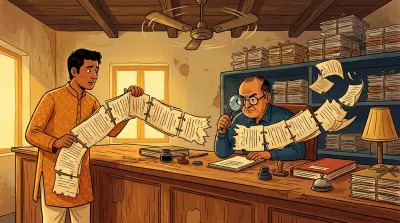
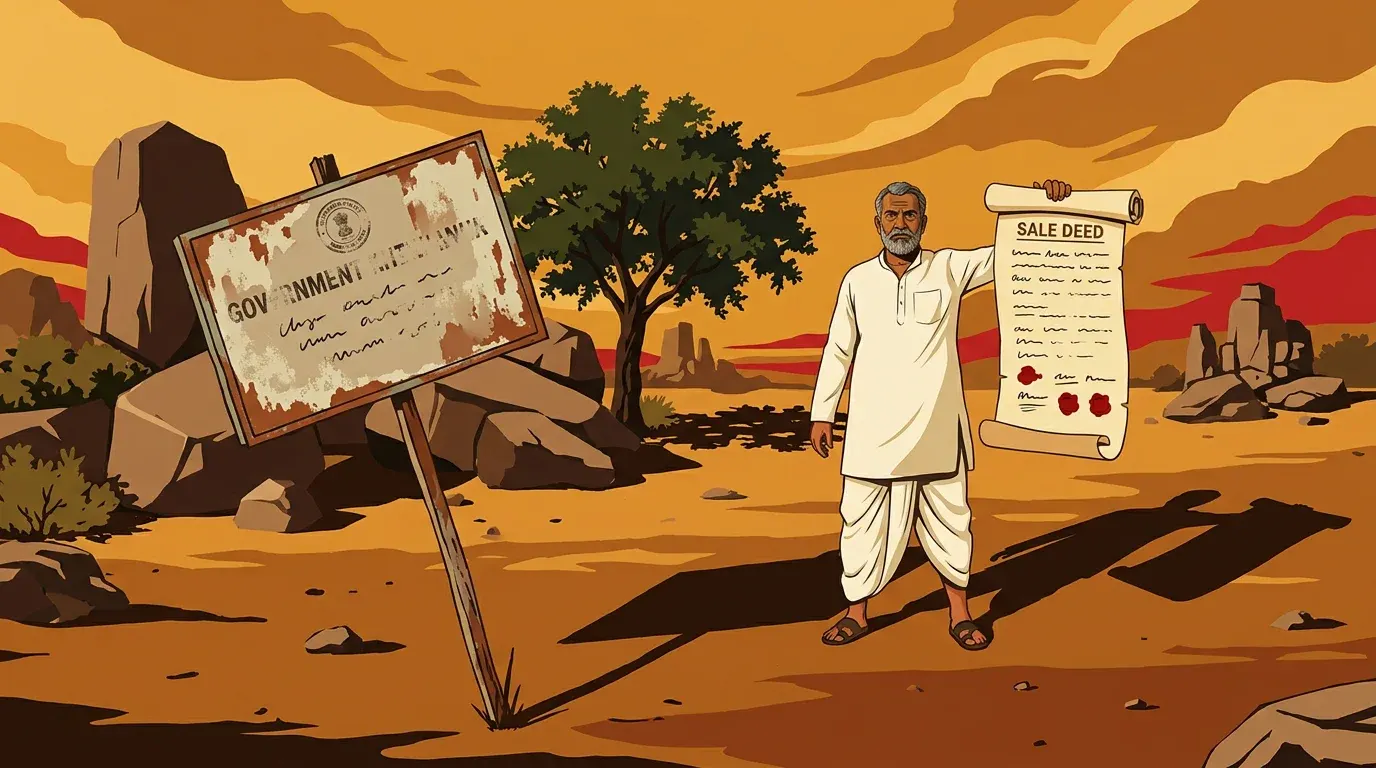

Imagine flying down to your plot near Hyderabad after two years abroad and finding a green metal signboard staked into the ground. “Government Land,” it says. No notice reached you. No court decided anything. A revenue official pointed to an entry in a register, and a board went up.
In June 2026, the Telangana High Court told the State it cannot do that. And the reason it gave is the single most useful thing an absentee property owner can understand about Indian land records: a register entry is not a title.
The document lesson: a register records, it does not own
There is a difference between a document that records something and a document that establishes ownership, and almost every land dispute in India lives in the gap between the two.
The Town Survey Land Register, or TSLR, is a revenue record. It is maintained for administration and land revenue, not to decide who owns a parcel. When the State treated a TSLR entry as if it were proof of government ownership and marked the land accordingly, it collapsed that gap. The High Court reopened it.
This matters far beyond one signboard, because the same category of document appears all over an owner’s life: the mutation entry that follows a purchase, the pattadar passbook for agricultural land, the entries on Bhu Bharati, and the Section 22A prohibited list. All of these are administrative records. None of them, on their own, decides title. Understanding that one sentence changes how you react when any of them turns against you.
What the court said
In its June 2026 ruling, reported as 2026 LiveLaw (Tel) 95, the Telangana High Court, through Justice Laxmi Narayana Alishetty, held that the State “cannot claim title over a property or erect a signboard declaring it to be ‘Government land’ solely on the basis of entries in the Town Survey Land Register in absence of any substantive material or title documents.” TSLR entries, the court observed, are only revenue records.
The court was not inventing a new rule. It was applying a principle the Supreme Court has stated many times. In Jitendra Singh v. State of Madhya Pradesh, and earlier in Bhimabai Mahadeo Kambekar v. Arthur Import and Export Company, the Supreme Court held that mutation and revenue entries are made for a “fiscal purpose”, the collection of land revenue, and do not create, extinguish, or confer title. As the court put it, such an entry has no presumptive value on the title of the land. Title, the Supreme Court has repeatedly said, can be decided only by a competent civil court.
So the State claiming your land through a register entry is on exactly the same footing as a stranger claiming your land through a mutation entry. Neither works. The paper that decides ownership is a registered title document, tested if necessary in a civil suit.
This is a pattern, not a one-off
The ruling did not appear in isolation. In the same period, the Telangana High Court granted interim suspension of proceedings that had placed private land on the Section 22A prohibited list, pending a proper examination of whether the parcels really belonged in that category at all. Different provision, same logic: an administrative act that restricts or flags a property is not the same as a judicial finding that the property is government land or is legally prohibited.
For owners, the through-line is simple. Revenue registers, survey registers, and prohibited lists are powerful in practice, because a sub-registrar will refuse to register a flagged parcel and a signboard will scare off buyers. But powerful in practice is not the same as conclusive in law. When one of these records is wrong, it can be challenged, and the burden of producing real title documents falls on whoever is asserting ownership.
The flip side most owners miss
Here is the part that should make every owner pause, because the rule that protects you also disciplines you.
If a TSLR entry cannot make the government the owner, then a pattadar passbook, a mutation entry, or a Bhu Bharati record cannot make you the owner either. Many families believe that because a parent’s name sits in the revenue record, or because the passbook is in hand, ownership is settled. It is not. Those are the same species of administrative record the court just described as “only revenue records.”
Your ownership rests on a registered sale deed and an unbroken chain of title running back through each prior owner, supported by actual possession. The revenue entry is corroboration. It is not the foundation. An owner who has kept the deeds and the link documents can defeat a wrongful government-land board. An owner who has only a passbook and a story is in a far weaker position, whichever side of the dispute they are on.
What this means for property owners, especially NRIs
Absentee owners are the ones this hits hardest, for a practical reason. A board gets planted, a survey entry gets changed, or a parcel gets added to the prohibited list, and nobody is standing there to notice or object. Months pass. By the time the owner hears about it, the wrong record has hardened into a fact that everyone treats as true.
The Telangana ruling is genuinely good news for those owners, because it confirms that a wrong record is not the end of the story. But it only helps the owner who can walk into a court with documents. The ruling protects title; it does not manufacture it. If your papers are scattered across relatives, lawyers, and old trunks, the protection is theoretical.
What you should do
- Assemble your title kit and keep it in one place. The registered sale deed, the prior link documents that form the chain of title, a current Encumbrance Certificate, and evidence of possession. This is what defeats a wrongful entry, not the passbook alone.
- Do not treat a revenue record as your title. Confirm that a registered deed and a clean chain sit behind every passbook or mutation entry you rely on.
- Check whether your parcel has been flagged. A Section 22A or prohibited-list tag is administrative and contestable, but you cannot contest what you do not know about. Our guide on how to check prohibited land in Telangana walks through it.
- If a board goes up or a tag appears, do not panic and do not ignore it. It is not a final loss of ownership. It is an administrative act you challenge with documents, and, if needed, in a civil court, which is the only forum that can decide title.
- If you live abroad, monitor the parcel on a schedule rather than on your next visit. The document trail behind government-land disputes in Hyderabad shows how much damage a decade of nobody-watching can do.
A signboard is cheap to plant and, it turns out, easy to pull up if the paperwork behind it is empty. The lesson runs the other way too. Keep the paperwork that actually proves what you own, because in Indian property law the register describes the land, but the deed decides it.