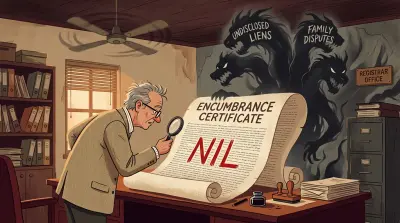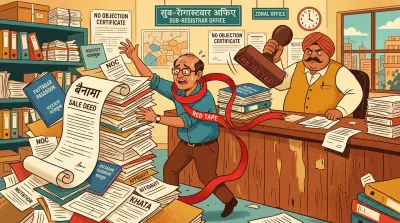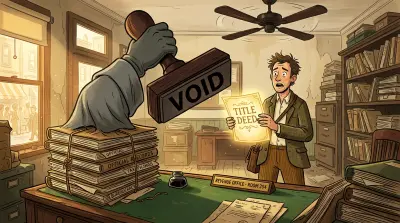


You know the document number. You know the year. The original deed is missing, damaged or sitting in a bank file you cannot reach.
This is exactly the job a certified copy of a registered deed is meant to handle. It is a copy issued from the Registration Department’s record, signed and sealed by the registering officer under the statutory process. It is more than a phone photograph or a photocopy from a broker.
Andhra Pradesh’s official IGRS portal currently lists a CC Search service. As checked on 10 August 2026, the link opens the Government of Andhra Pradesh’s CARD PRIMME system, where the public screen requires an account or OTP-based login before the protected workflow. The portal confirms that the service exists, but it does not expose every post-login field on the public page.
This guide separates what the official sources confirm from what you still need to verify in the live session or at the Sub-Registrar Office.
Certified copy, EC and ordinary photocopy are different
| Document | What it records | Best use | Main limitation |
|---|---|---|---|
| Certified copy of registered deed | The contents of a particular registered entry | Reconstructing or proving the recorded deed’s contents | Does not prove the transferor had good title |
| Encumbrance Certificate | Indexed registered entries found for a property and period | Reviewing registered transaction history | Can miss unregistered claims and depends on search inputs |
| Ordinary photocopy or scan | Whatever document was copied | Working reference and document organisation | Has no official certification by the registering officer |
| Original registered deed | The instrument returned after registration with endorsements | Primary transaction record | Can be lost, damaged or held elsewhere |
If your task is to understand one deed, request its certified copy. If your task is to see the registered history around the property, obtain an Encumbrance Certificate as well. One does not replace the other.
The legal basis for a certified copy
Section 57 of the Registration Act, 1908 deals with inspection of specified register books and certified copies of entries.
For Book 1, which contains non-testamentary documents relating to immovable property, the section provides for inspection and copies subject to payment and the Act’s conditions. Access to entries in Book 3 and Book 4 is more limited, so do not assume every registered document is open to every applicant in the same way.
Section 57(5) says copies given under the section “shall be signed and sealed by the registering officer” and are admissible to prove the contents of the original document.
That is the value of certification. The department is certifying the copy from its record. It is not certifying that every recital in the deed was true or that the person who executed it had a flawless title.
What to collect before opening CC Search
The strongest request begins with the registration endorsement on another linked document, an old EC or a reliable scan. Collect:
- Document number exactly as registered.
- Registration year, kept separate from the execution date.
- Sub-Registrar Office, including the office name used at the time.
- Registration district and current district if boundaries changed.
- Names of the parties, with spelling variants where relevant.
- Property schedule details, such as village, survey number, plot or flat number and extent.
- A working email address or mobile number for the current login and OTP route.
The AP Registration Department’s citizen charter says that the correct document number and, where possible, the names of the parties are expected to identify the document properly. That charter is dated 2013, so treat it as useful departmental guidance rather than a promise that the current screen has the same fields or turnaround time.
How to use the official online route
- Open the official IGRS Andhra Pradesh portal.
- In Public Data, choose CC Search. Do not enter deed or identity details on a lookalike private site.
- The current link opens the Government’s CARD PRIMME environment. Register or use the OTP login route shown on the live page.
- Follow the certified-copy workflow available after authentication and enter the deed identifiers exactly.
- Review the record match before payment. Check parties, SRO, year and property description.
- Pay only through the official flow and save the receipt, application reference and status.
- Download the issued copy if the case is available digitally. If the record is unavailable or requires manual retrieval, use the relevant SRO route.
The protected fields can change without notice. If the post-login flow asks for a detail not covered here, follow the live government instructions or confirm it with the SRO rather than guessing.
What fee should you expect?
The registration-fee PDF currently linked from the official AP IGRS portal is G.O.Ms.No. 463 dated 17 August 2013. It lists Rs 200 per certificate for conducting a search and issuing a certified copy.
That is an official schedule, but it is old. The amount payable in 2026 should be verified on the live payment screen or with the SRO, especially where additional user, search, scanning, delivery or manual-record charges may apply. Do not quote an old PDF as a guaranteed final amount.
The same caution applies to timing. The department’s 2013 citizen charter described a one-hour service for computer records and 24 hours for manual records. Those are historical service standards, not a reliable promise for every current request.
When the online search does not find the deed
A missing online result does not mean the deed was never registered.
Check these possibilities:
- the document number was paired with the wrong year;
- the wrong SRO or registration district was selected;
- the office name or jurisdiction changed;
- the record predates complete digitisation or requires manual retrieval;
- the deed is in a register category with different access rules;
- the party name or property description was indexed differently; or
- the portal session failed before a valid search was completed.
Use a known link deed or EC to confirm the registration reference. If the reference is sound, contact or visit the relevant SRO with the identifiers and ask for the current certified-copy application route. For a remote owner, a properly authorised representative may be able to handle an office step, but confirm the authority and identity documents required before sending them.
What a certified copy can and cannot do
A certified copy can help you:
- reconstruct a missing deed file;
- review the parties, recitals and property schedule in the registered entry;
- provide official evidence of the recorded contents in legal or administrative work;
- compare a later deed with its link document; and
- investigate a mismatch discovered in an EC, mutation or sale file.
It cannot, by itself:
- prove an unbroken chain of title;
- show every later transaction or encumbrance;
- settle a boundary or inheritance dispute;
- validate a forged, void or unauthorised underlying transaction; or
- prove current possession.
For a transaction, read the copy as part of the full chain-of-title review. Match its schedule with later deeds, revenue records, survey documents and the property on the ground.
If the original sale deed is lost
Do not market the property as if nothing happened, and do not substitute an uncertified scan without explaining it.
First obtain the certified copy and an updated EC. Then ask an Andhra Pradesh property lawyer what additional evidence, notices, declarations or police documentation the transaction and buyer’s lender will require. Those steps can depend on the facts and should not be copied from a generic lost-document checklist.
Add the certified copy, application receipt and correspondence to a dated property file. If the original later turns up, keep both and record where each version came from.
A remote-owner checklist
- Confirm you are on
registration.ap.gov.inor the government service it links to. - Gather the document number, year and SRO before starting.
- Keep party names and the property schedule available to distinguish similar records.
- Save the application number, receipt and status after every step.
- Verify the seal, signature or digital certification on the issued copy.
- Pair the copy with a current EC and title-chain review before relying on it for a sale or loan.
Related Reading
- IGRS Andhra Pradesh property-records guide - find the official deed, EC, market-value and prohibited-property services.
- How to get an Encumbrance Certificate online - search the registered history around the property.
- What an Encumbrance Certificate shows and misses - understand the boundary of an EC result.
- Documents needed to sell property in India - place the certified copy in the wider sale file.
- Title deed vs sale deed - separate the instrument from the larger ownership question.
Assetly helps property owners organise and track their property documents digitally. Learn more.